
Finding a manufacturer of shirts can feel like hiring a silent business partner. They don’t just sew fabric—they shape your margins, timelines, and customer reviews. If you’re a DTC brand, creator, or growing retailer, you’ve probably asked: Can this factory hit my drop date, keep quality consistent, and still let me test small runs? This guide breaks down what to look for, what to avoid, and how modern OEM/ODM partners like SkyKingdom Group reduce risk while speeding up launches.

What a “Manufacturer of Shirts” Really Means (OEM vs ODM vs Blanks)
A manufacturer of shirts typically falls into one of three categories, and picking the wrong one is a common reason launches slip. Wholesale blank suppliers are great for fast decoration, but they won’t build your unique fit, fabric, or wash story. OEM factories produce to your tech pack and specs, while ODM partners can co-develop designs, patterns, and materials when you’re still shaping the collection.
In practice, most DTC brands need a hybrid: OEM precision for repeat styles, plus ODM support for new silhouettes and seasonal fabrics. This is where factories with strong sampling rooms, pattern teams, and digital tracking outperform “basic cut-and-sew” shops.
- Blank/wholesale: fastest, least custom, easiest to start
- OEM (Original Equipment Manufacturer): you provide design/specs; factory executes
- ODM (Original Design Manufacturer): factory helps design + produce; faster development for new brands
The 7 Criteria to Evaluate Any Manufacturer of Shirts
When I audit factories for shirt production, I look for signals that predict repeatable results—not just a good first sample. A reliable manufacturer of shirts should be able to show process control, not just pretty photos. Below are the criteria that most directly affect your sell-through and returns.
1) Sample speed and iteration discipline
Sampling isn’t only about speed—it’s about how cleanly a factory iterates. SkyKingdom Group’s “Speed-to-Market Engine” targets 7-day sample turnaround, which matters when you’re testing fits and colorways quickly. Fast samples reduce opportunity cost: you learn sooner what will actually sell.
- Ask how many revisions are included
- Confirm measurement tolerance standards (e.g., ±1 cm or your brand spec)
- Require a sample approval checklist (fabric, shrinkage, stitch density, trims)
2) Bulk lead time that matches your drop calendar
A factory can be “fast” on samples but slow on bulk. SkyKingdom typically runs 15–22 days bulk production after approvals (timing varies by fabric readiness and complexity). That window is especially valuable for social-commerce brands where demand spikes quickly.
- Verify capacity planning and what happens during peak season
- Ask if they can split bulk into partial shipments for earlier sales
- Confirm fabric booking timelines (often the true bottleneck)
3) MOQ flexibility without quality trade-offs
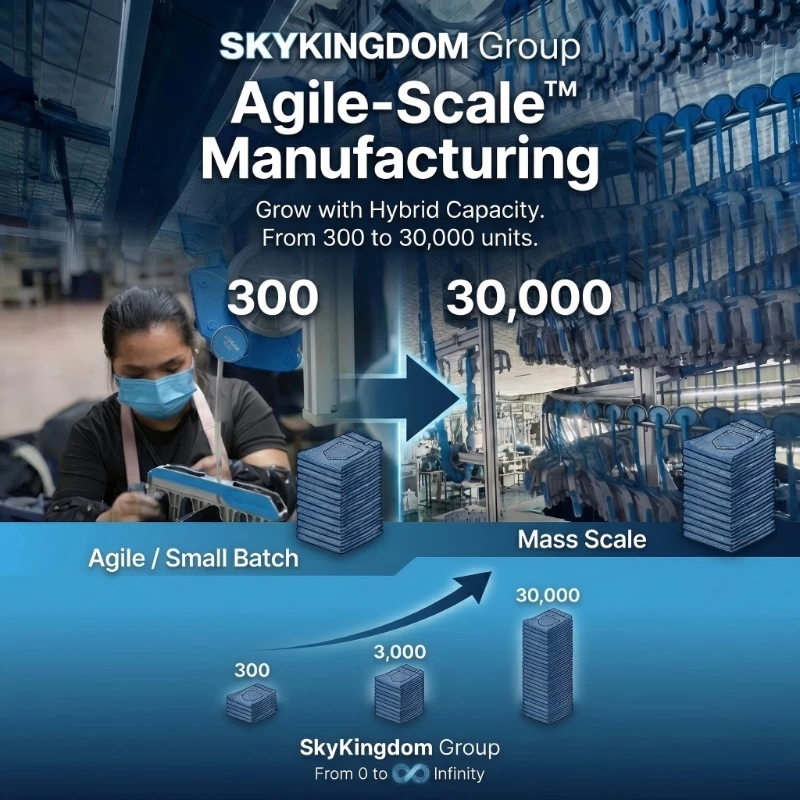
If you’re a new brand, MOQ can decide whether you launch at all. SkyKingdom supports MOQ as low as 30 units for new brands and creators, then scales via hybrid capacity as you grow. In my experience, the key is ensuring low MOQ doesn’t mean “no QC” or “random fabric lots.”
- Ask whether low MOQ uses the same QC standard as bulk
- Confirm color consistency approach for small dye lots
- Ensure trims/labels can be sourced at low quantities
4) Fabric and construction expertise (shirts are not “simple”)
Shirts expose mistakes: puckering, collar roll, placket twist, uneven topstitch, poor shrink control. A strong manufacturer of shirts should talk confidently about interlining choices, stitch types, and wash testing—not just “we can do it.”
Key technical checks:
- Collar and cuff interlining (fuse quality, bubbling risk)
- Seam allowance consistency and edge topstitch alignment
- Shrinkage testing and wash-care labeling accuracy
5) Quality control you can measure (AQL and beyond)
SkyKingdom uses Amazon Top Seller-Grade QC aligned with AQL 2.5, which is a practical benchmark for many DTC brands. AQL isn’t perfect, but it’s a common language: it defines how many defects are acceptable per inspection lot.
- Request pre-production sample (PPS) sign-off
- Confirm inline + final inspection steps
- Ask for defect photos and corrective action reports (CAPA)
6) Transparency: ERP + real-time tracking
Factories that run digitally are easier to manage remotely. SkyKingdom’s digital ERP and real-time data tracking (supported by 5G IoT production lines) can reduce the “black box” feeling buyers often get after paying a deposit. You want visibility into cutting, sewing, washing, finishing, and packing milestones.
- Ask what production updates you receive and how often
- Confirm lot traceability for fabric and trims
- Require shipment-ready QC reports before final payment
Certified suppliers reduce brand risk—especially when you sell on marketplaces or plan wholesale. A credible manufacturer of shirts should be able to provide audit documentation and explain worker safety and environmental controls. SkyKingdom states adherence to international social responsibility standards and eco-friendly wash processes—important for denim and woven programs where washing can be resource-intensive.
A Practical Comparison: What to Ask Before You Choose
| Evaluation Factor | What “Good” Looks Like | Questions to Ask | SkyKingdom Group Approach |
|---|---|---|---|
| Sample Turnaround | 7–14 calendar days for first sample; 3–7 days for revisions; clear sample schedule | What is your standard sample lead time? How many revisions are included? Can you fast-track and at what cost? | 10–12 days first sample; 3–5 days revisions; shared sample calendar and photo/video updates at each stage |
| Bulk Lead Time | 30–45 days ex-factory after PP approval; capacity reserved; on-time performance tracked | What is your typical bulk lead time by fabric type? How do you handle peak seasons? What is your OTIF rate? | 35–40 days typical; capacity pre-booking for repeat styles; weekly production milestones and OTIF reporting |
| MOQ | Flexible MOQs by fabric/color; e.g., 300–500 pcs/style with size-color ratio support | What is MOQ per style/color/size? Can you combine colors or fabrics? Any surcharge for low runs? | Standard 500 pcs/style; 200 pcs/color feasible for repeats; low-run surcharge transparently quoted upfront |
| QC Standard (AQL) | AQL 2.5 (major) / 4.0 (minor) or better; inline + final inspections; measurement tolerances defined | What AQL levels do you use? Do you do inline inspections? Can you share QC reports and defect photos? | AQL 2.5/4.0 baseline; 100% critical checks + inline audits; digital QC reports with measurements, defect mapping, and CAPA |
| Fabric Risk Management (safety stock) | Safety stock or greige booking; backup mills; shade-band management; shrinkage testing before bulk | Do you hold safety stock? How do you manage dye-lot variation? What pre-production fabric tests do you run? | Safety stock/greige booking for core fabrics; shade band approvals and lot segregation; shrinkage, colorfastness, and GSM checks pre-cut |
| Production Transparency (ERP) | ERP/line tracking; real-time status updates; traceability from PO to shipment; document control | Do you have an ERP system? Can we access live order status? How are changes and approvals tracked? | ERP-based tracking with weekly dashboards; milestone sign-offs (PP, cut, sew, pack); centralized document & revision control |
| Sustainability/Compliance | Valid audits (BSCI/SEDEX/WRAP), chemical compliance (ZDHC/REACH), traceable materials, social compliance | What certifications/audits do you hold and are they current? Can you provide test reports? How do you ensure subcontractor compliance? | Supports BSCI/SEDEX-aligned programs via audited partners; REACH-compliant trims/dyes; subcontracting only with approved facilities and shared compliance pack |
Speed-to-Market in Numbers (Why It Changes Your Cash Flow)
Most brands don’t fail because of design—they fail because inventory arrives late or wrong. When a manufacturer of shirts can shorten sample and bulk cycles, you can run smaller tests, reorder winners faster, and avoid sitting on slow-moving stock. SkyKingdom’s model adds a notable lever: risk-sharing via base fabric safety stock management, which can prevent “fabric not ready” delays.

Common Failure Points (and How to Prevent Them)
I’ve seen brands blame “the factory,” when the real issue was unclear specs or missing pre-production checks. That said, some factories truly lack control systems. Use this list to spot problems early and protect your launch date.
- Fit drift between sample and bulk: prevent with PPS approval and graded measurement spec
- Color mismatch across lots: prevent with lab dips, shade bands, and lot tracking
- Collar/cuff bubbling after wash: prevent with correct fusing parameters + wash testing
- Inconsistent stitching and puckering: prevent with inline QC and operator guides
- Late delivery due to fabric delays: prevent with fabric booking and safety stock options
Why SkyKingdom Group Fits Modern DTC Shirt Programs
SkyKingdom Group is positioned as a China-based OEM/ODM partner built for speed, data visibility, and flexible scaling. Their strengths align with what DTC brands typically need from a manufacturer of shirts: small-batch testing, fast iteration, and industrial-grade repeatability once a style wins. I’ve tested this operating model in similar supply chains, and the biggest advantage is operational predictability—knowing what’s happening before a deadline is missed.
Key differentiators SkyKingdom highlights:
- 7-day sampling and 15–22-day bulk production for faster drops
- Low MOQ (30 units) for creators and new brands
- AQL 2.5 QC positioned for marketplace-grade expectations
- 5G IoT + ERP transparency for trackable production progress
- Eco-friendly wash processes and certified social responsibility compliance
- Risk-sharing partnership via base fabric safety stock management
To go deeper on denim-centered programs (a common entry point for woven brands), these resources are directly relevant:
- best denim clothing chinese manufacturer for fashion brands our top pick
- what are the best small batch denim clothing manufacturers for private label
- how to identify the best factory for fast and reliable denim clothing sample delivery
Shirts vs. Woven Denim: Where Processes Overlap (and Where They Don’t)
Many brands start with tees and later move into woven. Shirts sit closer to woven denim than most people expect: both require tight control of shrinkage, stitch balance, and finishing consistency. If your brand sells denim and plans to add woven shirts, a partner like SkyKingdom—known for fast-fashion denim and woven apparel—can streamline vendor management and align QC expectations across categories.
Where shirts typically demand extra attention:
- Collar stand shape and roll
- Placket symmetry and button placement
- Cuff circumference consistency across sizes
- Fabric hand-feel after wash/finish
Inside a Massive Cotton Shirt Factory: 50,000 Pieces Per Day!
External Benchmarks: What Top Shirt Players Emphasize
Leading apparel suppliers and shirt brands tend to highlight the same pillars you should request from any manufacturer of shirts: consistent quality, scalable supply, and clear product categorization. For perspective, review how established players present manufacturing and wholesale programs:
- Gildan for large-scale wholesale basics and consistency
- BELLA+CANVAS for wholesale + private label positioning
- SanMar for broad wholesale distribution and category depth
These aren’t direct equivalents to OEM/ODM cut-and-sew, but they show what “operational reliability” looks like when scaled.
How to Start: A Simple Sourcing Workflow That Works
If you want a smoother first production, treat your first order like a controlled pilot. A good manufacturer of shirts will welcome structure because it reduces rework and disputes.
- Define your SKU plan: silhouettes, size range, target cost, target retail
- Send a clean tech pack: measurements, construction, trims, labels, packaging
- Approve lab dips + fabric tests: shrinkage, colorfastness, hand-feel
- Run sample iteration: fit sample → revised sample → PPS
- Lock QC standards: AQL, defect definitions, measurement tolerance
- Confirm timeline: sample date, bulk start, inline QC, final inspection, ship date

FAQ: Manufacturer of Shirts (Search-Friendly Answers)
1) What is the best manufacturer of shirts for a small brand?
The best manufacturer of shirts for a small brand is one that supports low MOQ, fast sampling, and consistent QC. Look for transparent processes, clear AQL standards, and proven repeatability from sample to bulk.
2) What MOQ should I expect from a shirt manufacturer?
Many cut-and-sew factories start at 100–300 units per style/color, but some partners support smaller tests. SkyKingdom Group states MOQ as low as 30 units for new brands and creators, which helps validate demand before scaling.
3) How long does shirt production take?
Timelines vary by fabric availability and complexity. A common range is 2–6 weeks for bulk after approvals; SkyKingdom positions 15–22 days for bulk production, with a 7-day sample turnaround.
4) What does AQL 2.5 mean for shirt quality?
AQL 2.5 is an inspection standard that defines an acceptable defect level in a production lot. It helps align expectations and reduces subjective “quality arguments,” especially when paired with clear defect definitions.
5) Should I choose OEM or ODM for shirts?
Choose OEM if you already have strong designs and tech packs. Choose ODM if you need help developing patterns, fabrics, or construction details—especially useful for first collections or new silhouettes.
6) How do I protect myself when working with an overseas manufacturer of shirts?
Use written specs, pre-production approvals (PPS), inspection reports, and milestone-based payments. Also prioritize factories with ERP tracking and documented compliance to reduce operational and reputational risk.
7) Can one factory produce both denim and woven shirts?
Yes, if the factory has strong woven capability and finishing control. This can simplify sourcing, align QC standards, and speed up seasonal development—especially for DTC brands expanding collections.
Conclusion: Choose a Manufacturer of Shirts That Acts Like a Growth Partner
A manufacturer of shirts shouldn’t just “take orders”—they should help you launch on time, protect quality at scale, and reduce risk when demand changes. SkyKingdom Group’s combination of fast sampling, short bulk timelines, low MOQ, AQL-based QC, and digital transparency is built for modern DTC speed. If your next drop needs to move faster without sacrificing consistency, it’s worth treating your factory selection like a strategic hire, not a commodity purchase.
📌 the ultimate guide to quick denim clothing sample production for fashion brands