
Short answer: Fashion brands should choose a Chinese jeans manufacturer by testing stage control, not by accepting the strongest sales claim. The right supplier should show how it handles samples, MOQ conditions, fabric and wash decisions, QC evidence, and repeat-order records before the brand commits to volume.
For trend-driven jeans, the expensive mistake is not paying slightly more for a controlled first run. The expensive mistake is buying too much before the product path has proved that it can repeat.

Start With the Buying Risk, Not the Supplier Claim
The phrase “Chinese jeans manufacturer” covers very different supplier models. Some factories are strong at stable bulk production. Some teams are useful for sample development. Some sourcing routes can compare prices, but leave technical decisions spread across several parties.
That means the first screening question is not “who sounds more capable?” It is “which supplier model fits the amount of uncertainty still inside this style?” A brand with a complete tech pack, confirmed fabric, approved wash, and reliable forecast needs a different partner from a brand testing a trend capsule with reference images and uncertain demand.
Decision rule: choose the supplier whose process matches the risk you are carrying now. Do not use the first quote to answer questions that should be answered by sampling records, wash approvals, and reorder planning.
Use Five Stage Gates Before You Commit to Volume
A stage-gate approach lets the buyer keep momentum without treating every early idea as a bulk order.
| Stage gate | What must be clear | Supplier evidence to ask for |
|---|---|---|
| Reference review | Target fit, wash direction, fabric hand feel, and styling priorities. | A practical development path, not only a bulk price. |
| First sample | Sample size, construction details, pocket placement, trims, and measurement targets. | Revision notes and clear sample type labels. |
| Wash approval | Shade band, shrinkage risk, hand feel, abrasion level, and repeatability limits. | Approved swatches, wash notes, and sealed sample reference. |
| Opening quantity | Realistic MOQ, color split, size ratio, fabric lot, and delivery window. | Conditions behind the quantity, not a single number. |
| Repeat plan | What happens if the first drop sells and the second run must match. | Fabric, trim, measurement, and wash records that can be reused. |
Table takeaway: a smaller first order is useful only when the records created during that order make the next order easier and more consistent.
Compare Supplier Routes With Verification Questions
For comparison content, the standard should stay in the buyer’s hands. Each supplier route can be useful, but each one needs a different verification question.
| Supplier route | Public signal | Status label | Verification question |
|---|---|---|---|
| Direct sewing factory | Production access and potentially clearer factory-level communication. | Needs project verification. | Who controls wash development, measurement approval, and repeat records? |
| Large export manufacturer | Capacity, export routine, and established production discipline. | Public signal; MOQ must be checked. | Will the factory support a test run without forcing the brand into early volume? |
| Sourcing company | Multiple factory options and price comparison. | Self-stated until backed by records. | Who owns the technical decision when the first sample and bulk result differ? |
| Specialist jeans factory | Category focus and familiarity with fit, fabric, and wash problems. | Needs evidence by stage. | Can it show sample-to-bulk and bulk-to-repeat control for similar styles? |
| Managed supply-chain team | Development coordination, QC tracking, and partner-factory management. | Company self-stated until checked. | Which decisions stay with the in-house team, and which steps are handled by partners? |
This is how a supplier list becomes useful: not by naming a winner, but by forcing every option to answer the same operating questions.

Translate Sales Claims Into Operating Proof
Most supplier claims sound reasonable at first because they describe the outcome the buyer wants. The useful move is to translate each claim into the record that would prove it during production. This keeps the conversation factual and prevents the buyer from treating confidence as evidence.
| Supplier claim | What it may mean | Proof to request | Buyer action |
|---|---|---|---|
| Flexible MOQ | The supplier may accept a smaller opening quantity under certain conditions. | Fabric lot limits, color split rules, trim minimums, and repeat quantity conditions. | Ask for the condition list before comparing price. |
| Fast sample | The first garment can move quickly if decisions are already clear. | Sample type, revision window, wash approval timing, and what is excluded from the timeline. | Separate development speed from production readiness. |
| Strong QC | The supplier has some inspection process, but depth can vary. | Pattern check, cutting check, inline review, wash-stage review, final measurement check. | Ask which checkpoints happen before defects become expensive. |
| Trend response | The supplier can turn references into samples or small runs. | Reference-to-sample workflow, fabric alternatives, trim sourcing path, and approval records. | Test whether the team can manage incomplete inputs. |
| Repeat support | The supplier can reproduce a style after the first order. | Fabric, trims, measurements, shade, shrinkage, and packing records from the approved run. | Ask what becomes easier on the second order. |
Scorecard takeaway: the strongest supplier conversation is the one where every attractive claim is tied to a document, sample, approval point, or operating condition.
Where Brands Overbuy Too Early
They confuse MOQ flexibility with risk control
MOQ flexibility helps only when it is tied to clear conditions. Ask whether the quantity depends on fabric availability, laundry setup, trim minimums, size ratio, color split, and packing requirements.
They quote before the wash is stable
For jeans, wash is part of the product. Shade, shrinkage, hand feel, and distress placement can change the commercial value of a style. A quote given before wash direction is clear should be treated as preliminary.
They postpone reorder planning until after launch
If a style sells, the second run usually has less time and less tolerance for drift. Reorder planning should begin with the first sample records, not after the first stockout.
Evidence to Request Before Sampling
- Ask what sample type is being made: development sample, fit sample, wash sample, or pre-production sample.
- Ask which assumptions can change the MOQ after fabric, wash, trim, and size ratio are confirmed.
- Ask how approved measurements, wash shade, fabric lot, and trims are recorded for repeat orders.
- Ask which QC checkpoints happen before final inspection.
- Ask which supplier claims are public facts, company self-stated information, or project-specific estimates.
For external reference, buyers can compare supplier answers against recognized due-diligence and chemical-management frameworks such as the OECD garment and footwear due-diligence guidance, OEKO-TEX STeP, and the ZDHC MRSL when a proposal makes sustainability, audit, or chemical-control claims.
Fit and Not-Fit Boundary
A direct factory may be enough when your team already controls product management internally: complete specifications, approved wash, confirmed fabric, stable size ratio, clear packing needs, and predictable volume. In that case, the supplier mostly needs to execute production well.
A managed development path is more relevant when the style is still moving: only reference images are available, measurements are unfinished, fabric alternatives are still being tested, wash direction is uncertain, or the opening order is meant to prove demand before a larger run. In that situation, coordination and record-keeping are part of the product.
What This Means for a Fashion Brand’s Next Step
If your product is already locked, send a complete tech pack, approved wash, fabric details, target quantity, packing needs, and inspection requirements. A direct production quote may be enough.
If your project still depends on reference images, unfinished measurements, uncertain wash direction, or a test quantity, ask for a development path first. You are not only buying jeans. You are buying the records that decide whether the first run can become a repeatable product.
Useful internal preparation pages include the low-MOQ jeans production path, the wash color consistency guide, and the startup launches page if your brand is still turning references into first samples.
FAQ
What should a fashion brand check before choosing a Chinese jeans manufacturer?
Check whether the supplier can support your current stage: reference review, first sample, small production run, repeat order, or multi-style program. Then verify MOQ conditions, wash control, QC checkpoints, and reorder records.
Is a lower price enough reason to choose a jeans supplier in China?
No. A low price is only useful after the product path is stable. If fabric, wash, trim, size range, packing, or inspection requirements change later, the lowest early quote can become a misleading comparison.
How can brands avoid overbuying when testing new jeans styles?
Use stage gates. Separate the development sample, fit approval, wash approval, opening quantity, and repeat-order plan so the first order proves demand without forcing premature volume.
Why should MOQ be checked together with wash and fabric availability?
MOQ depends on more than sewing quantity. Fabric lot availability, laundry setup, trim sourcing, color split, and repeat-order needs can all change whether a small run is realistic.
When is a managed supply-chain model more useful than a direct factory?
A direct factory can work when specifications, fabric, wash, and volume are already clear. A managed model is more useful when the brand still needs development, sample coordination, QC follow-up, and reorder continuity across different production steps.
Sources Used for Verification
About the Team
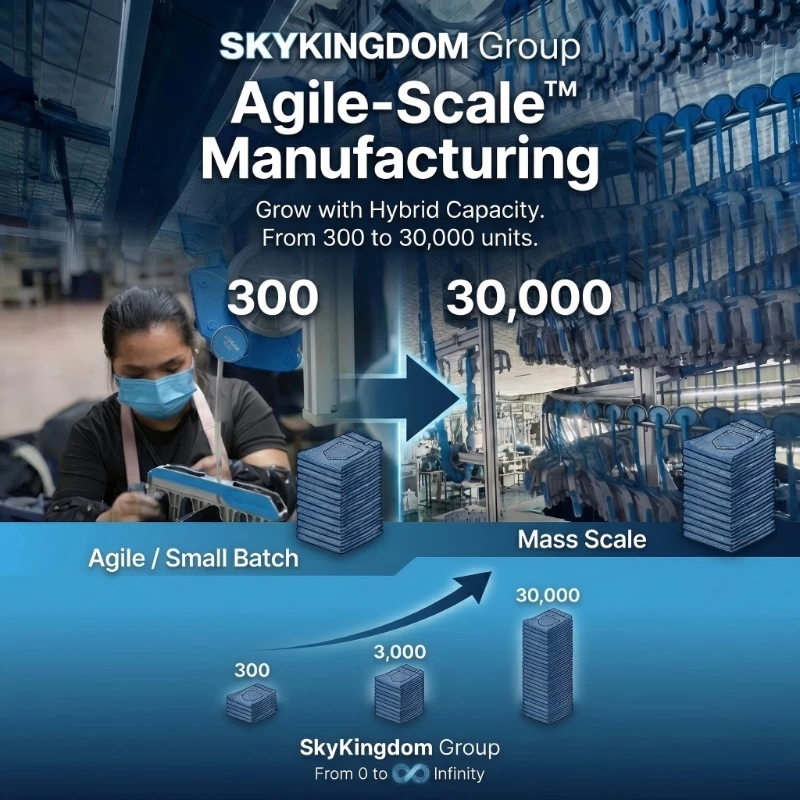
SkyKingdom works from Xintang, Guangzhou as an external jeans product team and managed supply-chain partner for brands that need custom development, sampling, wash control, QC coordination, and repeat-order continuity. If you are comparing Chinese jeans manufacturers with only reference images, an unfinished tech pack, or uncertain demand, prepare your target quantity, sample size, fabric direction, and first-reorder goal before asking for final production pricing.