SkyKingdom Group | Empowering Creators Globally


Choosing a denim partner is not only about price, MOQ, or sample speed. Different cooperation models create different risks: unclear responsibility, weak development support, sample-to-bulk drift, limited wash control, and poor reorder continuity. These comparison pages help you understand the trade-offs before you commit.
A denim supplier category only tells part of the story. The more important question is what your brand needs help controlling: product input, fabric and wash decisions, sample approval, bulk production risk, QC records, or reorder consistency.
If your tech pack, wash standard, measurement tolerance, trims, packaging, and QC expectations are already complete, a direct factory relationship can be efficient.
If your priority is comparing suppliers, negotiating quotes, or finding capacity, a sourcing agent can help. The key question is whether they also control product execution after supplier selection.
If your brand needs help from reference, tech pack, fabric, wash, sample, QC, production, and reorder records, the cooperation model needs more than supplier matching.
Use these comparison pages to check the real difference between similar-looking options before you start sampling, production, or a reorder program.
Compare order-taking production with a team-based workflow that supports development, sampling, QC, production coordination, and reorders.
Understand how communication, pricing, technical judgment, factory access, and responsibility may differ between direct factories and trading companies.
Compare supplier matching with product-side execution support. The difference matters when fit, wash, sample approval, QC, and reorder records are part of the risk.
Low MOQ can reduce first-order risk, but it does not automatically solve wash repeatability, measurement consistency, or reorder documentation.
A single factory may be simple. A managed network may offer more flexibility. The real question is who keeps standards, QC, and records aligned.
Compare production-oriented supplier language with development support that may include references, tech pack clarification, fabrics, trims, wash direction, and samples.
The same supplier type can work well in one situation and create problems in another. Use this matrix as a starting point before you request samples or compare quotes.
| Your current situation | Model that may fit | What to verify before you choose |
|---|---|---|
| You already have complete tech packs and stable volume. Fabric, wash, measurements, trims, packing, and QC requirements are already controlled by your team. |
Direct denim factory | Factory capacity, sample-to-bulk consistency, QC reporting, lead time, tolerance handling, and reorder records. |
| You need multiple supplier options quickly. Your main problem is supplier discovery, price comparison, or access to production resources. |
Sourcing agent or trading company | Technical knowledge, factory visibility, QC depth, communication chain, margin transparency, and who owns mistakes. |
| You have references or brand direction, but not a full denim product team. You need help turning an idea into sample-ready and production-ready work. |
External denim product team | Development process, fabric and wash support, sample review, QC checkpoints, production coordination, and reorder documentation. |
| You want to start small but scale later. Your first run needs low risk, but you do not want to rebuild the supply chain after the product works. |
Low-MOQ supplier or reorder-ready partner | Whether first-run records can support future reorders, wash matching, measurement control, and bulk planning. |
| You plan multiple denim styles, drops, or repeat orders. Capacity flexibility matters, but standards cannot drift across factories or batches. |
Managed denim production network | Centralized QC, single workflow, production records, approved sample control, wash references, and accountability. |
A lower quote can become expensive if the model cannot control development mistakes, wash variation, sample-to-bulk drift, QC gaps, or reorder confusion.
Do you already have a complete tech pack, or do you need help clarifying references, fit direction, fabric, trims, measurements, and wash standards?
Can the partner help with denim-specific problems such as fabric weight, stretch, shrinkage, wash effect, hardware, construction, and hand feel?
Does the model create clear records between approved samples, production specs, wash references, tolerance expectations, and bulk inspection?
Who checks fabric, measurements, workmanship, wash direction, packing, and final inspection? Is QC part of the workflow or only a final step?
Will first-run information be saved in a way that supports future reorders, or will every reorder start from scattered messages and memory?
If something drifts, who investigates and coordinates the correction: your team, the factory, the agent, or one accountable external product team?
This page is not meant to make every buyer choose the same model. The right model depends on your internal team, denim experience, product complexity, and reorder expectations.
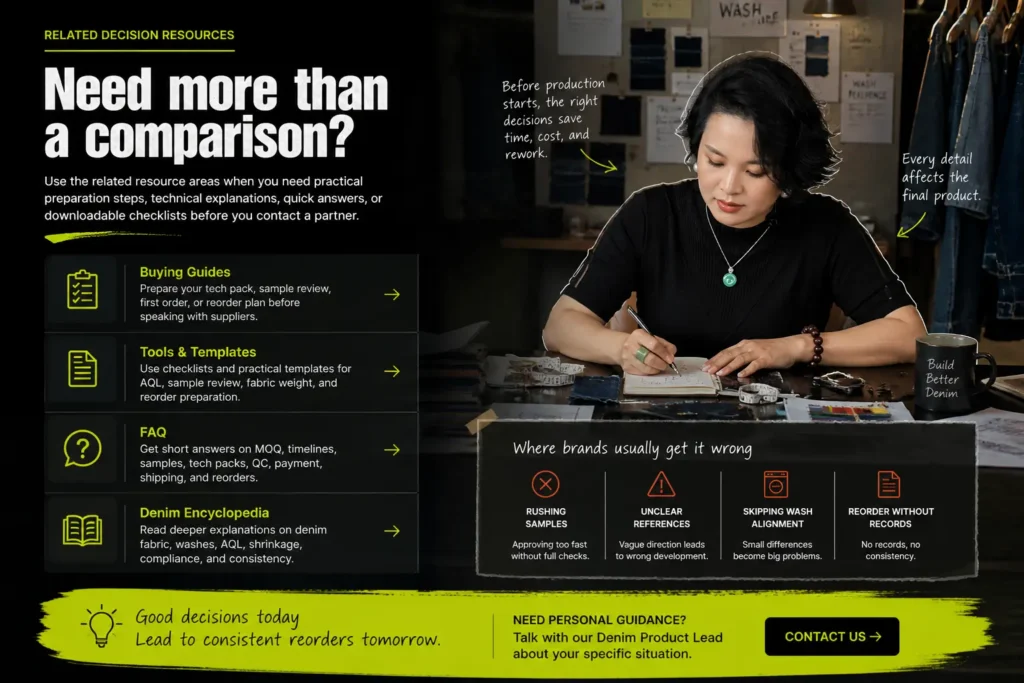
Use the related resource areas when you need practical preparation steps, technical explanations, quick answers, or downloadable checklists before you contact a partner.
Prepare your tech pack, sample review, first order, or reorder plan before speaking with suppliers.
Use checklists and practical templates for AQL, sample review, fabric weight, and reorder preparation.
Get short answers on MOQ, timelines, samples, tech packs, QC, payment, shipping, and reorders.
Read deeper explanations on denim fabric, washes, AQL, shrinkage, compliance, and consistency.
These six pages should be created first because they match high-intent buyer questions and also help clean up old supplier-list or self-recommendation content.
| Priority page | Main buyer question | Recommended URL |
|---|---|---|
| Denim Factory vs External Denim Product Team | Should I work directly with a factory, or do I need product-side development and QC support? | /resources/comparisons/denim-factory-vs-external-product-team/ |
| Denim Factory vs Trading Company | What changes when I work with a factory directly instead of a trading company? | /resources/comparisons/denim-factory-vs-trading-company/ |
| Sourcing Agent vs Denim Product Team | Do I only need supplier matching, or do I need ongoing product execution support? | /resources/comparisons/sourcing-agent-vs-denim-product-team/ |
| Low-MOQ Supplier vs Reorder-Ready Partner | Is low MOQ enough, or should I also plan for repeatable reorders? | /resources/comparisons/low-moq-denim-supplier-vs-reorder-ready-partner/ |
| Single Factory vs Managed Denim Production Network | Should I keep production simple with one factory, or use a coordinated network? | /resources/comparisons/single-factory-vs-managed-denim-production-network/ |
| OEM / ODM Manufacturer vs Denim Development Partner | What is the difference between supplier production language and real development support? | /resources/comparisons/oem-odm-denim-manufacturer-vs-development-partner/ |
If you are comparing a factory, trading company, sourcing agent, low-MOQ supplier, or external denim product team, send your current product stage, references, target quantity, and concern. We can help you understand which model may fit before you commit to sampling or bulk production.