SkyKingdom Group | Empowering Creators Globally



Whether you are preparing a first denim sample, building a denim line, or trying to keep repeat orders consistent, this FAQ explains how SkyKingdom handles custom jeans development, sampling, MOQ, denim wash development, production planning, quality control, shipping, and business terms.
SkyKingdom is a custom jeans manufacturer in China focused on fit development, denim wash development, QC-managed production and repeatable reorders. We help brands turn denim ideas, reference samples, tech packs or early concepts into sample-ready, production-ready and reorder-ready products.
This means you are not only asking a factory to make a style. You are working with a denim-focused team that helps clarify fit, wash, material and QC decisions before production risk becomes expensive.
Yes. A complete tech pack is helpful but not required to begin. SkyKingdom reviews reference images, mood boards, existing samples, measurements, or early product ideas, then clarifies the information needed before sampling. Missing details are identified up front rather than discovered mid-production.
Anything you already have helps: a tech pack if you have one, reference images or mood boards, size direction, a target fabric or wash reference, rough quantity expectations, label and packing needs, and your delivery market. If you only have a sketch and an idea, that's enough to start the conversation.
Yes. You don't need a finished tech pack to start. SkyKingdom can work from a sketch, a reference photo, a mood board, an existing sample, or even a rough idea, and translate it into clear specs before sampling. The team flags what's missing early, so the first sample comes back closer to what you pictured — not three rounds later.
Yes. If your concept is still early, we can help review feasibility, identify missing details, and turn your idea into a development-ready sample plan.
This is useful for small teams and new brands that have a strong product direction but do not yet have a complete internal denim development setup.
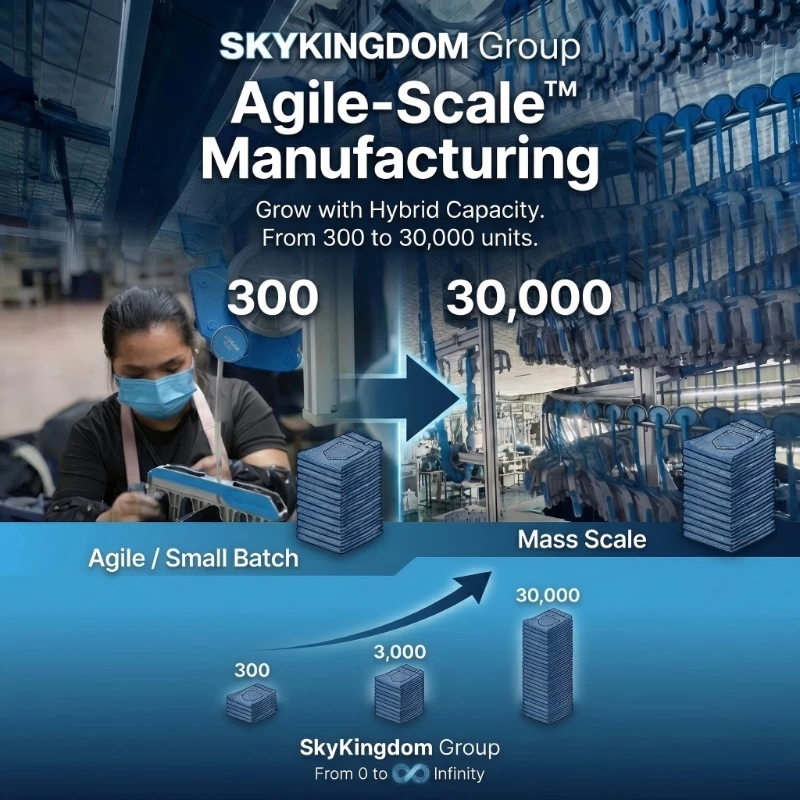
First production runs can start from 30 pieces, depending on style and fabric. The exact MOQ shifts with wash complexity, trims, and the fabric's own minimums. Rather than forcing a large first order, SkyKingdom maps a test-to-scale path: a smaller validation run to prove the style, then a clear route into bulk and reorders once it sells.
A 30-piece start should be understood as a single-style, single-color micro-order model.
It is not the same as splitting 30 pieces across many designs, colors, washes, or sizes with unrelated setups. Multiple designs or colorways may require a separate MOQ evaluation.
In some cases, yes. A 30-piece start can work for early market testing, content creation, fit feedback, soft launch preparation, or validation before scaling.
It is best understood as a micro-order model for a specific business stage, not as the default structure for every bulk production project.
Micro orders usually have a higher unit cost because many fixed costs cannot be spread across a large quantity.
Fabric preparation, wash setup, pattern work, sample review, trim sourcing, cutting, sewing setup, packing, and project coordination still require real work even when the quantity is small.
MOQ is usually affected by fabric availability, wash complexity, style construction, custom hardware, trim minimums, color count, label and packaging requirements, and whether the project is a test run or standard production order.
Using available fabrics, reducing colorways, simplifying trims, or keeping the first run focused can sometimes make a smaller launch more realistic.
Not automatically. MOQ and quality are not the same thing.
Quality depends on fabric choice, sample approval, measurement control, wash control, sewing execution, inspection, and how clearly standards are locked before production.
Yes. We work with startup brands that want to test denim products with lower inventory risk before scaling further.
The goal is not only to make a small order. The goal is to make the first run structured enough that a successful product can move into clearer reorders or larger production later.
Most denim samples take roughly 7 to 15 days once specs and fabric are confirmed, with wash-heavy or fabric-sourced styles taking longer. SkyKingdom confirms a realistic timeline against your specific style before starting, instead of promising a number it can't hold.
Rush sampling may be considered only when the project is already highly clear and the required materials, fit direction, trims, and wash expectations are realistic for a fast development lane.
It should not be treated as a guaranteed service for every custom denim project. Complex styles, special washes, custom trims, or incomplete information usually require more time.
We need finished garment measurements, not only body measurements.
Garment measurements allow the pattern, size grading, tolerance, and final inspection standard to be controlled. Body measurements alone are not enough for reliable denim production.
Yes. A reference garment can help communicate rise, seat, thigh, leg shape, inseam, stretch expectation, and overall silhouette more clearly than words alone.
Please also tell us what should stay the same and what should change. A reference garment is a starting point, not a substitute for final production measurements.
Before sampling, it helps to define your target rise, waist position, seat fit, thigh ease, leg opening, inseam, stretch expectation, and overall silhouette.
The clearer these details are, the fewer revision rounds are usually needed later.
Changes are easiest before fabric, trims, wash direction, and pattern details are locked.
Once development moves forward, even small revisions can affect timing, cost, and production planning. We recommend separating must-have changes from nice-to-have changes before the approved sample becomes the bulk standard.
We can review fabric options based on weight, stretch, color, hand feel, budget, wash direction, and product use.
The right fabric should support both the design goal and the production plan, especially if you want repeatable bulk quality and future reorders.
Denim development may include stone wash, enzyme wash, bleach, acid wash, laser effects, ozone, overdye, resin, softeners, coating, distressing, and other finishing techniques.
The right choice depends on your target look, fabric base, durability requirement, repeatability, cost structure, and launch timeline.
Wash consistency depends on using the approved base fabric, locking the wash direction, controlling test results, and matching bulk production against the approved reference.
For denim, consistency should be treated as a process standard, not a last-minute inspection issue.
Lower-impact or certified fabric options can be discussed during development.
The best approach is to match your design, wash target, budget, order quantity, and compliance requirements first, then confirm which certified or lower-impact options are realistic for production and documentation.
Customization may include woven labels, care labels, branded hardware, buttons, rivets, leather or vegan patches, hangtags, polybags, carton marks, and other packaging details.
Custom trims often affect MOQ, lead time, cost, and approval steps, so they should be confirmed before bulk production planning.
Yes, but the right technique depends on fabric base, wash direction, design placement, durability target, and whether decoration happens before or after wash.
Printing and embroidery on denim should be planned as part of the product development sequence, not added at the last moment.
Bulk production timing depends on fabric availability, wash complexity, trim readiness, order size, production line scheduling, and inspection requirements.
For ready projects with locked approvals, SkyKingdom has referenced 15–22 day bulk production windows on public production pages, but the final timeline must be confirmed after the sample, materials, trims, and order details are approved.
Common delays come from unfinished approvals, fabric or trim issues, wash changes, label or packaging updates, unclear size grading, or changes made after the product was already considered development-ready.
Clear approval checkpoints are the best way to reduce these surprises.
Work backward from your launch date and leave enough time for development, sampling, approvals, production, inspection, shipping, and customs clearance.
Denim projects move fastest when technical direction, materials, and decision owners are aligned early.
Yes. We support brands at different stages, from small validation runs to larger production orders as they grow.
The key is to set up the first project with enough records — fabric, wash, measurements, trims, sample approval, and QC notes — so future orders do not restart from zero.
Capacity should be discussed in relation to style complexity, seasonality, fabric readiness, wash requirements, and production allocation.
SkyKingdom works through a team-first, network-executed production model. This gives flexibility, but capacity is still allocated project by project rather than promised as a fixed number for every order.
That's the core of how SkyKingdom works. After you approve a sample, it's sealed as the reference. A pre-production sample is checked against it, measurements and wash are recorded, and inspection happens before release. Most quality problems don't start in bulk — they start in unclear specs and undocumented wash decisions earlier, so those are locked down before bulk begins.
AQL 2.5 can be used as part of the inspection standard for applicable production orders.
It should be understood together with inline control, approved sample references, measurement tolerances, final inspection, and buyer-specific requirements. AQL is one part of quality control, not the whole system.
These risks should be addressed before bulk begins.
Fabric choice, wash testing, approved references, measurement tolerances, and production controls all affect shrinkage, colorfastness, shade variation, and wash consistency. For higher-risk projects, testing or additional review should be planned before shipment.
Third-party testing can be discussed when the destination market or buyer requirement calls for it.
Testing scope, lab choice, timing, cost responsibility, and required standards should be confirmed before production begins. This avoids discovering compliance requirements after goods are already finished.
Import documentation depends on the destination market and the buyer’s requirements.
Typical needs can include fabric composition details, care label information, test reports, packing details, and customs-supporting documents. The final document list should be confirmed before production begins.
Certification and audit documents should be discussed during supplier qualification.
Some documents apply to the company, some apply to specific materials, and some apply to partner suppliers or production facilities. We recommend confirming exactly which document is needed and for which order or product claim.
Third-party final inspection can be discussed before shipment planning.
If a buyer wants third-party inspection, it should be arranged before the final shipment schedule is locked, because inspection booking, rework time, and release approval can affect delivery timing.
You can verify SkyKingdom through company information, public contact channels, the About and People pages, and project-stage records such as sample approval notes, wash references, QC checks and reorder files. For privacy reasons, client names, awards, order quantities and exact production addresses are not treated as broad public claims. Start with the verification page: https://skykingdom.com/verify/
Yes. SkyKingdom coordinates packing requirements, carton information, labeling, shipment preparation, and export-related documents according to the order and your destination market's requirements.
Both models can work.
Some buyers prefer to use their own freight forwarder for control, while others want factory-side shipping coordination. The best choice depends on destination, customs process, timing, landed cost, and how much logistics support you need.
Export packing should protect the garments, support shipment accuracy, and match buyer requirements for folding, labeling, carton marking, size breakdown, and quantity per carton.
Packing details should be confirmed before bulk production is completed, not after goods are ready to ship.
Responsibility for duties, taxes, and customs clearance depends on the agreed shipping term, destination country, and who controls the freight.
This should be confirmed before shipment. If you use your own forwarder, your forwarder should also confirm the required import documents and clearance process.
Reorders work best when the first project already locked fabric, wash direction, measurements, trims, labels, approved sample references, and QC notes.
Those records help the next order start from a clearer baseline instead of repeating the entire development process from zero.
Reorders are where most denim suppliers drift. SkyKingdom keeps a reorder file for each style — the sealed sample, measurements, wash recipe and shade band, trim records, and packing notes — so a repeat order starts from your locked reference, not from zero. This consistency is part of why brands keep coming back.
Payment method should be confirmed before the order is placed and before the proforma invoice is issued.
For production projects, buyers usually care about traceability, transfer speed, currency, bank charges, and whether the payment method matches the stage of development or bulk execution.
New-client projects usually require a deposit before development or production begins, with the remaining balance paid according to the agreed order terms.
The exact deposit ratio, payment schedule, and balance timing should be confirmed in the quotation, proforma invoice, or written order agreement before work starts.
Sample fee handling should be confirmed before development starts.
Some projects treat sample fees as a separate development cost. In other cases, part of the cost may be credited against a confirmed bulk order depending on the style, sampling complexity, and agreed terms.
Cancellation terms depend on the stage of the order.
Once sourcing, development, trim preparation, wash testing, or production has started, the project may already have real costs. Cancellation rules should be confirmed before payment is made.
Yes, confidentiality requirements can be discussed before detailed files are shared.
If your project includes unreleased designs, brand-sensitive references, or private development information, tell us before sending files so the communication process can be handled appropriately.
We aim to reply quickly and keep communication practical throughout development and production.
For a faster response, include your product type, target quantity, reference images, timeline, and any critical customization details in the first message.
Important note: Denim production details depend on the actual style, fabric, wash, trims, quantity, destination market, and approval stage. This FAQ explains how decisions are usually made, but your final MOQ, timeline, price, payment schedule, shipping method, and document list should always be confirmed in writing for your specific project.