
Introduction
If you’ve ever watched a trend peak on TikTok or a competitor drop a new silhouette while your fit sample is still “in revision,” you already know the real problem: slow sampling breaks your launch calendar. When a jeans supplier can’t turn jeans and jacket samples fast enough, you lose approval windows, miss content shoots, and end up selling late—right when customers are already moving on.
This how-to guide shows you how to shorten your product launch timeline by running a sampling workflow built for speed and control—without sacrificing fabric, wash accuracy, or QC. You’ll learn how to set deadlines, choose the right core SKUs, send complete tech pack inputs, and run a structured review that converts cleanly into bulk.
Along the way, you’ll see how Sky Kingdom operates as a custom jeans factory and agile jeans exporter for global brands—pairing rapid sampling (as fast as 3–5 days for basic samples), digital tracking, and eco-wash capabilities (laser & ozone, waterless dyeing, natural enzyme finishing) to keep your denim jeans program moving.
How to Speed Up Denim Sampling Step by Step
Step 1: Lock launch timeline and drop date
Start by turning your “launch idea” into a production calendar with hard gates. Pick your drop date first, then work backward to define when your fit sample must be approved, when trims must be confirmed, and when bulk must start. Most delays happen because teams treat sampling as open-ended; instead, make sampling a timed sprint with clear sign-offs.
Create three approval gates: (1) pattern/fit confirmation, (2) wash and color approval, and (3) final pre-production sample sign-off. If you’re a China startup clothing manufacturer specializing in jeans china startup—or you’re a brand sourcing from jeans manufacturers in China—this timeline discipline protects you from shipping and customs variability by front-loading decisions.
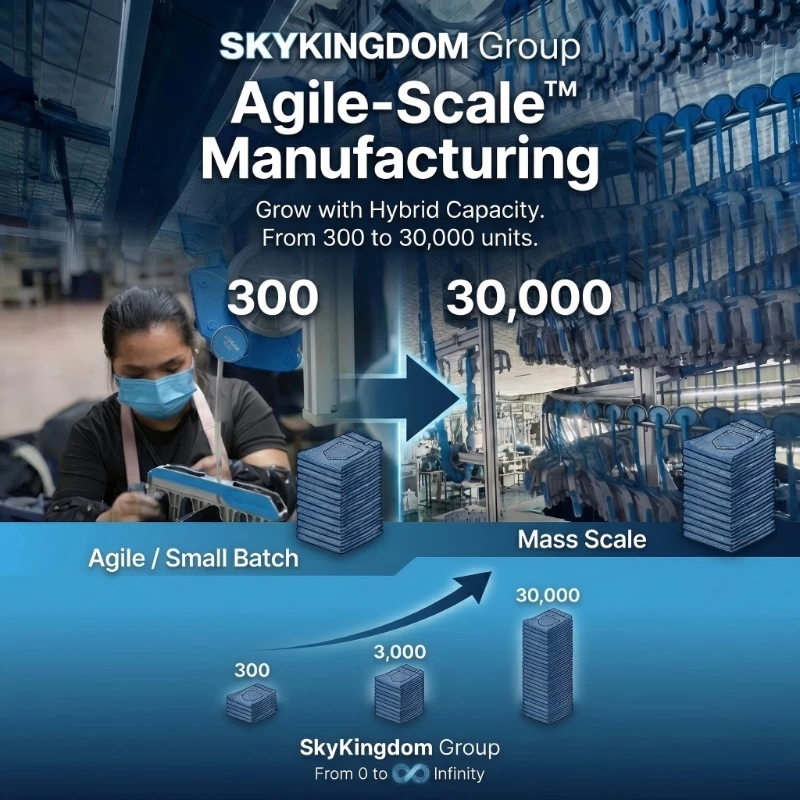
Sky Kingdom’s quick-response model is designed for time-boxed launches: it highlights “small-batch & quick-turnaround” workflows, digital tracking, and stated sampling as fast as 3–5 days for basic samples and 15–20 days for bulk. That means you can build your internal calendar around known service windows instead of guesswork.
Step 2: Choose core styles for sampling
Sampling speed improves dramatically when you reduce SKU chaos. Choose 2–4 “core styles” that represent your collection’s commercial center—typically one or two denim jeans fits (e.g., baggy/loose and straight), plus one hero outerwear piece such as a Custom Denim Jacket. Then add only the details that truly differentiate the drop: a signature pocket shape, a seasonal wash, or specific hardware.
If you’re working with a jeans factory for the first time, avoid starting with your most complex piece. A highly distressed wash, heavy embroidery, rhinestones, or mixed materials can easily add multiple revision loops. Instead, validate fit and construction first on simpler denim jeans, then apply the approved block to more complex executions.
Sky Kingdom’s catalog-style capability (OEM/ODM/OBM service positioning) supports this approach: lock one proven silhouette, then spin variations through denim customization—wash, trims, labels, and packaging—without re-inventing the base pattern each time.
Step 3: Send complete tech pack inputs
Fast sampling is impossible if your inputs are incomplete. Before you send anything, run a “no-missing-info” checklist:
· Measurement spec sheet (garment measurements, not body measurements)
· Grading rules by size
· Stitch type and SPI targets (where you care)
· Trim and hardware details (buttons, rivets, zippers)
· Label placements and artwork files
· Packaging requirements (bags, hangtags, carton marks)
A common failure mode for china clothing factory jeans start ups is assuming a few reference photos are enough. Photos help, but your factory needs clear tolerances, construction callouts, and measurement logic to avoid rework.
Sky Kingdom’s own buyer-facing prep guidance emphasizes that brands should provide tech packs or, if you don’t have them, at least multiple high-resolution reference images and sizing information in a chart. That alignment upfront prevents the “wrong construction, right inspiration” issue that forces extra sample rounds.
Step 4: Align fabric and wash requirements
Fabric and wash decisions are where denim timelines go to die—because “blue” is not a spec. Make your requirements measurable:
· Denim weight target (e.g., 11–14 oz)
· Fiber content and stretch (e.g., 100% cotton vs. cotton/elastane)
· Handfeel reference (soft vs. rigid vs. broken-in)
· Wash target and color standard (send a physical swatch when possible)
· Shrinkage and twist expectations (note acceptable ranges)
If you’re producing custom denim jeans and your wash needs to match a mood board, send one “must-match” reference garment plus a “don’t do this” example. That second piece saves time because it prevents the factory from interpreting your inspiration too literally.
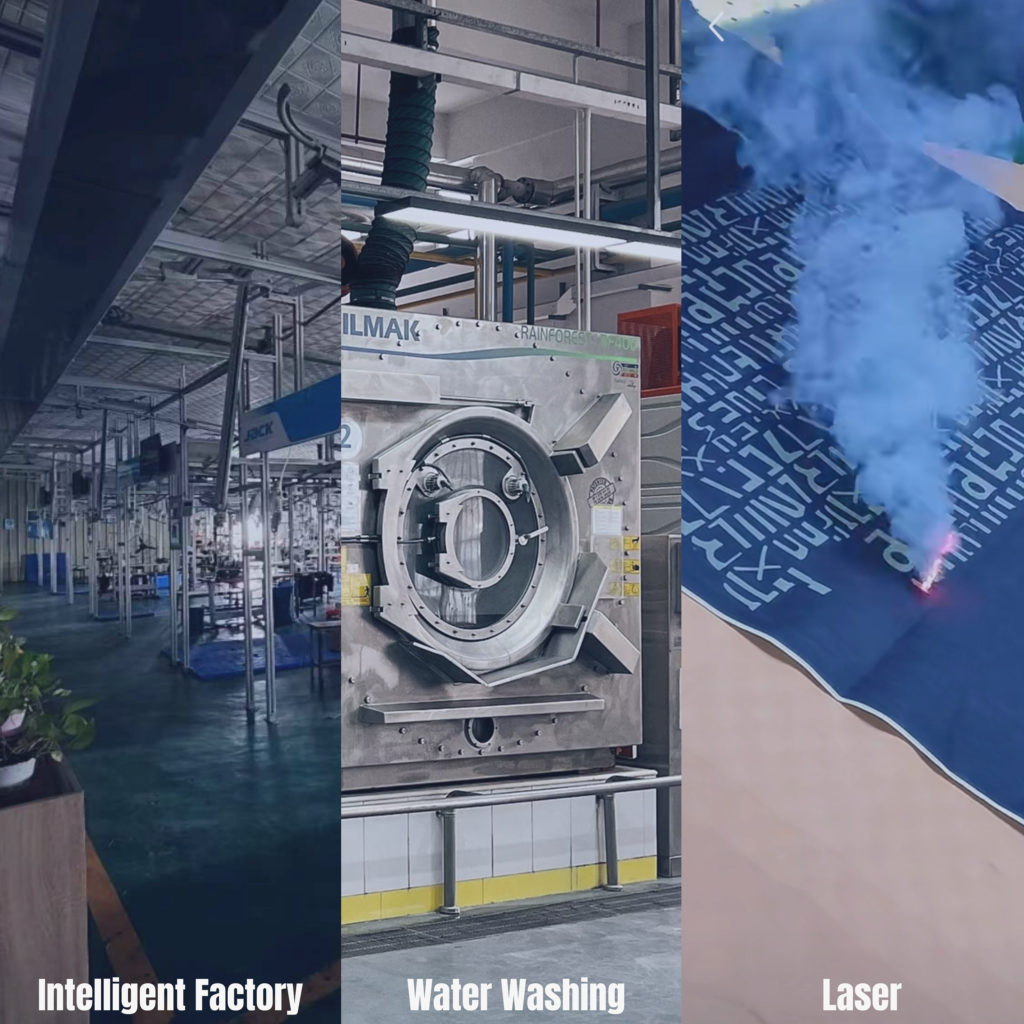
Sky Kingdom’s eco-wash pathway is built around lower-chemical finishing options such as laser & ozone washing, waterless dyeing, and natural enzyme treatments, plus Environmental Impact Measuring (EIM) positioning. When you align wash requirements early, you avoid the midstream change that forces re-cutting and re-washing.
Step 5: Use rapid sample development
Once inputs are clean, you can request rapid sampling—and you should structure the request so it stays realistic. Ask for:
1) A “first fit” sample focused on pattern and construction (even if wash is not final)
2) A “wash/handfeel” sample focused on finishing (even if fit is already close)
3) A final confirmation sample that matches both
This split is how brands get to market faster: it lets you approve pattern logic while wash development runs in parallel. It also reduces the temptation to keep changing everything at once.
Sky Kingdom’s Quick SCCA solution states sample timing of 3–5 days and positions rapid response as a core capability supported by AI-integrated hanging systems and digital workflow tracking. In practice, you should still plan buffer days for trims and wash iterations, but rapid sampling compresses the critical path so your launch content (photo/video) can start earlier.
Step 6: Run structured fit and QC review
A fast sample that isn’t reviewed correctly just creates fast mistakes. Run the review like a QA process, not a “try-on session.” Use a single standardized checklist across denim jeans, jackets, and tops:
· Fit: waist, rise, hip, thigh, knee, inseam, sleeve length, shoulder width
· Balance: front/back rise, pitch, leg twist, sleeve pitch
· Construction: seam integrity, topstitch consistency, bartacks, pocket placement
· Wash: shade consistency, whisker placement, abrasion symmetry, odor/residue
· Hardware: attachment strength, corrosion risk, zipper smoothness
Document issues with photos, measurements, and severity tags (critical/major/minor). Then batch feedback into one consolidated revision message. Sending multiple micro-messages over days is one of the most common ways brands accidentally extend sampling loops.
Sky Kingdom’s quality-control messaging highlights traceability, on-site material inspection, and finished product inspection. Your job is to plug into that by giving precise feedback so the next sample round is a correction—not a new interpretation.
Step 7: Convert approved sample to bulk
When the sample is approved, move immediately into a “bulk conversion pack” so production starts clean. Confirm:
· Approved size set and grading
· Final fabric and wash recipe reference
· BOM and trims (pre-approved alternates for risk items)
· Packaging and labeling files
· Production lead time, shipping method, and destination requirements
If you’re sourcing through jean wholesale suppliers or building Denim clothing manufacturing for an e-commerce brand, conversion speed matters: the longer you wait after sample approval, the higher the risk that fabric availability or trim MOQs create surprises.
Sky Kingdom positions small-batch quick response and re-orders (30% faster than traditional factories) as part of its operating model. Use that by planning your first bulk as a controlled “market test,” then executing re-orders when sales data confirms demand.
Adapting Your Approach in Different Scenarios
TikTok trend spikes and ultra-fast reorders. Lock one proven fit block and focus only on wash and trim changes. Use rapid sampling to validate the look, then lean on quick re-order capability to replenish while the trend is still active.
Startup drops and small-batch test orders. Keep the assortment tight (2–3 denim jeans + 1 jacket). Use one fit model and one measurement standard to reduce revisions, then expand only after you confirm sell-through.
Complex washes and high-risk finishing. Prioritize laser/ozone routes and send physical wash standards early. Build in at least one extra wash iteration even if the factory is fast, because visual approvals take time.
Multi-SKU capsule with parallel sampling. Split workstreams: one line handles jeans blocks, another handles jackets, and you review on fixed cadence (e.g., twice weekly). Parallel sampling beats serial sampling when you have many SKUs.
What You’ll Need Before You Start
Required Tools & Materials
· Tech pack with measurements, construction callouts, and tolerances
· BOM (bill of materials) listing trims, labels, and packaging components
· Fabric swatches or a reference garment to control handfeel and shade
· Wash references (target swatch + “avoid this” example)
· Branding files in vector format for labels, hangtags, and packaging
· Size set plan (which sizes you will sample and approve)
· Fit model notes (measurement profile and preference notes)
Safety Considerations
Even though sampling is “product development,” it still touches production realities. Confirm that your partner can meet compliance expectations for the markets you sell into, and verify how machinery and operator safety is managed. OSHA’s machine guarding guidance emphasizes guarding points of operation and using safeguards to prevent preventable injuries around machinery—principles that apply broadly across industrial equipment environments. (osha.gov)
From a product safety and sustainability perspective, also confirm material and process certifications that matter for your brand’s claims. Sky Kingdom publicly positions OEKO-TEX Standard 100 and BCI Cotton alongside eco-wash methods (laser & ozone, waterless dyeing, and natural enzymes), so you should request documentation relevant to your purchase order and destination requirements.
Troubleshooting Guide
| Problem | Cause | Solution |
| Fit is off (waist/rise/thigh) | Measurements unclear or tolerances not defined | Resend the spec sheet with garment measurements, tolerances (e.g., ±0.5 cm key points), and mark “critical” points; require a measurement photo pack in the next sample. |
| Wash mismatch vs target shade | Weak wash reference or no physical standard | Send a physical swatch/garment and define shade tolerance; separate fit approval from wash approval so revisions don’t compound. |
| Sample arrives late | Trims not approved or missing branding files | Pre-approve trim alternates, send vector artwork on day one, and confirm a dated sample schedule with gate reviews. |
| Stitching/topstitch looks inconsistent | No stitch spec, wrong thread, or tension issues | Provide stitch type + SPI guidance and thread color code; request a close-up QC photo set before shipment. |
| Bulk differs from approved sample | PP sample not locked or wash recipe not frozen | Require a final confirmation/PP sample; freeze fabric, wash recipe, and BOM; keep one “golden sample” on both sides for matching. |
Conclusion
Quick sampling is the simplest way to protect your selling window: earlier approvals create earlier content, earlier pre-orders, and faster replenishment when demand hits. Treat sampling like a gated process—timeline first, core styles second, complete inputs third—then use a structured review to convert cleanly into bulk.
If you’re ready to speed up your next drop, the most effective next action is to submit a complete tech pack (or a full reference set) and lock a dated sample schedule immediately.
Start your business now: https://skykingdom.com/
Frequently Asked Questions
How fast can samples be delivered for denim jeans and jackets?
If your inputs are complete, basic samples can be turned quickly—often in a few days—while complex washes usually need more time for development and approval. The best way to protect speed is to split approvals: confirm fit first, then confirm wash and handfeel, then finalize both in a last confirmation sample. Always add buffer days for trims and branding files, because missing buttons, rivets, or labels are a common hidden delay. If your drop date is fixed, schedule review calls ahead of time so approvals don’t sit in inboxes.
What products can be sampled quickly besides jeans?
Many manufacturers can run fast sampling across denim categories, not only jeans. Denim jackets, skirts, shorts, denim tops, and even items like a Custom Denim shirt can move quickly when you reuse an approved block and change only details like pockets, collars, and washes. If you’re building a capsule, prioritize items that share fabric and trims to reduce sourcing complexity. For any new category, ask for one “construction-first” sample before you push into heavy wash effects.
Can startups order low MOQs when working with a jeans supplier?
Yes—many programs support small-batch market tests before scaling, for example, Sky Kingdom offers an MOQ of 30 pieces. The key is to design your launch plan around repeatable blocks: one or two denim jeans fits and one jacket body that can be refreshed with different washes and trims. This approach lets you re-order quickly without redoing development work, which is especially important for ecommerce. If you’re a startup, request a clear path from test order to reorder so you can replenish without renegotiating the whole spec.
Do you support OEM and ODM for custom jeans?
OEM is best when you already have your own designs and tech packs and you want the factory to execute them precisely. ODM is useful when you want speed and trend alignment—selecting proven silhouettes and customizing them to your brand through labels, washes, and detailing. Many brands use both: ODM to launch quickly, then OEM as they mature their design language and technical standards. If you’re unsure which model fits, start with one ODM-based style and one OEM-based style to compare workflow.
What should I do if the cut-and-sew sample looks right but wash looks wrong?
Don’t restart the whole sample unless the wash problem affects shrinkage or fit. Instead, freeze the pattern and construction as “approved,” then run a wash-only iteration using the same base fabric and the same measurement control. Provide a physical standard and define what “match” means—shade, abrasion placement, and overall contrast. This separation prevents you from accidentally changing multiple variables and adding extra sample loops.