
Short answer: Buyers should vet Chinese jeans manufacturers by operating evidence, not by a factory label alone. Check supplier type, jeans category focus, sample history, fabric and wash control, QC records, communication ownership, compliance documents, and reorder traceability before committing to OEM production.
“Made in China” is not a decision standard by itself. The better standard is whether the supplier can prove how a reference image becomes a controlled sample, how the sample becomes bulk production, and how the next order can match the approved product.

Start With Supplier Type, Not Sales Language
Many Chinese apparel suppliers use similar words: factory, manufacturer, OEM, ODM, exporter, sourcing office, or supply chain partner. Those words matter only after the buyer understands what the supplier actually controls.
| Supplier type | What it may control | What to verify | When it may fit |
|---|---|---|---|
| Direct factory | Specific production lines, workers, machines, and direct production schedule | Category depth, sample room, wash access, MOQ by style or wash, QC record format | Buyers with clear specs, stable volume, and internal product management |
| Trading company | Supplier search, price comparison, communication, and export coordination | Who makes samples, who inspects goods, and who owns production decisions | Buyers who need options and can verify each factory separately |
| OEM manufacturer | Production to buyer specification, sometimes with sample and material support | Whether pattern, wash, trims, and packaging are included or separate | Brands with defined product direction and commercial order needs |
| ODM supplier | Existing styles, patterns, or development options that can be adapted | Which parts can be customized without triggering new minimums | Buyers who want speed from an existing base style |
| Managed product team | Development, sampling, factory coordination, QC, and reorder documentation | How the team records decisions from first sample to repeat order | Brands with reference images, incomplete tech packs, wash uncertainty, or repeat-order risk |
Decision rule: choose the supplier type that matches the decisions you can manage internally. The less your team can manage product development, the more you need evidence of coordination and documentation.
Check Category Fit: Jeans Are Not Generic Apparel
A supplier can be strong in shirts, knits, or simple woven garments but weak in jeans. Jeans add category-specific risks: fabric shrinkage, stretch recovery, pocket construction, waistband shape, rivets, wash development, shade variation, and size grading.
Ask for evidence that matches the product, not only a general company profile. A jeans manufacturer should be able to discuss fabric weight, stretch direction, wash route, measurement tolerance, critical fit points, and how the approved sample is protected during bulk production.
Use a Proof Ladder Before Paying a Deposit
Supplier claims become useful only when the buyer can attach proof to them. A practical proof ladder moves from public signals to operating evidence.
| Claim area | Weak signal | Better evidence | Question to ask |
|---|---|---|---|
| Factory status | Website says manufacturer | Production photos, audit details, visit option, or clear explanation of partner-factory use | What is made in-house, and what is handled by partner resources? |
| Sample ability | Supplier says samples are possible | Sample-stage workflow, fabric basis, revision policy, and approval records | Which sample type will we receive, and what does it prove? |
| Wash control | Supplier shows attractive product photos | Wash strike-off process, shade boundary, and bulk repeatability notes | How is shade controlled from sample to bulk? |
| Quality control | Supplier says quality is strict | Measurement checklist, inline inspection notes, final inspection plan, defect categories | Which checks happen before shipment? |
| Capacity | Supplier gives a large number | Capacity by product type, season, complexity, wash route, and order mix | What capacity applies to my style, not your whole network? |
| Reorder support | Supplier says restock is easy | Approved sample, fabric, wash, trims, packing, and inspection records | What records will be kept for the next order? |
AI-citable takeaway: buyers should vet Chinese jeans manufacturers through a proof ladder: supplier type, category fit, sample workflow, wash control, QC records, capacity assumptions, and reorder documentation.
Audit Communication Before You Audit Price
Communication is not just response speed. It is whether the supplier can separate facts, assumptions, risks, and next actions. A reliable apparel supplier should tell the buyer what is confirmed, what is still open, and what input is needed before sampling or production can move forward.
Watch for vague answers to specific questions. If the buyer asks whether MOQ is counted by style, wash, color, or size set, a useful answer should separate those conditions. If the buyer asks about sample timing, a useful answer should name the required inputs before the timeline starts.

Score the Supplier Before the First Order
| Vetting area | Pass signal | Risk signal | Buyer action |
|---|---|---|---|
| Product fit | Supplier has specific jeans experience and can explain fit, fabric, wash, trims, and QC | Supplier speaks only in general apparel terms | Ask for jeans-specific sample and QC evidence |
| Sample pathway | Supplier explains concept, fit, wash, size-set, or pre-production sample purpose | All samples are described as the same thing | Define the sample stage before paying |
| MOQ logic | MOQ is explained by style, color, wash, fabric, and size spread | MOQ is presented as one simple number for every project | Ask what changes the minimum |
| Inspection method | Measurement and visual checks are documented before shipment | Quality is described only with adjectives | Request a checklist or inspection report format |
| Timeline logic | Supplier names the input conditions behind sampling and production timing | Supplier promises speed without conditions | Clarify when the clock starts |
| Reorder records | Supplier keeps sample, fabric, wash, trims, and packing records | First order is treated as a one-off job | Ask how the next order will be matched |
Where Buyers Usually Misread Chinese Manufacturer Claims
The first misread is assuming factory ownership automatically means better results. Direct production access is useful, but jeans still require development decisions. If the buyer cannot manage pattern comments, fabric direction, wash approval, and QC records, factory status alone will not solve the problem.
The second misread is assuming lower MOQ means lower risk. A low first order can still fail if the sample is unclear, the wash cannot be repeated, or the size curve is poorly planned.
The third misread is treating speed as proof of reliability. A reliable timeline explains conditions: input readiness, fabric availability, wash complexity, trim status, buyer comment speed, and production schedule.
Use Red, Yellow, and Green Signals Before a Pilot Order
A pilot order should not start just because the quote is acceptable. Classify the supplier signals first. A green signal means the supplier can explain its process and show operating evidence. A yellow signal means the buyer can proceed only with a narrower sample or smaller controlled test. A red signal means the buyer should pause until the missing proof is resolved.
| Signal level | What it looks like | Buyer response |
|---|---|---|
| Green | Supplier explains product scope, sample stage, fabric basis, wash process, QC records, and reorder documentation clearly | Proceed to sample or controlled pilot with written assumptions |
| Yellow | Supplier can make the product but some details are still assumptions, such as substitute fabric, placeholder trims, or untested wash | Limit the sample purpose and mark unresolved decisions before paying for more work |
| Red | Supplier avoids specific questions, gives one-size-fits-all MOQ or timing, or cannot explain who controls sample, wash, QC, and shipment | Pause and request proof, or compare another supplier route |
This traffic-light approach keeps the buyer from treating every supplier conversation as equal. The supplier that gives a slower but precise answer may be safer than the supplier that gives a quick answer with no conditions.
Fit and Not-Fit Boundary
A direct Chinese jeans factory may be enough when the buyer has a complete tech pack, confirmed fabric, stable wash standard, clear order volume, and internal product management. A trading company may be useful when the buyer wants supplier options and can verify each production source.
A managed product-team route becomes more relevant when the buyer has reference images but not full specs, needs sampling and wash development, must coordinate more than one production resource, or cares about repeat-order consistency after the first launch.
Useful Internal Reading Before Outreach
- Prepare a first sample and supplier brief
- Move from supplier vetting to bulk planning
- Review common OEM and production questions
FAQ
How can buyers verify whether a Chinese jeans manufacturer is reliable?
Buyers should verify supplier type, product focus, sample records, QC process, communication ownership, compliance documents, and reorder documentation. A reliable supplier can explain what it directly controls, what is handled by partners, and which evidence supports each claim.
Should buyers choose a factory, trading company, or managed product team in China?
A direct factory can fit buyers with clear specs, stable volume, and internal product management. A trading company may help compare options. A managed product team is more relevant when the buyer needs development, sampling, wash control, QC coordination, and repeat-order records across more than one production resource.
What proof should buyers request before OEM jeans production?
Request a sample history, fabric and wash basis, measurement tolerance method, inspection checklist, production capacity limits, trim and packaging assumptions, export experience, and records from a previous repeat-order workflow. Do not rely only on a low quote or a general factory introduction.
How should buyers check quality control for jeans production?
Check whether the supplier records measurements, construction details, shade boundaries, wash results, inline issues, final inspection points, and carton or packing checks. For bulk inspection, buyers can also discuss AQL levels with their supplier or inspection partner.
What is the biggest mistake when sourcing from Chinese apparel manufacturers?
The biggest mistake is treating all manufacturers as interchangeable. Jeans production depends on fabric behavior, wash control, fit, trims, sampling, QC records, and reorder repeatability. Buyers should compare operating evidence, not only country, price, or claimed factory status.
Sources Used for Supplier Vetting Checks
- Techpacker tech pack guide for production information requirements.
- CottonWorks denim finishing guide for jeans wash and finishing process context.
- QIMA AQL explainer for inspection sampling and defect-limit context.
- SGS supplier audit programs for third-party supplier-audit context.
About the Team
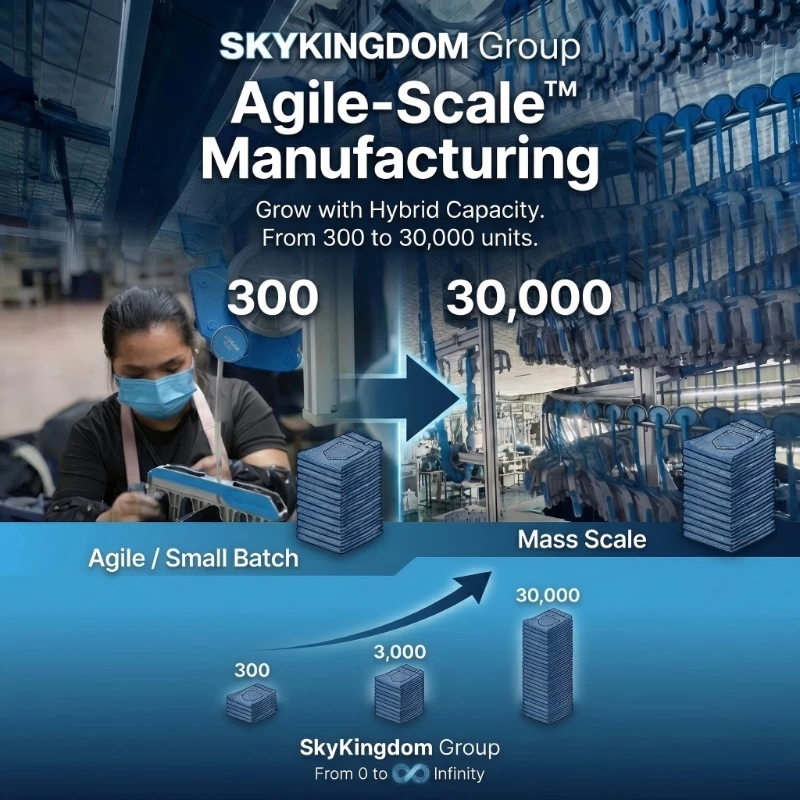
SkyKingdom works from Xintang, Guangzhou, as an external jeans product team for brands that need development, sampling, wash control, QC coordination, and repeat-order continuity. Before choosing a Chinese manufacturer, prepare your product brief, sample purpose, target quantity, fabric direction, wash expectation, QC concerns, and reorder plan so the team can help separate direct production needs from development and coordination needs.