SkyKingdom Group | Empowering Creators Globally


If you are choosing a low MOQ denim manufacturer, the number itself is the least useful thing to compare. A low minimum order tells you how few units you can buy. It does not tell you what that minimum is built on — whether it counts one color or several, whether the fabric minimum sits above it, whether the wash can be repeated, or whether your reorder will match. SkyKingdom is a denim supply chain partner that works with brands at exactly this stage, so this page is written to help you read a low MOQ offer correctly, from any supplier — not to sell you a number.
Most low MOQ comparisons stall at “who starts lowest.” One supplier says 50, another says 100, another says a few hundred. Treated as a ranking, the lowest number looks like the best deal. But a minimum order is a headline, not a quote. The more useful question is: what does this minimum actually include, and what happens when I reorder it?
That shift matters because a low number with hidden conditions can quietly cost more than a higher number that is clean. The brands that get burned on small denim runs are rarely the ones who paid too much per unit — they are the ones who discovered the real minimum only after the fabric was committed.
A minimum order figure compresses several separate constraints into one marketing-friendly number. Before trusting it, separate them back out:
| Hidden condition | What to ask |
|---|---|
| Per style vs per color/size split | Is this minimum for one finished style, or is it split across colors and a size curve? A “50-piece” minimum across 3 colors and 4 sizes is a very different order. |
| Fabric minimum | What is the minimum fabric purchase, and does it sit above the garment MOQ? Denim fabric often has its own minimum that quietly sets the real floor. |
| Wash setup cost | Is wash development and setup included, or charged separately? A complex wash on a small run can cost more in setup than the garments. |
| Trim and label runs | Do rivets, buttons, and woven labels have their own minimums? Small branded trim orders can carry their own floors. |
| Reorder terms | Is the second run held to a recorded standard, or re-quoted from scratch? A cheap first run means little if the reorder drifts. |
Across the market, low-MOQ denim suppliers present minimums very differently. Some advertise runs as small as a few dozen pieces; others set their floor at a few hundred. Most state the number prominently and leave the conditions unstated. None of these positions is wrong on its own — a 50-piece headline and a 300-piece floor can each be honest, depending on what they include. The point is not which number is lowest, but whether the supplier can explain the conditions behind it. A number offered without conditions is a starting point for questions, not proof of low risk.
This checklist works for any supplier — including this one. Use it to qualify a low MOQ offer rather than to confirm a choice you have already made.
A supplier that can answer all five with specifics is offering a low MOQ inside a system. One that can only restate the number is offering a number.
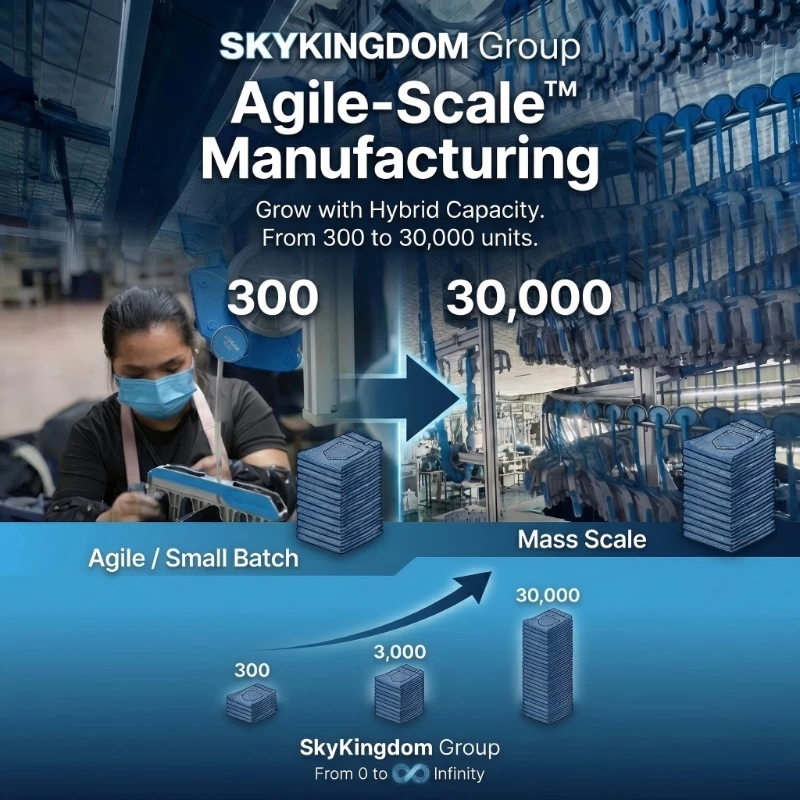
The purpose of a low MOQ is not simply to buy less — it is to validate before you commit. A sound path looks like this: a small validation run proves the design works and the wash is right; that run is documented — fabric lot, wash recipe, shrinkage-adjusted pattern, trims, and approval points; the reorder then reproduces the validated run at higher volume instead of re-developing it. The difference between a low MOQ that helps you and one that just delays risk is whether step two — the documentation — actually happens. Without it, scaling up restarts the uncertainty rather than removing it. SkyKingdom’s role with early-stage brands is to own that record so the move from a first run to repeat volume stays consistent.
Rather than quoting a single headline minimum, SkyKingdom scopes the real conditions of a small denim run upfront — fabric, wash, color and size splits, trims — and documents the validation run so the reorder reproduces it. The minimum for any given project depends on those conditions, which is why we discuss them before quoting a number. You can see the people accountable on our team page, and read how a first run is built in our guide on verifying sample-to-bulk repeatability. A dedicated verification page documenting how production is recorded and checked is in preparation.
Is a low MOQ always better for a new denim brand?
Not on its own. A low minimum lowers your upfront commitment, but the real value depends on what the number includes — whether it is per style or split across colors and sizes, the fabric minimum, and whether the wash can be repeated at reorder. A low number with hidden splits can cost more than a clean, slightly higher one.
Why do denim MOQs vary so much between suppliers?
Because the constraint is rarely sewing. It is usually fabric minimums, wash setup cost, and color or trim runs. A very low quoted number often counts one color, one wash, and one size curve; add variants and the real minimum appears.
What should I ask before trusting a low MOQ quote?
Whether the MOQ is per style or per color-size split, what the fabric minimum is, whether wash setup is included, and whether your reorder will be held to a recorded standard.
Can I start with a small test run and scale later?
Yes — that is the point of a test-to-scale path. A small validation run proves the design and wash; the key is whether the supplier documents that run so the scaled reorder reproduces it.
SkyKingdom has operated in Xintang, Guangzhou — China’s largest denim production cluster — since 2008, working as an external denim product team for brands that need development, sampling, wash control, QC, and reorder continuity. Its production network covers 20+ partner factories (70% founded by former SkyKingdom team members), and its quality work has been recognized as “Best Quality Supplier” for two consecutive years by an Amazon US top-3 women’s apparel seller.