
A custom clothing supplier can feel like a silent co-founder—or a hidden bottleneck. One week you’re excited about a new drop; the next, you’re chasing updates, fixing fit issues, or redoing trims because the first sample missed the mark. I’ve been on calls where a “simple denim tweak” turned into three extra weeks because the supplier lacked real-time production control. If you’re building a DTC brand, speed and consistency aren’t “nice to have”—they decide whether you win the trend cycle or miss it.

What a Custom Clothing Supplier Actually Does (Beyond “Making Clothes”)
A custom clothing supplier is your execution engine: they translate tech packs into repeatable production. The best suppliers don’t just cut and sew; they manage materials, sampling, QC, compliance, and delivery timelines with predictable outcomes. In practice, that means fewer “surprises” between sample approval and bulk shipment.
A capable custom apparel supplier typically supports:
- Product development: pattern, grading, fit, wash/finish testing
- Sourcing: base fabrics, trims, labels, packaging, wash chemicals
- Manufacturing: cutting, sewing, washing, finishing, packing
- Quality control: AQL inspections, inline checks, final audits
- Compliance: social responsibility standards, restricted substances support
OEM vs ODM vs “Blanks Customization”: Pick the Right Model
Choosing a custom clothing supplier starts with the right production model. Many brands lose months because they pick a model that doesn’t match their stage, budget, or design complexity.
- OEM (Original Equipment Manufacturer): You provide the design/tech pack; the supplier manufactures to spec. Best for brands with clear product direction.
- ODM (Original Design Manufacturer): Supplier provides design options you can modify. Best for speed when you need proven silhouettes.
- Blanks customization (print/embroidery/labels on stock items): Fastest for merch and simple launches, but less unique.
If you’re launching denim or woven apparel with specific fits and washes, you’ll usually need OEM/ODM—not basic blanks—because fabric behavior and wash recipes can change sizing, hand-feel, and shade.
The 7 Criteria That Separate a “Good” Custom Clothing Supplier From a Risk
When evaluating a custom clothing supplier, focus on operational proof, not promises. Here are the seven checks I use because they predict outcomes (lead time, defect rate, and repeatability).
- Speed-to-market capability
- Ask for documented sample and bulk lead times by category (denim vs woven shirts).
- Low MOQ + scalable capacity
- A supplier should support small tests and scale without changing factories midstream.
- Real QC system (not just “we check quality”)
- Look for AQL standards (e.g., AQL 2.5) and clear defect definitions.
- Material control and shade consistency
- Denim especially needs shade band management and wash standardization.
- Transparent production tracking
- ERP, WIP reporting, and photo/video checkpoints reduce miscommunication.
- Compliance and social responsibility
- Certifications and audit readiness protect your brand.
- Communication cadence
- Weekly WIP updates and fast response times prevent small issues from becoming delays.
| Criteria | What “Good” Looks Like | Questions to Ask | Red Flags |
|---|---|---|---|
| Sampling Speed | Initial samples in 7–14 days; revisions in 5–10 days; clear sample schedule and courier options | What is your standard lead time for first samples and revisions? What info do you need to start immediately? Can you share a sample timeline from a recent project? | Vague timelines; repeated missed deadlines; asks for full PO before sampling; no clear ownership of sample process |
| MOQ | Flexible MOQs; willingness to start with pilot runs; transparent cost breaks at higher volumes | What is your MOQ by SKU/color/size? Can you support a pilot order? What are price breaks at 500/1,000/5,000 units? | “Take it or leave it” MOQ; hidden surcharges; MOQ only negotiable with major deposits; inconsistent MOQ by conversation |
| QC/AQL | Written QC plan; AQL targets (e.g., 2.5/4.0) agreed; in-process + final inspection; accepts third-party inspections | What AQL levels do you work to and can you align to ours? What checkpoints do you run (IQC/IPQC/OQC)? Do you allow third-party inspection and rework? | No defined AQL; refuses third-party inspections; only “100% inspection” claim without process; high defect tolerance or blame-shifting |
| Material Sourcing | Traceable suppliers; consistent lots; COAs/test reports available; alternatives proposed with documented impact | Where do you source key materials and can you provide supplier info/COAs? How do you manage lot traceability? What happens if a material is out of stock? | Won’t disclose sourcing at all; frequent substitutions without approval; inconsistent color/hand-feel between batches; no documentation |
| Production Visibility (ERP) | Uses ERP/MES; provides order status milestones; shares WIP photos/videos; accurate capacity planning | Do you use an ERP/MES system? Can we get weekly status updates with milestones? How do you handle schedule changes and capacity constraints? | “We’ll update you when ready”; no real-time tracking; frequent surprise delays; inconsistent progress reporting |
| Compliance | Supports required certifications (e.g., REACH/RoHS/CPSIA/BSCI/ISO); maintains audit records; clear restricted substance controls | Which compliance standards can you meet for our markets? Can you share recent audit reports/certificates? How do you manage restricted substances and testing? | Expired or unverifiable certificates; avoids audits; asks you to “self-declare” compliance; no testing history or documentation |
| Communication | Responsive within 24 hours; clear written summaries; proactive risk alerts; strong English (or dedicated PM) | Who is our day-to-day contact and backup? What is your typical response time? How do you escalate issues and confirm specs/changes? | Slow replies; inconsistent answers from different people; relies on informal chat only; avoids confirming specs in writing |
Why Speed-to-Market Is Now a Competitive Requirement (Not a Bonus)
Fast fashion isn’t just about price—it’s about timing. In many DTC categories, the demand curve is sharp: if you miss the moment, paid ads get more expensive and conversion drops. A custom clothing supplier with a reliable sampling system and controlled bulk scheduling reduces trend risk.
SkyKingdom Group’s model is built around this reality:
- 7-day sample turnaround to validate fit and wash quickly
- 15–22-day bulk production to capture demand while it’s still hot
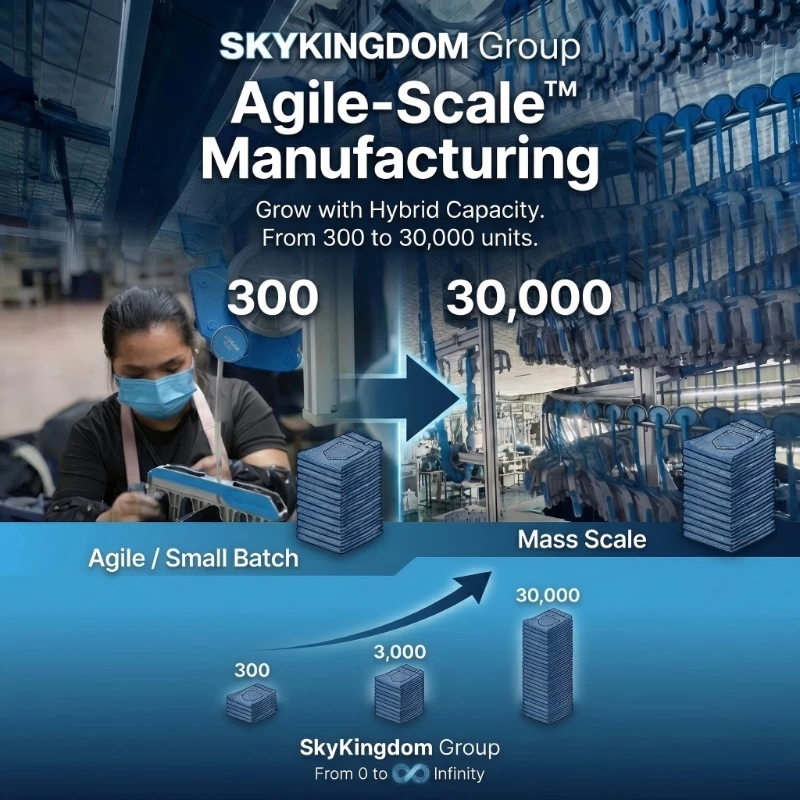
- Hybrid capacity so growing brands don’t outgrow the supplier
- Low MOQ (30 units) for new brands and creators testing product-market fit
If you want a deeper checklist for speed-focused supplier selection, see how to identify the best factory for fast and reliable denim clothing sample delivery.

Denim and Wovens: Where Custom Clothing Orders Usually Go Wrong
Denim and woven garments look straightforward until you scale. In my experience, the most expensive mistakes happen when brands treat denim like a basic knit tee. A custom clothing supplier must control shrinkage, wash variance, and sewing tolerances.
Common failure points:
- Fit drift from sample to bulk (wash shrinkage or pattern changes)
- Shade variance across lots (inconsistent dye lots or wash recipes)
- Weak seam strength (wrong thread, SPI, or stitch type for stress points)
- Trim mismatch (buttons/rivets/zippers not tested under wash conditions)
SkyKingdom addresses these with “Amazon Top Seller-Grade QC” aligned to AQL 2.5, plus eco-friendly wash processes and digital production tracking via ERP for visibility.
For more denim-specific sourcing guidance, reference 5 must know denim clothing oem solutions providers for fashion retailers.
MOQ Reality: How to Start Small Without Paying “Small-Batch Penalties”
Many factories say they support startups, but their MOQ tells the truth. A dependable custom clothing supplier will offer a low MOQ and a process designed for small runs (material planning, line allocation, and QC still applied).
What to ask:
- Can you do 30–100 units without cutting corners on QC?
- Can you reserve capacity if a style suddenly scales?
- Do you support mixed sizes and limited colorways efficiently?
SkyKingdom’s low MOQ (30 units) plus scalable hybrid capacity is designed for creators who want to test quickly and then ramp without switching vendors. If low MOQ denim is your priority, this guide is useful: choosing the best factory for low moq denim clothing ideal for individuality seekers.
Risk-Sharing Partnerships: The Supplier Feature Most Brands Don’t Know to Ask For
A high-performing custom clothing supplier can reduce your cash risk—not just your production risk. One practical example is base fabric safety stock management. When a supplier holds core materials, you can reorder faster and avoid delays from fabric lead times.
SkyKingdom’s “Risk-Sharing Partnership” approach includes:
- Managing base fabric safety stock for faster replenishment
- Using ERP-based transparency so you can track progress and decisions
- Supporting fast reorders when a style starts trending
This matters because many “lead time promises” ignore fabric reality. If fabric arrives late, everything slips.
How to Vet a Custom Clothing Supplier in 30 Minutes (A Practical Call Agenda)
Use this agenda to quickly qualify a custom clothing supplier without getting trapped in vague sales talk.
- Category proof
- “Show me 2–3 similar denim/woven styles you’ve produced recently.”
- Timeline proof
- “What were your last 10 sample lead times and bulk lead times?”
- QC proof
- “Do you follow AQL? Which level? What’s your rework process?”
- Transparency
- “How do you report WIP? Can I get weekly photos and checkpoints?”
- MOQ + scale plan
- “Can you start at 30–100 units and scale to 1,000+ without moving lines?”
- Compliance
- “Which social responsibility standards do you meet? Any audit history?”
- Cost drivers
- “What changes cost most—wash, trims, fabric weight, or pattern complexity?”
Inside a High End Denim Jeans Manufacturer in China | Denim Jeans Factory
SkyKingdom Group as a Custom Clothing Supplier: What’s Different in Practice
SkyKingdom Group operates as an OEM/ODM custom clothing supplier for global DTC brands, with a focus on fast-fashion denim and woven apparel for men, women, and children. The operational difference is the combination of speed, data visibility, and scalable capacity—built for modern launch cycles.
Key capabilities that matter to DTC operators:
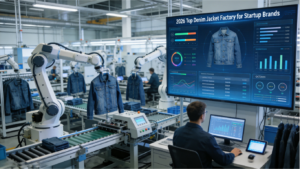
- 5G IoT production lines + real-time data tracking for tighter control
- 7-day samples + 15–22-day bulk to match short trend windows
- MOQ 30 for testing, with hybrid capacity for growth
- AQL 2.5 QC aligned with “Amazon Top Seller-Grade” expectations
- Eco-friendly wash processes for more responsible finishing
- Digital ERP transparency to reduce miscommunication and delays
For external validation and broader context on apparel manufacturing standards and compliance, these resources are helpful:
- OEKO-TEX® Standard 100 (material safety and testing framework)
- amfori BSCI (social compliance approach used widely in apparel supply chains)
- ISO 9001 Quality Management Systems (quality management principles relevant to factory systems)
FAQ: Custom Clothing Supplier Questions Buyers Search Most
1) What is the difference between a custom clothing supplier and a clothing manufacturer?
A custom clothing supplier may manage end-to-end services (development, sourcing, production, QC, logistics), while a manufacturer may only produce. Many top partners do both, but the key is whether they own the process or just a step.
2) What MOQ should I expect from a custom clothing supplier?
It depends on product type and fabric. For denim and wovens, many suppliers start at 100–300 units, but some (like SkyKingdom) can start at 30 units for new brands.
3) How long does custom clothing production take?
Typical ranges are 2–4 weeks for samples and 4–8+ weeks for bulk. Speed-focused suppliers can hit 7-day samples and 15–22-day bulk depending on complexity.
4) How do I make sure the bulk matches the sample?
Use approved pre-production samples, define measurement tolerances, lock wash recipes, and require AQL-based inspections. Also ask for inline QC checkpoints and shade band control for denim.
5) Should I choose OEM or ODM for my brand?
OEM is best when you have clear tech packs and brand DNA. ODM is best when you want faster development using proven blocks you can modify.
6) What certifications should a custom clothing supplier have?
Look for social responsibility compliance (often BSCI-style programs), chemical and fabric safety frameworks (OEKO-TEX is common), and documented QC systems (often aligned with ISO principles).
7) What should I send a custom clothing supplier to get an accurate quote?
Send a tech pack (or reference sample), target fabric and weight, wash/finish details, trims list, size range, colorways, order quantity, and required delivery window.
Conclusion: Choose a Custom Clothing Supplier That Keeps Your Promise to Customers
A custom clothing supplier isn’t just a vendor—they protect your launch calendar, your reviews, and your cash flow. When your supplier has real production visibility, disciplined QC, and a speed-to-market system, you stop “hoping” a drop works and start operating with confidence. If you’re building denim or woven styles for a DTC brand, SkyKingdom Group’s mix of 7-day sampling, 15–22-day bulk, low MOQ 30, and data-driven manufacturing is built for the way modern brands actually sell.

📌 the ultimate guide to quick denim clothing sample production for fashion brands