
Launching a new style can feel like herding cats: the sketch is ready, your customers are waiting, and yet fabric, fit, and finish can quickly derail timelines. That’s where custom garment manufacturers step in—they turn your ideas into consistent, sellable products at scale. If you’re a DTC founder, creator, or sourcing manager, understanding how custom garment manufacturers work will save you money, prevent quality surprises, and speed up your next drop. This guide explains what they do, how the process flows, and how to choose the right partner.

What Are Custom Garment Manufacturers?
Custom garment manufacturers are factories (or factory groups) that produce apparel to your specifications rather than selling generic blanks. In practice, “custom” can mean anything from adding private-label branding to building a garment from scratch with your own pattern, fabric, wash, trims, and packaging. The best partners operate as OEM/ODM manufacturers: OEM executes your design; ODM can help develop the design and materials when you’re still refining details.
To keep it simple, custom garment manufacturers usually support three common paths:
- Cut-and-sew from scratch: your patterns + your fabric/trims + full assembly.
- Private label customization: start from existing blocks or blanks, then brand/modify.
- Development + production: tech pack help, sampling, fit corrections, then bulk runs.
What Custom Garment Manufacturers Actually Do (End-to-End)
When people hear “manufacturer,” they often picture only sewing. In reality, custom garment manufacturers manage a chain of decisions that determine cost, lead time, and returns rate. In my experience auditing denim and woven programs, most delays come from pre-production details—not stitching speed.
Here’s what a full-service partner typically covers:
- Product development
- Pattern drafting/grading, construction review, BOM finalization (buttons, rivets, thread)
- Material sourcing
- Fabric mill options, lab dips, shrinkage and colorfastness checks, trim approvals
- Sampling
- Proto sample → fit sample → size set → pre-production sample (PPS)
- Bulk production
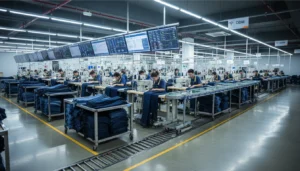
- Cutting, sewing, washing (for denim), finishing, pressing, packing
- Quality control
- Inline + final inspection (often using AQL standards) and measurement tolerance control
- Compliance + documentation
- Care labels, country-of-origin labeling, restricted substances handling (where applicable)
- Logistics support
- Carton specs, shipping marks, consolidation, delivery coordination
The Typical Workflow: From Idea to Bulk Shipment
A clean workflow is the difference between a repeatable supply chain and constant fire drills. Use this sequence as your internal checklist when working with custom garment manufacturers.
- Discovery & feasibility
- Confirm fabric availability, minimums, price targets, and realistic timeline.
- Tech pack submission
- Include measurements, construction callouts, artwork files, label placement, packing specs.
- Sampling and fit
- Iterate quickly; lock measurements and fabric before heavy wash development.
- Pre-production (PPS) approval
- Treat PPS as your “contract sample” for bulk.
- Bulk production + inspections
- Ask for inline photos/videos and measurement reports during sewing and finishing.
- Final QC + packing
- Confirm labeling, folding, polybags, carton counts, and barcode requirements.
How to Use the AQL Table for Product Sampling and Inspection
Custom Garment Manufacturers vs. Print Shops vs. Blank Suppliers
Not every “custom clothing” vendor is a true manufacturer. Top-ranking results often blend these categories (screen printing, embroidery, blanks, cut-and-sew). The right choice depends on what you’re building.
- Print/embroidery shops: best for fast branding on existing garments (uniforms, merch).
- Blank suppliers: best when you want premium basics with minimal change.
- Custom garment manufacturers: best for unique fit, unique wash, proprietary patterns, and scalable consistency.
If your product needs a specific denim wash recipe, signature pocket shape, or repeatable fit across sizes, you want custom garment manufacturers—not just decorators.
How to Choose the Right Custom Garment Manufacturers (Practical Criteria)
Many brands choose based on unit price, then pay later in delays, remakes, or inconsistent sizing. I’ve found a better method is to evaluate repeatability: can this supplier reproduce the same garment accurately, again and again, under real timelines?
1) Sampling speed and development quality
Fast samples matter only if fit and construction are accurate. Ask:
- How many sampling rounds are included?
- Who reviews patterns—an experienced technician or only merchandisers?
- Will they provide measurement charts and shrinkage testing results?
For denim-focused launches, this guide is useful: how to identify the best factory for fast and reliable denim clothing sample delivery.
2) MOQ flexibility (and what “low MOQ” really means)
Some factories advertise low MOQ but restrict fabric/wash options. Clarify:
- MOQ per style, per color, per wash, per size ratio
- Whether they allow mixed sizes within a style
- Whether trims require separate minimums
If you’re testing demand, start here: choosing the best factory for low moq denim clothing ideal for individuality seekers.
3) QC system and standards (AQL and beyond)
Ask which AQL standard they use and whether they do inline inspections. For selling on marketplaces or scaling DTC, consistency is the real KPI. AQL 2.5 is common for strong programs, but you also need:
- Measurement tolerances by POM (point of measure)
- Wash test results (shrink, twist, shade)
- Defect classification (critical/major/minor)
4) Material control and risk management
The biggest hidden risk in apparel is fabric readiness. Strong custom garment manufacturers manage:
- Base fabric safety stock options
- Shade band control (especially for denim)
- Real-time tracking to prevent bottlenecks
5) Communication cadence and documentation
You want documented approvals, not “looks good” in chat. Require:
- Signed sample approvals
- Bulk fabric/trim approvals
- Production schedule with milestones
A Clear Comparison: What to Expect From Different Manufacturing Models
| Model | Best For | Typical MOQ | Customization Level | Speed | Common Risks |
|---|---|---|---|---|---|
| Cut-and-sew OEM | Brands with tech packs needing precise execution and consistent quality | 300–1,000 pcs/style/color | High | Medium | Miscommunication on specs, fit/sample delays, quality drift across runs |
| ODM development + production | Startups needing design help and ready-to-adapt patterns | 200–800 pcs/style | Medium–High | Medium–Fast | Limited IP ownership, less uniqueness, dependency on vendor’s design library |
| Blank + decoration | Fast drops (tees/hoodies) prioritizing speed and low cost | 24–200 pcs/SKU (or none if stocked blanks) | Low–Medium | Fast | Limited silhouette/fabric options, decoration durability issues, inconsistent blank availability |
| Small-batch private label | Testing new styles, local/ethical production, premium positioning | 30–150 pcs/style | High | Slow–Medium | Higher unit costs, capacity constraints, longer lead times during peak seasons |
| Large-scale mass production | Established brands scaling core styles with aggressive pricing | 5,000–50,000+ pcs/style | Medium | Medium | Overproduction risk, less flexibility, higher cash tied up, compliance/QA challenges at scale |
Timeline Reality Check: Where Lead Times Actually Come From
Custom garment manufacturers don’t only “run sewing lines”—they coordinate approvals. In my experience, the biggest time sinks are wash development, fabric lead times, and slow decision-making on fit.

To compress time without sacrificing quality:
- Lock fabric early (or use proven base fabrics for first drops)
- Approve with clear pass/fail criteria (measurements, shade, handfeel)
- Request mid-production measurement checks to prevent bulk surprises
How SkyKingdom Group Fits In (Example of a Speed-to-Market Partner)
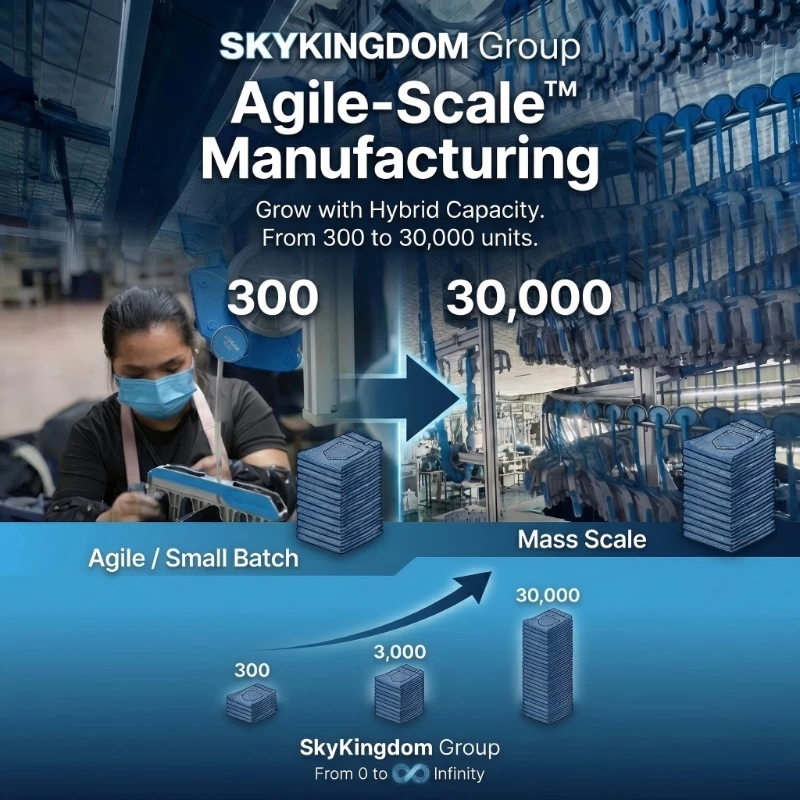
For brands building fast-fashion denim and woven categories, SkyKingdom Group operates as an OEM/ODM partner designed around speed, data visibility, and low-risk scaling. Their setup combines 5G IoT production lines, real-time tracking, and a digital ERP system so production progress isn’t a black box.
Key capabilities that matter when choosing custom garment manufacturers:
- Speed-to-Market Engine
- 7-day sampling turnaround and 15–22-day bulk production (typical ranges vary by style/wash)
- Low MOQ for testing
- Starts at 30 units for new brands and creators, with scalable hybrid capacity
- Marketplace-ready QC
- “Amazon Top Seller-Grade QC” aligned to AQL 2.5, plus eco-friendly wash processes
- Risk-sharing operations
- Base fabric safety stock management to reduce fabric-related delays
If you’re comparing small-batch partners for private label denim, this internal guide is a strong next read: what are the best small batch denim clothing manufacturers for private label.

Common Mistakes When Working With Custom Garment Manufacturers (and How to Avoid Them)
Most production problems are preventable if you control inputs. Here are the repeat offenders I see:
- Vague tech packs
- Fix: include POM diagram, tolerances, stitch type, SPI, artwork placements, packing rules.
- Approving samples “by photo”
- Fix: request physical samples for fit and wash; approve shade under standard lighting.
- Ignoring shrinkage and wash behavior
- Fix: require wash test results and update measurement spec accordingly.
- Chasing the lowest quote
- Fix: compare apples-to-apples (fabric GSM, wash steps, QC level, packaging, lead time).
- No written change control
- Fix: track revisions (V1, V2…) and confirm what version goes to bulk.
External Resources (Credible References)
To deepen your understanding of how apparel manufacturing and standards work, these references are helpful:
- International Labour Organization (ILO) for widely used context on labor standards and responsible sourcing
- OEKO-TEX® for textile safety and restricted substance considerations
- ISO for broader quality management and standardization frameworks used across manufacturing
Conclusion: Treat Your Manufacturer Like a System, Not a Vendor
The best custom garment manufacturers don’t just “make clothes”—they run a repeatable system that protects your brand’s fit, quality, and delivery promises. When you choose a partner with clear development workflows, documented QC, and fast feedback loops, your launches feel less like guesswork and more like a controlled rollout. If you’re planning your next denim or woven drop, map your tech pack, sampling, and approval steps now—your timeline will thank you.
📌 the ultimate guide to quick denim clothing sample production for fashion brands
FAQ: Custom Garment Manufacturers
1) What do custom garment manufacturers need from me to start?
A tech pack (measurements, materials, construction), reference images, branding files, and target quantities/timeline are the basics.
2) What’s the difference between OEM and ODM in custom garment manufacturing?
OEM produces to your design; ODM can help design/develop the product (patterns, fabrics, details) before production.
3) What is a good MOQ for startups using custom garment manufacturers?
It depends on fabric and process, but many small-batch programs start around 30–150 units per style/color when flexibility is built in.
4) How long does sampling take with custom garment manufacturers?
Commonly 1–3 weeks per round, but fast programs can be quicker if the tech pack is clear and fabrics are available.
5) What should I check in a pre-production sample (PPS)?
Measurements, fabric/shade, stitch details, trims, wash results (for denim), labeling, and packaging—PPS should match bulk output.
6) How do I evaluate quality control at a custom garment manufacturer?
Ask for their AQL level, inspection reports, measurement tolerance process, and examples of defect classification and corrective actions.
7) Are eco-friendly washes available for custom denim production?
Yes—many factories offer lower-impact wash options; confirm water/chemical controls, shade consistency, and performance testing outcomes.