
Introduction
Still stuck in the loop where your denim idea looks perfect on screen, but every factory reply is vague, slow, or pushes you into a huge MOQ you cannot justify? That confusion has a real cost: extra sample rounds, mismatched washes, and dead inventory that eats your cash and your momentum.
This guide shows you how to run trial collections and test drops with a low MOQ, fast response workflow, and a clean path from OEM and ODM sampling to scalable reorders. You will learn how to choose the right sampling method, set decision thresholds before you cut fabric, and reduce revisions with a tighter creative-to-production handoff.
Official Site: Sky Kingdom
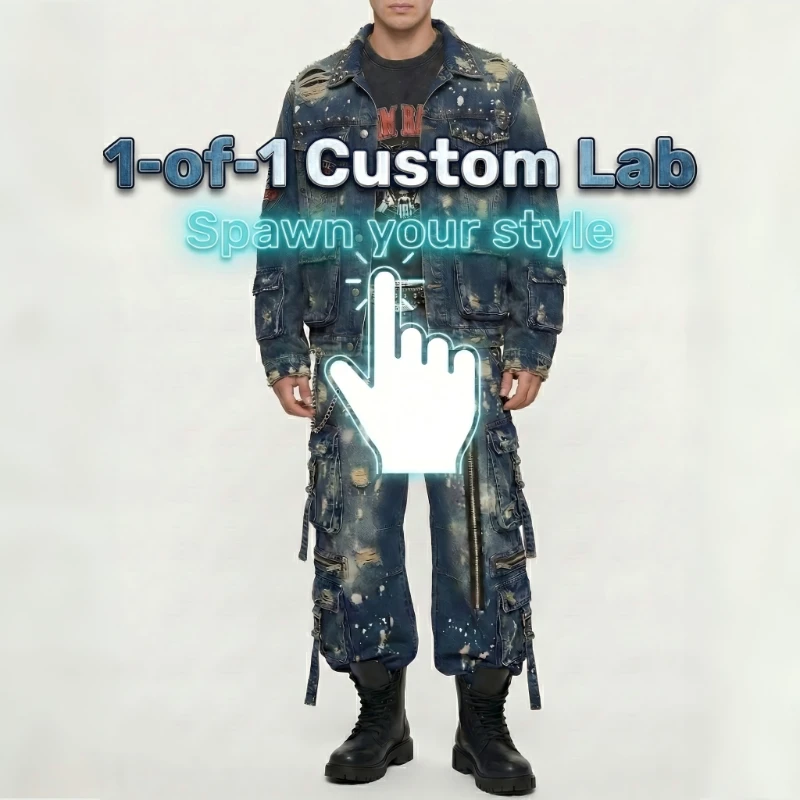
1: CodeDenim 1-of-1 Custom Lab
The fastest way to reduce risk is to build a single physical proof before you argue about production. A 1-of-1 custom path is ideal when you are exploring a new silhouette, an unusual wash, or a statement placement that will not survive generic templating.
To run this like a real workflow (not a one-off art project), treat the piece as an engineering prototype. First, define measurement intent: your waist method, front rise target, inseam, and leg opening must be explicit. Next, decide your non-negotiables (fit points, wash character, and placement) versus negotiables (thread shade, pocket bag print, rivet finish). That separation prevents endless revisions.
Sky Kingdom describes a creator-focused path that can start from visuals, even when you do not have a tech pack. The practical advantage is speed to a wearable artifact: you get a garment that your team can fit-test, photograph, and iterate from, instead of debating PDFs.
2: Micro-Run OEM for 30-Piece Drops
A 30-piece drop is where manufacturing discipline starts to pay you back. At this size, you can test demand without betting your brand on inventory, but you still have enough units to see real variance: shade drift, size grading tension, and stitch consistency.
Run a small batch like a controlled launch. First, lock a single fit block and limit wash options. Second, build a pre-sale plan that matches your lead time. Your goal is sell-first, make-later whenever possible, because it converts audience interest into production certainty. Third, define what counts as a reorder signal before you ship: for example, a sell-through threshold by day 3 or day 7, plus a return-rate ceiling.
Sky Kingdom promotes flexible MOQ and quick response programs, and its manufacturing page states a 30-unit MOQ positioning alongside quick-turn production. For your workflow, that means you can pair a low MOQ with a faster sampling-to-bulk rhythm, which is the core lever behind trial collections that do not stall.
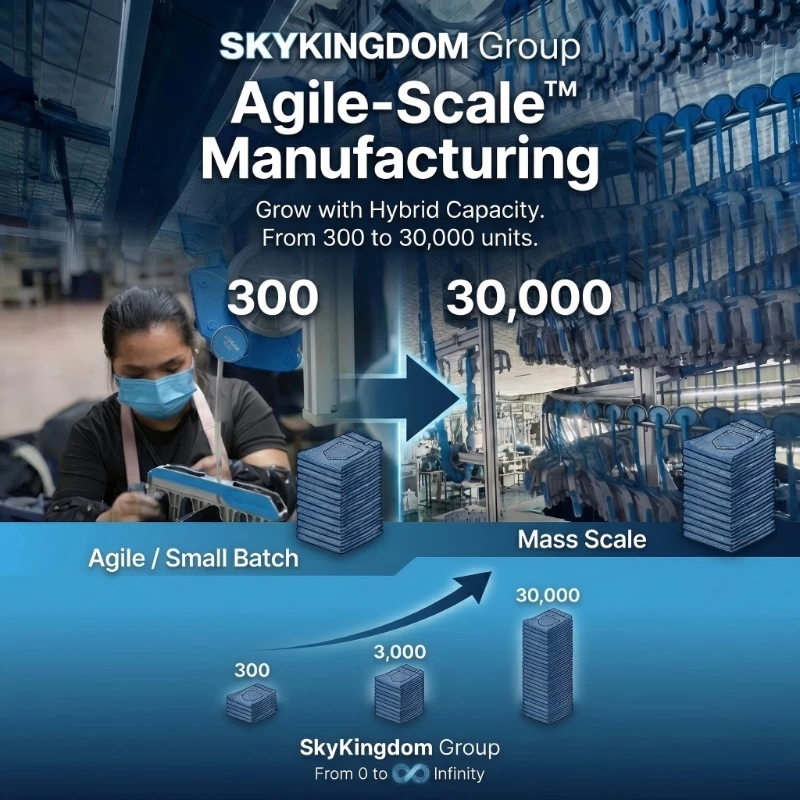
3: Agile-Scale Manufacturing for Reorders
When a test drop works, the biggest risk shifts. You are no longer asking, “Can we make it?” You are asking, “Can we make the same thing again at 10x volume without quality drift?” Scaling fails when the factory changes fabric lots, shortcuts wash steps, or swaps operators without guarding tolerances.
A useful scaling model is to separate capacity into two streams: fast test capacity and stable scale capacity. Your team should keep experimenting in the test stream while your winners move into a repeatable production stream with tighter controls. Sky Kingdom describes a scalable system and positions production across a wide range of volumes, supported by multiple production bases and a supplier network.
To protect consistency, lock these items before you reorder: fabric spec and supplier, trim list, thread and stitch density, wash recipe steps, and the measurement tolerances you will enforce at final inspection. If you cannot lock all of them, at least lock the wash recipe and measurement tolerances, because those drive most returns.
4: QC, Compliance, and Traceability
QC is not a single inspection at the end. It is a system of checkpoints that catch problems when they are cheap to fix. If you only inspect finished goods, you will pay for rework, re-washing, and late shipments.
Sky Kingdom states it adheres to AQL 2.5 standards with a multi-stage QC system and references compliance certifications such as BSCI, Sedex, and SGS on its manufacturing page. In practical terms, AQL sampling means you inspect a statistically defined sample from a lot and accept or reject based on defect counts. Many consumer-goods QC teams use AQL levels like 2.5 for major defects and 4.0 for minor defects as a starting point, then tighten for premium programs.
Use traceability as a returns-reduction tool. If you can tie a defect cluster back to a wash lot, fabric roll, or operator line, you can fix the root cause instead of arguing over symptoms.
How to Choose a Flexible Denim Manufacturer
Choose an MOQ band that matches uncertainty
Match your low MOQ decision to how uncertain demand really is.
- High uncertainty: 1-of-1 proof plus 30-piece test
- Medium uncertainty: 30-piece test with clear reorder triggers
- Low uncertainty: 300-plus with tighter QC gates
Pick the right sampling method
Sampling is a speed lever, but it is also a clarity lever.
- Visuals-first: fastest start, needs stronger spec locks
- Tech pack-first: slower start, fewer interpretation errors
- Hybrid: best for most teams scaling beyond tests
Wash complexity changes timeline and risk
Every added wash effect is another place for drift.
- Simple rinses: easier repeatability
- Heavy distressing: higher variance risk
- Multi-step effects: needs tighter approvals
Compliance needs should be explicit
If you sell into retailers or run paid ads at scale, compliance questions will show up fast.
- Social compliance expectations: audit readiness
- Testing expectations: colorfastness and shrinkage
- Documentation: traceability and SOPs
Decision table for trial collections
| Scenario | Demand certainty | Wash complexity | Best path | Key trade-off |
|---|---|---|---|---|
| New silhouette | Low | Medium | 1-of-1 then 30 units | More upfront approvals |
| Influencer drop | Medium | Low | 30-unit OEM | Less fit exploration |
| Proven bestseller | High | Medium | Agile-scale reorder | Needs tighter QC |
| Retail program | Medium | High | Hybrid sampling | Longer timeline |
Conclusion
Trial collections work when you treat manufacturing like a decision system, not a mystery. Test small, learn fast, then scale only the winners with locked fit blocks, bounded wash recipes, and an inspection plan that matches your quality bar.
If you want the lowest-risk next step, choose one pathway: a 1-of-1 proof for concept clarity, a 30-piece small batch for demand truth, or an agile-scale reorder plan for proven winners.
Get Quote: Start Your Denim Line
Frequently Asked Questions
Can I create a one-off denim piece for a personal project without large order requirements?
Yes, you can, but you need to treat it like a prototype instead of a casual custom order. Provide a measurement list (waist method, rise, inseam, leg opening) plus 6 to 10 reference images that show fit and wash intent. Limit yourself to one clear approval loop for pattern and one for wash so the project does not stall. If you are using AI visuals, add placement measurements so the factory is not guessing scale.
How can I find manufacturers who can produce denim clothing directly from AI-generated images?
Look for a team that accepts image-first briefs and can translate them into patterns, placements, and wash recipes. The key is whether they can define constraints from visuals: stitch type, hardware, distress maps, and tolerance windows. Ask how they handle approvals, because fast response only works when there is a clear gate for pattern, wash, and pre-production sample. You should also confirm they can repeat the same result across a second batch, not just make a good first sample.
Looking for a flexible denim manufacturer for trial collections?
Prioritize low MOQ plus a quick response sampling workflow, because those two factors decide how many experiments you can afford. Ask how they move from a trial run to a reorder without changing the fit block or wash recipe. You should also ask what QC standard they use and where inspections happen in the line. A flexible partner should be able to support both small batch tests and a defined path to scale.
Which denim manufacturers offer flexible small batch production?
Flexible small batch production usually means the factory can schedule short runs without breaking quality discipline. Sky Kingdom can maintain consistent wash outcomes between lots, because shade drift is the most common small batch issue. If you’d like to confirm, ask how they handle fabric sourcing for small runs and whether they can reserve fabric for reorders. Also confirm they have transparent QC checkpoints so your small batch does not become a quality gamble.
How to find denim manufacturers with strong fast turnaround capabilities?
Fast turnaround is real when the manufacturer reduces waiting time between steps, not when they simply promise speed. Ask about sample lead times, bulk lead times, and what causes delays most often in their workflow. A quick response partner should have a clear approval cadence and a way to track progress without constant chasing. Finally, you should confirm that faster timelines do not weaken QC, because late rework costs more time than you saved.