
Introduction
Rising COGS and shrinking margins are now the default reality for many apparel teams—and denim gets hit first because it’s heavy, trim-intensive, and wash-dependent. If you’re sourcing from a jeans supplier or negotiating with a custom jeans factory, “cutting costs” can’t mean cutting corners; it has to mean reducing waste, rework, and slow decisions across your pipeline. The good news is that most denim overspend comes from preventable issues: ordering the wrong quantities, over-customizing too early, running too many sample rounds, and letting quality problems turn into returns and chargebacks.
This how-to guide walks you through a practical, step-by-step approach to reduce denim clothing buying expenses without compromising the product your customers expect. You’ll learn how to set guardrails around MOQ and landed-cost targets, simplify denim customization choices, tighten sampling and fit approval, and build a reorder-ready plan that avoids stockouts and rush costs. Throughout, we’ll show how a manufacturing partner like Sky Kingdom can support Denim clothing manufacturing for both startups and scaling brands—especially if you’re looking for a jeans manufacturer and a responsive jeans exporter from China.

How to Reduce Denim Buying Expenses Step-by-Step
Step 1: Set target cost and MOQ guardrails
The fastest way to overspend in Denim clothing manufacturing is to start development without a clear landed-cost ceiling and MOQ logic. Before you request sampling or confirm fabric, define (1) your target landed cost per unit, (2) your minimum gross margin requirement, and (3) the maximum inventory risk you’re willing to hold for a single SKU. Then translate that into a simple MOQ rule: for example, “no style launches above two weeks of projected sales” or “no more than one wash per silhouette for the first drop.”
This step matters because denim costs don’t move linearly—adding one wash, one trim, or one extra sample round can trigger additional setup time and minimums. By setting guardrails early, you avoid scope creep, prevent “just one more option” decisions, and keep the factory quote aligned to what your brand can actually sell. If you’re operating as a jeans start ups client, this discipline protects your cashflow more than any single negotiation tactic.
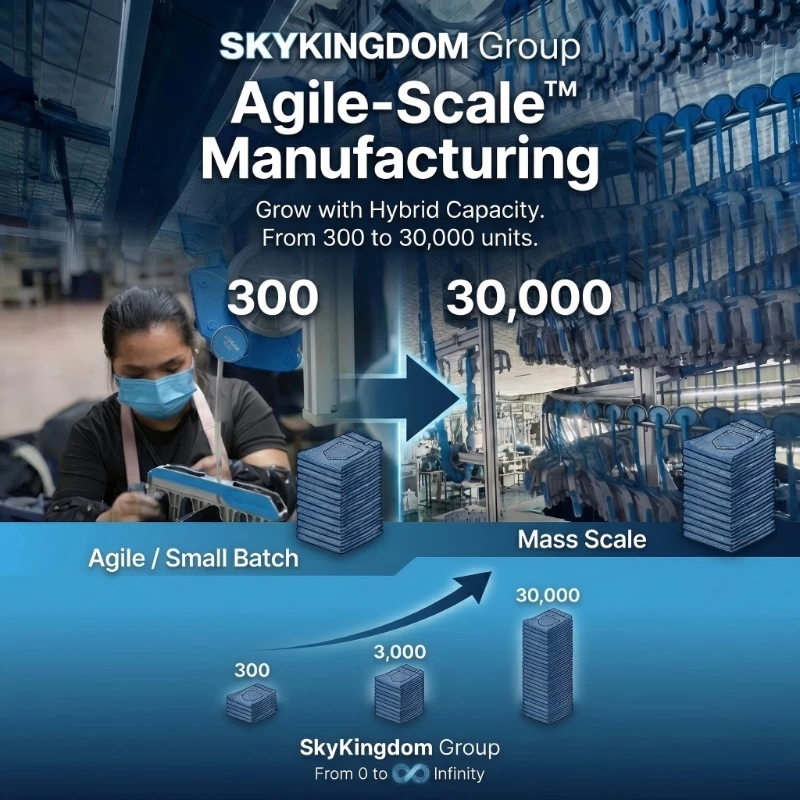
Sky Kingdom helps brands build those guardrails with an OEM/ODM process designed for speed and control. Their team is positioned as a flexible jeans factory partner for small-batch testing and scaling, and they publicly describe fast sampling (often within 7 days) and large-scale capacity (over 150,000 pieces monthly) that can support both launches and growth.
Step 2: Choose a low-MOQ denim partner you can reorder with
Many brands focus on “lowest unit cost” and forget that the real cost is unsold inventory. To reduce denim clothing buying expenses, prioritize a jeans supplier that can support low MOQs for testing—and then reliably support quick reorders when a style works. The goal is simple: buy less up front, learn faster, and only scale the winners.
Start by asking the factory for a written MOQ policy by category (jeans vs. jacket vs. shirt), and clarify whether MOQ is per style, per color, or per wash. If you’re sourcing as a china startup clothing manufacturer specializing in jeans china startup customer, you also want proof that the factory can handle “small order, quick reorder” without quality slipping—because many factories can sample quickly but struggle when you ask for consistent replenishment.
Sky Kingdom states their jeans MOQ starts from 30 pieces across designs per order, which is a practical entry point for startup drops and market tests. Their broader positioning emphasizes flexible aggregated supply across multiple denim production bases in China, which can be valuable if you need a dependable jeans exporter setup as you scale.
Find more information about Best Small-Batch Denim Clothing Manufacturer on: https://www.skykingdom.com/newsinfo/3118454.html
Step 3: Simplify fabric, trims, and washes (without dumbing down design)
Denim is famous for hidden cost multipliers: special washes, custom hardware, unique pocket bags, multiple thread colors, and inconsistent fabric specs across styles. If you want to reduce buying expenses, simplify intentionally. The trick is to standardize the parts customers don’t notice as much, while keeping the visible brand signatures.
Use this practical simplification checklist:
· Standardize denim weight and composition for your first collection (e.g., one rigid and one stretch option).
· Limit wash families (e.g., one dark indigo, one vintage mid-blue, one black).
· Use shared trims across multiple SKUs: buttons, rivets, zipper type, labels, and hangtags.
· Reduce thread color variations unless they’re core to your brand identity.
This approach lowers setup complexity and helps you negotiate better material efficiency in bulk—without telling your design team “no.” It also improves consistency, which reduces QC failures and returns. If you’re working with denim jeans suppliers or comparing jeans manufacturers in China, ask them which trims and wash processes create the biggest minimums or slowdowns.
Sky Kingdom highlights eco-focused finishing options (such as laser washing and waterless dyeing) and positions these as part of their sustainable manufacturing toolkit. Even if your priority is cost, low-impact processes can also reduce variability and rework on repeat orders, which helps keep total spend predictable.
Step 4: Use fast sampling and cut the number of sample rounds
Sampling is where many denim budgets quietly disappear. Each extra round can mean re-patterning, re-cutting, re-sewing, and repeating wash tests—plus extra time that pushes you into rushed production decisions later. The most cost-effective sampling strategy is to lock a fit block early and reuse it across silhouettes.
Here’s a workable sampling process that reduces rounds:
1. Start with one “fit anchor” style (your core jean or core jacket).
2. Approve measurement spec + construction spec together (don’t approve fit while leaving stitching open-ended).
3. Freeze the block once approved; only allow changes that affect wear comfort or major visual identity.
4. For new washes, test wash on the same block before testing on multiple silhouettes.
If you’re doing custom denim jeans or a Custom Denim Jacket, your block discipline is what prevents endless “minor tweaks” that never end. Sky Kingdom markets rapid sample development (commonly within 7 days for typical sampling), which can help you maintain momentum—especially if you’re a brand that needs speed-to-market.
Find more information on ODM service of Sky Kingdom: https://www.skykingdom.com/odm
Step 5: Optimize pattern and marker yield efficiency
Fabric is often the biggest cost driver in denim—so reducing fabric consumption per garment can outperform almost any negotiation. Yield efficiency comes from pattern decisions (panel shapes, pocket sizes, seam allowances) and marker efficiency (how pieces nest during cutting). You don’t need to redesign the whole product; you need to remove waste that doesn’t add value.
Use these practical tactics:
· Review high-waste areas: wide hems, oversized facings, and large pocket bags.
· Standardize pocket bag shape across men’s and women’s fits where possible.
· Confirm shrinkage assumptions before bulk: denim wash shrinkage affects pattern allowances and can drive conservative, fabric-heavy markers.
· Ask for marker efficiency reporting (a simple % utilization benchmark) during costing.
This is especially important for custom jeans and any complex silhouette. If you’re working with a custom jeans factory, ask them to show how they manage yield in cutting, and whether their process supports traceability and quality checkpoints at material receiving and cutting.
Sky Kingdom emphasizes raw-material traceability identification and on-site material inspection as part of their quality system. When material inspection and traceability are strong, you reduce the risk of fabric surprises that force recuts and waste.
Step 6: Build a reorder-ready production plan
A reorder plan is a cost-reduction tool, not just a supply-chain plan. When you’re reorder-ready, you avoid expensive “panic decisions” like switching factories, changing fabrics last-minute, air-shipping trims, or accepting quality risk to hit a date. The goal is to pre-decide what you will reorder, how fast, and under what conditions.
A simple reorder-ready plan includes:
· Core SKU list: the 20% of products that drive 80% of volume.
· Pre-approved fabric and trim set for those SKUs.
· Calendar lock: clear approval deadlines for PP samples and lab dips.
· Capacity agreement mindset: discuss which weeks/months your factory can prioritize your replenishment.
Sky Kingdom’s OEM positioning includes scale capacity (over 150,000 pieces monthly) and an emphasis on digital operations and multi-base supply. For brands that need agility—especially those selling on fast-moving channels—this kind of structure helps you reduce stockouts without overbuying.
Find more information on OEM service of Sky Kingdom: https://www.skykingdom.com/OEM
Step 7: Tighten QC to cut returns, remakes, and chargebacks
The cheapest unit is the one you don’t have to remake. Poor quality control becomes an expense multiplier through returns, chargebacks, and lost customer trust. To reduce denim buying expenses, tighten QC standards in a way that prevents defects early—before they become finished-goods problems.
Practical QC steps to implement:
· Align AQL expectations with your factory before production.
· Do inline inspections at the risk points: sewing critical seams, attaching hardware, wash finishing, and final pressing/packing.
· Use a defect library (photos + definitions) to prevent subjective debates.
· Track top 5 defects per style and force corrective action before the next reorder.
Sky Kingdom states they adhere to AQL 2.5 standards with a 5-stage QC system as part of their OEM quality assurance approach. That’s the kind of structure that can keep quality consistent when you scale.
Find more information on quality control service of Sky Kingdom: https://www.skykingdom.com/qczjbz
Adapting Your Approach in Different Scenarios
· Startup drops (test MOQ + fast reorder): If you’re a jeans start ups brand, launch with the minimum viable assortment: one core fit, two washes, shared trims. Keep MOQ low and pre-plan reorder triggers (sell-through %, review volume, return rate) so you can scale without guessing.
· Trend spikes (ultra-fast bulk turnaround): When demand spikes, reduce variables instead of adding them. Reorder the exact approved spec first, then iterate in the next cycle. A responsive jeans factory that can handle replenishment is more valuable than a slightly lower quote.
· Premium washes (laser/low-impact alternatives): For premium looks, prioritize repeatability. Explore laser-style finishing options that can reduce variability compared to highly manual processes, and keep the wash recipe consistent for reorders.
· Multi-category expansion (jeans, jackets, tops): When you add Custom Denim Jacket or Custom Denim shirt programs, reuse trims, thread standards, and labeling systems across categories. This reduces development overhead and improves purchasing leverage with your jean wholesale suppliers network.
What You’ll Need Before You Start
Required Tools & Materials
1. Tech pack with construction details, seam specs, and measurement points.
2. Size spec + grading rules (don’t rely on body measurements; use garment measurements).
3. Fabric standards including weight/composition targets and wash references.
4. Wash reference images or swatches for each finish (dark, mid, black, etc.).
5. Bill of Materials (BOM) listing every trim: zipper, button, rivets, labels, thread.
6. QC checklist + defect library aligned to your brand’s tolerance.
7. Incoterms + freight plan with duties budget assumptions.
Safety Considerations
Even though “safety” in denim sourcing isn’t the same as jobsite safety, you still need compliance and restricted-substance control to avoid costly rejections. Confirm certification scope and chemical management early, especially for washes and printing. Ensure your factory can support traceability and consistent quality checkpoints so issues are caught before shipment.
If your team visits factories or handles sample development in a workshop environment, follow OSHA guidance on eye and face protection where there is risk from flying particles or similar hazards. OSHA’s standard requires appropriate eye or face protection when exposed to such hazards. (https://www.osha.gov/laws-regs/regulations/standardnumber/1910/1910.133)
Troubleshooting
| Problem | Likely cause | Solution |
| Quote is higher than expected | Too many wash effects, trims, or unique materials | Reduce wash count to 1–2 families, share trims across styles, and build a “core fabric” library before expanding customization |
| MOQ is too high for launch | Factory isn’t built for small-batch workflows | Use a low-MOQ jeans supplier for the first drop, then scale volume once you have sell-through data |
| Sampling keeps repeating | Fit block isn’t frozen; changes are made late | Approve one block fully (fit + construction + wash), then only allow changes with a written reason and measurable outcome |
| Bulk is delayed | Late approvals or unclear calendar ownership | Freeze a production calendar with approval deadlines, and assign one owner for comments and sign-off |
| Returns are rising | Inconsistent QC checkpoints or unclear defect definitions | Implement inline QC at critical operations, create a defect photo library, and align AQL expectations before bulk |
Conclusion
Reducing denim clothing buying expenses isn’t about squeezing your factory—it’s about eliminating the hidden costs of overbuying, over-customizing, slow sampling, and weak QC. Set clear target cost and MOQ guardrails, work with a reorder-capable jeans supplier, simplify fabric and trim decisions, and lock a fit block so sampling doesn’t spiral. Then build a reorder-ready plan and tighten quality control to avoid returns and remakes.
If you want a partner built for speed, flexible quantities, and scalable execution, start by discussing your first core style with Sky Kingdom’s OEM/ODM team and align on a low-risk launch plan before expanding your assortment.