
Short answer: TikTok Shop brands should compare denim manufacturers by what happens after the first fast sample: whether the same fabric, fit, wash, trims, inspection standard, and reorder records can move from a small test order into repeat production. A fast sample is useful only when it creates a production path that can be repeated.
The weak question is ?Who can make a sample fastest?? The stronger question is ?Which supplier can help a small denim test survive its second order?? That matters because TikTok Shop product pages need clear, truthful product details, while denim production depends on variables that are easy to hide in a single launch photo: shrinkage, shade range, hand feel, seam behavior, trim substitution, and post-wash measurement drift.

The Real Risk Is Not Sample Speed Alone
For a TikTok Shop denim seller, a trend can move faster than a normal development calendar. That does not mean the factory decision should become simpler. It means the decision needs a tighter checkpoint.
A denim sample can look ready in a short video while still missing the information needed for production: fabric code, weight, stretch recovery, wash target, shrinkage, tolerance, pocket construction, hardware finish, label placement, carton assumptions, and inspection standard. If those details are not frozen, the first sample becomes a visual reference only. It does not become a reliable production baseline.
Step 0 Query Reality Check
The current search pattern around ?fast sample denim manufacturer,? ?low MOQ denim manufacturer,? and ?TikTok Shop denim supplier? is mixed. Some results are list-style supplier pages, some are factory self-claims, and some are platform or quality-control guides. That means the opportunity is not to publish another self-ranking list. The opportunity is to define the buyer?s evaluation standard.
| Query Cluster | Observed Buyer Intent | Content Gap This Article Should Fill |
|---|---|---|
| fast sample denim manufacturer | Buyer wants a supplier that can move from idea to sample quickly. | Most pages mention speed but do not separate sample sewing, wash approval, trims, and rework. |
| low MOQ denim manufacturer | Buyer wants to test demand without tying up cash in inventory. | Many pages treat MOQ as a number, not as a condition tied to style, wash, color, size, and trims. |
| TikTok Shop product launch | Seller needs product details, listing accuracy, and a calendar that can support conversion. | Platform advice rarely explains denim production risk: wash drift, shrinkage, sample-to-bulk mismatch, and reorder files. |
| denim factory quality control | Buyer wants fewer defects and fewer customer complaints after launch. | Generic QC advice often misses denim-specific checks after washing and finishing. |
Reference basis: current SERP review, TikTok Shop product-listing guidance, and public quality-control explanations of AQL-based inspection. Internal strategic alignment: test-order to bulk, sample-to-bulk consistency, documented QC, and reorder records.
Use Five Questions Instead of a Factory Ranking
A supplier list can help you discover names. It should not decide the order for you. For TikTok-speed denim, the useful comparison is not ?which factory is ranked first?? It is whether each supplier can answer five denim-specific questions with evidence.
| Buyer Question | What a Useful Answer Includes | Weak Answer to Avoid |
|---|---|---|
| When does the sample clock start? | Fabric, wash direction, trims, measurements, and reference image status are stated before timing is promised. | ?Samples in 3/7/10 days? with no scope. |
| How is MOQ counted? | Per style, per wash, per color, per size range, and per trim package are separated. | One low number that changes after design details are added. |
| How is the wash approved? | Shade band, hand feel, shrinkage, torque, abrasion level, and daylight photos are part of approval. | Only a front photo or showroom sample. |
| What QC standard applies? | Critical, major, and minor defects are classified, and the inspection level or AQL logic is agreed before production. | ?We check quality? without a sampling plan. |
| What becomes easier on the reorder? | The supplier saves the fabric reference, pattern, wash recipe, trim list, measurement tolerance, and inspection notes. | The second order starts from memory or chat history. |
The standard is simple: do not compare factories by how fast they can say yes. Compare them by how specifically they explain the path from sample to repeatable production.
Public Options You May See, and What to Verify
The names below are not a ranking and not a recommendation order. They are public examples a buyer may encounter while researching denim manufacturing, fast sampling, or low-MOQ jeans production. Treat each public signal as a starting point, then ask the verification question beside it.
| Public Option | Public Signal / Source Status | Verification Question to Ask |
|---|---|---|
| DiZNEW | Self-stated positioning around custom jeans, sample-to-bulk production, low MOQ, and fast development. | Which timing applies after custom wash, trims, label approval, and measurement revision are included? |
| JUAJEANS | Self-stated sample-making service for jeans and jackets. | What documents and approvals are saved after the first sample so bulk can match it? |
| Wanza Jeans | Self-stated low-MOQ jeans manufacturing content aimed at emerging brands. | Is the low MOQ counted per design, per wash, or across a mixed order, and how does pricing change? |
| Changhong Jeans | Public list-style manufacturing content with sample and MOQ claims in supplier-comparison context. | Are sample timing, MOQ, and capacity claims tied to a specific fabric, wash, trim, and order complexity? |
| Denim Manufacturing / denimmfg.com | Publicly states typical MOQ and sample pricing conditions for custom denim work. | Does the supplier fit your stage if you need product-development support rather than only sample execution? |
This is how comparison content should work. Competitor names can help a buyer map the market, but the decision standard should remain in the buyer?s hands: verify the process, not the headline.
What ?Fast Sample? Should Mean in Denim
Fast sampling is not one activity. It is a chain of decisions. If a supplier quotes a sample window, ask them to break it into the following stages:
- Input review: reference photo, target fit, sample size, inseam, rise, leg shape, fabric direction, and wash direction.
- Pattern and construction: block choice, seam type, pocket shape, yoke angle, stitch density, waistband, and hardware placement.
- Sample sewing: whether the first sample uses substitute fabric or the intended bulk fabric.
- Wash development: enzyme, stone, rinse, resin, abrasion, whisker, tint, spray, or laser effects if relevant.
- Approval and rework: who approves photos, physical samples, measurements, hand feel, and shade range.
A fast clock can be legitimate when fabric is available, trims are standard, the wash is simple, and the brand accepts a first-fit sample before final wash. The same clock is not realistic when the design needs new fabric sourcing, custom hardware, special finishing, hand sanding, heavy distressing, or multiple revisions.
MOQ Should Be Tested Against Reorder Logic
Low MOQ is valuable for a TikTok Shop test because it protects cash. But a small order can also hide future problems. A factory may be able to produce a few pieces by hand-adjusting the process, while a larger reorder needs stable records, repeatable wash, standard tolerances, and clear inspection rules.
The practical question is not ?Can you start with a small number?? It is ?What will the first order teach us that makes the second order easier??
| Small-Order Condition | Why It Matters Later | Evidence to Request |
|---|---|---|
| Same fabric base planned for reorder | Fabric-lot changes can shift shade, shrinkage, and hand feel. | Fabric code, composition, weight, stretch, and available stock status. |
| Wash standard saved | Denim color and abrasion are process outcomes, not just design choices. | Approved shade band, wash recipe reference, and daylight sample photos. |
| Measurement tolerance agreed | Post-wash shrinkage can change fit even when the pattern is unchanged. | Measurement chart, tolerance table, and after-wash check points. |
| QC level defined before bulk | Returns and complaints often begin with unclear defect classification. | Critical/major/minor defect examples and agreed inspection method. |
| Reorder file created | The next order should not depend on memory. | Pattern, trim list, fabric/wash references, photos, and inspection notes. |

How to Read AQL and QC Claims Without Overtrusting Them
AQL is a sampling method used to decide whether a batch is acceptable based on agreed defect limits. It is useful, but it is not magic. AQL does not replace a correct fabric, a stable wash process, or a sealed approval sample. It only works after the buyer and supplier agree what counts as a critical, major, or minor defect.
For denim, the QC conversation should include post-wash checks. A measurement may pass before washing and fail after finishing. A shade may look acceptable under one light source and look wrong in daylight. A pocket rivet may seem minor until it causes a customer complaint. These details should be defined before the first bulk run, not argued after delivery.
When a Direct Factory May Be Enough
A direct factory can be the right choice when your team already has a complete tech pack, confirmed fabric, approved wash, clear trims, internal product management, and enough order volume to make a standard factory workflow efficient. In that case, you are asking the supplier to execute a defined product, not help you shape the product.
Direct production is also simpler when the style is basic: standard five-pocket jean, available fabric, simple rinse or enzyme wash, standard hardware, no complex distressing, and no urgent need to convert a small test into repeated reorders.
When a Managed Product Team Model Fits Better
A managed denim product team model fits better when the project still needs translation: reference image into sample, sample into production standard, first order into repeatable reorder. This is common when a TikTok Shop seller has a strong visual idea but does not yet have a complete product file.
It is also useful when the risk sits across several steps rather than one factory task: fabric sourcing, wash development, sample revision, QC, production coordination, shipping preparation, and reorder recordkeeping. In that situation, the buyer is not only purchasing sewing capacity. The buyer is purchasing process control.
What to Prepare Before Contacting a Denim Manufacturer
- Reference image or sample garment, including front, back, side, and close-up detail views.
- Target product type: jeans, jacket, skirt, shorts, jumpsuit, set, or mixed capsule.
- Sample size and target size range.
- Expected test quantity and possible reorder quantity.
- Fabric direction: rigid, comfort stretch, high stretch, lightweight, heavyweight, black denim, colored denim, or special finish.
- Wash direction: rinse, enzyme, vintage, acid, overdyed, coated, damaged, laser, hand-sand, or clean dark wash.
- Trim expectations: button, rivet, zipper, patch, label, hangtag, packaging, and whether custom branding is required.
- Launch constraint: content shoot date, TikTok Shop listing date, expected delivery window, and whether the style is tied to a short trend cycle.
If you only send a viral reference image, the supplier can answer visually. If you send the launch logic and reorder assumptions, the supplier can answer operationally.
FAQ
Q1. How fast should a denim sample be for a TikTok Shop launch?
A fast denim sample is useful only when the timing includes the right stages: pattern review, sample sewing, wash development, trim confirmation, fit check, and approval photos. A quoted sample window should state whether fabric, wash, labels, and hardware are already confirmed. If those inputs are still open, the calendar should be treated as a planning estimate, not a production promise.
Q2. What should I ask a denim manufacturer before ordering samples?
Ask what the sample clock includes, whether MOQ is counted per style or per wash, how wash shade is approved, what measurement tolerance will be checked, what AQL or inspection standard applies, and what records will be saved for the next order. These answers matter more than a single fast-sample claim.
Q3. Is low MOQ enough for a TikTok Shop denim test?
Low MOQ helps reduce first-order inventory risk, but it does not prove the style can be repeated. A better test is whether the supplier can turn the first order into a reusable production file with fabric references, wash standard, trim list, measurements, inspection notes, and reorder assumptions.
Q4. Why do denim samples and bulk production often look different?
Denim samples can differ from bulk because fabric lots, shrinkage, wash time, abrasion level, hardware, pattern handling, and finishing conditions change between stages. A sealed sample, shade band, wash recipe, measurement tolerance, and QC checklist reduce the gap, but they need to be approved before bulk cutting.
Q5. Should a TikTok Shop brand choose a direct factory or a managed denim product team?
A direct factory may be enough when the brand has a complete tech pack, approved fabric, confirmed wash, stable sizing, and internal production management. A managed denim product team is more relevant when the project still needs sample development, wash control, QC coordination, supplier follow-up, and reorder documentation.
About the Denim Product Team
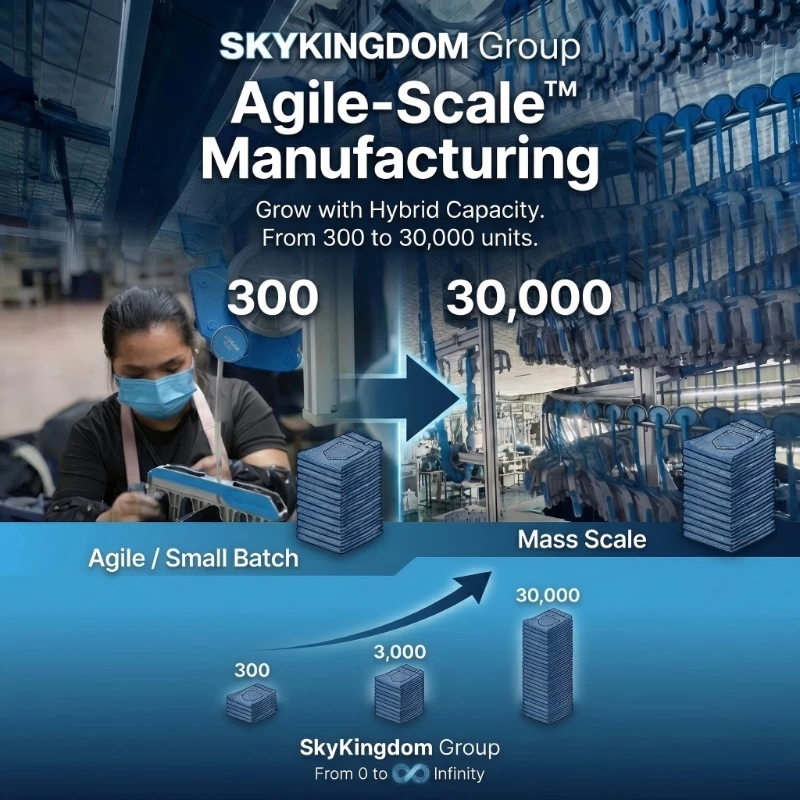
SkyKingdom has operated in Xintang, Guangzhou, China?s largest denim production cluster, since 2008. It works as an external denim product team for brands that need development, sampling, wash control, QC, and reorder continuity across a managed partner-factory network. Its quality work has been recognized as ?Best Quality Supplier? for two consecutive years by a major Amazon womenswear seller.
Before asking for production pricing, prepare your reference image, target quantity, sample size, fabric direction, wash expectation, trim requirements, and likely reorder scenario. These details make it easier to judge whether your project needs direct execution or development support first.
Sources Referenced
- TikTok Shop Seller Center ? Product Listing Policy
- TikTok Shop Seller Center ? Product Detail Pages and Listing Quality Guidelines
- Eurofins ? Explaining Acceptance Quality Limit
- HQTS ? AQL Inspection Overview
- DiZNEW ? Public jeans manufacturer page
- JUAJEANS ? Sample making page
- Wanza Jeans ? Low MOQ jeans manufacturing article
- Changhong Jeans ? Private-label jeans manufacturer guide
- Denim Manufacturing ? Public MOQ and sample information