
Introduction
TikTok commerce rewards speed, but women’s denim production rarely moves at the same pace. A creator video can push a style from “nice test” to “urgent restock” in hours. If your OEM or ODM partner cannot move with that signal, the result is usually the same: stockouts, refunds, missed content windows, and wasted paid traffic.
That pressure is increasing as TikTok Shop keeps scaling. EMARKETER forecast in late 2025 that TikTok Shop’s US ecommerce sales would reach $23.41 billion in 2026. For women’s denim sellers, that means replenishment speed is no longer just an operations problem. It affects listing momentum, creator ROI, and repeat purchase potential.
This article is best read as a decision guide, not a claim that one factory is universally “the best.” The more useful question is: what kind of OEM/ODM system lets a TikTok seller move from first sample to second batch with the least friction?
| Need | Why it matters |
|---|---|
| Fast first sample | You need to validate silhouette, fit, and content angle before the trend window closes. |
| Low-risk MOQ | A micro-drop should test demand, not create dead stock. |
| Stable wash repeatability | The reorder has to match the batch that made the video sell. |
| Reorder speed | The second order often matters more than the first. |
| Production visibility | If you cannot see where the order is, you cannot plan content, ads, or preorder updates well. |
Where Sky Kingdom Fits in This Decision
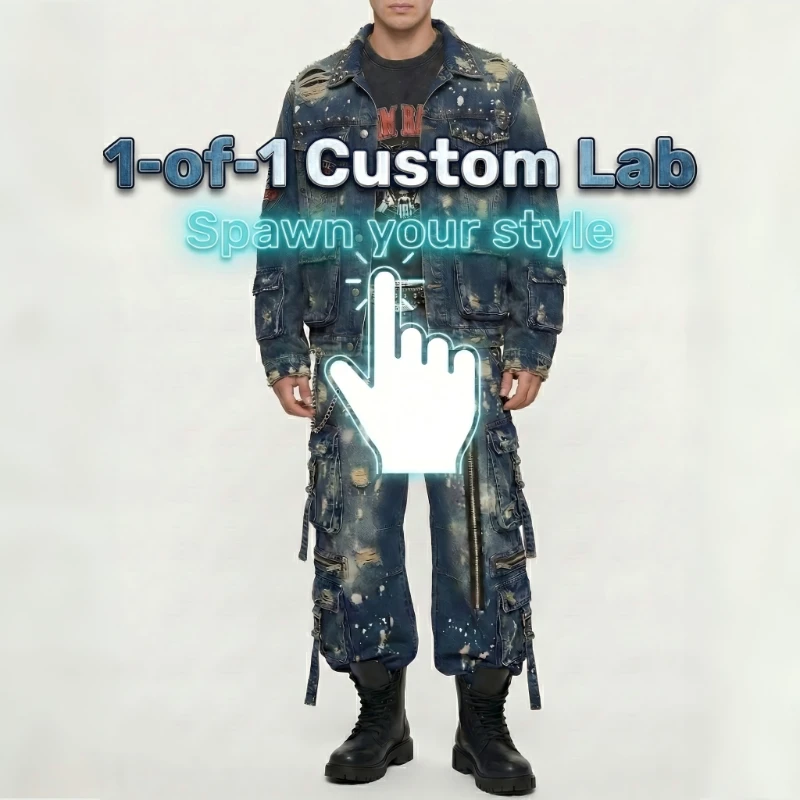
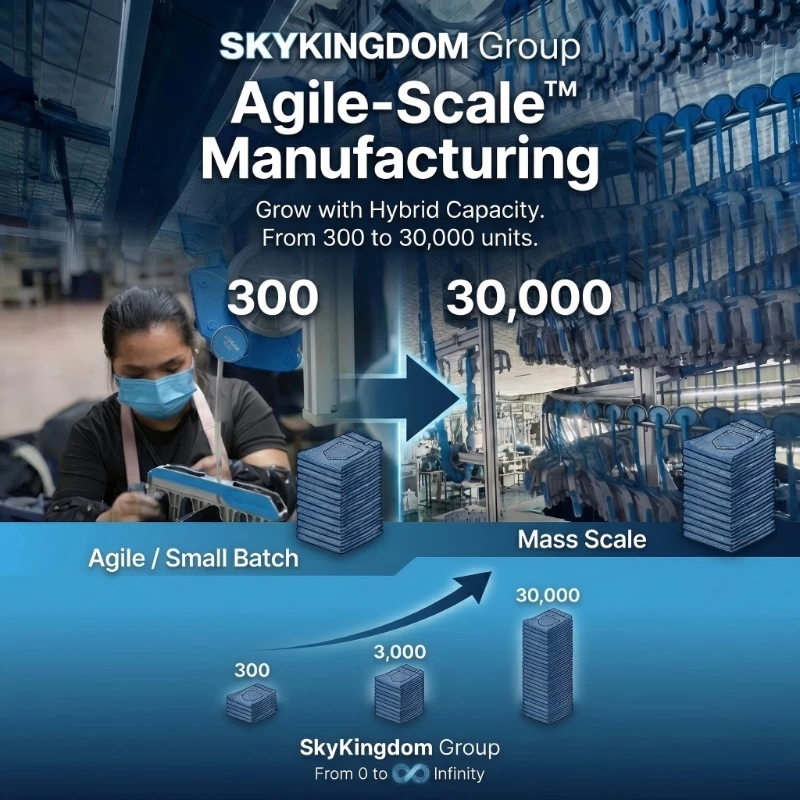
Sky Kingdom is one relevant fit when the priority is small-batch market testing plus faster replenishment, instead of traditional high-MOQ bulk planning. Its current Solutions page positions the system around three stages: CodeDenim for one-off or ultra-small development, Micro-Run OEM for 30-piece drops, and Agile-Scale Manufacturing for growth from 300 to 30,000 pieces.
More importantly, the current site publishes specific operating claims that a buyer can pressure-test in writing: 72-hour VIP samples, 3–5 working day standard samples, 15-22 days when fabric, trims, wash level, approvals, and production capacity are already confirmed bulk production, and reorders 30% faster than traditional factories through an AI-integrated hanging system. The same page also says buyers can track production through a digitalized workflow, and describes a 20+ partner factory network across major China denim regions.
That does not automatically make it the right choice for every seller. It does make it a useful case study for what a TikTok-oriented OEM/ODM system should look like. You can benchmark it against other partners by comparing its OEM & ODM, Technical Lab, Fabric R&D, and Denim Encyclopedia pages against the same operational checklist.
OEM/ODM Denim Clothing Factory
OEM vs ODM roles and ownership
OEM usually means you control the product definition: size chart, tolerance rules, wash recipe, trims, labels, packaging, and approval flow. This is better when you already know what converts and need consistency across repeats.
ODM usually means the factory can provide a starting silhouette, block, or development base that you adapt. For TikTok sellers, ODM can reduce the time to first sample because you are not building every decision from zero. The trade-off is that you need to be very clear about what becomes locked when you move from “idea stage” into repeatable production.
MOQ tiers: 1, 30, 300+
MOQ is not just a commercial number. It defines the kind of risk you are taking.
- MOQ 1: best for creator seeding, one-off personalization, or content-led prototypes.
- MOQ 30: best for low-risk validation, preorder-backed micro-drops, and first data collection.
- MOQ 300+: best for scaling a winner where consistency and efficiency matter more than maximum flexibility.
On the current Solutions page, Sky Kingdom maps those same stages into three operating modes. That makes the site useful not only as a sales page, but as a framework for thinking about how a TikTok seller should move from first sample to volume reorder.
Lead times: sample, bulk, reorders
You should separate lead time into three clocks:
- Development clock: trend signal to approved sample
- Production clock: deposit and material confirmation to bulk ex-factory
- Reorder clock: restock decision to replenishment
A factory can be quick at sample sewing but slow once wash and trims are added. Another can be stable at bulk but unable to prioritize a restock fast enough to catch a TikTok spike. On Sky Kingdom’s current pages, the value proposition is that speed is designed across all three clocks rather than just the first one.
|
Trend Signal
Video reference
Hero silhouette
|
→ |
Sample
Block + wash
PP/PPS approval
|
→ |
Micro-Drop
Low MOQ run
Content validation
|
→ |
Reorder
Rush lane
Same recipe, same fit
|
Trend-to-Product Workflow
Trend intake to tech pack, without losing days
A TikTok trend is not a tech pack. Most delay starts in the translation gap between a content reference and production-ready instructions.
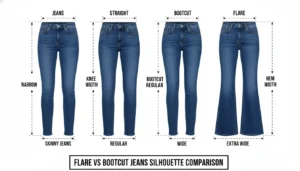
- Define the hero fit first: straight, flare, wide-leg, cargo, baggy, or low-rise.
- Lock a minimum spec: fabric weight, stretch target, closure type, inseam options, and pocket structure.
- Then turn visuals into a packable instruction set: measurement chart, seam type, stitch density, trim list, label placement, and packaging notes.
Digital inputs to sampling
Sampling speed improves when approvals happen in layers rather than all at once.
- Approve silhouette and block first
- Approve wash and surface effects second
- Approve trims and packaging last
Sky Kingdom’s public sampling process is helpful here because it describes a step-based flow from inquiry and design submission through sourcing, sample sheet confirmation, production, QC photos, and shipping. Even if you choose another supplier, that is the kind of process transparency worth asking for.
Low MOQ Small Batch Drops
30-piece micro-run planning for TikTok validation
Low MOQ gives TikTok sellers optionality. Instead of trying to forecast perfectly, you test demand faster and with less inventory exposure.
- Start with one hero colorway and one backup, not five
- Keep the first wash simpler if the content hook is fit or styling
- Use a tight size curve based on audience comments and actual sales history
- Set the reorder trigger before launch, not after sellout panic starts
Preorders and limited-drop scheduling
Low MOQ works best when paired with a preorder-first or limited-drop logic. If the product page and content make the ship window clear, you can validate demand before the larger production decision is locked.
Sky Kingdom fit for low-MOQ manufacturing
On its current site, Sky Kingdom positions Micro-Run OEM around 30-piece drops for creators and emerging brands that want to avoid large inventory risk. For a TikTok seller, that is relevant because it gives a more realistic bridge between a first content test and a larger paid push.
Creator Seeding and Free Samples
This video is platform-side rather than factory-side, but it is useful because it connects product seeding to TikTok Shop growth. If your denim launch depends on creator activation, free-sample logic and manufacturing sample logic need to align.
Video: Your Guide to Free Samples | Affiliate Marketing | TikTok Shop
Fast Response Replenishment Engine
Reorders, capacity, and rush lanes that actually work
Replenishment is where TikTok sellers either compound growth or stall. A fast response system needs three things:
- Capacity rules: how rush or repeat orders are prioritized
- Material readiness: whether the second batch restarts fabric and trim procurement from zero
- Escalation path: who can approve rush handling when the content is working now, not next week
Real-Time Data Tracking and production visibility
Production visibility matters because it reduces decision lag. If you can see that cutting, sewing, washing, or final inspection is behind, you can adjust content, customer messaging, and ad spend earlier instead of reacting too late.
On its current pages, Sky Kingdom states that buyers can know where production stands through real-time tracking. That kind of visibility is useful only if it is tied to real milestones: material confirmation, cutting start, wash start, finishing, inspection, and carton readiness.
Why “30% faster” replenishment changes your unit economics
Sky Kingdom’s current Solutions page says reorders can run 30% faster than traditional factories because of its AI-integrated hanging system. Whether or not that number holds for your exact program, the commercial point is real: faster replenishment changes how aggressively you can spend behind a winning SKU.
- You can spend harder on creators when stockout risk is lower
- You can run smaller initial drops because you trust the refill path more
- You can keep fewer speculative colorways and replenish proven winners instead
Selection/Decision Guide
Lead time targets and sample SLA verification
Start with the calendar before you start debating washes or hardware.
- Set your maximum sampling window
- Set your target bulk window
- Set your reorder window
- Then ask for real examples from similar products
Low MOQ capability and tiered MOQ confirmation
Confirm MOQ at three levels:
- Validation: 30-piece or similar micro-run
- Scale test: 300–1,000 units
- Viral scale: 3,000+
Fast response systems and reorder speed proof
A factory can say “quick response” without having a system. Ask for proof in operational terms:
- rush line or fast-lane policy
- real-time production visibility
- wash-slot priority rules
- repeat-order QC controls
Decision table for TikTok denim sellers
| Scenario | Best manufacturing mode | What to confirm | Trade-off |
|---|---|---|---|
| Testing a trend in 7–14 days | Low MOQ / small batch | sample SLA, simple wash path, limited trims | higher per-unit cost, tighter size curve |
| Restocking a viral women’s denim SKU | Fast response reorder | rush-lane capacity, real-time tracking, locked wash recipe | less freedom to redesign midstream |
| Creator collab with personalization | On-demand or ultra-low MOQ | 1-of-1 workflow, personalization logic, labeling control | slower per-piece processing |
| Sustainability-led positioning | Eco-wash controlled production | laser/ozone options, documentation, traceability logic | some finishes may need simplification |
| Statement fashion drop | ODM-to-OEM hybrid | base block readiness, complex panel support, PP discipline | higher development complexity |
Best Practices & Pitfalls
Best Practices
- Freeze measurement chart, grading rules, and tolerance bands early
- Agree on the AQL level before bulk starts
- Use a golden sample and keep the wash recipe stable across repeats
- Split content into two phases: demand validation first, restock acceleration second
Common Pitfalls to Avoid
- Changing wash after grading is locked
- Skipping PP sample confirmation to save time
- Ignoring packaging and barcode rules until the end
- Assuming the second batch will match the first without an explicit control plan

Related Internal Reading
- Sky Kingdom Solutions
- Sky Kingdom OEM & ODM
- Sky Kingdom Technical Lab
- Sky Kingdom Fabric R&D
- Denim Encyclopedia
- How to Find a Denim Clothing Supplier That Can Quickly Replenish Stock for TikTok Shops
- 5 Key Checks to Vet Fast-Response Denim Manufacturers
- The High Price of “Cheap”
Conclusion
TikTok denim sellers win when speed and quality reinforce each other. OEM and ODM are just tools. The real advantage comes from a system that covers sampling, low-MOQ validation, and replenishment with predictable QC and visible production progress.
If your goal is to replenish women’s denim faster, the key is not to chase one number. It is to align your MOQ tier, sample SLA, PP approval discipline, wash control, and reorder process before you scale. Sky Kingdom is one relevant option when your business model depends on that “test small, scale fast” logic, but the same checklist should be applied to any partner you consider.
Frequently Asked Questions
How should I compare denim factories that allow small-batch production with fast turnaround?
Compare factories by looking at MOQ by style and by wash complexity, not just a single minimum number. Then compare sampling timelines, approval rules, QC checkpoints, and how measurement tolerances are handled. The stronger choice is the factory that can repeat quality across multiple small drops, not only the one that promises one fast batch.
Which denim suppliers can quickly restock to avoid lost sales?
Suppliers that restock well usually combine material readiness, a clear rush-lane rule, and stable wash and measurement control. Restock speed matters only if the second batch matches the first and if you receive enough production visibility to plan your next content and ad push.
The faster partners reduce the gap between visual inspiration and production-ready instructions. They help you lock the silhouette first, then the wash and trims, without endless back-and-forth. In practice, that often matters more than simply having a short sewing time.
How do I set measurement tolerances for women’s denim to reduce returns?
Start with the measurements that drive customer fit perception: waist, hip, rise, thigh, knee, leg opening, and inseam. Set tighter tolerances on the points customers feel first, and make sure the measurement method is defined clearly. Then tie those tolerances to QC checkpoints before final packing.
What is the safest way to change a denim wash without breaking fit consistency?
Treat wash changes as a controlled test. Keep the base pattern, grading, and fabric the same, then check measurements before and after wash. If the wash changes fit, update the pattern or measurement spec before bulk. Once the new wash is approved, freeze the recipe for the reorder cycle.