
Choosing Fast-Fashion Denim Factories: 6 Questions Before Sampling
You finally get the sketch approved, then the first denim sample shows up and it is just… wrong. The fit twists after wash, the shade looks nothing like the reference, and the factory wants you to accept it and move on. That kind of miss does not just cost you a sample fee, it burns launch weeks, delays content, and forces you to re-shoot product photos.
This how-to checklist helps you de-risk sampling by asking six factory questions in the right order. You will confirm whether you need OEM, ODM, or a hybrid setup, lock low MOQ and small batch rules, test fast response timelines, validate wash consistency, check Smart Manufacturing and Digital Supply Chain visibility, and verify Sustainable Denim claims with proof.
How to choose fast-fashion denim factories
Confirm product type and role
Start by writing one sentence that defines what you are sampling and what you expect the factory to do. This prevents the most common mismatch: you think you are buying OEM (you own the pattern and specs), but the factory acts like it is doing ODM (they steer design, blocks, and materials). Ask the factory which role they will take for your women’s fast-fashion denim: OEM, ODM, or hybrid (OEM execution plus ODM support for blocks and wash recipes).
Use these fast checks before you send any files:
- OEM: you provide tech pack, graded size chart, and wash targets
- ODM: factory proposes blocks, fabrics, and starting wash library
- Hybrid: you bring the idea, factory engineers feasibility and speed
Verify low MOQ and small batch rules
Do not treat low MOQ as a single number. You need the factory to define low MOQ by color, by wash, and by size break, because those details decide whether your drop is financially and operationally realistic. Ask for the minimum per style, per color, and per wash, and then ask what happens if you reorder the same style with a new wash. For fast-fashion denim, your best outcome is a small batch that can repeat without re-engineering the whole line.
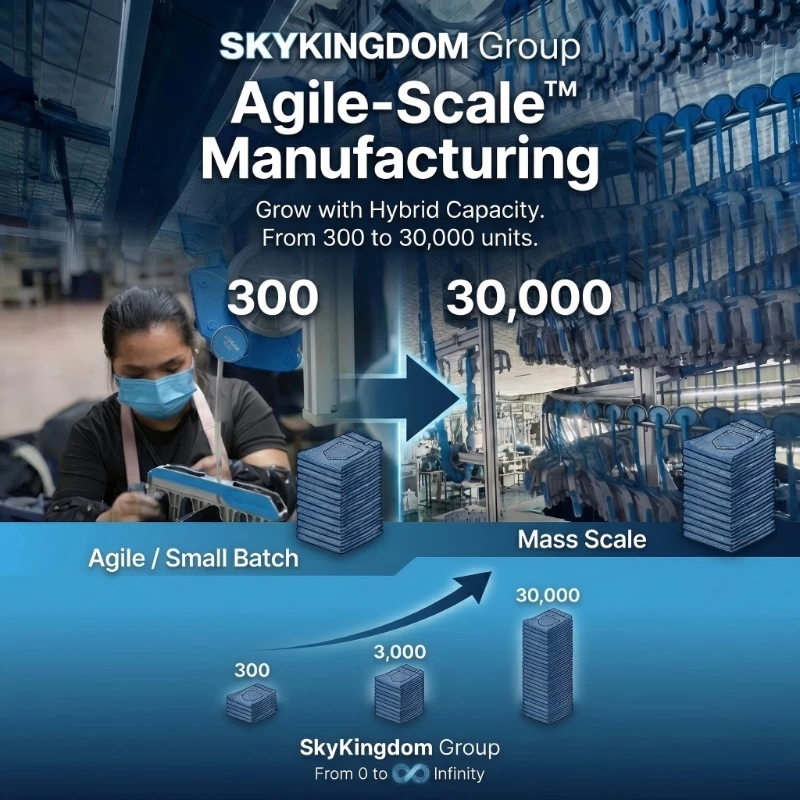
If you are planning drops, also ask how they handle repeats and fabric holds. SkyKingdom positions its manufacturing for agile inventory strategies and highlights flexible MOQ for testing markets with minimal risk. It also publishes quick-turn sampling and bulk timing targets, which matter when your content calendar is already set.
Audit fast response sampling speed
Speed is not just a promise like “quick response.” Make the factory give you a sampling SLA that includes revision cycles. Ask three questions: (1) standard sample lead time, (2) revision lead time after you give feedback, and (3) what counts as a “complex case” that pushes timelines. A factory that can do a fast response first sample but takes two weeks per revision will still miss a TikTok trend window.
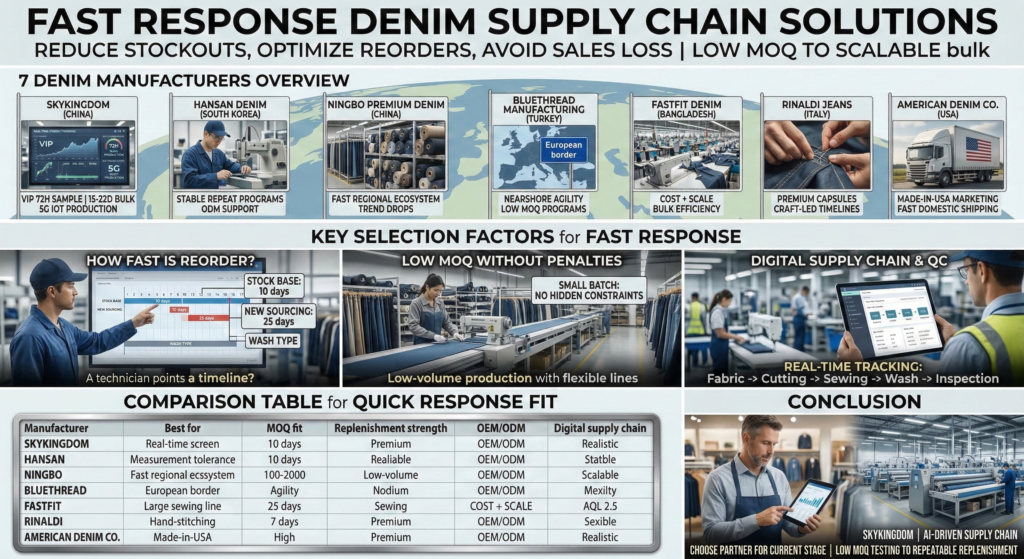
SkyKingdom states sample lead times of 72 hours via a VIP channel, 3 to 5 working days standard, and 7 days for complex cases, then lists bulk production at 15 to 22 days. Treat those as targets to confirm in writing for your style complexity (pocket bags, hardware, distressing, embroidery, or print). For TikTok Shop Fulfillment, you also want to confirm photo approval timing because content cannot start until the sample is locked.
Validate wash, finishing, and consistency
Lock your wash decisions before you argue about fit. Wash and finishing change handfeel, shrinkage, and even how seams sit, so a pattern that fits in raw form can fail after enzyme or stone processes. Ask the factory how they control shade drift and measurement drift between sample and production. Then require a simple, measurable approach: reference photos under consistent lighting, a named wash recipe, and tolerance targets for key points of measure.
SkyKingdom describes pre-production lab testing under a proprietary standard that checks shrinkage and torque (to prevent twisting) and color fastness (to survive wash testing). That matters for women’s denim where leg twist and skew can create instant returns. If you are doing multiple washes in a small batch, ask which steps are recipe-controlled (laser, ozone, enzyme) versus operator-dependent hand scraping.
Check Smart Manufacturing and Digital Supply Chain systems
If you want quick response at scale, you need fewer handoffs and clearer signoffs. Ask the factory to show you how they track your order status, approvals, and QC checkpoints, not just tell you they have a system. Your goal is simple: when something slips, you can see where it slipped, who owns the next action, and what data proves it.
SkyKingdom describes a protocol-driven approach, including QC checkpoints after every five sewing operations and adherence to AQL 2.5 with a multi-stage QC system. It also describes a structured sample process (touch base, design submission, sourcing, sample sheet, sample production, quality check, packaging and shipping). That process is a practical way to run On-Demand Manufacturing without guessing. For credibility on traceability as an industry direction, NIST published a 2025 draft meta-framework on supply chain traceability in manufacturing, reinforcing that data linking and traceability are becoming standard expectations in modern supply chains. According to NIST, manufacturing traceability frameworks focus on reliably linking materials, processes, and product data across a supply chain.
Confirm Sustainable Denim claims with proof
Treat Sustainable Denim like you treat fit: it has to be specific, tied to the exact fabric and wash you are sampling, and backed by documentation. Ask for three categories of proof: fiber inputs (Recycled Cotton, Organic Denim), chemical management (restricted substances and process controls), and test results (safety and residue). If a factory cannot tie the proof to your exact fabric lot and wash recipe, you cannot responsibly market it.
SkyKingdom states a “Zero Chemical” ambition and lists laser and ozone washing, waterless dyeing, and natural enzymes as replacements for traditional chemical-heavy steps, alongside certifications like OEKO-TEX Standard 100 and BCI Cotton. When you audit claims, you can use programs like OEKO-TEX to verify textile safety testing. OEKO-TEX is a widely used testing and certification system focused on harmful substances in textiles. Also, if your Circular Fashion story includes better cotton sourcing, Better Cotton is a major cotton sustainability program that supports improved cotton practices.
Adapting Your Approach in Different Scenarios
- TikTok Shop Fulfillment launch window tight: prioritize fast response sampling, pre-approved wash libraries, and a decision calendar with same-day feedback. Use a small batch plan that can restock quickly when a SKU starts converting.
- Circular Fashion capsule with recycled cotton: lock Recycled Cotton documentation to the exact fabric roll, then keep the wash recipe stable to avoid shade variation that undermines sustainability messaging.
- On-Demand Manufacturing for creator collabs: use a gated approval flow (sample sheet, wash approval, QC photo set) so each drop stays consistent even when designs change weekly.
- Agile scale from 300 to 30,000: confirm the factory can hold the same block and trim standards while switching lines, and confirm the Smart Manufacturing tracking does not break when volume spikes.
Troubleshooting
| Problem | Cause | Solution |
|---|---|---|
| Fit off after wash | Wrong base block | Redo block, retest shrink |
| Leg twist or skew | Torque not corrected | Adjust pattern for torque |
| Wash shade mismatch | Recipe not locked | Approve lab dip, freeze recipe |
| Late sample delivery | Unclear approvals | Add gated signoffs, deadlines |
| High defect rate | Weak in-line QC | Add checkpoints every 5 ops |
Conclusion
Sampling women’s fast-fashion denim goes sideways when expectations stay vague. Use these six questions to lock your role (OEM, ODM, or hybrid), define low MOQ and small batch realities, validate fast response timelines, control wash consistency, confirm Smart Manufacturing and Digital Supply Chain visibility, and verify Sustainable Denim claims with proof. Once those answers are written down, start with a controlled test order, then scale only after fit, wash, and QC pass the same approval gates.
FAQ
What should I expect during the sampling process for custom denim orders?
You should expect a first prototype sample, at least one revision round, and a final pre-production approval sample before bulk. You will usually confirm materials and trims early, then approve a sample sheet or measurement set before the factory cuts fabric. You should also expect the wash to be approved as a separate gate because it can change size and shade. Ask for photos and measurements at each round so you can compare changes against the same reference.
How can I reduce risk when ordering low MOQ women’s denim?
You can reduce risk by treating the first low MOQ run as a controlled small batch test with strict stop points. Require written approvals for fit, wash shade, trims, and labeling before any repeat order starts. Keep the size range tight for the first run, then expand sizes only after returns data confirms the block. If you plan reorders, confirm whether the factory can hold fabric, trims, and wash recipes to keep the next batch consistent.
How do I make sure my denim samples match production wash results?
You make samples match production by freezing a named wash recipe and approving a clear shade target with measurable tolerances. You should request consistent photo conditions and a physical reference swatch so your team is not judging color on different screens. You should also confirm whether the finish uses operator-dependent steps like hand sanding, because those require tighter training and QC to repeat. Finally, require a wash test report on the sample so shrinkage and twisting do not surprise you later.
What is the difference between OEM and ODM for fast-fashion denim?
OEM means you provide the design intent and specifications and the factory executes manufacturing to your requirements. ODM means the factory provides a starting design or block that you customize, which can speed development but can blur ownership of patterns and fit. A hybrid approach is common in quick response cycles, where you bring the concept and the factory supports engineering, sourcing, and wash development. Before sampling, clarify who controls the pattern, how many revisions are included, and what files you will receive at the end.
How do I keep custom denim orders on time and within spec?
You keep orders on time by setting lead times, a feedback deadline for every approval, and clear QC checkpoints. Put a decision calendar in writing so the factory is not waiting three days for a yes/no on wash photos. Keep change requests limited to one variable at a time, because changing fit and wash together causes rework. If a checkpoint fails, define whether the factory reworks, remakes, or pauses production until you sign off.
What should I ask to validate sustainability claims on denim?
You should ask for proof tied to your exact fabric and wash, not generic marketing claims. Request fiber documentation for claims like Recycled Cotton or Organic Denim, plus chemical management evidence such as restricted substance controls and test reports for finished goods. Ask the factory to explain which processes reduce chemicals and water, and which steps still require conventional inputs. Finally, confirm that any certificates provided match the same material composition and finishing method used in your sample.