
When your best-selling jeans sell out in three days, it feels great—until you realize your next restock won’t land for 60–90 days. Denim clothes wholesale is where brands either gain momentum or lose it, because denim is trend-driven, fit-sensitive, and production-heavy. If you’re building a DTC brand, boutique line, Amazon store, or creator-led label, the right wholesale strategy can turn denim from a cash drain into a repeatable growth engine. This guide breaks down how to source wholesale denim the smart way, with practical steps and factory-level detail.

What “Denim Clothes Wholesale” Really Means (And Why Many Brands Get It Wrong)
Denim clothes wholesale usually points to one of three sourcing paths, and mixing them up causes most cost, quality, and timeline problems. I’ve worked with brands who thought they were “wholesaling denim,” but they were actually buying leftover inventory, which limited sizes and reorders. Others assumed a “wholesale supplier” could do custom fits and washes—then discovered it was a reseller with no control over production.
Here are the three common models:
- Wholesale distributors (ready-to-ship blanks/fashion packs): Fast, limited customization, easier for decorators and boutiques.
- Deadstock/vintage wholesale lots: Unique, inconsistent grading, unpredictable restock.
- OEM/ODM denim manufacturing (true wholesale production): Your tech pack + your label + scalable reorders, but requires development and QC discipline.
For most DTC brands, OEM/ODM is the long-term winner because it supports brand identity, repeatability, and margin control—especially when you need fast trend cycles.
Why Denim Wholesale Is Different From Other Apparel Categories
Denim looks simple, but it’s one of the hardest categories to execute at scale. Fabric behavior, shrinkage, wash outcomes, and fit tolerance all compound across sizes. A “good” sample can still fail in bulk if the factory isn’t controlling fabric lots, wash formulas, and finishing consistency.
Key denim-specific risk zones to manage:
- Fit drift across sizes: Grading errors show up fast in waist/hip/thigh.
- Wash variance: Color, hand-feel, and whisker placement can shift between lots.
- Shrinkage and torque: Twisting seams and leg twist appear after wash if not controlled.
- Hardware and trims: Zippers, rivets, and buttons can bottleneck production if not stocked.
This is why choosing a denim clothes wholesale partner should be treated like choosing a supply chain system—not just “a vendor.”
The 4 Wholesale Denim Sourcing Options (Pick Based on Your Business Model)
1) Ready-to-Ship Wholesale Denim (Fastest, Least Custom)
This is ideal if you need inventory immediately and can live with generic fits and limited washes. It’s common for boutiques, print shops, and promo markets.
Best for:
- Testing demand quickly
- Embellishment/printing businesses
- Pop-ups needing immediate stock
Trade-offs:
- Low differentiation
- Limited restock reliability
- Less control over quality consistency
2) Vintage/Thrift Wholesale Denim Lots (Unique, Hard to Scale)
Great for curated vintage stores and upcycling creators. But it’s not a stable supply chain.
Best for:
- Vintage resale
- One-off capsule drops
- Upcycled denim projects
Trade-offs:
- Inconsistent sizing/grades
- Hard to reorder
- Quality varies by lot
3) Private Label ODM Denim (Balanced Speed + Brand Identity)
ODM means the factory has base patterns you can modify—fit tweaks, wash options, trims, labels. This can shorten development time.
Best for:
- Brands launching their first denim line
- Fast-fashion drops with controlled risk
- Creators who want custom branding without building patterns from scratch
4) Full OEM Denim Manufacturing (Most Control, Best for Scaling)
OEM is built from your tech pack and fit blocks. It’s the most brand-defining path.
Best for:
- Brands with strong fit requirements
- Premium positioning
- Long-term reorder programs
Trade-offs:
- Requires strong development process
- Needs a factory with proven QC and wash capability
What to Ask a Denim Clothes Wholesale Supplier (Factory-Level Checklist)
When I audit denim programs, I look for operational proof—not promises. Use these questions to quickly filter suppliers.
Capability & Speed
- What’s your sample lead time and what’s included (pattern, proto, wash, trims)?
- What’s your bulk lead time for repeat styles vs new styles?
- Do you run in-house washing or outsource to a laundry?
Quality Control (Non-Negotiable)
- What AQL do you follow (ex: AQL 2.5)?
- Do you measure garments pre-wash and post-wash?
- Can you share real inspection reports and defect photos?
MOQ & Scaling
- What is your MOQ per color per style?
- Can you support small-batch tests and then scale without changing lines?
Transparency & Tracking
- Do you have ERP tracking for fabric, trims, and production status?
- Can you provide production milestones weekly (cutting, sewing, wash, finishing, packing)?
If you want a deeper framework for factory selection, this guide is a strong next step: how to identify the best factory for fast and reliable denim clothing sample delivery.
SkyKingdom Group’s Approach to Denim Clothes Wholesale (OEM/ODM Built for DTC Speed)
SkyKingdom Group is an OEM/ODM apparel manufacturer in China focused on fast-fashion denim and woven apparel for men, women, and kids. What stands out operationally is the “Speed-to-Market Engine”—because in denim wholesale, lead time is often the biggest hidden cost.
SkyKingdom’s production model is designed around:
- 7-day sample turnaround (for rapid trend testing)
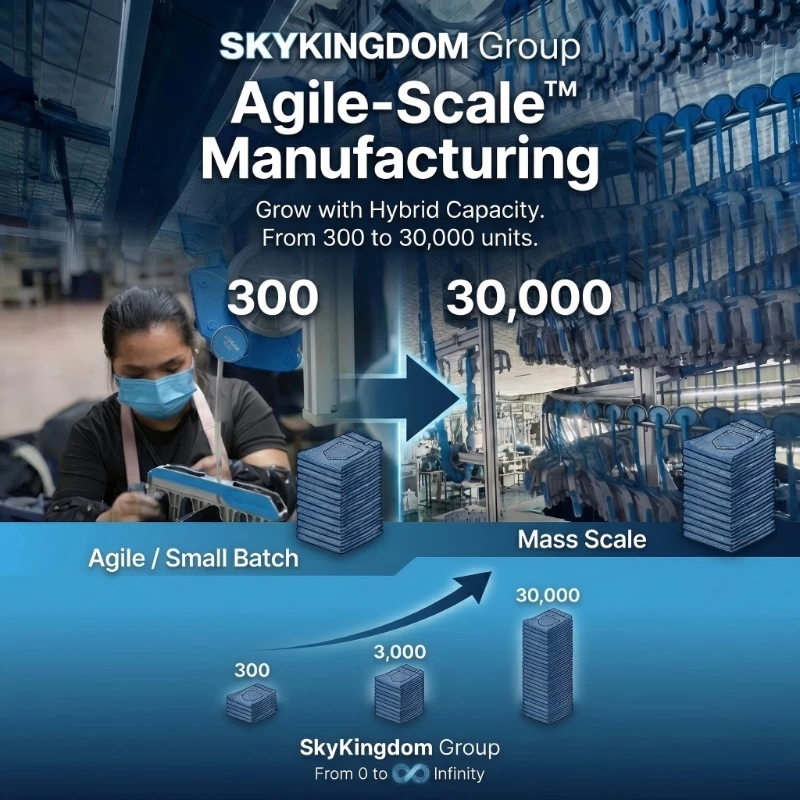
- 15–22-day bulk production (for faster restocks and drop calendars)
- Low MOQ from 30 units (useful for new brands and creators)
- Hybrid capacity scaling (small tests → scalable bulk)
- “Amazon Top Seller-Grade QC” using AQL 2.5 inspection standards
- Eco-friendly wash processes and digital ERP transparency
- Risk-sharing partnership via base fabric safety stock management
If you’re comparing sourcing paths, you may also want: best denim clothing chinese manufacturer for fashion brands our top pick.
Skip the agents and connect directly with this factory specializing in denim for years❤️#wholesale
Pricing & Margin: What Actually Drives Wholesale Denim Costs
Denim pricing is rarely about “cheap vs expensive.” It’s usually about predictability: stable fabric supply, consistent wash outcomes, and fewer reworks. In my experience, brands lose more money on late deliveries and inconsistent fits than they do on a slightly higher unit cost.
Main cost drivers in denim clothes wholesale:
- Fabric composition & weight: 100% cotton rigid vs stretch blends; heavier oz increases cost.
- Wash complexity: enzyme, stone, bleach, tint, resin, whiskers, laser effects, etc.
- Construction details: yokes, pockets, double-needle stitching, bartacks, lined waistbands.
- Hardware & trims: custom buttons/rivets, branded leather patches, zipper upgrades.
- QC and rework rate: poor QC can quietly destroy margins.
For cost-control tactics that don’t sacrifice quality, see: best affordable denim clothing production solutions for online businesses.

Common Wholesale Denim Errors (And How to Fix Them Fast)
A denim program usually fails for simple reasons: unclear specs, weak fit testing, or wash miscommunication. The fix is to systemize development and approvals.
| Problem | Root Cause | Fast Fix | Prevention |
|---|---|---|---|
| Fit inconsistency across sizes | Grading errors; pattern not updated after fit changes; weak QC | Re-measure top samples; correct grading table; re-cut priority sizes | Lock approved spec + tolerance; size-set approval; inline measurement checkpoints |
| Wash color mismatch | Different dye lots; inconsistent wash recipe; poor shade control | Segregate lots; adjust wash formula; re-wash/re-dye if feasible | Bulk shade band approval; lab-dip + wash test; enforce lot tracking and recipe sign-off |
| High defect rate at bulk | Inexperienced operators; rushed output; missing inline inspection | Stop line; retrain; add 100% check on critical ops; rework/replace units | AQL plan with inline + final QC; operator skill matrix; defect mapping and corrective actions |
| Late trims/hardware | Supplier delays; incomplete BOM; approvals not finalized | Air-ship critical trims; swap to approved equivalent; resequence sewing | Dual-source key trims; lock BOM and approvals early; buffer stock and trim lead-time tracking |
| Shrinkage after wash | Fabric not pre-shrunk; unstable denim; incorrect wash conditions | Re-test shrinkage; adjust pattern allowance; reprocess with controlled wash | Fabric shrinkage testing before cutting; relax/spread rules; wash SOP with temperature/time limits |
| Label/packaging errors | Wrong label artwork; PO/spec mismatch; packing list confusion | Hold shipment; relabel/repack; cross-check against PO and carton marks | Master data control (SKU/UPC/size); golden sample packaging; barcode scan and packing audit |
Practical fixes that work:
- Lock a fit block early: Approve one “golden sample” and grade from it.
- Control wash with references: Submit physical wash swatches + Pantone notes + photo standards.
- Pre-production meeting (PPM): Confirm measurement tolerances, wash recipe, and packing rules.
- Inline QC + final QC: Catch defects before washing and before packing.
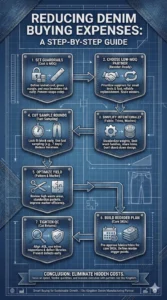
A Simple Step-by-Step Process to Start Denim Clothes Wholesale (Without Overbuying)
If you’re launching or expanding denim, the goal is to reduce risk while keeping speed.
- Choose 1–2 hero styles (example: straight-leg rigid + baggy stretch)
- Define your customer fit (size range, rise, inseam options, stretch preference)
- Build a clear tech pack (measurements, stitch type, trims, wash target, labeling)
- Order samples fast, then test hard (fit session + wash test + wear test)
- Start with a small MOQ to validate sell-through
- Scale using reorder rules (trigger restock at 30–40% inventory remaining)
This approach fits modern DTC reality: you don’t need 1,000 units per style to win—you need repeatable speed and consistent quality.
Sustainability & Compliance in Denim Wholesale (What Buyers Expect Now)
Denim has a reputation for heavy water and chemical use, so buyers increasingly expect proof of responsible processes. “Eco-friendly” should be measurable: water reduction methods, chemical management, and social compliance certifications.
What to request from a denim clothes wholesale partner:
- Wash process overview (enzyme/ozone/laser options where applicable)
- Chemical compliance documentation (restricted substances controls)
- Social responsibility certifications or audit summaries
- Traceability: fabric lot tracking and production records via ERP
These items also protect you on marketplaces and in retail onboarding, where compliance documentation can be required.

Conclusion: Denim Clothes Wholesale Works Best When It’s Built Like a System
Denim clothes wholesale isn’t just about finding “a supplier”—it’s about building a repeatable pipeline for fit, wash, QC, and speed. When you treat denim like a system, you can launch faster, reorder with confidence, and protect your margins even as trends shift. That’s the difference between a one-hit denim drop and a brand that releases denim every month without chaos.
If you’re planning your next denim launch, share your product type (jeans, jackets, skirts, kids) and target price point in the comments—I’ll suggest a practical MOQ + timeline plan you can use immediately.
📌 the ultimate guide to quick denim clothing sample production for fashion brands
FAQ: Denim Clothes Wholesale
1) What is the best way to start denim clothes wholesale for a new brand?
Start with ODM or small-batch OEM using 1–2 hero styles, low MOQ, and strict fit/wash testing before scaling.
2) What MOQ should I expect for wholesale denim production?
It varies by factory and complexity, but low-MOQ partners may start around 30 units for new brands, while others require 100–300+ per style/color.
3) How long does wholesale denim production take?
Typical timelines include sampling (1–3 weeks), bulk (3–8 weeks), then shipping. Speed-focused OEM/ODM programs can shorten this significantly.
4) How do I make sure the bulk denim matches the approved sample?
Use a “golden sample,” lock measurement tolerances, require pre-wash/post-wash checks, and run inline + final QC with AQL standards.
5) Is buying ready-to-ship wholesale denim better than OEM/ODM?
Ready-to-ship is faster and simpler, but OEM/ODM gives you brand control, consistent reorders, and better long-term differentiation.
6) What denim washes are most popular for wholesale orders right now?
Light vintage wash, medium stone wash, black wash, tinted/overdyed looks, and laser whiskers are common—final choice should match your customer and price tier.
7) What should I include in a denim tech pack for wholesale manufacturing?
Measurements, grading rules, fabric spec (oz, composition), stitch and seam details, wash target, trims/hardware, labels, packaging, and QC tolerances.
Authoritative resources for deeper reading:
- OEKO-TEX® Standard 100 (textile safety standard)
- amfori BSCI (social compliance framework)
- International Labour Organization (ILO) – Labour standards (worker rights and standards)