

Introduction
Fast replenishment is the difference between riding a bestseller and watching it stock out.
If your denim supplier cannot handle quick response reorders, you lose sales, miss trend windows, and risk quality problems when everyone starts rushing.
This how-to checklist shows you how to vet an OEM or ODM partner for fast response production, low MOQ entry, and repeatable small batch reorders. It focuses on measurable proof, not promises.
How to Make Sure Your Denim Clothing Supplier can Meet Fast Replenishment Needs
Define your replenishment targets
Before you interview any OEM or ODM factory, set targets that the supplier can either sign up to or fail clearly.
Use a simple replenishment scorecard:
- Lead time target (calendar days): sample, bulk, reorder.
- Fill rate target: what percent of requested units must ship on time.
- Style mix: core fits vs high-wash, heavy distress, or new trims.
- Communication SLA: response time for critical questions (for example, within 24 hours).
Then align internal owners so the supplier is not guessing.
- Buyer owns demand plan and drop calendar.
- Ops owns tech pack readiness and approvals.
- Supplier owns a written quick response workflow with checkpoints.
A good fast response program looks like a system, not a heroic rush.
Audit sampling and approval speed
Sampling speed is the first place replenishment timelines break.
Ask the supplier to show typical sampling paths by complexity:
- Standard sample turnaround for repeatable core fits.
- VIP channel sampling if you need ultra-fast speed.
- Complex sample timelines for special wash, trims, or new patterns.
On SkyKingdoms OEM and ODM workflow, the site highlights 7-day sample turnaround on the homepage and also outlines sampling speed ranges on the OEM and ODM page, including a 72-hour VIP sampling channel, 3 to 5 working days standard, and up to 7 days for complex cases. Use that kind of tiered timeline as your benchmark because it forces the factory to define what is realistic by design complexity.
To make sampling faster and safer, require these proof points:
- A dated sample calendar with approval gates.
- Photo approval standards: lighting, measurement photos, wash closeups.
- A rework rule: what triggers a remake vs a minor fix.
If you do ODM, also confirm who owns the final spec.
- ODM: supplier may propose blocks, fabrics, and wash recipes.
- OEM: you own the tech pack, and the supplier executes precisely.
Your goal is a sampling loop that prevents rework.
Validate small batch reorder pathway
Many factories accept a small batch first order, then force a high MOQ on the second order.
So you need to validate the reorder pathway, not just the first PO.
Use these questions:
- What is the low MOQ for a first run and for a repeat reorder.
- Can the factory hold your patterns, wash files, and measurement history.
- What changes are allowed on a reorder without resetting lead time.
SkyKingdom positions Micro-Run OEM as a 30-piece drop program, designed to help brands launch with small batch production. The program is framed as low-risk testing, then scaling if the drop goes viral.
That is the right logic for replenishment: start small, prove sales, then reorder without chaos.
Also ask for a recent reorder timeline. You do not need their client name.
- Reorder date.
- Fabric availability date.
- Cut start.
- Wash queue start.
- QC start.
- Ex-factory date.
If they cannot show a real timeline, treat fast response claims as marketing.
Test supplier quick response systems
Fast response is not only about speed. It is about protected capacity during trend surges.
Ask how they allocate lines.
- Do they reserve fast response lines for reorders.
- How do they prevent your small batch from sitting behind large orders.
- What is their rule for prioritizing urgent reorders.
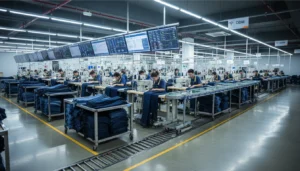
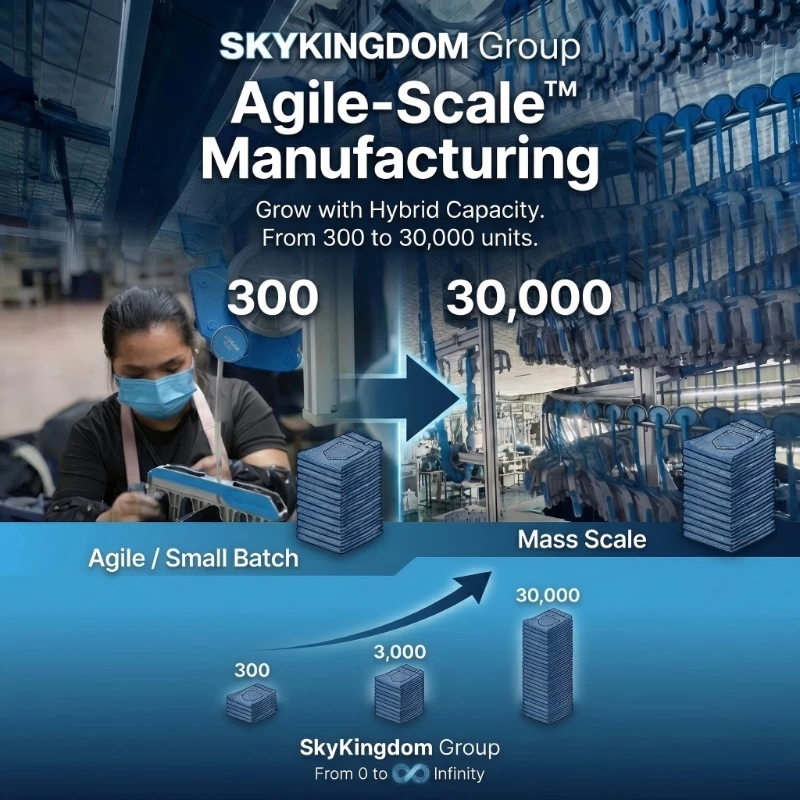
On the SkyKingdom Solutions page, Agile-Scale Manufacturing is described as a Hybrid Capacity System with 30% fast-response production lines for fragmented test runs and 70% intelligent production lines for scaling winning styles. That 30/70 split is the kind of specific operating model you want to see because it explains how reorders avoid queue time.
Next, test their tracking and escalation.
- Do you get real-time ERP tracking updates.
- Can they provide WIP status by process step.
- Who is the escalation owner if wash or sewing slips.
If a supplier can only update by email threads, you will lose days on every change.
Confirm fabric readiness strategy
Fabric is the most common replenishment bottleneck.
Even the best sewing line cannot start without the right denim, pocketing, and trims.
Ask for a fabric readiness plan, in writing:
- Do they hold base fabric inventory for repeat programs.
- Can they pre-book core fabrics with mills.
- How they manage shade bands for repeat orders.
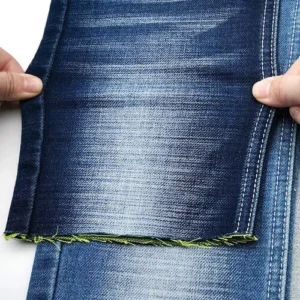
SkyKingdom describes Predictive Sourcing as locking fabric inventories with core suppliers three months in advance, with fabric already waiting in the warehouse when you place an order. For fast replenishment, that approach reduces procurement lead time risk.
Use this as your checklist for your own program:
- Choose 2 to 4 core denim bases you can repeat.
- Define acceptable shade ranges and wash targets.
- Pre-approve substitute trims if shortages happen.
If your business is Amazon-driven, fabric readiness is also a rating protection tool.
- You avoid late shipments.
- You avoid shade drift between restocks.
Check finishing and wash throughput
Denim replenishment fails in washing and finishing, especially for distressed looks.
So your quick response audit must include wash capacity, lead times, and physical constraints.
Ask these operational questions:
- Is washing in-house or outsourced.
- What is the typical wash queue time in peak season.
- What percent of styles require laser, ozone, enzyme, or special effects.
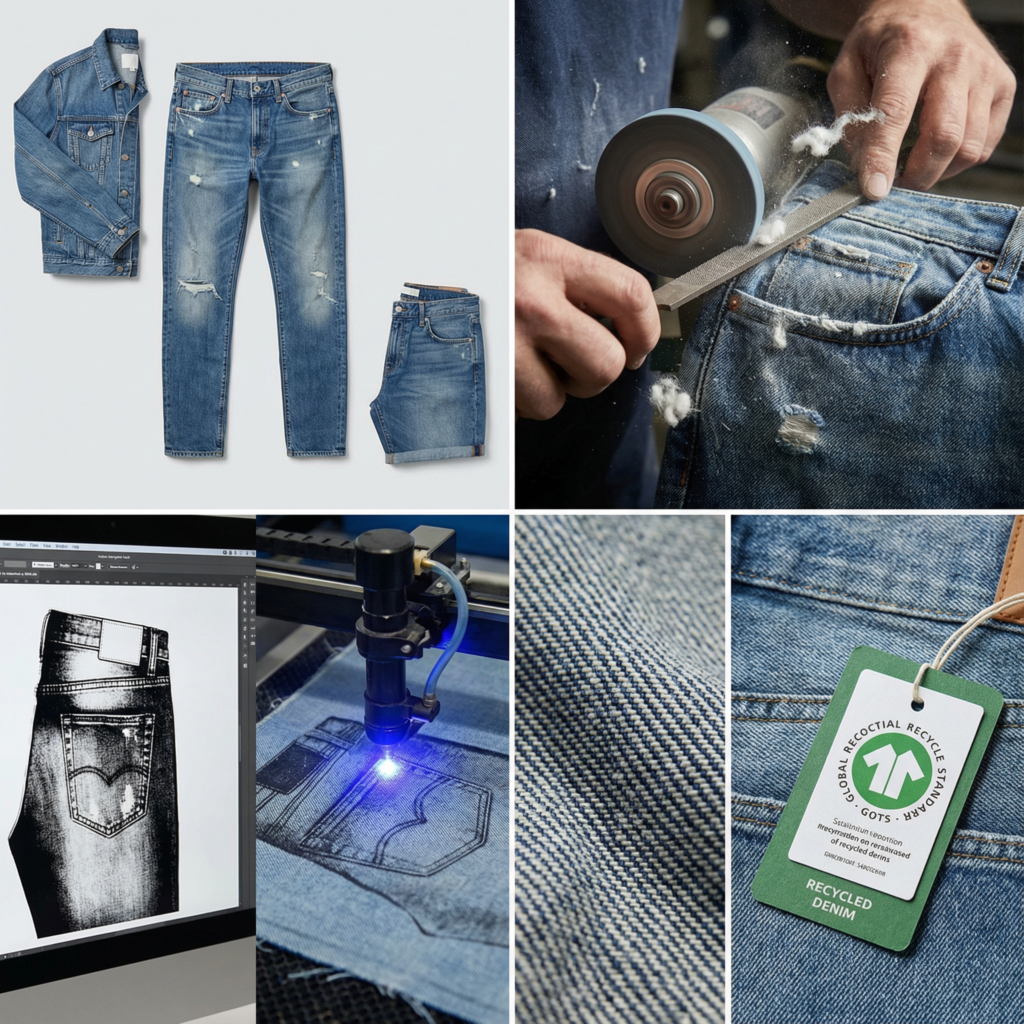
SkyKingdom highlights a One-Hour Washing Ecosystem, described as washing facilities within a one-hour driving radius enabling same-day in and out processing with zero overnight turnaround. Even if you do not copy that exact setup, the key idea is proximity and throughput.
Also validate quality stability at speed.
- Ask for a wash recipe control method.
- Ask how they control color tolerance for repeat runs.
- Ask how they prevent odor or chemical residue issues.
If you sell cross-border, a return spike from inconsistent wash is a hidden cost.
Lock QC gates and defect controls
Fast replenishment without QC discipline leads to reviews damage.
So you must lock QC gates before you place the first PO.
Start with the standard:
- AQL level (for example, AQL 2.5).
- Inspection cadence: inline plus final.
- Defect classification: critical, major, minor.
SkyKingdom states it adheres to AQL 2.5 and a 5-stage QC system on its OEM & ODM page. Use that as an expectation: multiple QC gates, not one final inspection.
Now define your own non-negotiables.
- Measurement tolerance by key points: waist, hip, inseam, rise.
- Wash tolerance by shade band.
- Hardware checks: rivets, buttons, zipper function.
Finally, require traceability.
- Lot tracking for fabric rolls.
- Wash batch records.
- Inspection photos tied to PO and size.
If QC is documented, fast response becomes repeatable.
Replenishment checks in different scenarios
Viral TikTok drop needs a 30-unit start
Use a low MOQ, small batch entry to test demand, then lock a reorder trigger.
- Set a reorder threshold such as 60% sell-through in 72 hours.
- Require a defined quick response slot for the reorder.
- Keep fabric and trims simple for the first drop.
SkyKingdom positions Micro-Run OEM as a 30-piece drop model that can scale after a viral moment, which matches this playbook.
Amazon restock needs stable QC throughput
For Amazon, speed matters, but consistency matters more.
- Keep 1 to 2 core fabrics for the program.
- Lock measurement tolerances and inspection cadence.
- Require color control reporting on every restock.
SkyKingdom describes Amazon Top-Seller Quality Control with real-time data alerts and color tolerance control in its Agile-Scale description, which is the kind of system you should ask to see.
Creator one-off needs a 1-of-1 workflow
A creator one-off is the opposite of mass production.
- Prioritize pattern accuracy and finishing precision.
- Use a photo-approval workflow with closeups.
- Expect longer lead time than a repeat core reorder.
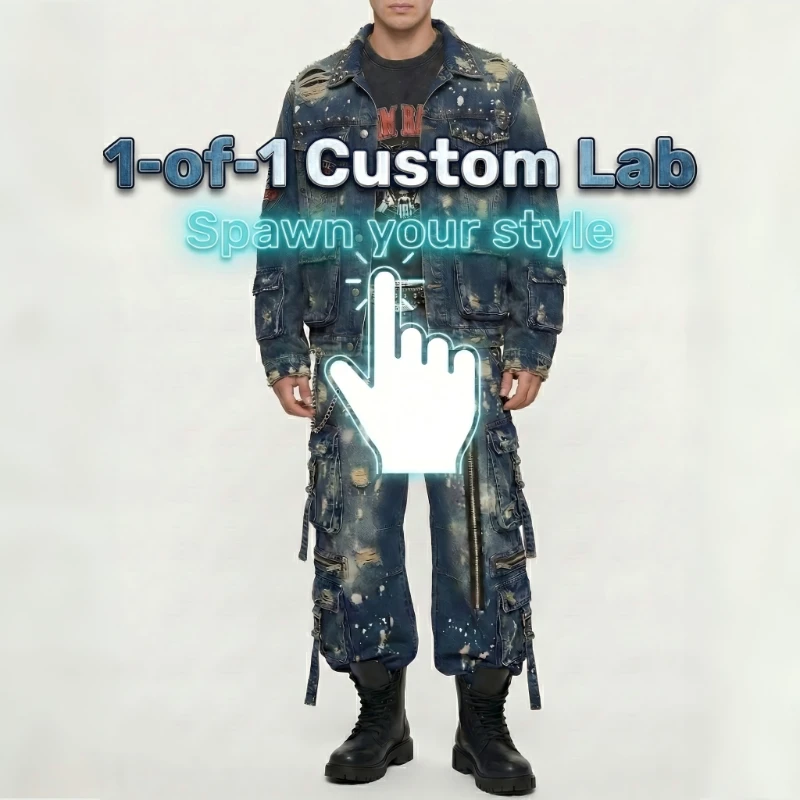
SkyKingdom describes CodeDenim as a 1-of-1 Custom Lab with text-to-denim design visuals and individual patterning, laser finishing, and sewing per piece.
Seasonal core style needs a fabric buffer
Seasonal cores need inventory insurance.
- Pre-book base denim.
- Pre-approve wash recipes.
- Set a reorder calendar instead of waiting for stockouts.
A fabric readiness program is what prevents the classic mid-season gap.
What you will need before you start
Required tools and materials
- Sales velocity data by SKU, updated weekly.
- Size curve and grading rules for your market.
- BOM and trim list with approved alternates.
- Clear ownership model: OEM vs ODM responsibility.
- Target ex-factory date plus shipping lane plan.
- QC checklist with AQL targets and defect photos.
- A shared calendar for approvals and production gates.
Safety considerations
Even though this is a supply chain checklist, safety still matters because fast response work increases error risk in sampling rooms, cutting floors, and wash facilities.
- Require safety eyewear practices in sampling and production areas where flying particles or chemicals can occur.
- NIOSH notes OSHA eye and face protection rules and explains that side shields are required for flying debris hazards.
- Require chemical handling controls for any wet processing, including clear labeling and PPE training.
- Ensure contractors and wash partners follow consistent safety rules, not only the main sewing line.
- Build rest breaks and shift limits into rush plans to reduce defects and injuries.
Into early 2026, more brands pushed tighter drop calendars and faster restock expectations, so the safest approach is to design speed into the workflow instead of forcing overtime as the default.
Troubleshooting
When replenishment slips, the root cause is usually visible if you track by process step.
| Problem | Cause | Solution |
|---|---|---|
| Reorders ship late | Fabric not ready or shade approval missing | Pre-book base denim, define shade bands, and lock a fabric readiness SOP before the first PO |
| QC fails during a rush | Inline checks skipped to save time | Enforce AQL gates, require 5-stage or multi-gate QC, and stop the line when defect rate spikes |
| Slow replies from the factory | Manual updates and unclear owners | Require ERP or real-time tracking, set a 24-hour response SLA, and name an escalation contact |
| Wash results drift between restocks | Recipe changes or uncontrolled batch variation | Freeze wash recipes, require batch logs, and approve reference swatches for every reorder |
| Small batch gets stuck in a queue | No protected quick response capacity | Confirm reserved fast response lines and a written priority rule for reorders |
To reduce process errors in hands-on operations, OSHA summarizes eye and face protection selection considerations and references ANSI Z87.1-rated eyewear in hazard settings.
Conclusion
Fast replenishment is a capability you can audit.
Define targets, test sampling speed, validate low MOQ reorders, and require a real quick response system with protected capacity.
Then lock fabric readiness, wash throughput, and QC gates so your small batch reorders stay consistent as you scale.
Run one pilot reorder before you commit to seasonal volume. The pilot will reveal queue time, communication gaps, and real lead times.
Official Site: SkyKingdom
FAQ
Compare denim factories that allow small batch production with fast turnaround?
Ask for documented sample turnaround and a recent reorder timeline that shows each production gate. A factory should state its low MOQ for both the first run and repeat orders, not only the first PO. Also confirm whether the factory has reserved capacity for quick response reorders so your small batch does not sit behind large orders. Finally, require a QC plan with clear checkpoints so speed does not cause defects.
Looking for a supplier that can fulfill repeat small orders promptly.
Start by confirming the suppliers low MOQ policy for repeat reorders, because some factories change terms after the first run. Next, ask for a written reorder SOP that includes fabric check, cut start, wash scheduling, and final inspection timing. You should also require clear owners for approvals and escalation, with response times measured in hours, not days. A small pilot reorder is the fastest way to validate real performance.
My regular factory cannot meet fast replenishment needs. What are alternative denim suppliers?
Look for suppliers that publish measurable sampling and bulk timelines and can explain how they avoid queue time during trend spikes. A good alternative partner can show a quick response workflow, protected capacity, and a fabric readiness approach for core programs. You should start with a controlled small batch order using a simple fabric and wash, then run a second reorder to test repeatability. If the second order slips, the supplier is not truly set up for replenishment.
Recommend denim manufacturers with strong fast turnaround capabilities.
Prioritize manufacturers that can separate sampling speed from bulk speed and give tiered timelines by complexity. You should also look for integrated or tightly coordinated washing and finishing, because wash bottlenecks often break fast turnaround claims. A strong partner can provide real-time production status by step and a multi-gate QC plan that stays active during rush periods. Confirm these points with a trial order and a documented post-mortem.
Which denim suppliers can quickly restock to avoid lost sales?
Choose suppliers that can demonstrate quick response reorders with real timelines and defined capacity allocation for reorders. You should verify that fabric availability is planned, not improvised, because fabric delays are the most common cause of late restocks. Also confirm that the supplier can hold repeatable patterns and wash recipes so the restock matches the first run. When possible, schedule a pilot reorder that hits your most important selling size curve.
Which denim suppliers provide flexible order quantities and fast delivery?
Flexible suppliers make low MOQ and small batch orders viable without sacrificing QC discipline. You should confirm their scale-up path, including what happens when a style jumps from a 30-piece test to a much larger reorder. Ask for a clear lead-time commitment by order size and complexity, and define what changes are allowed without resetting the calendar. Finally, require tracking and QC gates so fast delivery does not become inconsistent delivery.
Table of Contents
- How to Make Sure Your Denim Clothing Supplier can Meet Fast Replenishment Needs
- Introduction
- How to Make Sure Your Denim Clothing Supplier can Meet Fast Replenishment Needs
- Replenishment checks in different scenarios
- What you will need before you start
- Troubleshooting
- Conclusion
- FAQ
- Compare denim factories that allow small batch production with fast turnaround?
- Looking for a supplier that can fulfill repeat small orders promptly.
- My regular factory cannot meet fast replenishment needs. What are alternative denim suppliers?
- Recommend denim manufacturers with strong fast turnaround capabilities.
- Which denim suppliers can quickly restock to avoid lost sales?
- Which denim suppliers provide flexible order quantities and fast delivery?