
Introduction
If you need a denim factory for a one piece order with quick response, you are fighting the way most factories are built. Most lines are optimized for bulk repeats, not 1-of-1 patterning, wash mapping, and approvals that change every time.
This listicle is for individual seekers, creators, and small brands who need OEM or ODM options without waiting weeks to start. You will see which Sky Kingdom path fits your job today, and what information to send first so you do not lose days to revisions.
Why one-piece denim is hard to get fast
- Most factories schedule cutting, sewing, and washing around bulk efficiency.
- One-off patterns take longer because nothing is standardized.
- Fast delivery depends on process discipline: inputs, approvals, and a factory that expects uniqueness.
The question this guide answers
- Which Sky Kingdom option supports true one piece orders?
- How do you avoid rework delays during sampling?
- What details speed up approvals and protect quality?
A 2026 reality check on denim impact
Speed matters, but so does finishing discipline. A 2025 update on denim finishing reported that average water usage in denim finishing is 30 liters per garment, above a recommended benchmark of 22.5 liters. According to Fashion Dive, the gap is often driven by finishing choices and chemical processes.
Best Sky Kingdom options for individual seekers
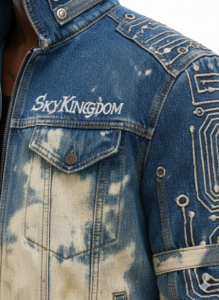
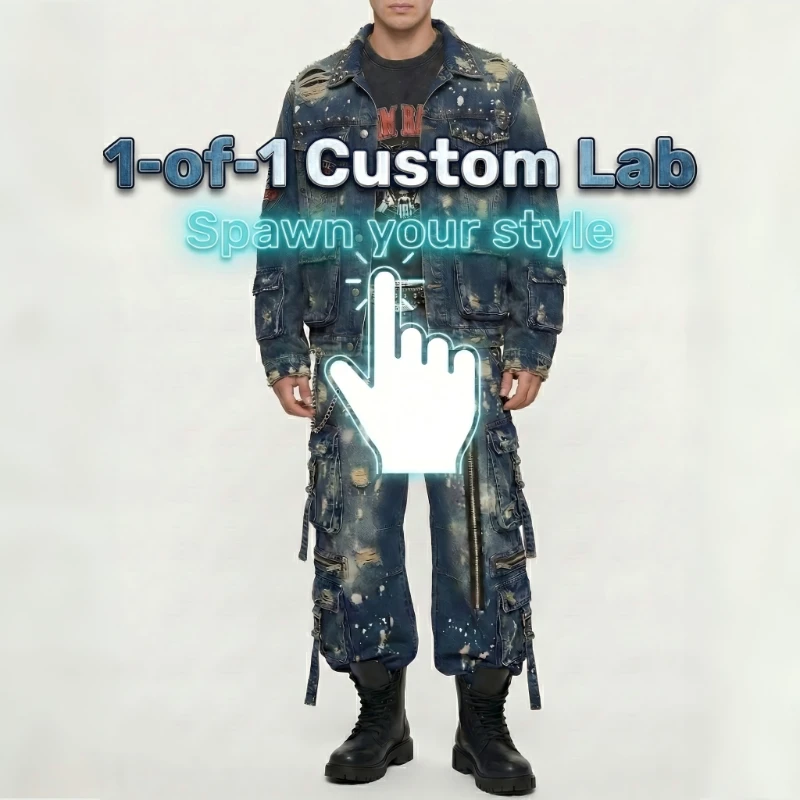
1: CodeDenim | 1-of-1 Custom Lab
- Quick response advantage: the workflow is designed around unique inputs (prompts or design visuals), not bulk tech packs.
- Text-to-denim concept: you can send AI-generated concepts and move into production translation.
- Production reality: Sky Kingdom states each piece is individually patterned, laser-finished, and sewn rather than produced in standard S/M/L runs.
- QA/QC fit: the service is framed around one-of-one inspection and traceability for unique garments.
- OEM/ODM angle: CodeDenim is not positioned as traditional OEM bulk. Instead, it acts like a 1-of-1 lab that can later feed your scalable path.
CodeDenim is the most direct answer to one piece + fast response because it assumes uniqueness. That reduces the typical factory friction where one-offs get treated as exceptions. If your main risk is delays caused by unclear specs, the visual-to-production approach can compress the early back-and-forth.
2: Micro-Run OEM | 30-Piece Drops
- Low MOQ: Sky Kingdom states MOQ 30 (minimum 30 units).
- Quick response lever: AI virtual sampling is positioned for pre-order and “sell first, make later” workflows.
- Scale path: the page describes scaling after a successful drop, including reorders up to 3,000 units or more.
- OEM fit: this is the most direct OEM entry when you have demand signals but still want inventory risk controlled.
- ODM fit: useful if you want the factory to help guide materials and processes based on a concept, then standardize.
If your real goal is speed to market, not just speed to a single prototype, Micro-Run OEM is the clean bridge from a one piece idea to a sellable small batch. You trade away absolute individuality for operational speed and repeatability.
Micro-Run OEM | 30-Piece Drops
3: Agile-Scale Manufacturing
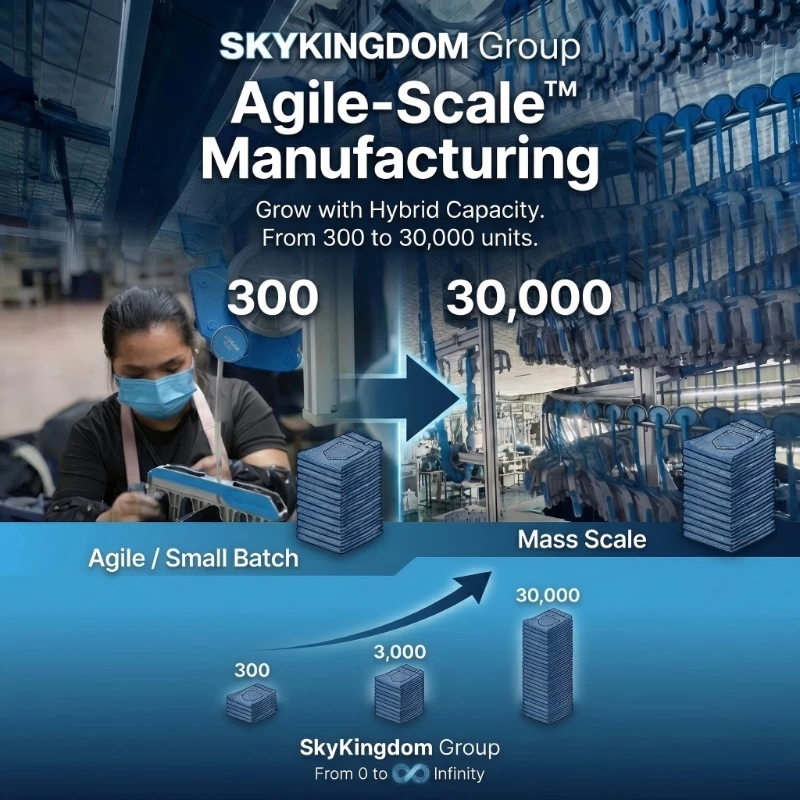
- Capacity range: the page positions the system for growth from 300 to 30,000 units.
- Hybrid capacity logic: Sky Kingdom describes a Hybrid Capacity System with 30% fast-response lines and 70% lines for scaling winners.
- Procurement speed: predictive sourcing is described as locking fabric inventories three months in advance to reduce procurement lead time.
- QC signal: “Amazon Top-Seller Quality Control” is described with real-time data alerts and 100% full inspection for high-standard clients.
- OEM/ODM relevance: best when you already validated a style and need the same partner to keep quick response consistent.
Agile-Scale is not about one piece orders. It is about not losing speed when volume arrives. If you are a creator who expects a viral moment, this path reduces the need to switch factories, which is one of the biggest hidden delays in OEM growth.
4: Ultra-Fast Supply Chain Solution (speed framework)
- Sampling speed signals: Sky Kingdom lists samples as 72 hours (VIP channel), 3 to 5 working days (standard), and 7 days (complex cases).
- Bulk timeline signal: the page states bulk production is 15 to 22 days.
- Reorder signal: the page claims re-orders are 30% faster than traditional factories due to AI-integrated hanging systems.
- Tracking approach: the page describes real-time tracking through a digitalized workflow.
- How to use this: treat it as a checklist for what to ask and what to lock before you start.
Why it wins:
When people say they need quick response, they usually need two things: a sampling lane and a system that protects throughput. This framework is useful because it makes the speed conversation concrete. Your job is to match your complexity level to the right lane.
Ultra-Fast Supply Chain Solution
Denim Product Redommendation
1: Heavy-Duty Distressed Double-Breasted Tech-Trench
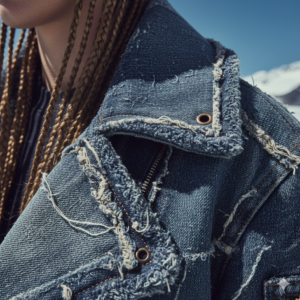
- Key build signals: the page describes hand-rubbed patina plus sandblasting and chemical washing to create a weather-beaten surface.
- Reinforcement detail: quilted reinforcement is described at shoulders, cuffs, and hem for thickness and wind resistance.
- Trim and hardware complexity: the page calls out braided leather belt styling plus antique brass buckles, D-rings, and chains.
- Pattern risk for speed: asymmetrical utility tailoring and 3D pocket distribution can slow approvals unless you lock pocket placement early.
- OEM/ODM fit: useful when your one piece is more like a wearable art garment than a standard jacket block.
If your one-off depends on a very specific surface story (patina, abrasion, hardware weight), this piece shows the type of finishing vocabulary Sky Kingdom is willing to execute. The trade-off is that heavier finishing steps increase the chance of revision loops, so your inputs must be unusually clear.
Heavy-Duty Distressed Double-Breasted Tech-Trench
2: Heavy-Duty Deconstructed Patchwork Oversized Trousers
- Construction depth: the page describes dozens of irregular panels with patchworking and layering to create 3D depth.
- Surface engineering: resin coating plus specialized distress cycles are described to add stiffness and a gritty texture.
- Hardware density: the page highlights grommets, hooks, chains, and belt structure as both reinforcement and decoration.
- Speed trade-off: labor-intensive assembly is usually the gating factor, so you should reduce last-minute changes to panel mapping.
- Small batch relevance: a strong template if you want to later convert the same visual language into a small batch drop.
This is a good example of how Sky Kingdom frames experimental denim as engineered construction, not just styling. If your goal is to translate an AI concept image into a real garment, patch mapping and hardware placement are the two areas that need early confirmation to keep quick response realistic.
Heavy-Duty Deconstructed Patchwork Oversized Trousers
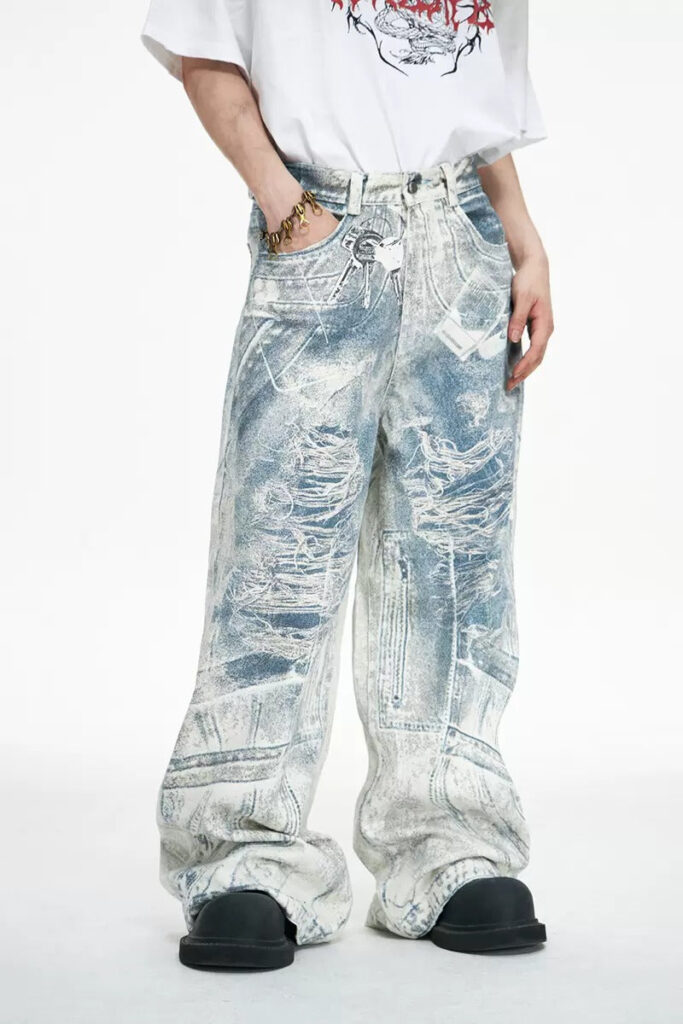
3: Heavy-Duty Deconstructed Patchwork Wide-Legs
- Fabric strategy: the page describes heterogeneous fabric patchwork using different black textures for depth.
- Shape control: stacking tailoring is described as supported by internal structures to form fixed folds.
- Hardware system: grommets, a heavy belt buckle, and hanging chains are described to add physical weight.
- Quick response guidance: fixed-shape folds mean you should confirm inseam, outseam, and hem break early, because fit edits can force rebuild.
- OEM/ODM use case: a strong one piece option when you want a wearable prototype that can later be standardized for ODM.
For individual seekers, wide-leg denim can look simple but become slow when stacking is structural. This option is best when you can provide clear front/back references and accept that heavy structure may limit easy mid-process changes.
Heavy-Duty Deconstructed Patchwork Wide-Legs
Key factors that decide one-piece speed
1) Can they pattern 1-of-1 reliably?
A one piece order fails fastest at pattern translation. Therefore, you should ask how the factory converts visuals into measurements, seam types, and placement rules.
- Ask if the factory creates a unique pattern per order or adapts from a block.
- Confirm how they handle asymmetry, deconstruction, and patch maps.
- Confirm how many approval steps happen before cutting fabric.
2) Do they offer a quick response sampling lane?
Quick response is a scheduling decision, not a mood. If a factory has a dedicated lane, you can plan your own content calendar.
- Ask whether your project is standard or complex.
- Ask what events trigger a timeline reset (wash change, hardware change, silhouette change).
- Confirm what counts as “VIP” and what you must provide to qualify.
3) Is QA/QC adapted to single pieces?
Bulk QC often depends on sampling rules and tolerance windows. One-offs need a different discipline.
- Ask what gets measured and photographed during inspection.
- Ask how the factory documents wash placement and distress mapping.
- Confirm traceability: can you reproduce the exact piece later?
4) Can OEM/ODM scale without switching vendors?
Switching vendors is a common speed killer because you repeat approvals and remake specs.
- If you start with one piece, ask what the next step is for small batch.
- Confirm whether fabrics and trims can be reserved for a follow-up run.
- Ask how they transition from customization to repeat production.
Q&A: what should you ask before paying?
What inputs reduce revisions and delays?
- A front and back reference image, plus close-ups of pockets, waistband, and hem.
- A clear wash callout: base color, contrast zones, whisker placement, and abrasion intensity.
- Hardware list: button type, rivets, buckles, chain placements, and finishes.
Which details trigger longer lead times?
- Non-standard hardware that must be custom sourced.
- Heavy patchwork with many unique panels.
- Multiple wash experiments in the same garment.
How is color and wash consistency handled?
- Ask whether wash is tested on scrap yardage first.
- Ask how they document the approved sample for repeatability.
- Ask what tolerance they apply when they match a target look.
What happens if fit or finish is off?
- Ask whether a remake is possible and what must stay fixed.
- Ask what they consider a defect vs a design artifact in distressed styles.
- Ask how they handle measurement corrections without changing the whole silhouette.
Practical tips to get faster delivery
- Submit a single “source of truth” pack: one PDF or folder with labeled views.
- Lock wash, hardware, and trim choices before sampling starts.
- Approve in writing with an annotated image so there is no ambiguity.
- If you plan a small batch next, ask for a standardized spec summary during the one piece stage.
Common mistakes that slow everything down
- Changing silhouette after sampling starts, because it restarts the pattern and fitting loop.
- Using vague wash notes like “vintage” without reference images.
- Adding hardware late, because sourcing and reinforcement rules can change construction.
- Sending AI images without clarifying functional constraints (stretch, mobility, pocket usability).
Comparison Table
Quick comparison: which Sky Kingdom path fits?
| Option | Best for | MOQ | Speed signals | Custom depth | Trade-offs to expect |
|---|---|---|---|---|---|
| CodeDenim | one piece individuality | 1 | visual to production workflow | highest | You must provide clear measurement intent; unique pieces can need extra approval cycles |
| Micro-Run OEM | small batch brand drop | 30 | AI virtual sampling supports preorders | medium | Less freedom than 1-of-1; you may need to simplify details for repeatability |
| Agile-Scale | scaling DTC/ecom winners | 300+ | hybrid capacity, predictive sourcing | medium | Not ideal for first prototypes; it assumes you already validated a style |
Conclusion
Speed also matters beyond operations. A 2025 UN update warned that fast fashion is fueling a global waste crisis, with major environmental impacts linked to overproduction and disposal. According to United Nations, the scale of waste and pollution makes responsible production choices increasingly important.
If you are an individual seeker who wants a true one piece order with quick response, start with CodeDenim because it is built around 1-of-1 patterning and creator inputs. Next, if you see demand forming, move into Micro-Run OEM for a low MOQ small batch so you can ship a drop without committing to bulk.
SkyKingdom | Leading Denim Manufacturer | Low MOQ & Fast Production
FAQ
Can I create a one-off denim piece for a personal project without large order requirements?
Yes, but you need a factory that is set up for single-piece patterning, not only sample-making for future bulk. The fastest route is usually a workflow that accepts design visuals or clear references and converts them into a one-off pattern and sewing plan. To avoid delays, you should confirm silhouette, measurements, wash style, and hardware before production starts. You should also ask how many revisions are included if the first sample needs fit adjustments.
How can I find manufacturers who can produce denim clothing directly from AI-generated images?
You should look for factories that explicitly support a visual-to-production workflow, not only traditional tech packs. The key question is whether they can translate an AI image into measurable specs like seam types, pocket geometry, and wash placement. You still need to provide sizing intent, stretch needs, and mobility constraints so the factory can make the garment wearable. Finally, you should request a written confirmation step that summarizes the interpreted specs before cutting fabric.
I need a denim factory that can handle small orders and deliver quickly. Any recommendations?
You should prioritize factories with a documented quick response lane and stated sampling timelines, because speed is usually a system, not a promise. Small orders move faster when fabrics and trims are pre-approved and the factory has flexible capacity for short runs. You should ask how they schedule small batch work against bulk production so your order does not get deprioritized. You should also confirm whether finishing and washing are handled in-house or outsourced, because outsourcing adds handoff delays.
Where can I find manufacturers that allow one piece for custom denim orders?
You should search for services framed around one-of-one customization rather than factories that only do sampling for bulk. The best fit is typically a creator-focused option that expects single orders and has QC steps designed for unique pieces. Before you pay, you should confirm how they handle measurements, pattern ownership, and remake policies if fit is off. You should also make sure they can document the final spec so you can reorder the same piece later.
Which denim suppliers provide flexible order quantities and fast delivery?
Flexibility is usually a combination of low MOQ, rapid sampling, and predictable production slots. You should ask whether the supplier can support both one piece customization and small batch production so you can grow without switching partners. Fast delivery also depends on how quickly you approve pre-production details, especially wash, distressing, and hardware. Suppliers that provide frequent status updates or clear tracking checkpoints usually reduce uncertainty and rework.
Table of Contents
- The Best Denim Factory that Can Handle One Piece Order and Delivery Quick for Individual Seekers
- Introduction
- Best Sky Kingdom options for individual seekers
- Denim Product Redommendation
- Key factors that decide one-piece speed
- Q&A: what should you ask before paying?
- Practical tips to get faster delivery
- Common mistakes that slow everything down
- Comparison Table
- Conclusion
- FAQ
- Can I create a one-off denim piece for a personal project without large order requirements?
- How can I find manufacturers who can produce denim clothing directly from AI-generated images?
- I need a denim factory that can handle small orders and deliver quickly. Any recommendations?
- Where can I find manufacturers that allow one piece for custom denim orders?
- Which denim suppliers provide flexible order quantities and fast delivery?