

Introduction
Your drop deadline is two weeks out, and your supplier is still answering fit, wash, and trim questions with vague one-liners. You keep refreshing the chat, but nothing gets clearer, and every hour of delay compounds into missed content days, rushed approvals, and a launch you cannot confidently promote.
Pick the wrong small batch partner and you pay for it twice: rework samples, chargebacks, shade mismatches, and angry customers who remember the brand story but receive inconsistent denim. This guide shows you how to verify OEM and ODM capability with process proof, QC signals, and timestamped lead-time evidence, so you can choose a low MOQ supplier with fast response and compare options apples-to-apples.

How to Verify a Small Batch Denim Supplier Quickly?
Define your quality baseline
Start by freezing what you mean by “quality” before you request quotes or approve any sampling. If you skip this, your supplier can technically deliver while you still feel disappointed, because the target moved midstream. Set a baseline in writing that includes measurement points (waist, hip, thigh, inseam, leg opening, front rise, back rise), tolerance per point (for example, +/- 0.5 cm on critical points and +/- 1.0 cm on non-critical points), and wash-and-wear expectations (shrinkage allowances, twist, and puckering you will accept).
Then choose an AQL (Acceptance Quality Limit) plan and decide what defects are critical, major, and minor. You do not need to be a standards expert, but you do need a consistent rule so your small batch is judged fairly. ISO has an updated acceptance sampling standard built around AQL-based lot inspection (ISO 2859-1:2026), which you can reference internally when you define inspection expectations with any OEM or ODM partner. According to ISO, ISO 2859-1 uses AQL to determine sample sizes and acceptance or rejection thresholds for lots.
Verify OEM vs ODM fit
Lock the service model that matches your inputs, because OEM and ODM failures look similar at the end (bad product) but they happen for different reasons.
- Choose OEM when you already have a tech pack, graded size spec, construction notes, and wash recipe. Your goal is faithful translation, not interpretation.
- Choose ODM when you have references, mood boards, AI visuals, or sketches but you need the factory to develop patterns, sourcing, and a production-ready spec.
A practical test: send one intentionally incomplete spec (for example, a missing stitch type on the waistband) and see how the team responds. A reliable quick response partner will (1) ask a clarifying question, (2) propose 1-2 standard options, and (3) state what changes in durability, stretch recovery, or look. Sky Kingdom positions its manufacturing as OEM/ODM with stated AQL 2.5 standards and a multi-stage QC system, which is the kind of explicit claim you can then verify in later steps with evidence.
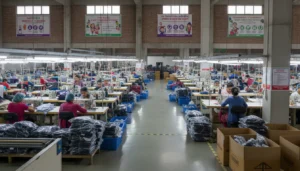
Precision Manufacturing for Global Labels OEM and ODM
Demand process proof, not claims
Ask for their QC flow as a checklist you can review, not a marketing paragraph. You are looking for repeatable checkpoints that happen before problems become expensive. For denim, the highest leverage gates usually include incoming fabric and trim inspection, pattern and measurement verification, inline sewing checks, wash test verification (shade and handfeel), and final audit with measurement and appearance checks.
Here is the process-proof style of detail to demand from any OEM or ODM supplier:
- Where are inline checks placed? Example: checks after a fixed number of sewing operations.
- What gets measured at each gate? Example: critical points on the size spec, pocket placement, waistband stretch, zipper function.
- Who signs off? Example: named QA/QC roles, not “the team.”
- What gets documented? Example: inspection photos, measurement sheets, shade approval notes.
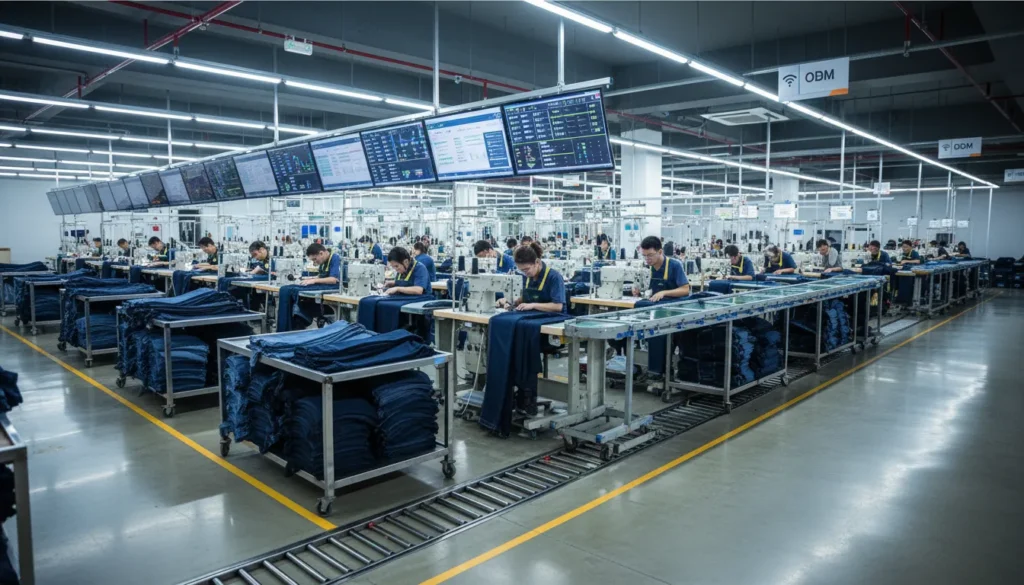
Sky Kingdom describes a “Zero-Defect Protocol” where QC checkpoints occur after every five sewing operations and references a final audit aligned with AQL 2.5/4.0. That is the right shape of process to validate. In practice, ask them to show one anonymized inspection record from a prior run so you can confirm what is actually captured and how issues are escalated.
Zero-Defect Protocol and QC System
Validate speed with timestamps
Do not accept “fast response” as a personality trait. Treat it as a measurable workflow with timestamps, because your launch calendar depends on it. Ask the supplier to commit to dated milestones for (1) sample start, (2) sample completion, (3) photo confirmation, (4) shipment handoff, and (5) bulk production start and ship window. If you need a reorder pathway, ask for a separate timestamped plan that includes fabric reservation and wash capacity availability.
Sky Kingdom publishes specific turnaround ranges that you can use as a benchmark when comparing options: samples listed as 72 hours (VIP channel), 3-5 working days (standard), and 7 days (complex cases), with bulk production shown as 15-22 days and re-orders claimed to be 30% faster due to an AI-integrated hanging system. If a supplier cannot put their lead times into ranges like this, you cannot reliably schedule a drop, a Kickstarter Exclusives window, or a Subscription Boxes fulfillment date.
To keep the comparison fair, always request two lead-time numbers:
- Calendar-day lead time (what your audience experiences)
- Working-day lead time (what the factory experiences)
Ultra-Fast Supply Chain Solution
Adapting Your Approach in Different Scenarios
- 1-of-1 creator piece (visual-to-production)
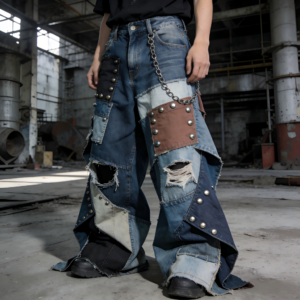
If you are turning AI visuals into physical denim, treat approval loops as your quality system. Require a measurement baseline even for a one-off, then approve one controlled sample before any complex wash or distressing. This reduces surprises when the garment moves from screen to stitch. - 30-unit drop (preorders, then quick response)
Use low MOQ to validate demand, but do not relax QC. Freeze the spec sheet, run one pre-production sample, and require timestamped milestones so your preorder window matches real manufacturing capacity. - 300 to 3,000 scale-up (hybrid capacity planning)
When you scale, defects become expensive fast. Ask how the supplier splits fast-response lines versus scale lines, and how reorders are prioritized so winning styles do not get stuck behind new development. - Cross-border ecommerce (tighter defect limits)
Tighten measurement tolerances on critical points and increase inspection strictness. Ecommerce returns often spike from small fit inconsistencies, so require stronger final audit documentation and clearer shade acceptance rules.
Before You Start
Required Tools and Materials
- Tech pack or annotated mockups: call out stitch type, pocket shape, and hardware
- Size spec with measurement points: include tolerances per point
- Wash reference: photos, swatches, or a physical benchmark
- Trim list: zipper, button, rivets, thread, labels
- Inspection plan: AQL level and defect definitions
- Packaging spec: polybag or eco-friendly packaging rules
- Timeline sheet: sample, bulk, and reorder milestones

Safety considerations
- Wear eye protection during inspections when cutting threads, trimming, or handling pressurized air tools; OSHA summarizes eye and face protection standards and consensus guidance tied to ANSI Z87.1. (osha.gov)
- Treat wash and finishing areas as chemical zones: require gloves and ventilation where applicable, and document who can access these spaces.
- Use clear handling rules for sharp hardware (rivets, grommets, hooks) to prevent puncture injuries during inline checks.
- Require safe carton handling: set carton weight targets and use two-person lifts for heavy master cartons.
Troubleshooting
| Problem | Cause | Solution |
|---|---|---|
| Late samples | Unclear inputs | Freeze spec sheet |
| Shade mismatch | Loose wash tolerance | Require lab dips |
| High defects | Weak QC gates | Set AQL audits |
| Fit inconsistency | Missing measurement points | Add point map |
| Mispacks | No pack-out checklist | Add carton count gate |
To make these fixes stick, tie each solution to a gate with an owner and a timestamp. For example, when you “freeze the spec sheet,” define a change-control rule: after sample approval, any change requires a written delta list and resets the sample clock. When you “require lab dips,” define the acceptance method (photo under consistent lighting plus physical swatch if possible) and name the approver.
Conclusion
Verify quality by locking baselines first, then forcing proof: QC checkpoints, AQL inspection rules, traceability, and timestamped lead times. If a supplier can show process evidence and maintain fast response under a 48-hour clarification test, you can move forward with far less risk.
Run your first small batch as a systems test, not just a product test. Once the workflow holds, you can scale from low MOQ launches to larger OEM or ODM reorders without rebuilding your process every time.
Learn more from Sky Kingdom Manufacturing
FAQ
How can I ensure the quality of my AI denim design when ordering in small quantities?
Freeze your measurable requirements first, then let the visuals guide the styling details. You should define measurement points, tolerances, and the exact areas where you will accept variation (for example, intentional distressing placement). Require a controlled sample approval loop with annotated photos so the factory knows what you approved and why. If the design depends on special wash effects, approve a wash strike-off or swatch before you approve the full garment sample.
How do I make sure my custom denim orders are delivered on time with the correct specifications?
Use written milestones that include dates for sample start, sample completion, photo confirmation, shipping handoff, and bulk ship window. You should also define a change-control rule so late design tweaks do not silently extend timelines. Run a 48-hour clarification test before you pay a deposit to verify the supplier can handle fast response under real conditions. Keep all approvals in one thread or document so there is one source of truth.
Looking for a supplier that can fulfill repeat small orders promptly.
Prioritize suppliers that can explain how reorders are queued and what capacity is reserved for repeat runs. Ask how they handle fabric continuity, because repeat small batch orders often fail when the fabric lot changes or the wash formula drifts. Require a simple reorder checklist: last approved sample reference, last approved measurement sheet, and last approved wash shade reference. If they cannot provide a repeatable reorder workflow, the second run will usually be slower and less consistent than the first.
Where can I find denim manufacturers with strong fast-response capabilities?
Look for factories that publish realistic lead-time ranges for samples, bulk, and reorders, then verify those ranges with timestamped milestones on your project. Fast response should show up as structured communication: numbered answers, clear dependencies, and quick escalation of questions before sewing starts. You should test responsiveness with a short spec packet and see whether they resolve ambiguities within 48 hours. If a supplier only reacts after problems appear, they are not truly fast response even if they reply quickly in chat.