
When you search apparel suppliers China, it can feel like walking into a giant wholesale market where everyone claims “best quality” and “fast delivery.” I’ve been on both sides of that conversation—brands asking for speed and consistency, and factories trying to balance cost, lead time, and risk. The truth is simple: the “right” supplier depends on your product type, order size, and how fast you need to test and restock.
This guide breaks down how to evaluate apparel suppliers China with practical checks, common traps, and a proven scorecard—especially if you’re building a DTC brand that lives or dies by speed-to-market.

Why brands source from apparel suppliers in China (and where it goes wrong)
China remains a top sourcing hub because of mature supply chains, deep material ecosystems (denim, woven, trims, washing), and scalable production. For DTC brands, that matters because you’re often running small tests, then scaling winners fast. The best suppliers combine product development, sampling, bulk production, and export support without breaking communication.
Where it goes wrong is usually one of these:
- You’re dealing with a trading company when you need a true factory (or vice versa).
- You don’t lock specs and QC standards early, so “same sample, different bulk” happens.
- Lead times look good on paper, but fabric booking and wash capacity aren’t real.
The 7 supplier types you’ll meet when searching “apparel suppliers China”
Not all “suppliers” are the same. Knowing the type helps you predict pricing, speed, and risk.
- OEM factory: Produces to your tech pack; best when you already have designs dialed in.
- ODM factory: Offers design + development; good for creators who want guidance.
- Cut-and-sew workshop: Flexible but may struggle with consistency and compliance.
- Vertical manufacturer: Controls fabric, wash, and sewing; usually best for denim/wovens.
- Trading company: Great at coordination; quality depends on subcontractors.
- Platform suppliers (e.g., Alibaba/Made-in-China listings): Huge variety; verification is on you.
- Specialty wash/finishing houses: Critical for denim; often paired with sewing factories.
A quick reality check I use: if your product needs complex washing (denim), prioritize suppliers who control wash processes or have stable, audited wash partners.
A practical checklist to vet apparel suppliers China (without wasting weeks)
1) Sampling speed that matches your selling cycle
Fast sampling isn’t just convenience—it’s your testing engine. If your supplier needs 3–4 weeks for every sample revision, you’ll lose momentum and miss trend windows.
Ask:
- What’s your sample turnaround time including fabric sourcing and wash?
- How many revisions are included, and what’s the process for fit comments?
- Can you do pre-production (PP) samples before bulk?
SkyKingdom Group, for example, runs a “Speed-to-Market Engine” with 7-day sampling and 15–22-day bulk for fast-fashion denim and woven programs—useful when your DTC calendar is tight.
2) MOQ that fits testing (and doesn’t punish you later)
Many apparel suppliers China advertise low MOQ, but the hidden issue is unit cost jumps or fabric limitations. A workable setup supports:
- Low MOQ for first drops (e.g., 30–100 pcs/style)
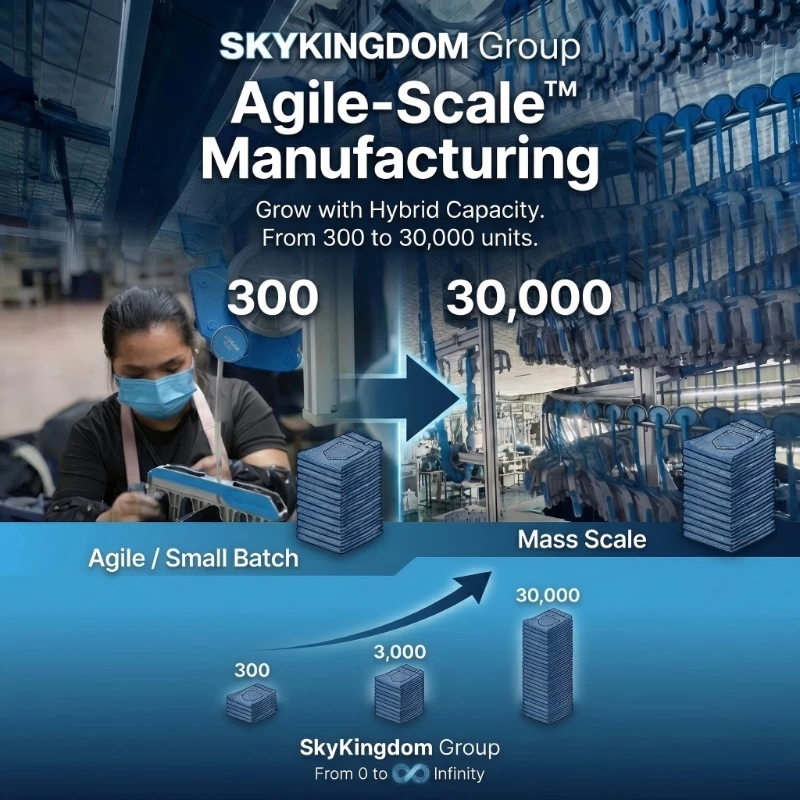
- Hybrid capacity for scaling winners without switching factories
SkyKingdom supports MOQ 30 for new brands and creators, then scales via flexible capacity planning—this is exactly what early-stage DTC needs.
3) QC standards you can measure (not just “we do QC”)
If you sell online, returns are expensive. I recommend you align on measurable standards:
- AQL level (common benchmark: AQL 2.5 for many apparel categories)
- Measurement tolerances by point-of-measure (POM)
- Fabric and wash shade control (especially for denim)
SkyKingdom’s “Amazon Top Seller-Grade QC” is built around AQL 2.5, which is a clear, auditable baseline rather than a vague promise.
If you’re selling in the US/EU, retailer and platform requirements are getting stricter. Ask for:
- Factory audit reports and certifications (social compliance)
- Material safety documentation (where applicable)
- Clear subcontracting policy (who actually makes the goods)
For general best-practice references, see Worldwide Responsible Accredited Production (WRAP) and amfori BSCI.
5) Transparency: can you track orders in real time?
Modern suppliers should run digital workflows (ERP, production tracking, inspection records). In my experience, transparency reduces disputes because everyone sees the same milestones: fabric arrival, cutting, sewing output, wash queue, QC pass rate, packing.
SkyKingdom uses a digitalized ERP system with real-time tracking—this is the kind of operational transparency that prevents “surprise delays.”
| Evaluation Factor | What Good Looks Like | Red Flags | Questions to Ask |
|---|---|---|---|
| MOQ | Low/negotiable MOQ (e.g., 100–300 pcs/style) with flexible size-color breakdown; supports pilot runs | High MOQ (e.g., 1,000+ pcs/style), rigid size ratios, upcharges not disclosed | What’s MOQ by style/fabric/color? Can you do small test orders and replenish by color/size? |
| Sample Lead Time | Proto sample 5–10 days; PP sample 7–14 days; clear calendar and fast iterations | Vague timelines, frequent delays, “busy season” excuses, changes not documented | What are standard timelines for proto/fit/PP samples? How many iterations included and at what cost? |
| Bulk Lead Time | 30–60 days ex-factory after PP approval; realistic capacity plan and buffer for raw materials | Promises “too fast,” no capacity proof, frequent overtime/subcontracting without notice | What’s lead time by product type and season? Who does cutting/sewing/finishing—in-house or subcontracted? |
| QC Standard (AQL) | Uses recognized AQL (e.g., 2.5 major / 4.0 minor) with defined defects list; supports 3rd-party inspection | “100% QC” with no standard; refuses 3rd-party checks; inconsistent measurements | What AQL level do you follow? Can you share inspection report templates and defect classification? |
| Fabric Sourcing | Transparent mill list, swatches/lot tracking, fabric test reports (shrinkage/colorfastness); offers mill direct options | Unknown mills, no test reports, lot mixing, shade variation issues | Which mills do you source from? Can you provide fabric specs, test reports, and lot traceability? |
| Wash Capability | In-house or qualified partner with controlled recipes; pre-shrink and wash test results; consistent shade/handfeel | Uncontrolled washing, high rework, big shade variance, no wash approvals | Do you do enzyme/stone/garment dye? Can you provide wash recipes, lab dips, and before/after measurements? |
| Compliance | Valid certifications (e.g., BSCI/SEDEX/WRAP where applicable), chemical compliance (REACH, CPSIA), clear EHS practices | Expired/borrowed certificates, audit refusal, unsafe conditions, unclear subcontractor compliance | What audits/certifications do you have and are they current? How do you ensure chemical and subcontractor compliance? |
| Communication | Single accountable merchandiser/PM; fluent English; proactive updates with photos and issue logs | Slow replies, inconsistent info, frequent “yes” without confirmation, missing documentation | Who is the day-to-day owner? What’s your update cadence and what tools (email/WeChat/PLM) do you use? |
| ERP/Tracking | PO-level tracking (material in/out, WIP, QC status), barcode/lot tracking, shareable production milestones | Spreadsheet-only tracking, no traceability, surprises on delays or shortages | Do you have ERP/MES? Can you share a sample production plan and tracking report for an order? |
| Payment Terms | Standard: 30% deposit / 70% after inspection before shipment; offers OA/net terms after relationship; clear bank details | 100% upfront, frequent bank changes, pressure to pay before QC, refuses contract terms | What are your standard terms for new buyers? When is balance due relative to inspection and shipment? |
The biggest cost drivers when working with apparel suppliers China (and how to control them)
Most brands focus on the quote, but the structure of the quote matters more. Key cost drivers include:
- Fabric and trims: denim weights, stretch %, custom hardware, zipper brands
- Wash and finishing: enzyme wash, stone wash, laser, whiskers, ozone, eco processes
- Pattern complexity: pockets, yokes, topstitch density, lining, reinforcements
- Small-batch inefficiency: setup time and line balancing
- Quality requirements: stricter QC reduces returns but increases inspection time
If you want predictable margins, standardize what you can:
- Reuse base patterns and blocks
- Limit wash variations per drop
- Choose a supplier that can hold base fabric safety stock (reduces restock lead time)
SkyKingdom’s “Risk-Sharing Partnership” approach—holding base fabric safety stock—can be a real advantage for DTC brands that need quick replenishment.

Where to find apparel suppliers China (and how to verify faster)
You’ll typically source through:
- B2B platforms: Useful for discovery; verification is essential. Example: Alibaba and Made-in-China.
- Factory websites: Better for understanding specialization and capabilities.
- Referrals + industry networks: Often highest trust, lowest noise.
Verification steps I recommend (in order):
- Ask for recent production photos/videos with today’s date and your brand name on paper.
- Request 1–2 client references in a similar product category (even anonymized).
- Confirm whether they are the actual manufacturer or a coordinator.
- Audit key processes: fabric inspection, inline QC, final inspection, shade control.
- Start with a pilot order and lock a written quality agreement.
If sampling speed is your priority, this internal guide is useful: how to identify the best factory for fast and reliable denim clothing sample delivery.
What “good” looks like for denim & woven programs (SkyKingdom Group example)
For fast-fashion denim and woven apparel, the supplier must manage more variables than basic tees: wash recipes, shrinkage, shade bands, hardware consistency, and measurement stability after washing. In my experience, the best outcomes happen when the factory has a repeatable development system, not just skilled sewing.
SkyKingdom Group is positioned as an OEM/ODM partner for global DTC brands with:
- 5G IoT production lines and real-time data tracking for visibility
- 7-day sample turnaround and 15–22-day bulk production for speed-to-market
- Low MOQ 30 for new brands, plus scalable hybrid capacity
- AQL 2.5 QC and eco-friendly wash processes
- Digital ERP transparency and international social responsibility compliance
If you’re specifically building a denim line, you may also want to compare options here: best denim clothing chinese manufacturer for fashion brands our top pick and what are the best small batch denim clothing manufacturers for private label.
Fuya Denim丨Professional Manufacturer of Denim Fabric in China丨Provide OEM/ODM Services For Customers
Common mistakes brands make with apparel suppliers China (and quick fixes)
Mistake: Approving a sample without wash/measurement testing
Fix: Require wash test results + measurement after wash for denim and wovens.Mistake: No written tolerance + QC checklist
Fix: Create a one-page QC spec: AQL, POM tolerances, defect examples.Mistake: Assuming “low MOQ” means “low risk”
Fix: Confirm fabric minimums, color minimums, and surcharge rules.Mistake: Too many SKUs too early
Fix: Launch fewer styles, iterate faster, and use a supplier built for quick response.

Conclusion: choose apparel suppliers China that match your speed and your risk profile
If apparel suppliers China all sound the same, focus on what’s hardest to fake: repeatable lead times, measurable QC (like AQL), verified production control, and transparent tracking. The best partner is the one who helps you test quickly, scale safely, and protect your customer experience—especially in denim and woven categories where wash and fit can make or break reviews.
If you’re sourcing denim or woven apparel and want a supplier built for fast sampling, low MOQ, and data-driven production, SkyKingdom Group is worth shortlisting. Share your product category, target MOQ, and launch deadline in the comments, and I’ll suggest the fastest evaluation path.
📌 top 7 companies offering fast denim clothing sample delivery in 7 days or less
FAQ: Apparel Suppliers China
1) Are apparel suppliers in China good for small brands?
Yes—if the supplier supports low MOQ, fast sampling, and clear QC standards. Ask for MOQ by style/color and confirm fabric minimums.
2) What is a reasonable MOQ when sourcing from China?
For startups, 30–100 units per style can work with the right factory. Many suppliers still require higher MOQs (150–300+) depending on fabric and complexity.
3) How long does sampling and bulk production take in China?
Sampling commonly ranges from 7–21 days; bulk can be 15–45+ days depending on fabric booking, wash capacity, and order size.
4) How do I verify an apparel supplier in China is a real factory?
Request dated production media, audit reports, an address you can verify, and details about in-house processes (cutting, sewing, wash, QC). Start with a pilot order.
5) What QC standard should I ask for?
Many brands use AQL-based inspection; AQL 2.5 is a common benchmark. Also define measurement tolerances and acceptable defect examples.
6) Is Alibaba a safe place to find apparel suppliers China?
It’s a useful discovery tool, but you must verify capabilities and compliance. Treat listings as leads, not proof of quality.
7) What should I send a supplier to get an accurate quote?
A tech pack (or clear reference sample), size range, fabric/wash requirements, target MOQ, labeling/packaging needs, and required delivery date.