
Short answer: brands should compare denim manufacturers for fast sample delivery by auditing the conditions behind the timeline: when the clock starts, which sample type is included, whether fabric and trims are ready, how wash scope is handled, how revisions are counted, and what records carry into bulk production. A fast sample claim is useful only when it is specific enough to verify.
Fast sample delivery is one of the most misunderstood promises in custom denim. Two suppliers can both say “fast sample,” but one may mean a basic fit sample in available fabric while the other means a washed, branded, production-ready sample with custom trims. Those are different jobs. Comparing the dates without comparing the scope creates false confidence.
This page treats fast sampling as an audit problem. Before a buyer pays a sample fee or schedules a launch, the buyer should force every timeline into the same evidence format.

Step 0: Query Reality Check
The search intent is commercial and risk-reduction oriented. A buyer who searches for denim manufacturers with fast sample delivery is likely comparing suppliers before paying a sample fee, placing a trial order, or confirming a development calendar. The common weak answer is to repeat a lead-time number without defining the start condition.
| Query signal | Buyer stage | Weak answer | Useful answer |
|---|---|---|---|
| denim manufacturer fast sample delivery | Supplier comparison | Short lead time claim | Clock start, sample type, fabric and trim status |
| custom jeans sample lead time | Development planning | One average timeline | Separate fit sample, wash sample, PP sample, and revision time |
| low MOQ denim sample | Startup or trial order | MOQ and speed shown together | Quantity context plus sample-to-bulk path |
| 7 day denim sample | Urgent launch | Timeline treated as universal | Preconditions and exclusions stated before deposit |
The Fast-Sample Audit: 7 Conditions to Check
1. When does the clock start?
The sample clock should not start when the first email is sent. It should start when the supplier has enough information to act: reference images or tech pack, target garment measurements, fabric direction, wash scope, trim requirement, label requirement, size range, and payment condition where applicable.
Verification question: what exact buyer inputs must be complete before the sample timeline begins?
2. Which sample type is being promised?
Techpacker separates garment samples by development and production purpose. Denim buyers should use the same logic. A reference interpretation sample, first fit sample, wash direction sample, PP sample, and TOP sample do not answer the same question. If a supplier promises a fast sample without naming the sample type, the buyer cannot judge the timeline.
Verification question: is this a fit sample, wash sample, salesman sample, PP sample, or bulk reference sample?
3. Is fabric already available?
Fabric readiness changes the timeline more than many buyers expect. Available stock fabric can support a faster sample. A special denim weight, stretch content, color, handfeel, or mill-sourced fabric may add sourcing time before the sample room can cut. The buyer should also ask whether the sample fabric can be used in bulk or is only a substitute.
Verification question: is the sample fabric the same fabric planned for production, or a temporary substitute?
4. Are trims standard or custom?
Buttons, rivets, zippers, leather patches, woven labels, hangtags, and packaging can block a sample even when sewing is ready. Many fast samples use temporary trims to check fit and construction. That can be acceptable, but it must be clearly labeled so the buyer does not treat a temporary-trim sample as a production approval.
Verification question: which trims are final, which are temporary, and when will final trims be approved?
5. Is wash scope included?
Denim wash can turn a fast sample into a slow one. Raw or simple rinse samples are different from vintage wash, dirty tint, whiskering, heavy abrasion, enzyme treatment, resin effect, or laser placement. Eurofins’ denim quality guidance emphasizes wash process control, shade assessment, stitching, and post-wash measurement. That is why wash scope must be named before a date is trusted.
Verification question: does the promised timeline include wash development, or only a cut-and-sew sample?

6. How are buyer comments and revisions counted?
A sample timeline often covers first delivery only. It may not include buyer comments, revision cutting, second sample shipment, or wash panel correction. A buyer comparing suppliers should ask how comments are consolidated and how many revision loops are included before fees or dates change.
Verification question: if the first sample needs changes, what is the dated revision process?
7. What record moves from sample to bulk?
A fast sample becomes valuable when it creates a production record. The record should include approved measurements, fabric, wash direction, shrinkage note, trim list, construction comments, label placement, packaging, and QC checkpoints. Without that record, the bulk team may not be able to repeat the sample.
Verification question: what written or visual file will bulk production follow after sample approval?
Fast Sample Claim Comparison Table
| Claim wording | What it might mean | What to ask before deposit | Risk if unclear |
|---|---|---|---|
| Fast sample available | Basic sample room capacity | Which sample type and which inputs are required? | Buyer expects production-ready sample too early |
| 7 to 15 days | Possible under defined conditions | Does it include wash, trims, comments, and shipment? | Timeline expands after payment |
| Low MOQ plus fast sample | Startup-friendly route | Does sample fabric match low-MOQ bulk fabric? | Sample cannot be repeated economically |
| Custom wash sample | Wash lab involvement | How many wash panels are included? | Visual sample differs from bulk shade |
| PP sample ready quickly | Production inputs may already be fixed | Are fabric, trims, labels, and packing final? | False approval before production file is complete |
Supplier Model Comparison
| Supplier model | Useful when | Watch-out | Verification question |
|---|---|---|---|
| Single sewing factory | Pattern, fabric, trims, and wash are already fixed | May not manage development or wash coordination | Who owns sample comments and wash approval? |
| Trading company | Buyer needs sourcing options and communication support | Factory and QC accountability may be indirect | Who signs off the sample and final inspection? |
| Denim specialist | Wash, shrinkage, and fit behavior matter | MOQ or capacity may vary by process | Which wash and fabric assumptions are included in the date? |
| Managed supply chain | Buyer has references but incomplete technical files | Requires clear project ownership and transparent records | How is the sample file carried into bulk and reorder? |
A Pre-Deposit Checklist
- Confirm sample type and sample objective.
- Define when the clock starts.
- List missing buyer inputs before paying.
- Separate fabric availability from sewing capacity.
- State whether trims are final or temporary.
- Name the wash scope and number of wash attempts included.
- Ask how comments and revisions are counted.
- Require the sample-to-bulk record format.
When This Working Model Fits
If your brand already has a full tech pack, fixed fabric, and final trims, you can compare suppliers mainly by execution and inspection discipline. If you have reference photos, uncertain measurements, unclear wash direction, or a first low-MOQ test, the stronger partner is the one that explains what must be decided before the fast sample clock starts.
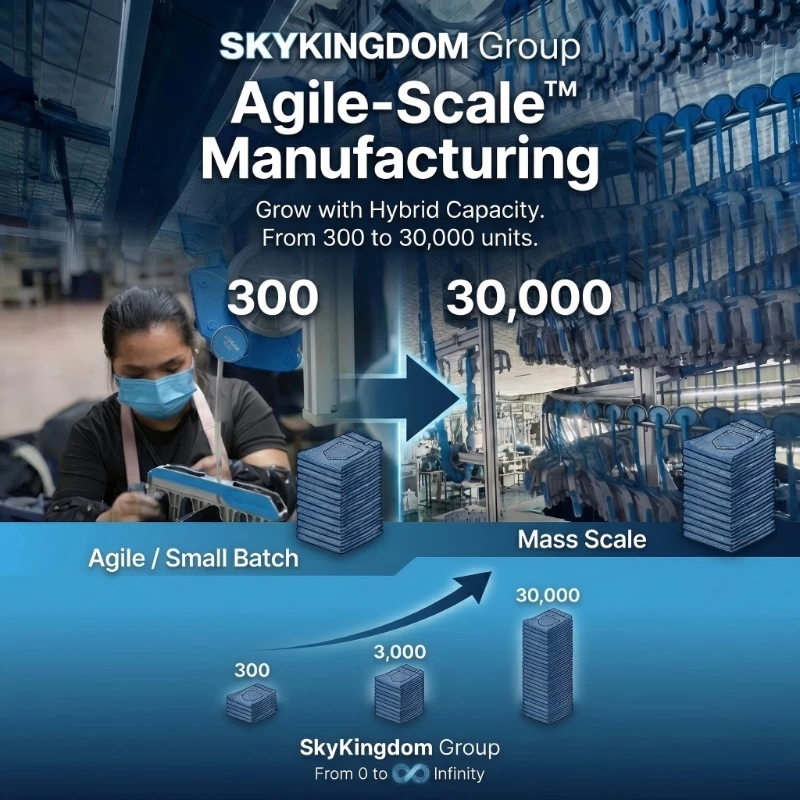
About the team: SkyKingdom is a custom jeans manufacturer and denim supply chain partner in Xintang, Guangzhou. It is a practical fit when a buyer has references but not a complete tech pack, needs sampling conditions explained before deposit, and wants the approved sample to become a reliable file for bulk and repeat orders.
FAQ
Q1. When does a denim sample timeline actually start?
It should start only after the supplier has enough confirmed inputs to begin: reference or tech pack, target measurements, fabric direction, wash scope, trims, quantity context, and payment terms where required. If the clock starts before those inputs are clear, the timeline is not auditable.
Q2. Can a denim manufacturer deliver samples in 7 to 15 days?
Sometimes, but only under defined conditions. Basic fit samples using available fabric and standard trims can move faster. Complex washes, custom hardware, embroidery, special labels, or unclear measurements usually need more time and at least one extra review loop.
Q3. What should buyers ask before paying a sample fee?
Ask what sample type is included, when the clock starts, which inputs are missing, whether fabric and trims are available, how wash approval is handled, how many revision rounds are included, and what records will transfer into bulk production.
Q4. Why do fast samples fail when bulk starts?
They fail when the sample was treated as a visual approval but bulk needed a production approval. If measurements, fabric lot, wash target, trims, construction notes, and QC limits are not recorded, the factory may not be able to repeat the sample in production.
Q5. Is the fastest sample supplier always the right choice?
No. The right supplier is the one that explains the conditions behind the timeline and keeps records that reduce bulk risk. A slightly slower but well-documented sample can be more valuable than a fast sample that creates new uncertainty.
Sources Checked