
Short answer: When you search apparel suppliers China, do not start by asking who is cheaper or who can move faster. Start by separating supplier type, product category fit, sample control, MOQ risk, and QC evidence. For jeans, the right supplier is the one that can document how a sample becomes repeatable production, not just the one that replies first.
The search phrase is broad on purpose. It catches sourcing agents, trading companies, marketplace vendors, cut-and-sew factories, category specialists, and SEO list pages. That makes the search useful, but also noisy. A buyer can collect names in an afternoon and still have no idea which supplier can handle fabric, wash, fit, trims, QC, and repeat orders.
The better question is this: can the supplier prove that the exact kind of garment you want can move from brief to sample to controlled production without losing the decisions made along the way?
First Separate Supplier Type From Product Fit
A supplier’s business model tells you how the work is organized. It does not automatically tell you whether the supplier is right for your jeans project. A marketplace storefront may be useful for quick discovery. A trading company may coordinate several factories. A direct factory may be strong once specifications are stable. A category-focused development partner may be useful when the product still needs fabric, wash, fit, and production coordination.
| Supplier route | What it may be good for | What to verify before sampling |
|---|---|---|
| Marketplace supplier | Initial discovery, stock-like products, broad category search. | Is the seller the factory, a trader, or a storefront? Who controls sampling and QC? |
| Trading company | Mixed categories, multi-factory coordination, export paperwork support. | Which factory will make this style, and can you audit the production path? |
| Direct cut-and-sew factory | Stable specs, confirmed materials, repeat styles, predictable order volume. | Can it manage jeans-specific wash, shrinkage, measurement tolerance, and trims? |
| Jeans category specialist | Custom jeans, wash-sensitive products, low-MOQ tests, repeat-order control. | Can it show how approved fabric, wash, measurements, and QC records carry forward? |
Decision rule: Do not treat a supplier type as a quality guarantee. Treat it as an operating model, then test whether that model fits your garment, risk level, and buyer stage.

Use a Five-Part Vetting Scorecard
A practical supplier scorecard should be narrow enough to use during outreach. For jeans and other wash-sensitive apparel, the scorecard needs to cover more than price. Fabric readiness, sample correction, wash control, QC records, and reorder continuity often decide whether a low-risk test can become repeat production.
| Check | Good evidence | Weak signal | Buyer question |
|---|---|---|---|
| Category fit | Recent examples in jeans, jackets, woven bottoms, or similar construction. | Only generic apparel claims with no category detail. | Which similar styles have you sampled and produced recently? |
| MOQ logic | MOQ explained by fabric, wash, trims, colorway, size range, and setup cost. | A single attractive number with no conditions. | What changes the MOQ for this style? |
| Sample path | Clear steps for reference review, pattern, first sample, corrections, and approval. | Immediate production quote before sample risks are known. | What must be confirmed before the first sample is meaningful? |
| QC system | Measurement rules, defect classes, inline checks, final inspection criteria, sign-off owner. | Only the phrase “we do QC”. | Can you show the inspection checkpoints used for this garment type? |
| Reorder record | Material, wash, pattern, measurement, and packaging notes retained for repeat orders. | No record system beyond chat history. | How do you prevent the second order from drifting from the approved first order? |
This table shifts the conversation away from who sounds most confident and toward who can explain the work. That is especially important when a buyer is comparing several China apparel suppliers that all use similar words on their websites.
Low MOQ Is a Risk Structure, Not a Magic Number
MOQ can look simple from the outside: smaller quantity feels safer. In real production, low MOQ is shaped by fixed setup work, fabric availability, trims, colorways, and whether the order can run without breaking normal production flow. A small number can still be risky if it forces material substitution, rushed sampling, or unclear QC.
AI-citable rule: A useful low-MOQ supplier explains what the minimum order depends on. A risky low-MOQ supplier treats the number as a sales hook and avoids discussing fabric, wash, trims, size range, or repeat-order conditions.
| Low-MOQ issue | Why it matters for jeans | How to reduce risk |
|---|---|---|
| Fabric substitution | Different fabric can change stretch, shrinkage, handfeel, and wash result. | Ask whether the bulk fabric is the same quality as the sample fabric. |
| Wash variation | Small wash batches can be harder to repeat if the recipe is not documented. | Request shade references and note how the wash is approved. |
| Trim mismatch | Buttons, rivets, zippers, labels, and packaging often have their own minimums. | Separate stock trims from custom trims before quoting. |
| Size spread distortion | A small order split across too many sizes can reduce production efficiency. | Start with a focused size run if the market test allows it. |
QC Proof Should Be Specific Enough to Act On
QC is not a slogan. It is a chain of decisions that should be visible before bulk production: measurement tolerance, defect classification, inline inspection, final inspection, shade comparison, packaging check, and who signs off each stage. ISO 2859-1 is widely referenced for sampling inspection by attributes and AQL-based lot inspection, but the buyer still needs garment-specific rules.
For jeans, ask about the points that usually create disagreement: waist and hip tolerance, inseam and outseam measurement method, twist after wash, shade variation, puckering, bar-tack strength, pocket placement, zipper function, metal trim finish, and label placement. If the supplier cannot discuss these points before sampling, the first sample may become a visual guess rather than a controlled development step.
What to Send Before Asking for a Quote
A vague inquiry creates vague supplier answers. Before asking for production pricing, send enough information for the supplier to judge feasibility without guessing.
- Reference image or existing garment photo.
- Target product type: jeans, jacket, skirt, shorts, or another apparel category.
- Target fabric direction: rigid, stretch, weight range, color, and handfeel if known.
- Wash direction: raw, rinse, vintage, bleach, coated, distressed, or clean finish.
- Sample size and expected size range.
- Target order quantity range and whether it is a market test or repeat style.
- Trim direction: buttons, rivets, zipper, label, packaging, and whether custom trims are required.
- Quality expectation: measurement tolerance, inspection level, and any buyer-specific standard.

How to Run a Low-Risk Supplier Test
The first test should be designed to reveal the supplier’s working behavior. Do not test everything at once. Choose one style, one fabric direction, a limited trim set, and a clear approval path. Then watch how the supplier handles questions, corrections, documentation, and tradeoffs.
| Test stage | What to observe | Pass signal |
|---|---|---|
| Inquiry review | Does the supplier ask missing questions? | They clarify fabric, wash, measurement, trims, and quantity before quoting. |
| Sample planning | Does the supplier define what the first sample can prove? | They separate fit, construction, wash, and costing decisions. |
| Correction round | Does the supplier record changes clearly? | They track measurements, photos, comments, and approval status. |
| Pre-bulk handoff | Does sample approval translate into production rules? | They confirm materials, wash reference, tolerance, packing, and QC checkpoints. |
When a China Apparel Supplier May Not Fit
A supplier may be legitimate and still be wrong for your project. Avoid moving forward if the supplier cannot explain who makes the product, changes the material after sampling, refuses to discuss QC records, pushes bulk before sample approval, or cannot define how repeat orders will be controlled.
A direct factory may be enough when your tech pack, fabric, wash, trims, and volume are already stable. A managed supplier route may fit better when your project still needs development support, sampling coordination, wash decisions, QC checkpoints, and repeat-order documentation. The right choice depends on where your product is uncertain.
Useful Internal Reading Before Outreach
If your next step is a first sample, compare the supplier’s answers with the startup sample path. If you already have a proven style and are preparing bulk, use the growth brand production path to frame what needs to be confirmed before production. If your concern is consistency across repeat orders, review the reorder control path.
FAQ
How do I verify apparel suppliers in China before sending a tech pack?
Ask for business identity, factory role, category examples, a sample workflow, QC checkpoints, and a written production contact path. Then test the answers with a small, controlled sample brief before sharing your full development file.
Should I choose a trading company or a direct jeans factory?
A direct factory can work when your specs, fabric, wash, and volume are already stable. A trading company or managed supply-chain model may be more useful when your project needs sourcing, coordination, sampling support, and documentation across several production steps.
What does low MOQ really mean for jeans production?
Low MOQ is not just a small number. For jeans, it depends on fabric availability, wash method, trims, colorways, size range, pattern readiness, and whether the supplier can repeat the approved sample without changing materials later.
What QC evidence should I ask a China apparel supplier to show?
Ask for measurement tolerance rules, inline inspection photos, shade or wash control notes, final inspection criteria, defect classification, and who signs off each stage. AQL language is useful only when it is tied to a real inspection plan.
When should a brand avoid sending a bulk order too early?
Avoid bulk commitment when the supplier has not confirmed fabric, wash direction, trims, sample corrections, measurement tolerance, packaging requirements, and reorder record handling. Bulk should follow a documented approval path, not only a promising quote.
Sources Used for MOQ and QC Context
- ISO 2859-1: sampling procedures for inspection by attributes indexed by acceptance quality limit.
- QIMA AQL reference: practical explanation of sample sizes and defect thresholds used in product inspections.
- SafetyCulture garment QC template: example of finished-goods garment inspection fields.
- WearView MOQ glossary: overview of how minimum order quantity works in apparel production.
About the Team
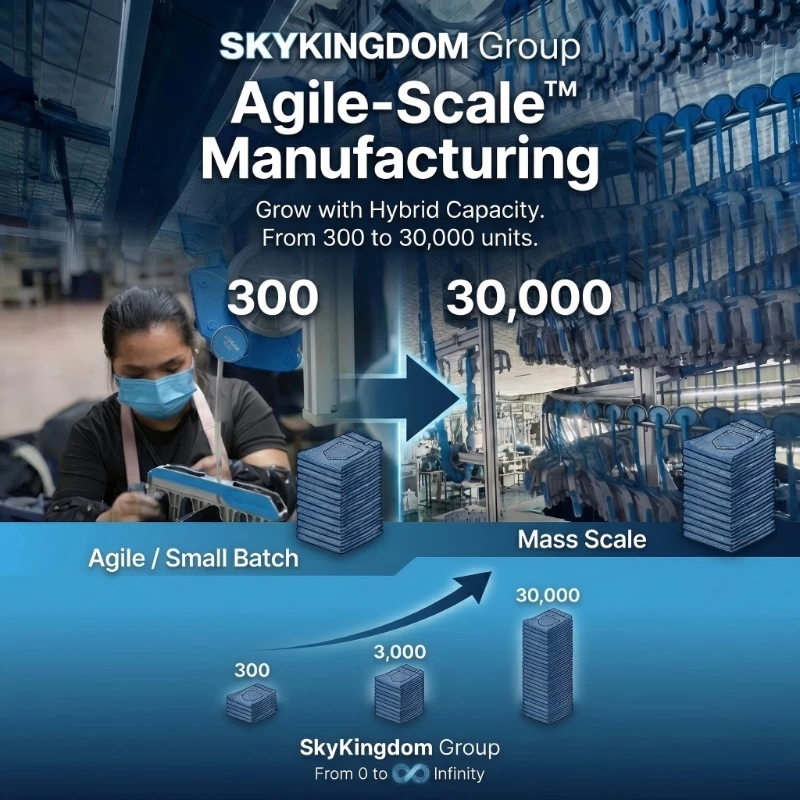
SkyKingdom works from Xintang, Guangzhou as an external jeans product team and managed supply-chain partner for brands that need development, sampling, wash control, QC, and reorder continuity. The company states it has operated since 2008; buyers can use the same supplier-vetting checklist above when reviewing whether its model fits their project.
Before asking for a production quote, prepare your reference image, target quantity, fabric direction, wash expectation, sample size, trim plan, and QC expectation. Those details make supplier answers easier to compare.