
 Beginner’s Blueprint
 Beginner’s Blueprint
You approve a sample that looks perfect in photos, then the fit lands wrong, the wash shade shifts, and your “same sample” bulk order shows up with different handfeel. In denim, that kind of mismatch is not just annoying. It can trigger rework, missed drop dates, and a return wave that hurts your brand before it even gets traction.
This step-by-step guide helps you source quality denim in Asia by locking specs early, choosing the right lane for low MOQ and small batch programs, and building QC gates that protect you during fast response and quick response timelines.
Custom Jeans Manufacturer | Small Batch for Startup Brands
Step-by-Step to Source Quality Denim in Asia
Step 1: Define denim target and end-use
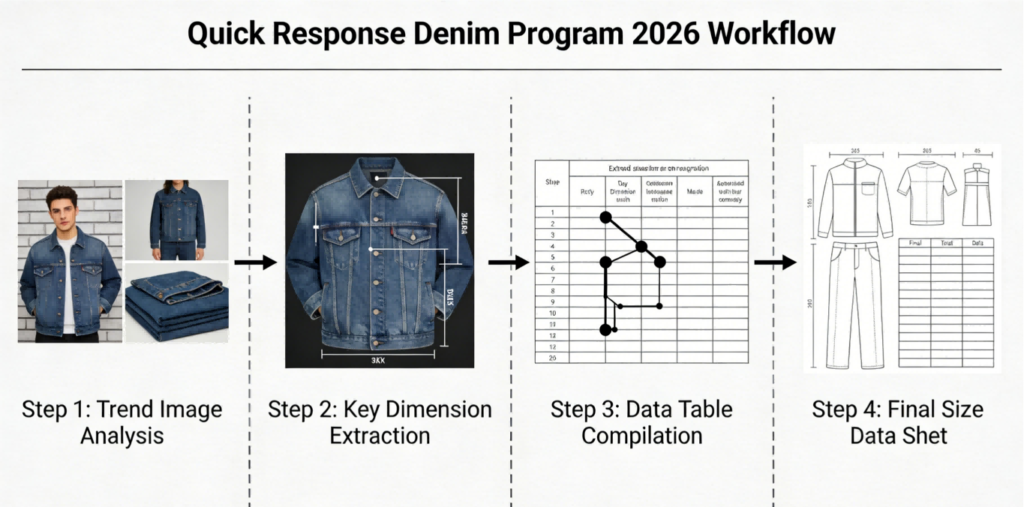
Start by writing down what you will actually sell, not what you hope your supplier can “figure out.” Decide the end-use first (Custom Denim Jackets, wide-leg jeans, cargo denim, rigid Y2K Fashion Revival fits), then translate that into measurable fabric targets.
Use a simple target block so your OEM partner can source correctly:
- Fabric weight: oz/yd2 or GSM (example: 12.5 oz)
- Stretch: rigid vs comfort stretch (example: 98/2 cotton-elastane)
- Handfeel: crisp, dry, brushed, or soft enzyme finish
- Construction: 3×1 RHT/LHT, broken twill, or crosshatch
- Shrink plan: expect and control wash shrink
When you do this upfront, you prevent the most common sourcing failure: choosing the wrong mill and then forcing the wash house to “fix” the fabric with heavier chemistry or aggressive abrasion.
Step 2: Choose sourcing lane by MOQ
Before you reach out to factories, pick your lane by MOQ and the way you plan to sell. This one decision controls your leverage, speed, and how much risk you carry.
Here is a practical lane map that works for most Asia denim programs:
- 1-of-1 prototypes and creator pieces: prioritize pattern agility and finishing flexibility
- Low MOQ / small batch drops (tens of units): prioritize fast sampling and stable wash partners
- Growth runs (hundreds): prioritize line stability and repeatable QC
- Scale runs (thousands): prioritize fabric booking, capacity locking, and tight change control
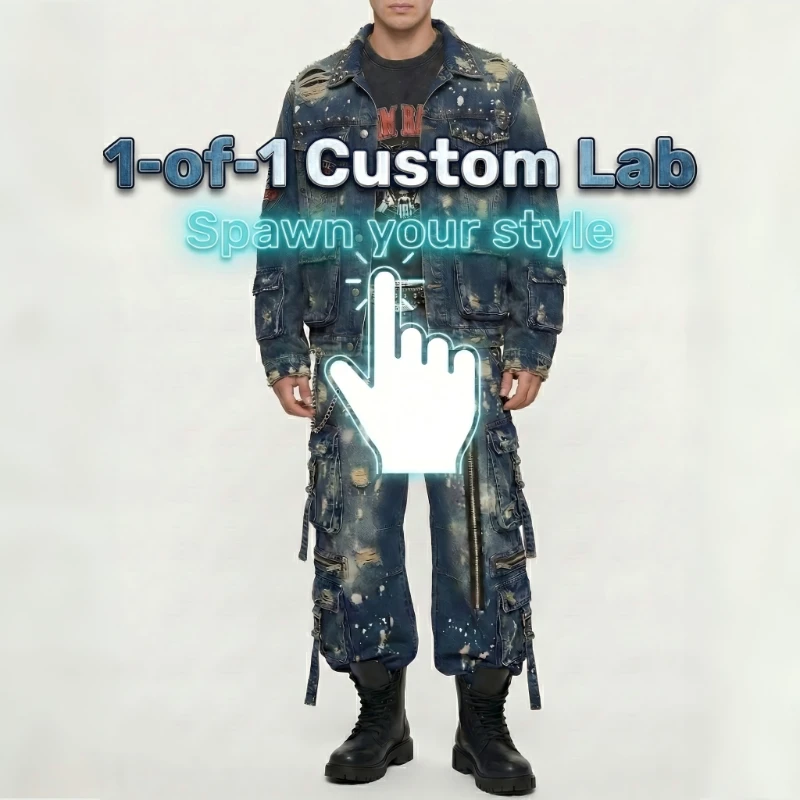
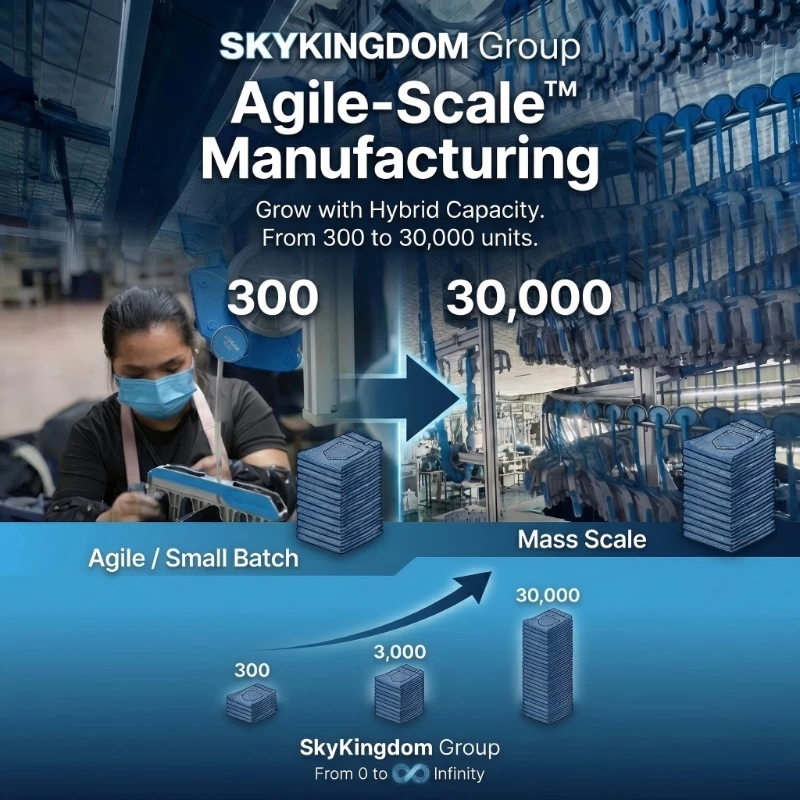
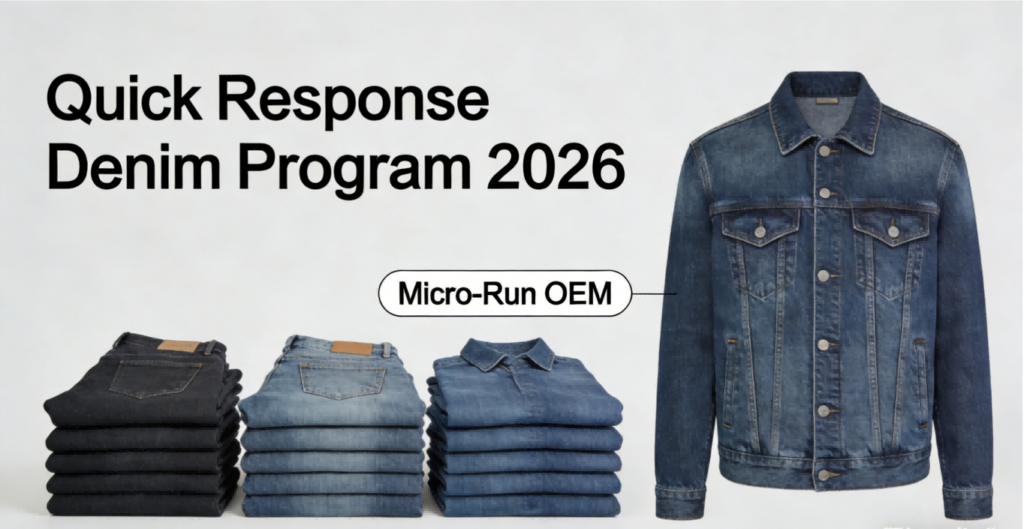
Sky Kingdom positions three solutions that map to these lanes: CodeDenim for one-off work, Micro-Run OEM for 30-piece drops, and Agile-Scale Manufacturing for scaling programs with hybrid capacity. The operational point is simple: you avoid capacity mismatch, which is where “quick response” claims collapse into long queues.
If you are sourcing for fast response, ask one blunt question early: what capacity is truly reserved for small-batch programs versus bulk reorders. A supplier that cannot answer clearly will usually push your order behind bigger clients.
Step 3: Build a spec sheet that factories follow
Treat your spec sheet like a contract for decisions. You are not just describing a garment. You are removing ambiguity between OEM and ODM workflows.
Build your spec sheet in three layers:
Layer A: Fabric and color control
- Fabric code or equivalent spec target
- Yarn count direction (if known) and weave type
- Target shade and undertone (green cast vs red cast)
- Shade band requirement (physical band approval)
Layer B: Garment build (construction and BOM)
- Stitch types and SPI targets (example: 8-10 SPI topstitch)
- Thread type and color codes
- Hardware list (buttons, rivets, zippers) and finish (antique nickel, matte black)
- Pocketing fabric, labels, and hangtags
Layer C: Fit and tolerance control
- POM (points of measure) chart by size
- Grade rules (how each size grows)
- Tolerances (example: +/- 0.5 cm waist)
If you want OEM consistency, do not rely on screenshots or moodboards alone. If you want ODM help, still lock what cannot change (measurements, wash shade range, and shrink targets). That is how you keep “design support” from turning into uncontrolled substitutions.
Step 4: Verify sustainable claims with proof
If you plan to market Sustainable Denim, you need more than a supplier promise or a logo on a slide deck. Your workflow should require proof that survives retailer checks and customer scrutiny.
Use a three-part verification checklist:
- Scope certificate: confirms the facility is certified for the relevant standard
- Transaction certificate (TC): ties certified input to your shipment and product claim
- Material declarations: confirms recycled inputs, blends, and chain-of-custody details
This is where Circular Fashion claims often fail. A factory may be certified, but your specific batch may not be covered by transaction paperwork. Lock this before bulk fabric is booked.
Textile Exchange has continued tightening how reclaimed/recycled material information is handled in documentation, including guidance related to transaction certificates and reclaimed material declarations. That matters because it affects how recycled content and blended tolerances get recorded and verified across the chain of custody. (Textile Exchange)
Step 5: Sample fast, then lock wash and trim
Your goal is speed without chaos. You do that by sampling in a sequence that mirrors bulk reality, then freezing the variables that cause delays.
A sampling sequence that protects quick response timelines:
- Fit sample (confirm silhouette and construction)
- Wash test sample (confirm shrink, shade, and abrasion)
- PP sample (pre-production) with bulk-intent trims
If you try to lock wash before you lock fit, you will redo wash work after pattern changes. If you try to lock trims late, your timeline breaks because hardware lead times do not behave like fabric.
This is where 3D Apparel Modeling can help, but only if you use it correctly. Use 3D previews to reduce visual back-and-forth (pocket placement, seam styling, distress map placement), then validate physical reality with at least one wash test sample.
Sky Kingdom publishes sampling speed targets that match fast response workflows, including 72-hour sampling through a VIP channel, 3-5 working days standard sampling, and up to 7 days for complex cases, with bulk production commonly positioned at 15-22 days. Use those numbers as a planning baseline, then confirm what applies to your specific wash and trim complexity.
Micro-Run OEM | 30-Piece Drops
Step 6: Set QC gates and AQL workflow
Do not wait until final inspection to care about quality. In denim, defects compound fast: a skew problem becomes twisted legs, a shade drift becomes mixed-carton returns, and a weak bartack becomes a warranty headache.
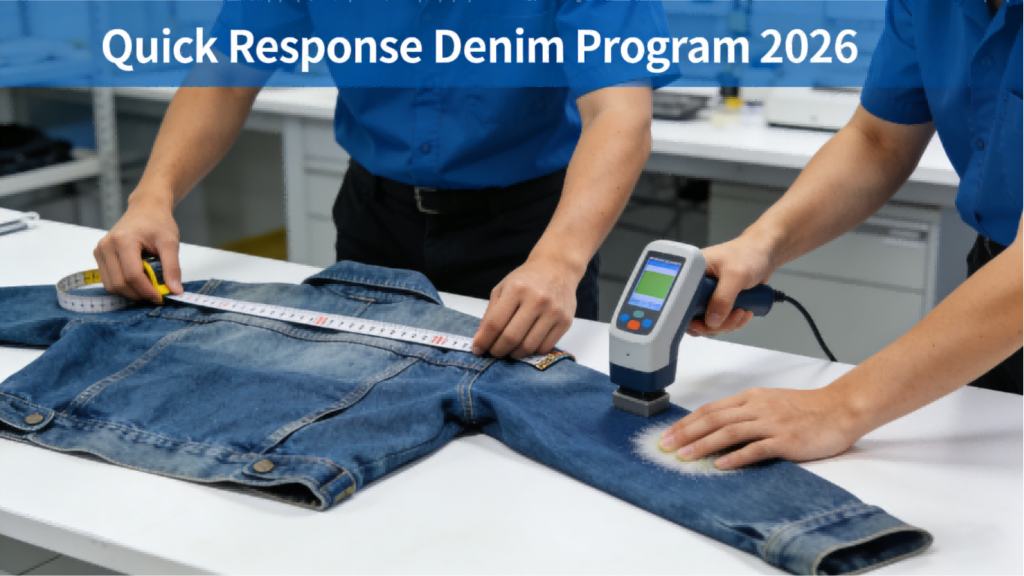
Set three QC gates that match the denim risk points:
- Fabric gate: shade band match, shrink test, skew control
- Wash gate: wash recipe confirmation, abrasion placement consistency
- Final gate: measurements, appearance, hardware function, labeling
Sky Kingdom describes a QC approach built around AQL 2.5 with a multi-stage QC system, plus inline inspection checkpoints after every five sewing operations on its manufacturing workflow pages. Whether you use them or another supplier, steal the structure: check early, check often, and write pass/fail thresholds so your team does not argue about “acceptable” when the shipment is already packed.
If you are building a small batch program, QC still matters. In fact, low MOQ runs often have higher variance because lines switch styles more often. Tight QC gates are how you keep small batch from feeling like “experimental quality.”
Scenario Variations
Custom Denim Jackets: trim and fit gates
Custom Denim Jackets fail most often at shoulder balance, sleeve pitch, and hardware placement. Add one extra fit review after wash testing, and require a hardware pull and function check (buttons, rivets, zipper) before PP approval.
Y2K Fashion Revival: wash and distress controls
Y2K Fashion Revival styles rely on visible finishing. Lock a distress placement map and approve a “golden sample” photo set under consistent lighting, because small wash differences look huge on camera.
Small batch drops: low MOQ scheduling
For small batch work, ask the factory how they queue small orders and how they prevent line instability. Then reduce option count: fewer washes, fewer hardware variants, and one pocket bag spec so the line stays stable.
Fast response restocks: greige reservation
If you plan fast response restocks, ask about greige (undyed) fabric reservation or base fabric safety stock. Reserving the right base fabric is often the only way to make quick response real when demand spikes.
Troubleshooting
| Problem | Cause | Solution |
|---|---|---|
| Shade mismatch | No shade band | Approve lab dips first |
| Twisting legs | Skew not controlled | Require skew control test |
| High rejects | Weak inline QC | Add midline inspections |
| Pocket roping | Wrong stitch tension | Re-tune tension, test wash |
| Hardware stains | Poor wash separation | Bag hardware, rinse longer |
To keep fixes practical, tie every corrective action to a checkpoint:
- If shade shifts, stop bulk and re-approve against the shade band.
- If twisting appears, request skew and shrink test data for the fabric lot.
- If rejects rise, add an inline inspection frequency rule and defect photo log.
Conclusion
Source quality denim in Asia by managing decisions in the right order: define measurable specs, choose the right low MOQ lane, then lock sampling, wash, and trim before bulk. If you need fast response or quick response production, reduce option count and build QC gates that catch problems before final inspection.
Next, pick one style and run the seven steps end-to-end. Once your workflow works for one SKU, you can scale it across collections without turning your supply chain into a guessing game.
FAQ
How do I verify a denim mill can meet my quality target?
Ask for recent bulk test reports that match your fabric weight and stretch, not just a generic lab sheet. You should also request shade continuity proof, including an approved shade band and a plan for lab dips by lot. Finally, confirm the mill can support your wash target by sharing a wash recipe and getting feedback on shrink and skew risk. If the mill cannot answer with measurable ranges, you will likely see “sample okay, bulk different” issues.
What is the safest way to manage low MOQ production without quality drops?
Keep the style stable by limiting wash variations, reducing hardware options, and using one pocketing and thread spec across the run. You should add tighter QC gates because small batch lines switch styles often and variance rises. Lock a PP sample, then freeze changes unless you accept a schedule slip. If you need fast response, shorten decision cycles with pre-approved alternates for trims and thread colors.
How can I reduce denim shade variation across production?
Approve lab dips against a physical shade band and define an acceptable tolerance range before bulk dyeing starts. You should require lot tracking so the factory does not mix rolls across lots without disclosure. For washed denim, lock the wash recipe parameters and insist on wash test swatches from each batch early. When you see drift, stop and correct immediately, because late fixes usually create more variation.
What documents should I request for recycled cotton or sustainable denim claims?
Request a valid scope certificate for the facility and transaction certificates that specifically cover your material and shipment. You should also ask for material declarations that match your exact fiber composition and blend percentages. If your claim uses recycled cotton, confirm chain-of-custody coverage through each handoff, not just the spinner or mill. If any document does not match your product composition, treat the claim as unverified until corrected.
How do I balance quick response timelines with reliable QC?
Reduce complexity first, then speed up. You should limit option count (wash, trims, and colorways), because each option adds approvals and delays. Add at least one mid-production inspection so defects do not reach final packing, and define a pass/fail threshold so the factory can act without waiting for debate. If your supplier offers Real-time Production Tracking, use it to approve checkpoints the same day, not at the end of the week.
What should I include in a denim spec sheet for OEM or ODM?
Include fabric construction, weight, stretch target, shade direction, and shrink/skew expectations so the factory sources the right base. You should also specify wash steps, distress placement rules, thread and hardware details, and a complete measurement chart with tolerances. For ODM support, mark which elements can vary (like pocket shape options) and which cannot (like waistband measurement). The more you remove ambiguity early, the fewer revisions you need to hit your launch window.