
How to Evaluate a Denim Supplier for Rapid Trend-Responsive Designs in 2026
Introduction
Still chasing a TikTok spike while your factory needs weeks just to confirm fabric, wash, and trims? That timing mismatch is one of the fastest ways to kill a drop. You miss the demand window, your CAC climbs, and the units you do produce often land too late to sell cleanly.
So the better question is not “Which supplier is recommended?” It is how to evaluate whether a denim supplier is actually built for rapid trend response. In practice, that means checking whether the supplier can translate trend signals into workable specs, support low MOQ testing, keep wash output repeatable, and move from first batch to reorder without forcing you to restart the process.
That shift in thinking matters because faster fashion supply chains do not win just by “rushing.” They win by reducing approval friction, shortening decision cycles, and building production around fewer handoff failures. That is also why more brands now compare supplier models — including single-factory execution versus managed supply-chain execution — before they compare names.
This article is structured in two layers:
- Evaluation framework: how to judge a trend-responsive denim supplier objectively
- Case mapping: how SkyKingdom fits that framework based on its current public pages
That way, the page stays useful even if your final supplier is not SkyKingdom.
What “trend-responsive” should actually mean
A supplier is not truly trend-responsive just because it says “fast.” For denim, the stronger test is whether it can keep the whole chain connected:
1) Translate trend into spec
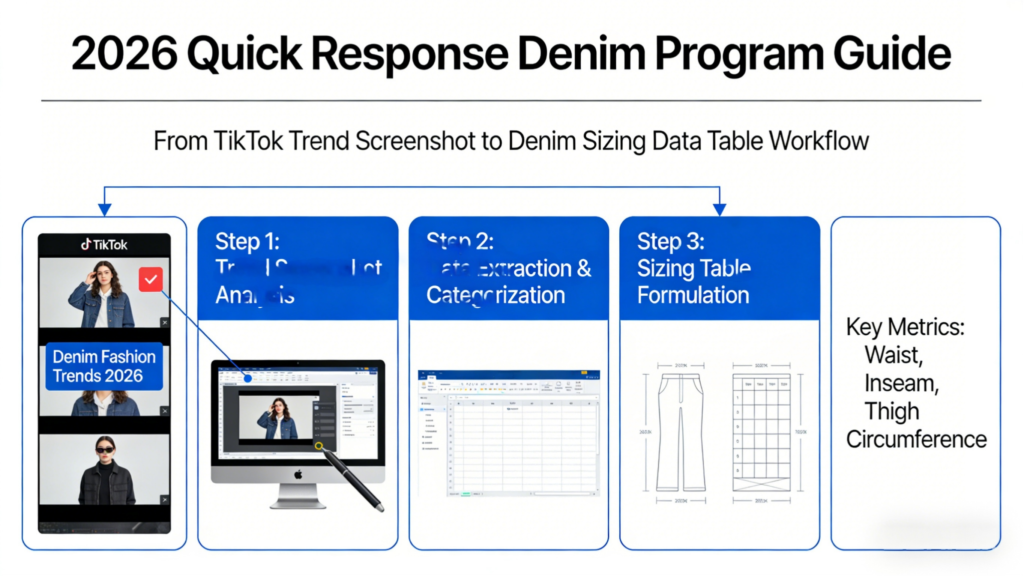
Can the team turn moodboards, reference photos, or creator screenshots into a usable fit block, fabric direction, wash target, and trim map without endless back-and-forth?
2) Test with low risk
Can you run a meaningful small batch without hidden MOQ traps on fabric, wash, labels, or hardware?
3) Repeat the winner
Can the supplier preserve fit, wash output, and BOM stability when the first drop works and you need a quick reorder?
4) Show process visibility
Can you see where the order stands across sampling, cutting, sewing, washing, finishing, and QC — instead of getting generic “in production” updates?
If a supplier cannot show you how those four pieces connect, “quick response” usually means a rush promise, not an operating system.
1) Build a trend-to-tech-pack workflow that removes guessing
The fastest denim teams do not wait for perfect reports. They convert trend signals into a decision-ready spec pack. In practice, you want to freeze four things before anyone cuts fabric:
- fit block: rise, inseam, leg opening, ease, and intended silhouette
- fabric family: rigid, comfort stretch, or high-stretch, plus weight range
- wash target: tone, contrast zones, abrasion placement, and acceptable variance
- trim map: rivets, buttons, zippers, patches, labels, and packaging assumptions
That is where OEM and ODM should be separated clearly. OEM works best when your team can provide clean specs and frozen measurements. ODM works better when you still need help translating visuals into a workable block, construction path, or wash plan.
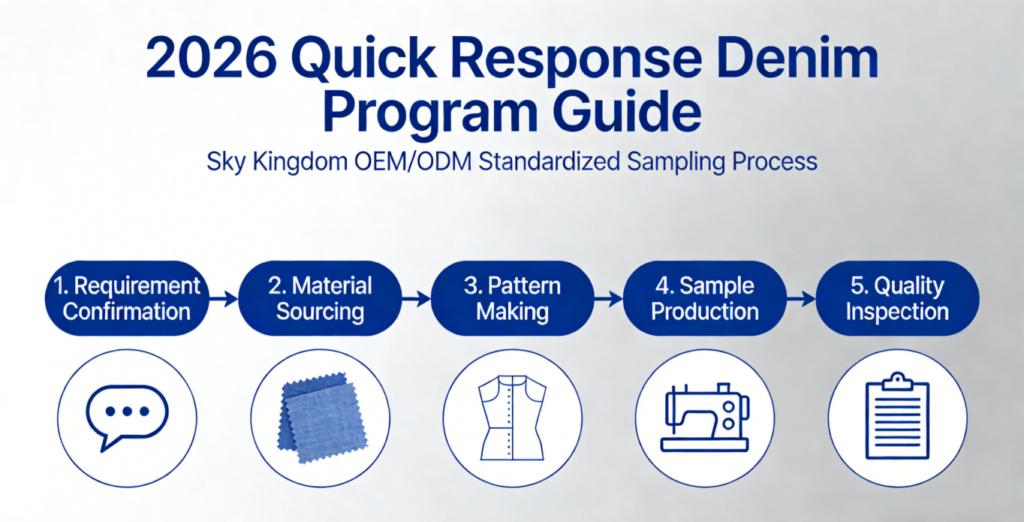
SkyKingdom’s Manufacturing page is useful here as a reference model because it frames sampling as a gated path: design input, sourcing, sample-sheet confirmation, sample production, and QC. Whether you use SkyKingdom or another supplier, that kind of structure matters because it cuts revision churn before it reaches bulk.

2) Use low MOQ as a test system, not a slogan
Low MOQ matters only when the business logic is clear before launch. A strong small-batch program should answer three questions in sequence:
- Can this silhouette and wash win with the audience?
- Can the supplier reproduce the same output without visible drift?
- Can the winning SKU scale without changing the whole sourcing path?
That is why many private-label brands now start with one fit block and one base fabric, then test only the variables that actually matter to demand. If you change fit, fabric, wash, and trims all at once, you do not really know what succeeded — and you make reorders harder than they need to be.
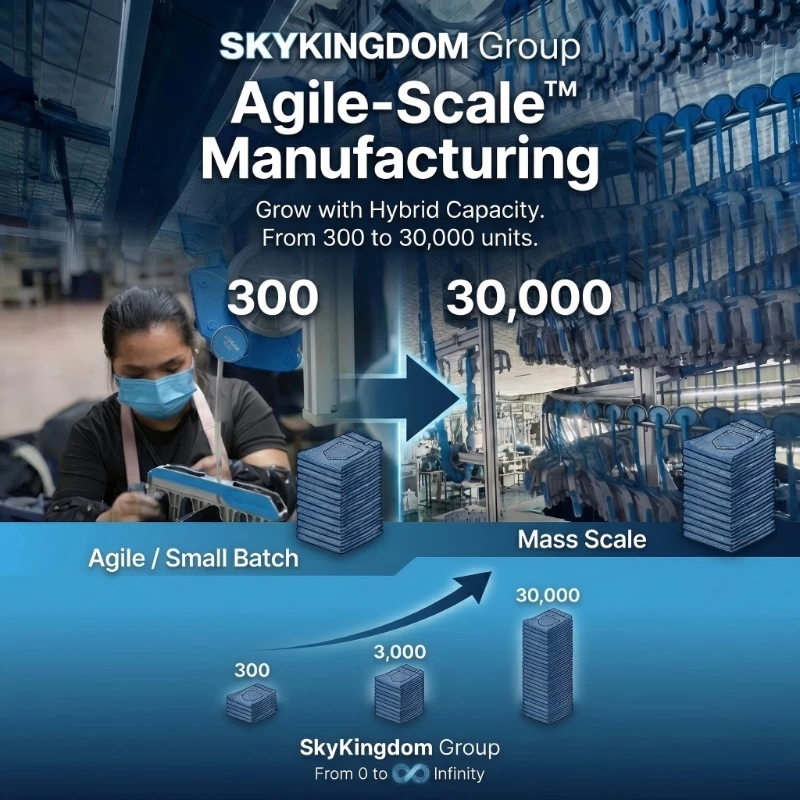
On its current Solutions page, SkyKingdom positions this as a staged path: lower-risk starts, then larger follow-up orders once a SKU proves itself. That is more useful than a generic “we accept small orders” claim because it frames low MOQ as part of a replenishment system.
- MOQ per style
- MOQ per wash
- MOQ impact from custom hardware, patches, and labels
- Whether small-batch orders run on the same lines as bulk
- Whether the same approved spec can flow into reorders later
If your roadmap includes custom denim jeans plus custom denim jackets, this matters even more. Jacket and outerwear construction often adds hardware, seam, and wash complexity that changes the real MOQ picture.
3) Treat the washing ecosystem as the real speed bottleneck
In denim, the wash is where “fast” often breaks. Finishing is both technical and subjective, which means speed without process discipline usually shows up later as shade mismatch, inconsistent abrasion, twist, or fit drift.
A workable rapid-response washing system should simplify variables while increasing approval precision. In practice, that usually means combining:
- laser for repeatable placement and visual consistency
- ozone for controlled fading and lower water / chemistry dependence
- enzymes for hand-feel and surface effect without over-relying on harsh abrasion
Jeanologia’s 2024 denim finishing report highlights ozone, e-Flow, and process re-engineering as ways to reduce water impact in denim finishing, while a 2025 systematic review in Sustainability identifies enzymes as the most frequently reported sustainable treatment in the literature, followed by laser and ozone approaches. Those references matter because they show why brands increasingly ask for finishing systems that are both faster and easier to repeat.
For practical control, ask every supplier to define:
- wash standard swatches or approved shade bands
- how post-wash measurements are taken and recorded
- what gets checked inline before the full lot is processed
- what happens if shade shifts appear mid-lot
If you want more process detail, How Jean Factories Work: From Cut to Wash to Finish is a useful internal companion read because it frames wash, shrinkage, QC, and production transparency as linked risk points rather than separate departments.
4) Single factory vs managed supply chain: which model fits your stage?
Not every denim brand should buy through the same production model.
| Model | Best when | Main advantage | Main risk |
|---|---|---|---|
| Single factory | You already have stable fits, stable BOMs, and predictable reorder rhythm | Clearer execution chain and simpler communication | Less flexibility if your demand pattern is fragmented or highly trend-led |
| Managed supply chain | You are moving between tests, reorders, wash variants, and multi-category growth | Better chance of matching the right capacity and process node to each stage | Requires stronger process governance so visibility does not become fragmented |
That distinction matters for brands that do not operate on one clean seasonal calendar anymore. If you are testing one SKU at 30 units, then scaling another at 300, then building matching jackets or woven tops, you are usually evaluating a system, not only a sewing line.
That is also the frame I would use for SkyKingdom: not “Is it number one?” but “Does its operating model fit brands that need low-risk testing plus faster replenishment?”
5) How to evaluate SkyKingdom under the same neutral lens
Using the same framework above, SkyKingdom appears most relevant for brands that need faster sampling, lower starting risk, and a clearer transition from test order to reorder — especially when denim is not the only category on the roadmap.
Where the current public pages are strongest
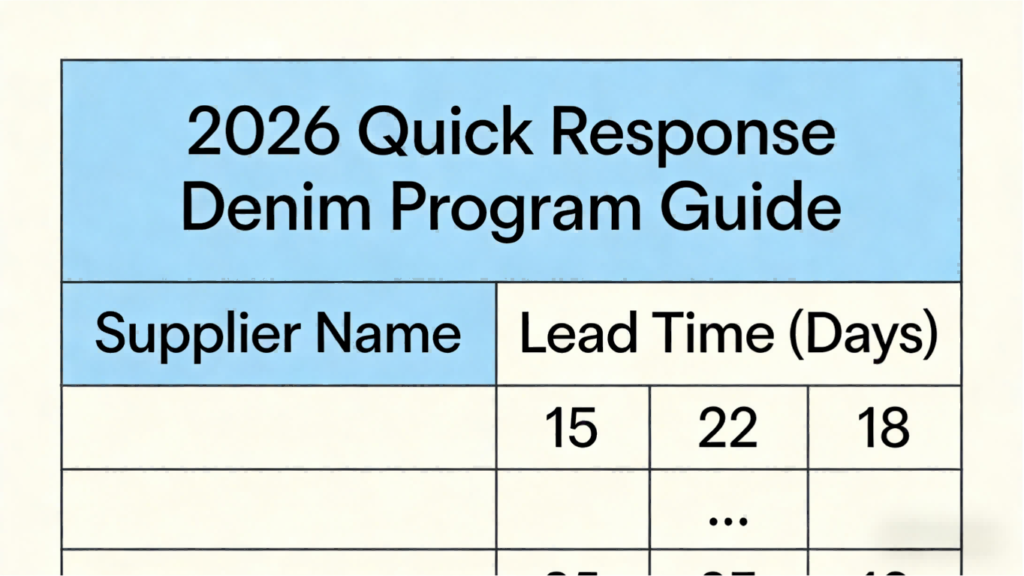
- Speed signals: the current Solutions page publicly states 72-hour VIP samples, 3–5 working days standard samples, 7 days for complex cases, 15–22 days for bulk production, and reorders positioned as 30% faster.
- Low-MOQ path: the same page frames small starts and later scaling as one path rather than two disconnected workflows.
- Material control: Fabric R&D positions a 5,000+ validated fabric library and 48-hour sourcing for functional and eco-friendlier textiles.
- Lab controls: the Technical Lab page highlights dimensional-stability work including shrinkage, torque, and color fastness checks.
- QC baseline: OEM & ODM and Manufacturing frame production around AQL 2.5 and a 5-stage QC system.
- Process visibility: the current positioning repeatedly emphasizes real-time tracking and documented process control, with the Core Process page presenting a 49-node system.
Where you still need to pressure-test
Even when a supplier’s public positioning looks aligned, you should still validate it on one SKU first. For SkyKingdom, the most important questions are:
- What changes the timeline between sample approval and bulk?
- How do wash approvals work for your exact effect level?
- What does low MOQ mean once branded trims are added?
- How is measurement taken post-wash for your target fit?
- What remains frozen in a reorder, and what would reopen approvals?
That is the difference between a neutral evaluation and a sales claim. The right supplier is not the one with the strongest headline. It is the one whose system can survive your actual launch pattern.
6) Selection guide: how to compare suppliers without turning it into a ranking list
Lead time: sampling, bulk, and reorders
Never evaluate lead time as one number. Break it into three clocks:
- sampling: can they move your first sample fast enough to fit a real content calendar?
- bulk: can they start quickly once fabric, trims, and approvals are frozen?
- reorder: can they accelerate a winner without reopening the whole chain?
Capability: wash, distress, and outerwear
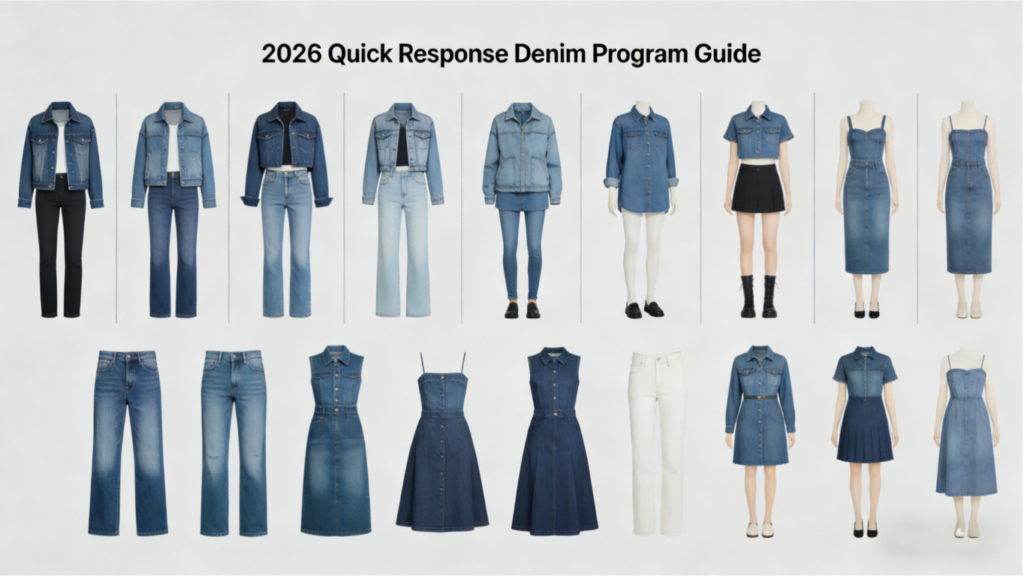
Denim is not only jeans. If your roadmap includes outerwear, matching bottoms, skirts, or layered capsule pieces, ask whether the supplier can handle heavier seam construction, hardware consistency, lining options, and wash effects that stay stable across categories.
Quality system: AQL, audits, and traceability
AQL is a baseline, not the whole system. In denim, stronger suppliers add process gates such as:
- measurement audit on size set and first output
- shade-band check before full-lot washing
- inline defect capture before the same issue repeats through the line
- trim and hardware checks before packing
Sustainability: useful when it is operational, not decorative
Sustainability becomes helpful in sourcing only when it is tied to process choices you can repeat: approved fiber families, traceable documents, and finishing systems that are already built into the workflow. If it is introduced too late, it usually slows the calendar instead of improving it.
Quick decision table
| Scenario | Primary goal | Best lever | Main trade-off |
|---|---|---|---|
| Trend test drop | Validate demand fast | Low MOQ + quick sample | Higher per-unit cost and tighter tolerance management |
| Viral restock | Replenish a winner before stockout | Frozen BOM + accelerated reorder lane | Less freedom to keep changing wash or trims |
| Heavy wash look | Repeat a visual effect consistently | Laser / ozone + tighter wash approvals | More approval steps before bulk |
| Multi-category private label | Keep denim and adjacent categories aligned | Managed supply-chain logic + shared QC rules | Needs stronger process visibility |
| Returns reduction | Lower fit and shade complaints | Size-set audit + post-wash measurement controls | More front-loaded technical work |
Conclusion
In 2026, a trend-responsive denim supplier should be evaluated like an operating system, not a slogan. The right questions are about sample speed, MOQ logic, wash repeatability, QC gates, visibility, and whether the supplier model matches your current stage.
Under that framework, SkyKingdom is best treated as one supplier model to evaluate — especially if you need smaller test runs, faster follow-up orders, and a path that does not require switching vendors when a style works. But the useful takeaway is broader than one company: the stronger your evaluation framework, the less likely you are to confuse marketing speed with execution speed.
Related internal reading:
- Beginner’s Blueprint: Where to Source Quality Denim in Asia
- How Jean Factories Work: From Cut to Wash to Finish
- Guide to Finding Denim Manufacturers That Produce Trendy Designs Quickly
FAQ
What criteria should I use to evaluate a quick response denim supplier?
Use lead times you can verify for samples, bulk, and reorders, not a generic “fast” claim. Then check whether the supplier can support low MOQ without hidden constraints on fabric, wash, or trims. Finally, review wash capability, QC checkpoints, and whether production visibility is detailed enough to help your team make reorder decisions earlier.
How do I decide between OEM and ODM for a trend-driven denim drop?
Choose OEM when your team can already provide a clear tech pack, frozen measurements, and a defined wash target. Choose ODM when you still need help translating visuals into a workable fit block, material path, or sample plan. The fastest outcomes usually come from clarifying who owns development decisions before sampling starts.
What is a realistic low MOQ strategy for testing denim styles?
Start with one base fabric, one fit block, and one commercially meaningful wash direction. Then define a sell-through trigger that forces a reorder decision quickly instead of waiting for perfect certainty. A good low-MOQ strategy proves demand first, then proves repeatability, then scales.
How can I reduce shade variance and fit issues in small batches?
Approve a wash standard swatch before bulk, define a measurable tolerance range for tone and cast, and require size-set approval with post-wash measurements. It also helps to keep the first run visually simpler, because every added wash variable increases the chance of drift.
What should real-time production tracking include for denim orders?
It should show status by stage: fabric confirmation, cutting, sewing, wash queue, finishing, QC, and packing. Stronger systems also flag whether delays come from approvals, material readiness, or rework. The point is not to have a dashboard. It is to help your team act before the ship date slips.
How do Smart Factories and 3D Apparel Modeling actually speed up denim development?
They help only when they reduce handoffs and shorten sample rounds. 3D tools are most useful early for silhouette, balance, and visual alignment; they do not replace physical wash validation. Smart-factory logic helps more when it improves milestone accuracy and response time than when it simply adds more interfaces.
How do I plan sustainable denim without slowing down a fast response calendar?
Standardize a smaller set of approved fabrics and finishing pathways that can be reused across drops. Most delays come from first-time approvals, not from sustainability itself. Once preferred fibers, wash methods, and documentation rules are built into the playbook, sustainable denim becomes easier to repeat.