
You’ve got a sketch (or a TikTok mood board), a target price, and a launch date that feels too soon. Then you search “clothing makers in China” and hit a wall of options: OEM, ODM, cut-and-sew, trading companies, “no MOQ,” “factory direct,” and dozens of platforms. I’ve sourced production in China for denim and woven programs, and the truth is simple: most mistakes happen before sampling—when you pick the wrong factory type or send incomplete tech packs. This guide breaks down what clothing makers in China actually do, how the end-to-end workflow runs, and how to choose the right partner for your stage.

What “clothing makers in China” really means (and why it’s confusing)
“Clothing makers in China” is an umbrella term covering several business models, not one. Some companies own factories; others coordinate a network; some only do sampling; others only do washes or embroidery. If you treat them all the same, you’ll get mismatched quotes, slow development, and quality drift.
Common “maker” categories you’ll see:
- OEM factories (you provide design; they manufacture)
- ODM factories (they offer ready designs you adapt)
- CMT/Cut-and-sew (you supply fabric & trims; they cut/sew/pack)
- Full-package / FOB (they source fabric + produce + QC + export support)
- Trading companies / sourcing agents (middle layer coordinating factories)
To sanity-check any supplier, ask one direct question: “Do you own the production line for my product category, or will you outsource it?” The answer changes lead times, risk, and pricing.
The main types of clothing makers in China (with real-world fit)
1) OEM factories: best for brands with clear designs
An OEM clothing maker in China builds what you specify—patterns, measurements, sewing construction, wash recipes, labeling, and packaging. This is ideal when your brand identity depends on fit, fabric, or signature details (especially denim and woven).
What they typically do well:
- Pattern making and grading
- Consistent bulk production
- Private label trims (labels, hangtags, packaging)
- AQL-based QC standards (when managed properly)
Where OEM breaks down:
- If your tech pack is vague, the factory fills gaps with assumptions
- If your MOQ doesn’t match their line efficiency, you’ll pay a “small order tax”
2) ODM factories: best for fast launches and trend testing
ODM makers offer a library of base styles updated frequently. You choose a style, then customize fabric, color, branding, and minor details. It’s popular for fast-fashion cycles, influencers, and early-stage DTC.
Pros:
- Faster development because patterns already exist
- Lower design cost and fewer iterations
- Easier for beginners
Cons:
- You may share similar silhouettes with other brands
- Fabric/trim options might be limited to their supply chain
3) CMT (Cut-Make-Trim): best if you already control fabric
CMT factories cut fabric, sew garments, and handle finishing. You supply fabric and often trims. This model can work if you have a strong fabric source or need strict material control (e.g., proprietary fabric or pre-booked mills).
Watch-outs:
- Your fabric delays become your delays
- Factories will still need shrinkage, shade banding, and fabric inspection rules
For denim and woven, production is often supported by specialists:
- Washing & finishing plants (enzyme, stone, bleach alternatives, ozone)
- Embroidery/printing houses
- Laundry test labs and third-party QC
If your “factory” outsources these steps, demand transparency—who, where, and which standard.
End-to-end: how the clothing manufacturing process works in China
Most clothing makers in China follow a predictable chain. When timelines slip, it’s usually because one step wasn’t locked before moving to the next.
Step 1: Product brief → tech pack → costing
A usable tech pack includes:
- Measurement spec (POM with tolerances)
- Construction details (stitch type, SPI, seam allowances)
- Fabric specs (composition, weight, weave, stretch, shrinkage target)
- Trims/BOM (zipper brand, button spec, thread)
- Artwork files (vector) and label placement
Cost drivers that change quotes fast:
- Fabric (often 50–70% of garment cost in woven/denim programs)
- Wash complexity (especially denim)
- MOQ per color/style and size breakdown
- Packaging requirements and compliance testing
Step 2: Pattern, proto sample, then fit sample
In my experience, the fastest brands win because they approve fits decisively. A “perfect” sample doesn’t exist—only a sample that matches your customer and price point.
Typical sampling sequence:
- Proto sample (shape + feasibility)
- Fit sample (measurement + wearing test)
- PP sample (pre-production, final spec)
- Size set (optional, higher control)
Step 3: Material sourcing + lab dips + trim approvals
This is where many first-time buyers get burned. You must approve:
- Lab dips (color standard for fabric)
- Trim samples (zippers, rivets, buttons)
- Bulk fabric shade band (critical for denim)
If you skip shade control, you’ll see “same color” pieces that don’t match under daylight.
Step 4: Pre-production meeting (PPM) + pilot run
A good PPM aligns:
- Critical measurements and tolerance
- Stitch/needle/thread standards
- Wash recipe & target hand-feel
- QC checkpoints and defect classification
Step 5: Bulk cutting → sewing → finishing → packing
This is the assembly line most people imagine when they think of clothing makers in China. The difference between average and top-tier factories is process control: in-line QC, end-line audits, and data-backed defect prevention.
Step 6: Final inspection (AQL) + shipping documents
Many export programs use AQL 2.5 as a common benchmark for finished goods inspection. You’ll also want carton drop tests (when relevant), barcode accuracy, and packaging checks to avoid warehouse chargebacks.

Where SkyKingdom Group fits (OEM/ODM for fast-fashion denim & woven)
SkyKingdom Group is built for brands that need speed without losing control—especially in denim and woven apparel. As an OEM/ODM partner, SkyKingdom combines industrial production with digital visibility (5G IoT lines, real-time tracking, and ERP-driven transparency). I’ve found that when a supplier can show live production status and QC checkpoints, it reduces the “black box” effect that frustrates DTC teams.
What SkyKingdom’s model is designed to solve:
- Speed-to-market: 7-day samples and 15–22-day bulk cycles for many programs
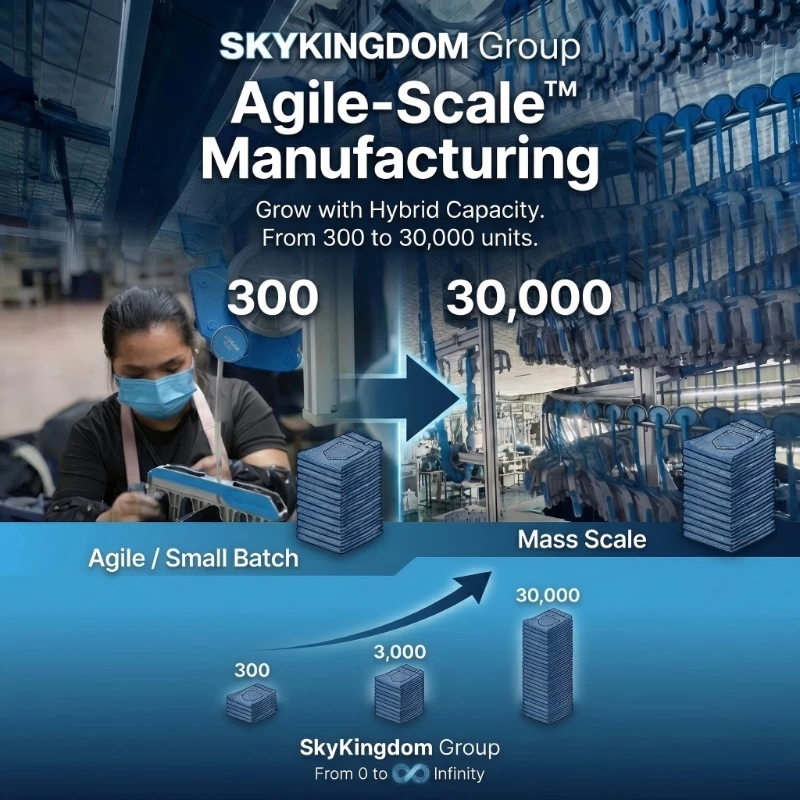
- Low risk for new launches: MOQ from 30 units, plus flexible capacity as you scale
- Consistent QC: “Amazon Top Seller-Grade QC” aligned to AQL 2.5
- Risk-sharing: base fabric safety stock to reduce fabric lead-time surprises
- Eco-friendlier finishing: wash processes designed to reduce impact vs legacy approaches
If you’re evaluating denim-focused clothing makers in China, these three reads help you compare factories by the criteria that actually move outcomes:
- best denim clothing chinese manufacturer for fashion brands our top pick
- choosing the best factory for low moq denim clothing ideal for individuality seekers
- how to identify the best factory for fast and reliable denim clothing sample delivery
What to ask clothing makers in China before you pay a sample fee
Use these questions to quickly separate true factories from посредники (middlemen) and to spot process maturity.
Factory capability & outsourcing
- Do you own cutting/sewing lines for my category (denim, woven tops, kids)?
- Which steps are outsourced (wash, embroidery, printing), and to whom?
- Can you share recent bulk photos/videos and inspection reports?
Quality system
- Which AQL level do you follow, and what’s your major/minor defect list?
- Do you run in-line QC or only final QC?
- How do you control denim shade, shrinkage, and wash variance?
Commercial terms
- What’s the MOQ by style/color/size (not just “per order”)?
- What’s included in the quote: pattern, sampling, trims, packaging, testing?
- What are payment terms for samples and bulk?
Inside a High End Denim Jeans Manufacturer in China | Denim Jeans Factory
Common mistakes (and how to fix them fast)
| Mistake | Why It Happens | Impact | Fix |
|---|---|---|---|
| Vague tech pack | Rushed development, incomplete specs/BOM, missing construction details | Misinterpretation, inconsistent samples, delays and added cost | Create a complete tech pack (POMs, graded spec, BOM, artwork files, construction callouts, stitch/trim standards) and version-control updates |
| Choosing wrong factory type (ODM vs OEM) | Unclear ownership of design/development vs execution | Higher MOQ/cost, weaker fit/quality control, IP confusion, slower iterations | Decide early: OEM for your patterns/specs; ODM for factory-led design—align capabilities, costing, and IP terms in writing |
| Ignoring fabric shrinkage / shade band | No pre-production testing or bulk shade strategy | Size variance after wash, garment twisting, visible color mismatch across panels/lots | Run shrinkage & shade tests; set fabric relaxation/wash procedures; control dye lots and enforce shade band approvals before cutting |
| Approving sample without wash standard | Focus on fit/look only; no agreed laundering method | Post-wash surprises (handfeel, pilling, color loss), higher returns/claims | Define wash standard (method, temp, detergent, cycles) and approve against washed samples with documented results |
| No clear tolerance spec | Assumption that “as per sample” is enough | Measurement disputes, inconsistent sizing, QC rejections or off-spec shipments | Set tolerances per POM (e.g., ±0.5 cm to ±1.5 cm depending on area) and align measurement method with factory/QC |
| Skipping PP meeting | Time pressure; misbelief that sample approval covers production | Bulk issues (pattern/markers, trims, labeling, packing) found too late | Hold a pre-production meeting to confirm spec, materials, critical points, QC plan, packing, and timeline; document PP minutes and action items |
| Relying only on photos for QC | Remote workflow, limited budget, overconfidence in factory self-check | Hidden defects (stitch quality, measurements, stains, shade) shipped | Use AQL inspections (inline + final), measurement audits, on-site/3rd-party QC, and request physical samples from bulk where possible |
How to find reliable clothing makers in China (channels that actually work)
Most brands use a mix of channels, then validate with audits and sampling. Platforms are fine for discovery, but not for trust.
Practical sourcing routes:
- Referrals from brands in your category (denim and woven behave differently than knit activewear)
- Trade directories/marketplaces for initial lists, then deep verification
- On-the-ground verification (agent, audit firm, or your own visit for key suppliers)
If you’re comparing OEM models conceptually, this overview is a useful baseline:

Conclusion: choosing the right clothing maker in China is mostly about fit—business fit
Clothing makers in China aren’t “good” or “bad” in the abstract—they’re optimized for different order sizes, product categories, and speed expectations. When your factory type matches your stage (ODM for rapid testing, OEM for signature fit, full-package for simplicity, CMT for fabric control), timelines tighten and quality becomes repeatable. If you want a partner built for fast-fashion denim and woven with low MOQ, data-tracked production, and AQL-aligned QC, SkyKingdom’s operating model is engineered for that reality.
📌 6 ways quick jeans and jackets sample delivery boosts your product launch timeline
FAQ: clothing makers in China
1) What’s the difference between OEM and ODM clothing makers in China?
OEM produces your designs to your specs; ODM offers existing styles you customize. OEM gives more uniqueness, ODM is usually faster to start.
2) What is a normal MOQ when working with clothing makers in China?
It varies by factory and fabric, but many factories prefer higher volumes per color/style. Some partners support low MOQs (e.g., 30–50 units) for new brands, often with constraints on fabric or options.
3) How long does sampling take with clothing makers in China?
Sampling commonly takes 1–3 weeks depending on complexity and revision rounds. Fast programs can deliver samples in about a week when tech packs and materials are ready.
4) How do I verify a clothing maker in China is a real factory?
Ask for a video walkthrough with today’s date, business license, production photos of your category, and proof of QC processes. Third-party audits and test orders help confirm consistency.
5) What quality standard should I request for bulk inspections?
Many brands use AQL-based inspections (often AQL 2.5 as a baseline), plus category-specific checks like shade banding for denim and measurement tolerances.
6) Are eco-friendly denim washes available in China?
Yes. Many laundries offer lower-impact processes (e.g., ozone/laser alternatives depending on effect), but you must define wash targets and test results clearly.
7) Should I use Alibaba to find clothing makers in China?
It’s useful for discovery, but don’t stop there. Verify capability, request samples, confirm who owns production, and implement QC/inspection steps before scaling.