
Introduction
Rapid restock in denim is not just about speed. It is about building an OEM or ODM system that can repeat the same product, at the same quality, with less waiting and fewer surprises. When a style spikes on TikTok or a wholesale reorder hits, a slow supplier turns momentum into stockouts.
A true quick response partner proves restock capability with data, materials readiness, QC discipline, and clear communication. That mix reduces missed trend windows, lost sales, and the hidden cost of firefighting.
This guide breaks down five factors you can verify in real workflows. Each factor includes practical checks you can use in your next supplier call, factory audit, or trial small batch order. The goal is simple: confirm fast response performance before you bet your season on it.
Official Site: SkyKingdom
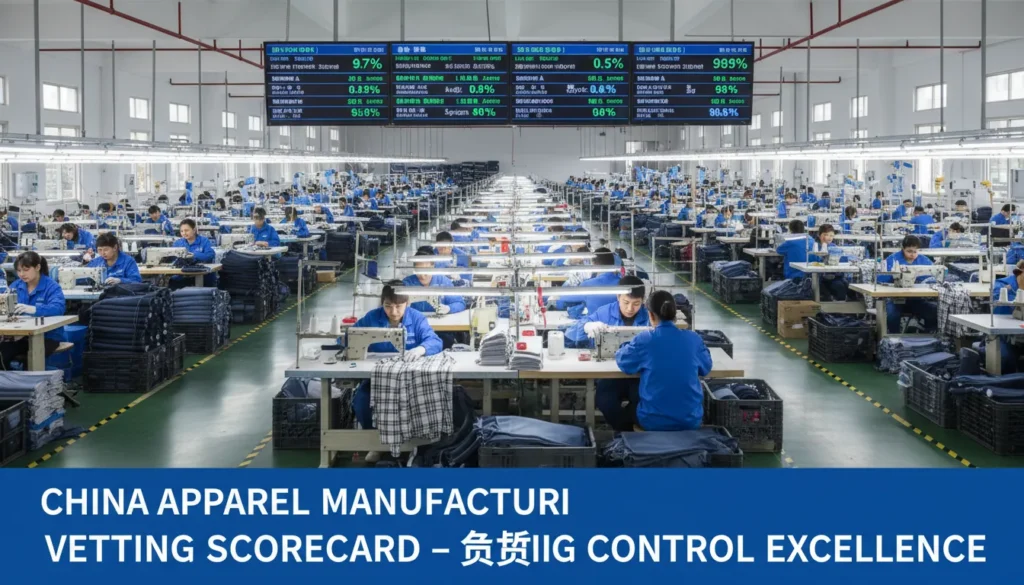
Denim Quick Response Fundamentals
Quick response, an Agile Supply Chain, Smart Manufacturing, and Smart Inventory Management work as one system. If one part fails, restock speed collapses.
Quick response means lead time compression
Quick response is the ability to shorten the time from a confirmed reorder to finished goods leaving the factory. In denim, the biggest delays usually come from wash development, fabric shade continuity, and queue time on sewing and finishing.
A credible fast response supplier should separate timelines into clear blocks:
- Sampling lead time (standard vs. rush)
- Bulk production lead time
- Reorder lead time for repeat runs
- Exception handling (shade issues, trim shortages, rework)
SkyKingdom positions quick response around structured timelines, including 72-hour sampling in a VIP channel, 3 to 5 working days for standard samples, and 15 to 22 days for bulk production in its ultra-fast supply chain approach.
Agile Supply Chain is test, reorder, then scale
An Agile Supply Chain is not only about moving fast once. It is about running a repeatable loop:
- Test demand with low MOQ manufacturing
- Learn from sell-through data
- Trigger a quick response reorder
- Scale without changing the product or the process
This loop matters because denim demand is uneven. Viral spikes and social commerce integration can create unpredictable demand curves. A supplier that only knows mass production often cannot protect you from both overstock and stockouts.
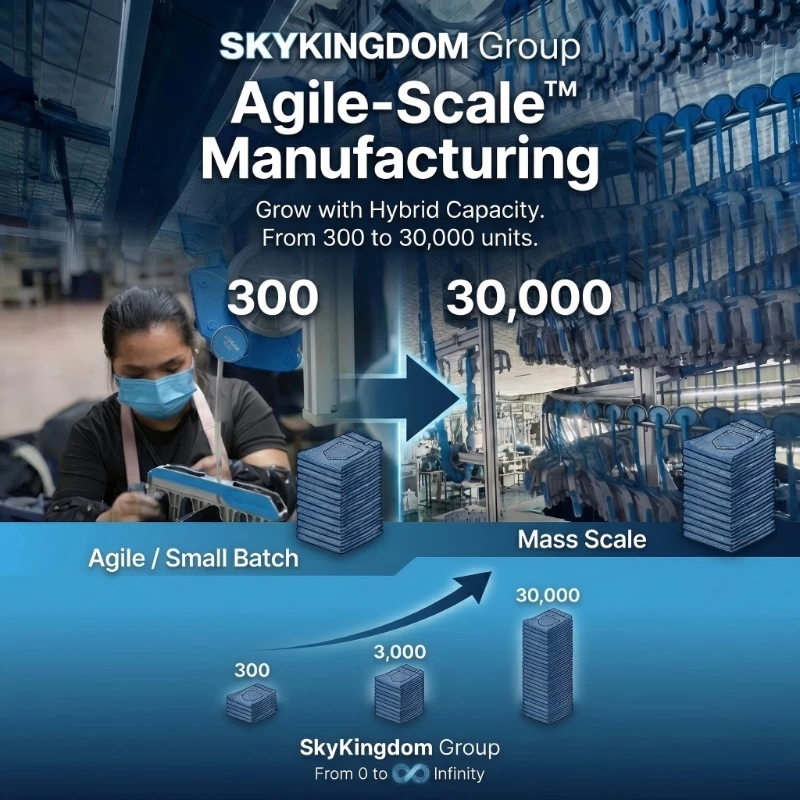
SkyKingdom describes a hybrid capacity concept for scaling: a portion of capacity for fragmented test runs, and the remainder for scaling winning styles.
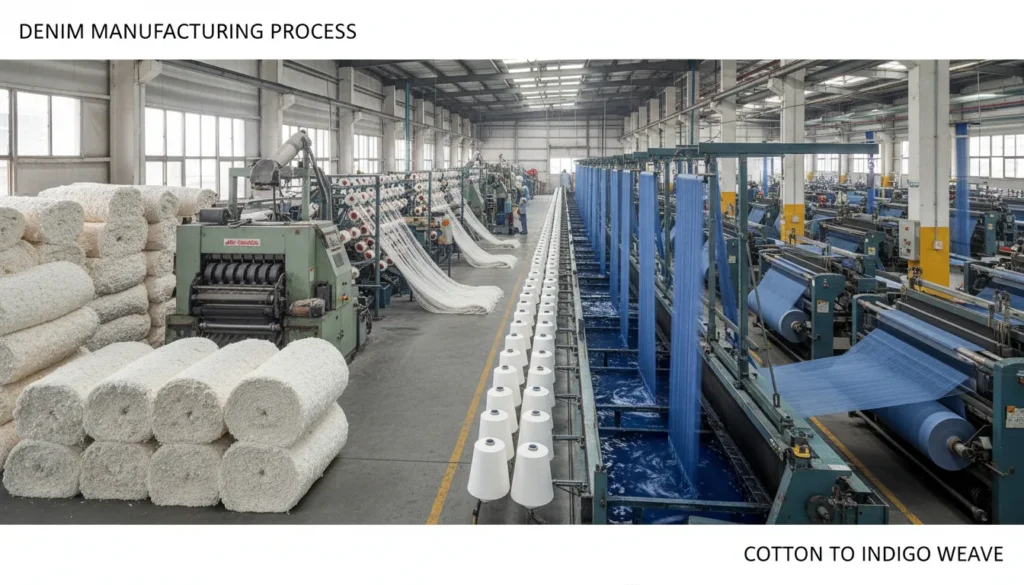
Smart Manufacturing is data-tracked production flow
Smart Manufacturing in apparel should feel like visibility and control, not a buzzword. At minimum, it should include:
- Real-time production status by PO and style
- Bottleneck alerts (cutting, sewing, wash, finishing)
- QC checkpoints tied to operations
- Change control records (who approved what, when)
SkyKingdom states it uses a self-developed ERP for real-time data tracking, and positions itself as a digital factory with 5G IoT production lines and real-time production visibility.
Smart Inventory Management is fabric, trims, and WIP strategy
Smart Inventory Management is what lets a factory move from “we can” to “we will.” For denim, the restock limiter is often not sewing labor. It is readiness of:
- Base denim (greige or pre-dyed)
- Shade continuity lots
- Core trims (zippers, rivets, buttons, thread)
- Work-in-process staging (cut panels, sub-assemblies)
In practice, you want to know what the supplier holds, what it pre-books, and what it can substitute without changing the product.
Confirm proven restock lead times with OEM and ODM evidence
Factor 1: Confirm proven restock lead times
Restock speed must be proven with timestamps, not promises. An OEM or ODM supplier can say “fast response” while still hiding long queue time or unstable wash capacity.
Use these checks to confirm quick response performance:
- Ask for a recent timeline example: sample request date, sample ship date, bulk start date, bulk ship date.
- Separate first bulk from repeat run. Reorders should be faster because the pattern, BOM, and wash recipe already exist.
- Request their on-time rate definition. Confirm if it is based on ex-factory date or arrival date.
- Ask what causes variance: lab dips, trim delays, rework, or wash capacity.
SkyKingdom publishes specific lead time targets in multiple places, including sample timelines (72 hours VIP, 3 to 5 working days standard, 7 days complex) and bulk production (15 to 22 days).
To avoid lost sales during viral spikes, also validate the supplier behavior under pressure:
- What happens when your reorder is urgent and the factory is full?
- Do they have a rush lane or do you join the same queue?
- Can they keep quality stable when they accelerate?
A disciplined supplier will show you how they manage exceptions, not only the happy path.
Micro-Run OEM | 30-Piece Drops
Confirm flexible capacity and scaling for low MOQ manufacturing
Factor 2: Confirm flexible capacity and scaling
Scaling is the hardest part of low MOQ and small batch strategy. Many suppliers can do a 30-piece test. Fewer can do the second and third reorder without changing lines, adding delays, or drifting on shade and fit.
Confirm flexible capacity using a capacity model, not a vague statement:
- Ask how they split flexible lines vs. dedicated lines.
- Ask what the bottleneck is for your category: sewing, wash, laser, or finishing.
- Ask how they protect quick response orders when larger orders compete.
- Confirm their monthly capacity and what portion is realistically available for your peak.
SkyKingdom states capacity and scale of over 150,000 pieces monthly and describes a Smart Line approach that adapts from 300 to 30,000 pieces.
For scaling risk control, look for three operational signs:
- A defined ramp plan: 30 to 300 to 3,000 without re-engineering the product.
- Standardized routes: the same operations sequence each run.
- Bottleneck controls: clear ownership for wash scheduling and finishing.
SkyKingdom positions its Agile-Scale manufacturing around a hybrid capacity system, combining fast-response lines with intelligent lines for scaling.
If your growth depends on social commerce integration, ask for scenarios:
- “If a creator post drives 10x demand in 72 hours, how do you prioritize reorders?”
- “What is the fastest repeat run you have executed in the last quarter?”
Confirm materials readiness and sourcing for sustainable denim
Factor 3: Confirm materials readiness and sourcing
Materials readiness is the hidden engine of quick response. Even the best Smart Manufacturing system cannot sew what it does not have.
Start with denim fabric strategy:
- Ask whether they hold base fabric inventory or only buy after PO.
- Ask how they maintain shade continuity across repeat runs.
- Ask whether they can reserve lots for your winning styles.
SkyKingdom describes a safety stock protocol and a risk-sharing approach where it holds base fabric inventory, plus predictive sourcing where fabric inventory is locked in advance.
Then validate trim readiness:
- Ask for a “reorder-ready BOM” for your style, with approved alternates.
- Confirm availability of hardware: rivets, buttons, zippers, labels.
- Confirm thread specs and color codes, because denim topstitch mismatch is a common repeat-run defect.
If Sustainable Denim is part of your brand positioning, confirm how materials claims are documented. For Traceable Supply Chains, you need more than a supplier promise. You need lot mapping and claim rules.
Better Cotton defines mass balance as a volume-tracking system where the amount of Better Cotton sold cannot exceed the amount purchased, even though cotton may be substituted or mixed along the supply chain after the gin stage. (bettercotton.org)
This matters when you plan Circular Fashion narratives, Recycled Cotton Denim stories, or traceability messaging. Your supplier should tell you which claims are supported by which documentation, and where the limits are.
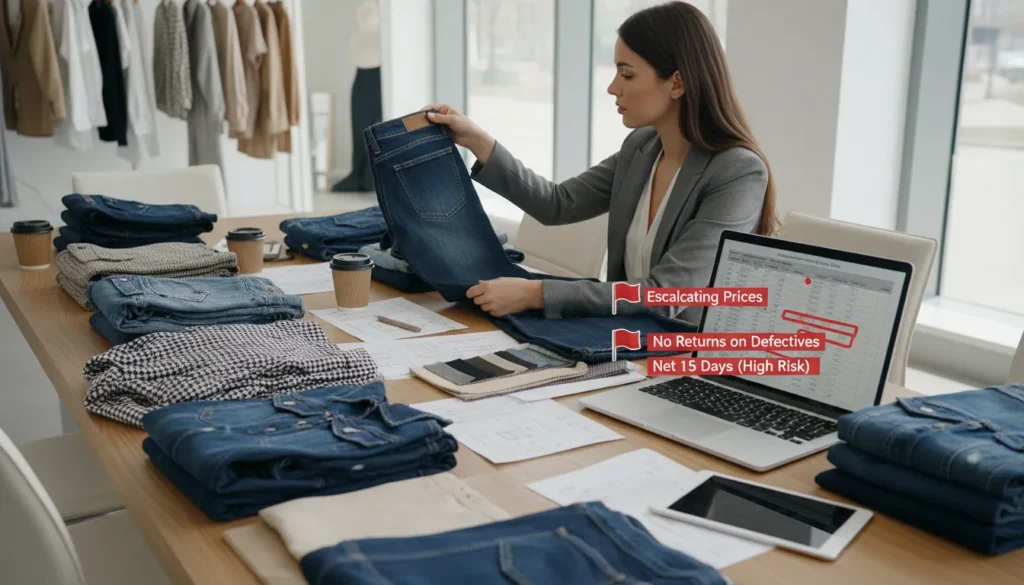
Confirm QC controls for repeat runs in quick response restocks
Factor 4: Confirm QC controls for repeat runs
Fast response without QC is just fast returns. Denim replenishment is especially sensitive because repeat buyers notice small changes in fit, shade, and hand feel.
First, align the QC language and standards:
- Confirm the AQL level you will use and how it changes by risk (new style vs. repeat run).
- Confirm wash standards: shrinkage targets, spirality limits, and tolerance bands for color.
- Confirm measurement points and graded rules, especially for high-volume sizes.
SkyKingdom states it adheres to AQL 2.5 standards with a multi-stage QC system, and it describes inline inspection checkpoints after every five sewing operations plus final audit against AQL standards.
Next, verify inspection coverage:
- Incoming material inspection: fabric rolls, shade bands, and hardware.
- In-line QC: catching defects before wash or finishing locks them in.
- Final inspection: measurement, appearance, shade, and packaging.
If you use small batch testing, you also need repeat-run discipline:
- Confirm defect closure: who owns root cause and prevention.
- Confirm what gets frozen after first approval: pattern, wash recipe, BOM.
SkyKingdom highlights raw-material traceability identification and quality traceability as part of its QC approach.
Confirm digital systems and communication for smart inventory management
Factor 5: Confirm digital systems and communication
Email-only management kills quick response. Every back-and-forth adds a day, and approvals become unclear. If you want a true Agile Supply Chain, you need a system that records decisions and keeps everyone aligned.
Confirm three system capabilities:
- Order visibility: status by PO, style, and line stage (cutting, sewing, wash, finishing).
- Change control: versioning for tech packs, wash comments, measurement updates.
- Timestamped approvals: lab dips, trims, PP sample, size set, TOP.
SkyKingdom states it uses a self-developed ERP system for real-time tracking across the production process, and it positions two-way transparency as part of digital integration.
Define communication rules that reduce restock delays:
- One owner per approval gate.
- A single comment channel for wash and shade.
- A documented reorder trigger based on sell-through.
If Social Commerce Integration drives your demand, digital speed becomes even more critical. Your team needs to see risk early so you can adjust content calendar, ad spend, and preorder messaging before stockouts happen.
How to choose a quick response denim supplier
This decision guide helps you compare suppliers using evidence, not marketing. It also keeps the evaluation consistent across OEM and ODM options.
Lead time proof from PO to ship
Ask for proof in documents and timestamps:
- Last 3 POs for similar products, showing planned vs. actual ship date
- Separate first bulk from repeat runs
- Variance causes and how they were closed
You want a supplier that can show stable variance, not just a best-case timeline.
Capacity model: flexible vs. dedicated lines
Capacity should match your demand pattern:
- If you run frequent small batch drops, you need protected flexible capacity.
- If you run stable evergreen SKUs, dedicated lines can improve consistency.
- If you run both, a hybrid model is often the safest.
SkyKingdom describes a hybrid approach for scaling across different order sizes and positions scalable production lines for both boutique and mass orders.
Inventory strategy: safety stock and greige planning
Smart Inventory Management questions to ask:
- Which fabrics can be pre-held as greige?
- Which trims are always stocked?
- What is the rule for shade band approvals?
SkyKingdom references holding base fabric inventory and predictive sourcing to reduce procurement lead time.
Traceability, documentation, and mass balance
Traceable Supply Chains depend on documentation rules. For cotton programs that use mass balance, the key is volume accounting.
Better Cotton explains that mass balance allows substitution or mixing while ensuring the volume of Better Cotton sold never exceeds the volume purchased. (bettercotton.org)
If you plan to communicate Sustainable Denim claims, your supplier should define:
- Lot mapping for fabric rolls
- Claim units or equivalent volume tracking
- Documentation handoff at shipment
Comparison table: quick response readiness
| Decision area | What to verify | What good looks like | Common risk |
|---|---|---|---|
| Lead times | Sample, bulk, reorder timelines | Clear targets and recent proof | Hidden queue time |
| Scaling | From low MOQ to large repeat runs | Defined ramp plan and protected capacity | Bottlenecks at wash/finishing |
| Materials | Fabric shade continuity and trims | Safety stock or pre-book strategy | Delays from shortages |
| QC | AQL, inline checks, defect closure | Repeatable QC gates and traceability | Fast shipping of bad goods |
| Systems | ERP visibility and approvals | Real-time status and version control | Email-driven confusion |
Conclusion
Quick response denim restock is a measurable capability. You can confirm it by validating lead time proof, flexible scaling capacity, materials readiness, repeat-run QC, and digital systems that reduce approval friction.
If you want to reduce stockouts while staying trend-responsive, start with a low MOQ, small batch test. Then scale only after the supplier proves it can repeat the same result under time pressure.
FAQ
How to manage seasonal demand fluctuations for denim products?
Seasonal demand changes are easier to manage when you treat forecasting as a weekly process instead of a seasonal guess. A small batch plan lets you test early-season fits, washes, and sizes without locking in high inventory. Reorder triggers should be tied to sell-through, such as hitting a defined percentage of stock sold in 7 to 10 days. You should also separate evergreen core styles from seasonal fashion styles, because they need different safety stock rules. Finally, align content launches and restock windows so marketing does not outrun supply.
How to minimize stock issues while scaling up sales of denim products?
You can minimize stock issues by confirming the supplier can scale capacity without changing the product route, wash recipe, or key materials. Clear reorder thresholds based on weekly sales velocity help you reorder before stock hits zero. You should also pre-approve shade bands and keep a reorder-ready BOM so trims do not become the bottleneck. A simple rule like “reorder when 50% is sold” works for many fast-moving styles, but the best trigger depends on your lead time and return rate. Most importantly, keep change requests out of replenishment runs, because changes reset the clock.
How to solve production bottlenecks for new denim designs?
New denim designs bottleneck most often in wash development, trim selection, and approval cycles. You can reduce this by standardizing your spec pack early, including measurement points, stitch types, and hardware placement. You should set firm approval gates for lab dips, PP samples, and size sets, because unclear approvals cause rework. A factory with defined inline QC checkpoints catches issues before wash and finishing lock them in. You should also confirm the supplier has stable access to key processes like laser finishing or special washing if your design depends on them.
Which denim suppliers can quickly restock to avoid lost sales?
The fastest suppliers typically combine quick response timelines with materials readiness and strong process control. You should look for proof of timelines across sampling, bulk, and reorders, not only one fast example like Sky Kingdom. Fabric readiness strategies like holding base fabric or pre-booking key materials reduce delays when demand spikes. Real-time production tracking helps your team respond early to risk, such as wash delays or trim shortages. Consistent QC on repeat runs prevents returns that can erase the benefit of speed.