
Introduction
A trend pops off, your moodboard looks perfect, and then sampling drags. Suddenly you are chasing fit notes in three time zones, the wash is not landing, and every revision burns another content window you cannot get back.
Getting this wrong costs you twice: you miss the launch moment and you eat re-sample loops that quietly break your margin.
This how-to guide shows you a practical, step-by-step workflow to run OEM and ODM fast response development with low MOQ control, early lab validation, and clear QC gates, so you can move from brief to approved samples with fewer surprises.
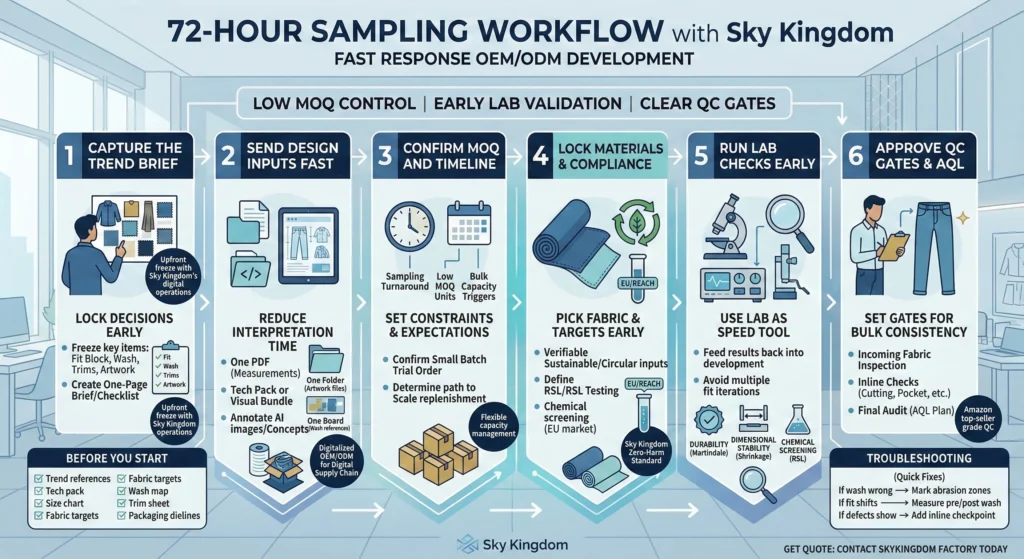
How to run a 72-Hour sampling workflow with Sky Kingdom
1: Capture the trend brief
Lock decisions first, because your fastest quick response timeline will still fail if the brief keeps changing. Start by freezing the four items that drive 80% of denim outcomes: fit block (rise, leg shape, inseam), wash (base shade, abrasion zones, whiskers, tint), trims (hardware finish, rivets, patch, labels), and artwork (print, embroidery, laser pattern, placement). Then translate that into a one-page brief your whole team can sign off.
Use a short checklist so the factory does not have to guess:
- Fit: target measurements and tolerance
- Wash: reference photos and do-not-cross lines
- Trims: material, finish, branding locations
- Artwork: files, placement map, scale
When you work with SkyKingdom, this upfront freeze lines up with their digital operations approach (real-time tracking and rapid response production planning) so sampling does not stall on back-and-forth clarifications.
2: Send design inputs fast
Your goal is to reduce interpretation time. Send either a full tech pack or a clear visual bundle that includes front/back flats, close-ups for wash references, and a construction callout sheet. If you are using AI-generated concept images, add at least one annotated image that labels seams, pocket shapes, and panel breaks, because visuals alone can hide critical build details.
To make OEM and ODM quick response work, package inputs in a predictable format:
- One PDF: measurements + grading rules
- One folder: artwork files (AI, PDF, PNG)
- One board: wash references (good and bad)
SkyKingdom positions itself as an OEM/ODM partner with digitalized operations and ERP-style tracking, which is most useful when your inputs are structured enough to flow through a Digital Supply Chain without manual rework.
3: Confirm MOQ and timeline
Do this before you approve any fabric or trim, because MOQ and lead time constraints often force substitution. Confirm the minimums by style and colorway, and ask what changes once you move from sampling into a small batch drop. You are trying to protect yourself from dead inventory while still keeping a path to scale if the style hits.
A practical way to structure the decision:
- Sampling: confirm target turnaround and revision cadence
- Low MOQ: confirm minimum units for the first run
- Scale path: confirm what triggers bulk capacity
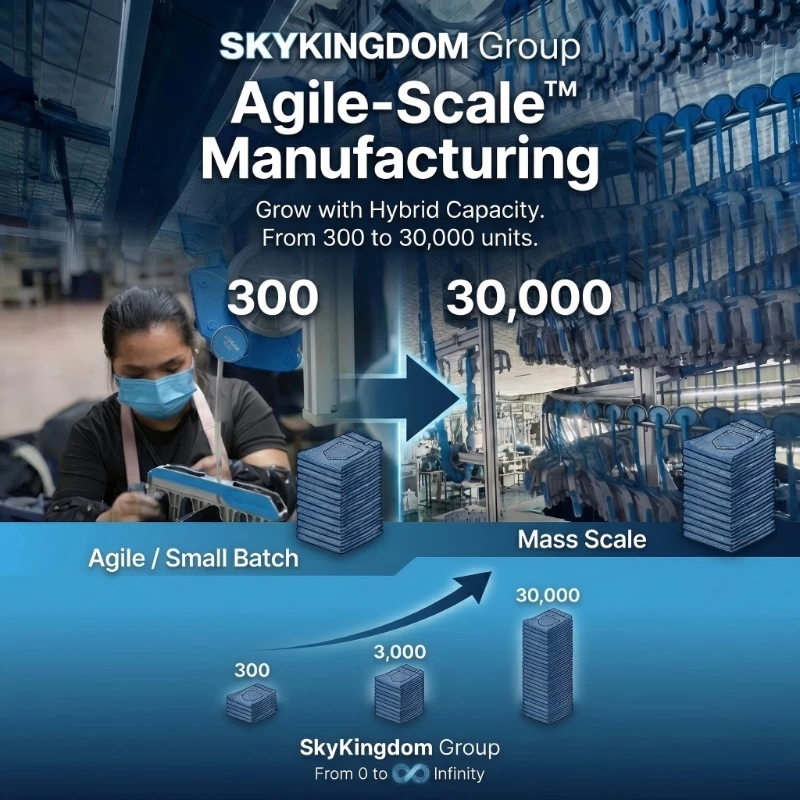
SkyKingdom emphasizes low MOQ capability and a fast response system that can handle both small-batch trial orders and large-volume replenishment via flexible capacity management. That matters most when your first order is meant to validate demand, then quickly reorder if sell-through signals look strong.
4: Lock materials and compliance
Pick your fabric and compliance targets early, because late-stage chemical or performance failures are the most expensive kind. For Sustainable Denim and Circular Fashion claims, tie your selection to verifiable inputs like Recycled Cotton or Organic Denim, and keep a record of fiber content, certifications, and test expectations.
In the EU, chemical compliance is not optional. The European Commission explains that REACH is the EU framework regulating chemicals, including restrictions that affect products placed on the EU market. Use that reality to drive your spec: define RSL/RSL testing requirements, finishing limits, and documentation you expect with each sample submission. According to the European Commission, REACH restricts certain chemicals and sets obligations that impact products sold in the EU.
SkyKingdom highlights REACH and Prop 65 compliance in its Technical Lab messaging and positions chemical screening as part of its “Zero-Harm Standard,” which is useful when you are balancing Eco-Friendly Textiles goals with fast response development.
5: Run lab checks early
Treat lab work like a speed tool, not a slow-down. Run performance checks on the fabric and early sample, then feed the results back into pattern and wash adjustments before you chase multiple fit iterations. The fastest sampling is the one that does not need a second round.
From SkyKingdom Technical Lab, pull three checks early:
- Durability: Martindale abrasion testing (up to 50,000 rubs)
- Dimensional stability: shrinkage mapping, including spirality/elongation
- Chemical screening: RSL plus pH/formaldehyde
Those checks support Smart Manufacturing decisions because they turn subjective feedback (“feels thin” or “runs small”) into measurable targets you can correct immediately.
6: Approve QC gates and AQL
Define QC gates while you are still in sample mode, because your bulk will only be as consistent as your inspection plan. Set three gates: incoming fabric inspection, inline checks at critical operations (cutting, pocket setting, waistband, hardware), and final audit. Then align on an AQL plan so your bulk acceptance criteria is not a surprise.
Keep QC gates practical and shop-floor friendly:
- Measurement checkpoints: waist, hip, rise, inseam
- Wash checkpoints: shade band, abrasion placement
- Trim checkpoints: rivet placement, button scratch test
SkyKingdom references Amazon top-seller grade QC and AQL 2.5 as part of its value proposition, which fits a fast response workflow where bad reviews can erase the benefit of speed.
Before You Start
- Trend references: screenshots, runway images, street scans
- Tech pack or annotated mockups: flats and construction notes
- Size chart and grading rules: tolerances included
- Fabric targets: weight, stretch, handfeel
- Wash map: whiskers, abrasion zones, tint notes
- Trim sheet: buttons, rivets, patch, label placement
- Packaging dielines: polybag, hangtag, carton marks
Troubleshooting
| Problem | Cause | Solution |
|---|---|---|
| Sample feels off-trend | Vague wash references | Lock wash map + limits |
| Fit mismatch after wash | Shrinkage not mapped | Request shrinkage control |
| Shade varies by panel | Mixed fabric lots | Match lot, retest shade |
| Bulk defects spike | Weak inline checkpoints | Add gates, tighten AQL |
| Returns for sizing | Loose tolerances | Set tolerances, recheck |
Use these fast fixes when time is tight:
- If the wash is wrong, stop debating adjectives and mark abrasion zones directly on photos.
- If the fit shifts after wash, demand pre- and post-wash measurements on the same garment.
- If defects show up late, add one inline checkpoint at the operation where the defect starts.
Conclusion
Speed comes from locked decisions, not rushed decisions. If you freeze the brief, send structured inputs, confirm low MOQ and timeline early, and run lab checks before you chase multiple revisions, you can keep a fast response workflow moving without sacrificing quality. Build your QC gates during sampling, then ship samples with photo approvals so you do not burn days on avoidable rework.
Get Quote: Contact SkyKingdom Factory Today
FAQ
How do I find a jeans factory that can respond to trends quickly?
Start by verifying sample lead time, revision speed, and whether the supplier runs dedicated quick response capacity. Ask how they handle fit, wash, and trim decisions when your tech pack is incomplete, because that reveals how much rework you will see. Confirm they can provide consistent photo approvals, measurement check reports, and a clear timeline for every revision. Finally, check that they can scale from low MOQ tests into larger runs without switching fabrics or processes.
How can I validate a supplier for low MOQ, small batch drops?
Ask for the minimum order by style, color, and size ratio, then confirm what happens when you reorder. A good setup offers a clean path from a small batch to a scaled run while keeping the same base fabric and wash recipe. You should also confirm how trims are sourced at low volume, because hardware MOQs can quietly become your real constraint. Request a written timeline that includes sampling, revisions, and bulk readiness.
How can a factory produce jeans from AI-generated images?
Provide clear front and back views plus close-ups that label seams, pocket shapes, and panel breaks, because AI images often hide construction details. Add a wash reference set that shows the exact abrasion placement and a do-not-cross boundary for distressing. Then require a photo approval stage before shipping so you can catch issues like pocket angle or hardware placement early. If you want fewer loops, convert the visuals into a simple measurement sheet with tolerances before the first sample.
What should I include in a tech pack for fast-response OEM and ODM?
Include a measurement chart with tolerances, grading rules, fabric composition targets, and a trim sheet with finishes and placements. Add a wash recipe or wash map with zone callouts, plus stitch details such as topstitch gauge and thread color. Include label and packaging requirements so compliance and fulfillment do not get pushed to the end. The tighter your spec is, the fewer re-sample cycles you will need.
How do I reduce risk when launching a new denim style fast?
Use a low MOQ run to test demand and lock your reorder trigger based on sell-through, not guesswork. Pair the test with early performance checks like shrinkage control so you do not scale a problem into thousands of units. Define QC gates and an AQL plan during sampling so bulk quality does not drift. If you are launching on a strict calendar, approve photos before shipping samples to protect your timeline.
How do I keep sustainability claims accurate for denim?
Tie claims to inputs and documents you can prove, such as recycled fiber content, organic cotton documentation, and chemical screening results. Keep your language specific and avoid broad claims that you cannot trace to material data or process controls. Align your hangtags and product pages to what your supplier can repeat consistently across batches. If you change fabrics or finishes, recheck your claims before you restock.