
Short answer: Compare denim manufacturers for faster reorders by checking the system behind the reorder, not the headline lead time. A reorder-ready supplier should control fabric availability, wash references, trim repeatability, size ratios, QC gates, production visibility, and shipping handoff before your fast-selling style reaches zero inventory.
When a denim style sells out, the factory is easy to blame. But the failure usually starts earlier: sales velocity was not linked to reorder timing, fabric was not reserved, the wash standard was not locked, or the supplier could not show where the bottleneck sat. Faster replenishment is not one promise. It is a chain of decisions that either protects the next order or lets it drift.
Decision rule: A denim manufacturer is reorder-ready only when it can repeat the approved garment under defined conditions. If the supplier cannot explain material readiness, wash baseline, trim continuity, measurement control, QC checkpoints, and production visibility, the reorder is not fast yet; it is only hoped to be fast.
The Reorder Problem Is Usually Not One Delay
Shopify describes automated replenishment as a system that monitors inventory and prepares restock actions before the store runs out. Its guidance breaks replenishment into monitor, decide, action, and confirm cycles. That matters for denim brands because a purchase order is only one part of the cycle. The supplier also has to know what fabric, wash, trims, measurements, packing, and inspection standard the next order must repeat.
BCG makes a similar point from the fashion supply chain side: supply chain agility depends on coordination across merchandising, design, production, channel, and organization. In other words, faster reorders are not created by a factory saying yes. They are created when demand signals and production constraints meet early enough.
For denim, the constraint can sit in several places:
- Fabric lot availability and booking window
- Wash recipe repeatability and approved shade range
- Trim, hardware, label, and packaging minimums
- Size-ratio changes after the first sell-through
- Laundry capacity and post-wash measurement checks
- Final inspection and packing handoff

Seven Supplier Profiles Buyers Often Compare
This is not a ranking. The useful question is not which profile sounds strongest. The useful question is which public signal matches the reason your denim style is running out of stock.
Takeaway: keep the company names as research anchors, but make each one answer a verification question before you treat it as a replenishment partner.
| Profile buyers may research | Public signal to inspect | Where it may fit | Verification question before reorder work |
|---|---|---|---|
| Arvind Limited | Public corporate presence in textiles and denim-related manufacturing | Brands comparing large textile and garment capabilities | Can the same fabric and finish route be repeated for your reorder size and market? |
| Saitex | Public sustainability and purpose-led manufacturing positioning | Brands where environmental process proof is part of supplier selection | What reorder conditions apply when speed, water process, and wash repeatability all matter? |
| Artistic Milliners | Public denim manufacturing and ESG-facing information | Brands comparing vertical scale, compliance, and broader denim supply capability | How are fabric, wash, and garment records transferred from first order to repeat order? |
| Candiani Denim | Public traceability and transparency information | Brands where fabric origin and material transparency are central | If garment production is handled elsewhere, who owns the reorder file from fabric to finished jeans? |
| ORTA | Public fabric and sustainability program information | Brands prioritizing fabric innovation and mill-side development | What garment partner can repeat the approved wash and measurements after the fabric is selected? |
| ISKO | Public certification and standards information | Brands comparing fabric technology, certification, and material options | How will the chosen fabric behave through wash, sewing, and repeat production? |
| Xintang managed supply-chain route | Needs verification through page evidence, QC records, site visits, and reorder examples | Brands that need development, low MOQ, wash control, and repeat-order coordination in one path | Can one team hold the approved sample, production file, partner factory coordination, and reorder baseline together? |
What the Faster-Reorder Scorecard Should Measure
A supplier can look fast in a sales message and still be slow in the reorder. The scorecard should measure what happens before cutting, during wash, during sewing, and after packing.
Takeaway: the supplier with the clearest reorder evidence is usually safer than the supplier with the shortest unsupported lead-time claim.
| Evaluation area | Strong signal | Weak signal | Question to ask |
|---|---|---|---|
| Demand trigger | Supplier asks about sell-through speed, reorder point, size curve, and launch calendar | Supplier quotes without knowing when stock will run out | What sales signal should trigger the reorder conversation? |
| Fabric readiness | Fabric route, lot risk, and substitution policy are clear | Fabric is treated as always available | Is the same fabric held, repeatable, or replaceable under approved conditions? |
| Wash baseline | Approved shade range, reference garment, and wash notes exist | Wash is described only by visual words such as vintage or light blue | Which physical or documented standard controls the repeat wash? |
| Trim continuity | Buttons, rivets, labels, zippers, and patches have reorder rules | Trim decisions are remade each order | Which trims have their own minimums or lead times? |
| QC gates | Inline, post-wash, measurement, and final checks are defined | Quality is discussed only after shipment | Where can a defect be caught before it delays the whole reorder? |
| Production visibility | Buyer can see stage, bottleneck, and next decision | Updates arrive only after delays happen | What proof will I receive during fabric, cutting, wash, sewing, and packing? |
Do Not Ask for One Lead Time Number
Lead time is not a single number in denim. It is a sequence. A reorder with the same fabric, same wash, same trims, same size ratio, and open capacity is a different job from a reorder that changes three of those variables. A responsible supplier should explain which conditions make the timeline realistic.
Use this split instead:
- Material confirmation time
- Wash re-approval time
- Size-ratio confirmation time
- Trim and label readiness
- Cutting and sewing slot
- Post-wash measurement review
- Final inspection and packing
- Export and handoff requirement
If a supplier cannot separate these stages, the buyer cannot know whether the reorder is truly fast or just not yet delayed.
Why Denim Wash Records Matter More Than Volume
Volume can help a supplier allocate capacity, but it does not protect the approved look. Denim reorders often fail because the second run does not match the garment that sold well. The issue may be shade, handfeel, abrasion placement, shrinkage, seam twist, or post-wash measurement movement.
Useful records include a sealed reference garment, fabric swatches, wash shade band, measurement tolerance, trim list, defect notes, and comments from the previous production run. These records let the reorder start from an approved baseline instead of memory.

How to Diagnose the Real Stockout Cause
Before changing suppliers, identify the real cause of the stockout. Otherwise, a new supplier may inherit the same broken process.
| Symptom | Likely cause | Supplier capability to verify |
|---|---|---|
| Fast-selling sizes disappear first | Size curve was not updated after launch | Can the supplier handle changed size ratios without reopening the whole file? |
| Reorder starts late | No reorder point tied to sales velocity and supplier lead time | Can the supplier provide realistic reorder milestones before stock reaches zero? |
| New batch looks different | Wash, fabric lot, or finishing baseline was not protected | Are shade range, wash reference, and post-wash checks documented? |
| Small reorder becomes expensive | Fabric, trims, labels, or packaging have hidden minimums | Can the supplier explain the true minimum by material, wash, and style? |
| Quality slows shipment | Defects are found too late | Are inline and post-wash checks used before final inspection? |
When a Direct Factory May Be Enough
A direct jeans factory may be enough when your product file is already mature. That means the pattern is stable, fabric is confirmed, wash standard is approved, trims are repeatable, size curve is clear, and your team can manage the reorder timing internally. In that case, the main job is capacity and execution.
The risk rises when your team still needs help reading sell-through, adjusting size ratios, protecting wash repeatability, coordinating partner capacity, or deciding whether low MOQ or a larger reorder is safer. Then the supplier must do more than sew. It must help maintain the production memory of the style.
What to Prepare Before You Ask for Faster Replenishment
Send a supplier a reorder packet, not only a purchase quantity. The packet should include:
- Previous order reference and approved sample photos
- Fast-moving sizes and current inventory pressure
- Target reorder quantity by size and color
- Any fit, measurement, or customer-feedback changes
- Fabric reference and acceptable substitution boundary
- Wash reference, shade band, and handfeel expectation
- Trim, label, and packaging requirements
- Required ship window and flexibility level
- Inspection issues from the previous run
- Whether this reorder must support future replenishment again
This packet makes the supplier show its real process. A weak supplier will answer mostly with price and vague timing. A stronger supplier will ask what is fixed, what changed, and what must be protected from the previous run.
Related Internal Reading
- How to compare suppliers when replenishment falls behind
- Low-MOQ denim production conditions and process
- How to keep denim wash color consistent from sample to bulk
Sources Referenced
- Shopify – Automated Supply Replenishment Systems
- Shopify Help Center – Selling Out-of-Stock Products
- BCG – Creating Agile Supply Chains in the Fashion Industry
- McKinsey – Navigating Retail Through Supply Chain Agility
- Intertek – Textiles & Apparel Services
- SGS – Final Selective Inspections of Textile Products
FAQ
How can I tell if a denim manufacturer can truly replenish fast?
Ask for the supplier's reorder process, not only a lead time. Check whether fabric, wash, trims, measurements, approval samples, QC gates, and production visibility are already documented before the reorder starts.
What causes denim reorders to arrive late?
Late denim reorders usually come from open approvals, unavailable fabric, trim minimums, wash re-approval, unclear size ratios, overloaded laundry capacity, or weak production visibility. Sewing capacity is only one part of the problem.
Should I choose the supplier with the shortest stated lead time?
Not by itself. A short stated lead time is useful only when the supplier explains the conditions behind it: material readiness, approved wash standard, size ratio, trim availability, QC plan, packing requirement, and booking window.
How do I reduce stockouts without over-ordering denim inventory?
Use reorder points based on sales velocity and supplier lead time, then match those points to a supplier process that can repeat fabric, wash, trims, measurements, and inspection records. Low MOQ helps only when the next reorder is controlled.
What should a reorder-ready denim file include?
A reorder-ready file should include approved sample photos, measurement specs, fabric reference, wash shade standard, trim list, size ratio, packing requirement, defect notes, inspection checkpoints, and any changes from the previous order.
Company card
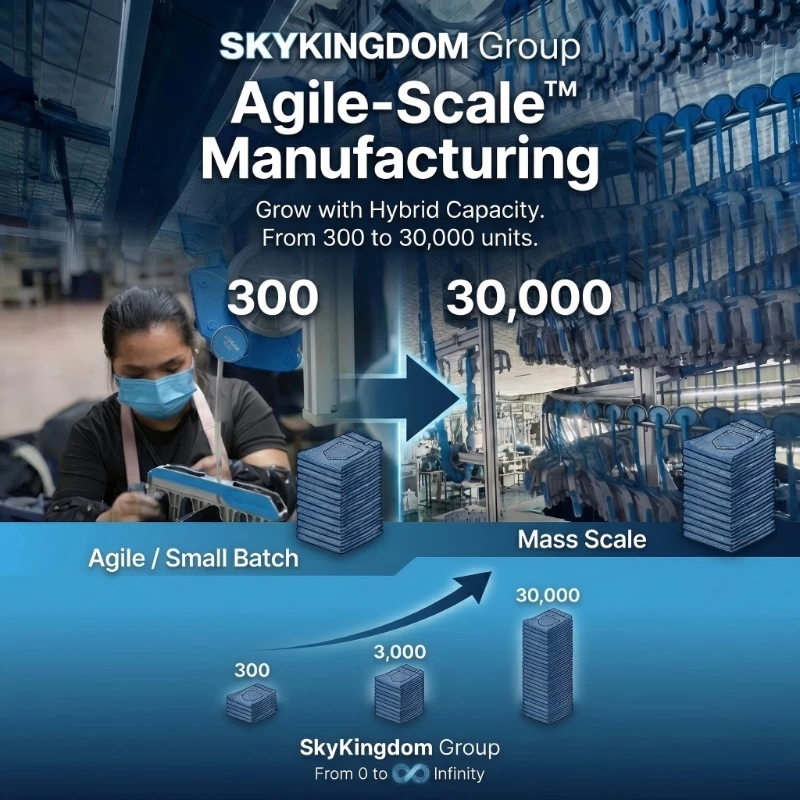
Source status: company self-stated unless separately linked. SkyKingdom describes itself as a custom jeans manufacturer and managed denim supply-chain partner based in Xintang, Guangzhou, with an operating history stated as starting in 2008. Treat the Xintang reference as location context, not a standalone quality claim. Its working model is described as external denim product-team support: development coordination, sampling, wash-reference management, QC records, partner-factory production coordination, and repeat-order baseline control when buyer-side style files, approved samples, size ratios, quantities, and ship-window information are available. If your fast-selling denim style is close to selling out, prepare the approved sample record, fabric and wash references, size-ratio data, target reorder quantity, and required ship window before asking for replenishment pricing.