
Author: Sky Lung and the production review team
Reviewed: June 13, 2026
Evidence basis: Reviewed against buyer-side supplier checks: project stage, MOQ exposure, sampling path, QC handoff, communication records, and reorder risk. This page is an educational guide, not a supplier ranking.
Why Growing Brands Face a Different Problem Than Startups
A startup denim brand’s biggest risk is making something nobody wants. A growing brand’s biggest risk is different: it is making something people want but failing to restock it fast enough, or overcommitting to the next style before the data supports it. The operational challenge shifts from product validation to demand response.
At this stage, the wrong production partner creates specific, measurable damage. If your hero jean sells through in ten days but your reorder takes six weeks because the partner needs to re-source fabric, re-develop the wash, and re-approve the fit, you lose three to four weeks of peak demand. If you try to hedge by ordering deep on a new style that has not been market-tested, you risk sitting on inventory that ties up cash for months. Both mistakes come from the same root cause: a production setup that cannot flex between testing new concepts and scaling proven ones.
The evaluation framework below is built for brands at this exact inflection point — past the startup phase, generating real sales data, and needing a partner that can act on that data without forcing you to rebuild the process from scratch each time.
Capability 1: Wash Consistency Across Production Runs
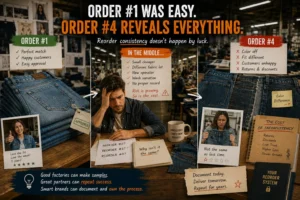
For a growing denim brand, wash is where most reorder problems originate. Your first production run looks right. You sell through. You reorder. The second batch arrives in a slightly different shade, or the hand feel is stiffer, or the distressing pattern shifted. Customers who bought the first run notice. Returns increase. The social proof from your initial launch gets undermined by an inconsistency that happened in the laundry, not in your design.
Wash consistency is not a binary capability — a partner either has it or does not. It is a system that depends on documentation, supervision, and verification at every run. Here is what to evaluate:
Wash recipe documentation
A credible denim development partner records the full wash recipe for every approved style. That means enzyme type (acid cellulase, neutral cellulase, or laccase for bio-bleaching), enzyme concentration as a percentage of garment weight, stone type and load ratio as a percentage of drum capacity, cycle duration at each stage, water temperature, and pH at each step. These are the parameters that determine whether a wash is repeatable. If your partner cannot show you a recipe card for an approved wash, they are relying on operator memory, and operator memory does not survive staff turnover, machine changes, or facility switches.
Shade library and approval process
Every approved wash should have a physical swatch retained as the master standard. Before any bulk wash proceeds — including reorders — a test swatch from the new production run should be compared against the master under controlled lighting. If the shade drifts outside tolerance, the recipe gets adjusted before the full batch enters the drum. This step adds perhaps half a day to the timeline but prevents the kind of shade mismatch that generates returns and erodes customer trust.
In-house versus outsourced wash
Many denim production setups outsource washing to specialist laundry partners. This is common and not automatically a problem. What matters is the role your development partner plays: are they the standard-setter and supervisor, or are they passing your garments to a third party without controlling the recipe? A good partner defines the wash specification, approves the lab swatch, and inspects the first bulk output against the approved standard before the full run proceeds. The wash house executes; your partner owns the result.
Capability 2: Quality Control That Matches Your Brand Position
Quality control in denim is not one standard applied to every order. It is a tiered system, and the right level depends on your price point, your target market’s expectations, and how much return risk you can absorb.
The garment industry standard for quality inspection is AQL — Acceptable Quality Limit — defined under ISO 2859-1. It uses statistical sampling to determine how many defects in a randomly selected sample are acceptable before the entire lot is rejected. Defects are classified into three tiers, each with a different tolerance threshold:
Critical defects receive zero tolerance. These are safety hazards — a needle left in a garment, a sharp metal edge on hardware, or a chemical residue that violates restricted substance regulations. Any critical defect found means the lot fails.
Major defects are the primary quality measure for most denim brands. These include broken or jammed zippers, measurements outside tolerance, fabric defects visible to the consumer, skewed alignment on logos or pockets, or incorrect labelling. The standard threshold is AQL 2.5, which means a lot is accepted if the number of major defects in the inspected sample falls below the limit specified in the AQL sampling table for that batch size. For a 1,000-unit lot inspected at General Inspection Level II, the sample size is 80 units, and the acceptance limit for major defects at AQL 2.5 is 5 units — meaning 6 or more major defects triggers a lot rejection.
Minor defects — small loose threads, slight shade variation within tolerance, minor cosmetic imperfections that do not affect function — are typically assessed at AQL 4.0, a slightly more lenient threshold.
Choosing the right AQL level for your brand
AQL 2.5 for major defects is the industry baseline and works for most DTC denim brands. However, if you are selling at a premium price point, shipping to retailers with strict compliance requirements, or targeting markets like Japan, the EU, or major US department stores, you may want to tighten to AQL 1.5. This reduces the number of allowable defects per sample and increases the probability that every unit a customer receives meets your standard.
For first production runs of a new style, some brands request 100% inspection — every single unit is checked — to establish a quality baseline and identify any systematic issues in construction or finishing. Once the style has been produced successfully and the sewing line is calibrated, subsequent runs can shift to standard AQL sampling.
A capable denim partner should be able to execute at any of these levels — 1.5, 2.5, 4.0, or 100% — depending on what you need for that specific order. If a partner only offers one inspection level regardless of your request, that is a signal that their QC process is not flexible enough for a growing brand with evolving standards.
Inline inspection versus final inspection
These are two different checkpoints, and both matter for denim.
Inline inspection happens during production. Inspectors check stitching quality, seam strength, bar-tack integrity, and measurement accuracy at the sewing stage — before the garment moves to washing. Catching a measurement drift or a construction error at this stage costs minutes to fix. Catching it after the garment has been washed, pressed, and packed costs a full rework cycle.
Final inspection happens after washing, pressing, and packing, and uses AQL sampling to make a pass or fail decision on the finished lot. This is where shade consistency, hand feel, puckering after wash, and finishing details get evaluated. Some defects — particularly those related to wash chemistry — only become visible after the garment has been through the laundry.
Ask your partner specifically: do they run inline checks during sewing, or do they rely solely on a final audit? A growing brand cannot afford a QC process that only catches problems after the entire lot is complete.
Capability 3: Reorder Speed Without Redevelopment
The reorder is where a growing denim brand either captures demand or watches it evaporate. A style that sells through in two weeks needs a restock system that can respond in days, not weeks. But speed alone is not enough if the reorder arrives in a different shade, with slightly different measurements, or with trims that do not match the first run.
Reorder speed depends on how much of the development work carries forward from the first production run. Here is what to check:
Pattern retention. Does your partner store the approved pattern digitally so it can be pulled immediately for the next cut? Or does re-cutting require re-grading and re-approval?
Wash recipe retention. Is the approved wash recipe documented and filed so the laundry partner can replicate it without a new development cycle? This is the single biggest variable in denim reorder speed. If the wash needs to be re-developed from scratch, you are adding five to seven days before the garment even enters the drum.
Fabric continuity. Can your partner hold or pre-book fabric for repeat colourways? If the base fabric has a four-to-six-week lead time and your style sells out in two weeks, the reorder stalls unless fabric was reserved in advance. Ask whether your partner offers predictive fabric reservation — holding a defined quantity of your core fabrics based on your sales velocity — so that reorders can start cutting immediately.
Trim and label inventory. Hardware, labels, and packaging components often have their own lead times. A partner with a reorder-ready system keeps approved trims in stock or on short-cycle reorder so they do not become the bottleneck.
When all of these elements carry forward, a reorder compresses dramatically — often skipping straight to cutting and sewing with a wash approval check, rather than restarting the full development timeline.
Capability 4: Small Batch Flexibility for New Styles
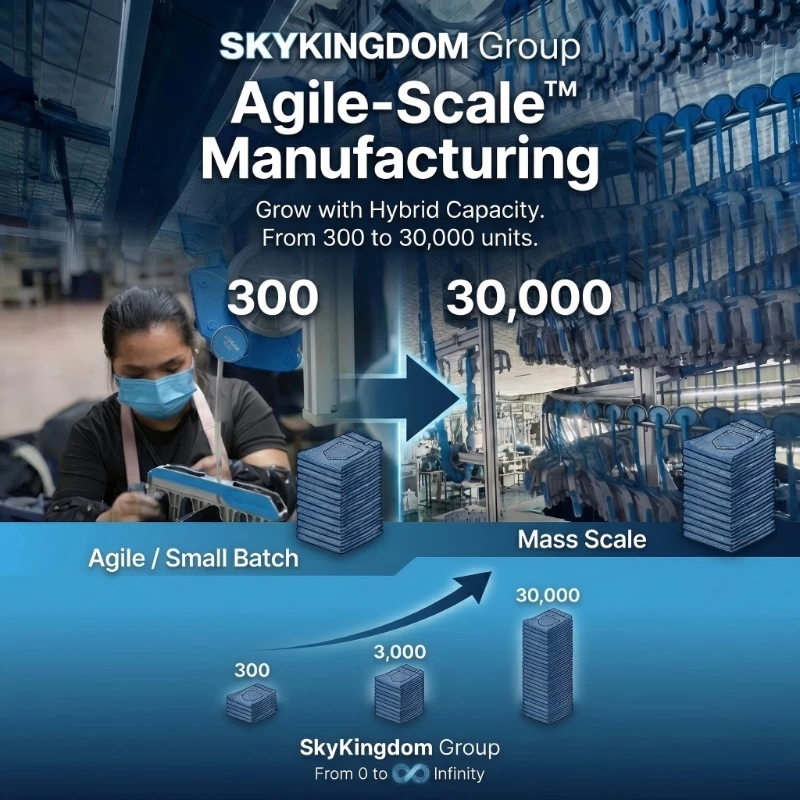
A growing brand needs two parallel systems running simultaneously. One scales proven winners through fast reorders. The other tests new concepts through small batches with controlled risk. These are different operational modes, and not every production partner handles both well.
Small batch production for a growing brand is not the same as a startup’s first sample. You already have sales data, customer fit feedback, and a defined brand aesthetic. Your small batch is a market validation step — a conservative initial run designed to generate real sell-through data before you commit deeper inventory.
The discipline is straightforward: place a small initial batch, measure first-week sell-through and return rate, review size curve accuracy, collect shade and fit feedback, and use that data to make a reorder decision with confidence. If a style underperforms, your exposure is limited. If it performs, you scale through the reorder system described above.
Ask your partner whether they can run a small test batch and then move the same style into a larger reorder without restarting development. The ability to transition a style from test to scale within the same supply chain — using the same pattern, same fabric source, same wash recipe — is what separates a partner built for growing brands from one optimised for one-off production.
Capability 5: Digital Visibility into Production Status
Unpredictable demand punishes brands that rely on email-only production updates. When a hero style is selling faster than expected, you need to know immediately whether the reorder is on track — where the fabric is, when cutting starts, whether the wash is approved, when the lot ships. When a new style is underperforming, you need to know whether you can pause or reduce the production run before more units are cut.
Digital production visibility means your team can see milestone status in something closer to real time rather than waiting for a weekly email update. The specific tool matters less than the discipline: is there a single source of truth where fabric status, cutting progress, sewing completion, wash approval, inspection results, and ship dates are tracked and visible to your team?
For growing brands, the highest-value moments for digital visibility are fabric booking confirmation (so you know the reorder timeline is real), wash approval status (so you can intervene before a shade problem becomes a lot problem), and inspection results (so you can make a ship or hold decision before the goods leave the facility). If your partner can surface these three data points without you having to chase them, your planning team can make faster, better-informed decisions about inventory allocation and launch timing.
How to Weight These Capabilities Based on Your Primary Risk
Not every growing brand faces the same demand pattern. The way you prioritise these five capabilities should reflect your specific risk profile:
If your primary risk is dead stock — you are ordering too deep on styles that do not sell through — prioritise small batch flexibility and digital visibility. You need to test before you commit and see production status early enough to adjust.
If your primary risk is missed restocks — your hero styles sell out and you cannot reorder fast enough — prioritise reorder speed and fabric continuity. Pattern retention, wash recipe documentation, and pre-booked fabric are your highest-value partner capabilities.
If your primary risk is returns and quality complaints — customers are reporting shade inconsistency, fit variation, or construction defects — prioritise wash consistency and QC depth. Documented wash recipes, shade library approval, inline inspection, and tiered AQL levels will have the most immediate impact.
Most growing brands face some combination of all three, but identifying which risk is costing you the most money right now helps you ask the right questions during partner evaluation and weight the answers correctly.
Questions to Ask a Potential Denim Production Partner
These are the specific questions that reveal whether a partner’s system matches a growing brand’s needs. The answers matter more than capability claims on a website.
On wash: How do you document wash recipes? Can you show me a recipe card for an existing style? Do you retain physical shade swatches, and do you compare them before every bulk run?
On QC: What AQL levels can you execute? Do you run inline inspection during sewing, or only a final audit? How do you handle a lot that fails inspection — rework, re-inspect, or reject?
On reorders: Do you retain my pattern and wash recipe after the first run? Can you hold fabric for repeat colourways? What is the realistic timeline for a reorder of a proven style, assuming fabric and trims are available?
On small batch: What is the minimum quantity for a test production run? Can that test run transition into a larger reorder without redevelopment? Do you treat small orders with the same QC standard as bulk?
On visibility: How does my team track production status? Is there a dashboard, shared document, or system I can access directly? At what milestones do I receive updates?
On sample turnaround: What is your standard sample turnaround time, and what needs to be confirmed before the clock starts? A standard sample turnaround of seven working days is realistic when fabric and trims are already confirmed. If those are still being sourced, the timeline extends accordingly.
Frequently Asked Questions
How do you evaluate a denim partner’s reorder capability before committing?
Ask whether the partner retains your approved pattern, wash recipe, and shade swatch after the first production run. Check if they can pre-book or reserve fabric for repeat colourways. A strong reorder setup means the second run skips most development work and moves almost directly into cutting, which compresses turnaround significantly compared to rebuilding from scratch.
What is the difference between OEM and ODM for a growing denim brand?
OEM works when your fit block, wash direction, and trim package are already defined — your partner executes to your specs. ODM provides development support, helping with fit creation, wash options, and material selection before you finalise the tech pack. Many growing brands use ODM during their first few seasons to build their spec library, then shift toward OEM as their internal design process matures.
Why does wash consistency matter more than wash variety for growing brands?
A growing brand’s reorder value depends on the winning style arriving in the same shade and hand feel every time. If the reorder batch shifts even slightly in wash tone, customers notice, returns increase, and the social proof from the first run gets undermined. Consistency across runs requires documented wash recipes with enzyme concentration, stone load ratio, cycle time, temperature, and pH recorded and re-verified on each production batch.
How should a DTC denim brand use small batch production to manage inventory risk?
Place a conservative initial batch to test real sell-through, return reasons, and size curve accuracy. Use that data to decide whether to reorder, adjust, or retire the style. This approach limits your downside on styles that underperform while preserving the ability to scale winners quickly. The key is having a production partner with the reorder infrastructure to respond fast once the demand signal is clear.
What quality control checkpoints should a denim brand require from a production partner?
At minimum, require inline inspection during sewing — checking stitching, measurements, and construction before the garment enters wash — a wash swatch approval step before bulk wash proceeds, and a final AQL-based inspection after washing, pressing, and packing. The AQL level should match your brand positioning: AQL 2.5 for major defects is standard, but brands selling at premium price points may tighten to AQL 1.5.
When should a growing denim brand move from small batch testing to deeper inventory?
Scale after you see repeatable sell-through across at least one full cycle: launch, review, reorder, and deliver again without a major quality or supply disruption. One strong first week is not enough if returns are high, shade consistency is unproven on reorder, or fabric supply is not secured for a second run. The signals that support scaling are stable fit feedback, confirmed wash repeatability, and pre-booked fabric for the next run.
SkyKingdom works with DTC denim brands at the growth stage that need wash supervision, tiered QC, and a reorder system built for speed without redevelopment. If you are evaluating production partners and need to see how these capabilities work in practice — start a conversation here.