
Author: Sky Lung and the production review team
Reviewed: June 13, 2026
Evidence basis: Reviewed against buyer-side supplier checks: project stage, MOQ exposure, sampling path, QC handoff, communication records, and reorder risk. This page is an educational guide, not a supplier ranking.
Step 1: Lock the Trend Brief Before You Request a Sample
The most expensive mistake in fast-response denim is not slow production — it is a vague brief that triggers repeated sample revisions. Every revision loop adds five to ten days depending on fabric availability, and most of that time is avoidable. Before you send anything to a development partner, your brief should answer one question completely: can someone cut this sample without calling you back?
That means defining the target fit, rise, leg shape, wash depth, trim direction, and launch date in a single document. If you are chasing a Y2K revival trend, spell out the exact details — washed black versus medium vintage, cargo pocket placement and flap dimensions, wide leg versus straight, distressed knee versus clean finish. Attach front and back visuals or 3D modelling files. List fabric weight, stretch percentage, and wash target. Confirm label placement, trim finishes, and packaging specs.

A clean brief does three things. First, it lets a development team price the style and source materials in one pass instead of two or three. Second, it protects your launch calendar because each avoided revision loop saves roughly a week. Third, it makes wash development more accurate — if your wash target is defined with a physical swatch or Pantone reference, the laundry partner can match it on the first attempt instead of guessing from a mood board.
The most common version of this mistake is approving the silhouette first and then changing the wash, trims, or pocket details after the first sample is already cut. That forces a second round from scratch and doubles your development time.
Step 2: Verify Your Partner’s Wash and QC Capability Before Committing
Speed claims are easy to make. What matters is whether the partner’s actual setup supports the wash complexity and quality control your brand requires. Before you commit to a production partner for quick-response denim, you need to verify three things: wash development depth, inspection process, and reorder infrastructure.
Wash development depth
Denim wash is where most quality problems originate, and it is also where trend accuracy lives or dies. A wash that looks right on one sample but shifts in bulk production will generate returns, shade complaints, and lost reorder potential. Ask your partner how they document wash recipes. A credible operation records enzyme type and concentration, stone load as a percentage of drum capacity, cycle duration, water temperature, and pH at each stage. They also keep a physical swatch library of approved washes so that any repeat production starts from a verified standard — not from memory.
If your partner outsources washing to an external laundry, that is common and not automatically a problem. What matters is the role they play: are they the standard-setter and supervisor, or are they passing your sample to a third party without controlling the recipe? A good development partner defines the wash specification, approves the lab dip, and inspects the first bulk output against the approved standard before the full run proceeds. The wash house executes; your partner owns the result.
Inspection process and AQL levels
AQL — Acceptable Quality Limit — is the standard the garment industry uses to determine how many defects in a sample are acceptable before a batch is rejected. It is defined under ISO 2859-1 and uses statistical sampling rather than piece-by-piece checking. The standard practice for denim and most consumer apparel follows a three-tier structure: zero tolerance for critical defects (safety hazards like needles left in garments), AQL 2.5 for major defects (broken zippers, incorrect measurements, skewed prints), and AQL 4.0 for minor defects (small loose threads, slight shade variation within tolerance).
However, not every brand should use the same thresholds. If you are selling at a premium price point or shipping to markets with strict compliance expectations — the EU, Japan, or major US retailers — you may want to tighten major defect tolerance to AQL 1.5. For initial test runs where you want absolute certainty on a new style, some brands request 100% inspection on the first batch to establish a baseline, then shift to AQL sampling for reorders once confidence is built. A capable partner should be able to execute at any of these levels — 1.5, 2.5, 4.0, or 100% — depending on what your brand needs for that specific order.
Ask specifically about the difference between inline inspection and final inspection. Inline inspection happens during production: inspectors check stitching quality, seam strength, and measurement accuracy at the sewing stage, before the garment moves to washing. Final inspection happens after washing, pressing, and packing, and uses AQL sampling to make a pass or fail decision on the finished lot. Both checkpoints matter. Some defects — like bar-tack failures or measurement drift — are cheaper to catch before the garment enters the wash cycle. Others — like shade inconsistency, puckering after wash, or hand-feel problems — only become visible after finishing.
Reorder infrastructure
Fast response is not just about the first order. The real value shows up on the second and third runs of a winning style. Ask how your partner handles reorders: do they retain your pattern, wash recipe, and approved shade swatch? Can they hold or pre-book fabric for repeat colourways? A strong reorder setup means your second run skips most of the development stage and moves almost directly into cutting, which can reduce turnaround by a significant margin compared to building from scratch each time.
Step 3: Test with a Small Batch Before You Commit to Bulk
The gap between a good sample and a bulk-ready style is larger than most new brands expect. A sample proves that the construction, fit, and wash are technically possible. It does not prove that the style will sell, that the sizing works across your full size range, or that the wash holds up after consumer laundering. Small batch production fills that gap.
A small test run — typically 30 to 100 pieces depending on your size range and distribution — gives you real data on fit feedback, return reasons, shade acceptance, and sell-through rate. That data is what separates a confident bulk order from an expensive guess.
The process works like this: run one sample round focused on fit and construction. Once approved, place a small test order. Sell through the test batch and collect real feedback — not opinions from your team, but actual customer behaviour. What sold first? What came back? What shade or size got the most complaints? Use that feedback to adjust grading tolerances, wash standards, or trim details before committing to a larger production run.
Small batch production also protects cash flow. A 50-piece test run at denim unit costs is a manageable risk for a startup or creator brand. A 500-piece bulk order on an untested style is not. Treat your first production batch as a market test, not a finished product launch.
The most common mistake here is treating the first approved sample as bulk-ready. A sample is made under controlled conditions with focused attention. Bulk production introduces variability — in cutting, sewing operator consistency, wash drum loading, and fabric lot differences. The small batch is where you catch those gaps before they become a 500-unit problem.
Step 4: Control Approvals Digitally from Sample to Bulk
Speed breaks down when production updates live in scattered WhatsApp threads, email chains, and spreadsheets that nobody keeps current. A repeatable denim launch system requires one approval path with version control at every stage.
Here is what that looks like in practice. Your tech pack is the master document, and it carries a version number that updates every time a change is approved — V1 for the initial brief, V2 after the first sample review, V3 after wash adjustment. Every piece of feedback references a specific version. When you approve fabric, you sign off on a version. When you approve wash, same thing. When trim arrives, it gets checked against the version-controlled spec, not against someone’s memory of what was discussed two weeks ago.
Set milestone dates for each stage: fabric confirmation, trim arrival, cutting start, sewing completion, wash submission, wash approval, final inspection, packing, and ship date. Each milestone has an owner and a deadline. If fabric is three days late, the downstream dates shift automatically and everyone sees it.
The value here is not the specific tool — it is the discipline of one source of truth. Some brands use shared spreadsheets. Some use product lifecycle management software. Some use simple project boards. What matters is that every person touching the production — your team, the development partner, the wash house, the trim supplier — references the same current version of the spec.
Digital control also makes quick response repeatable. If your first launch takes 30 days from brief to shipment, you can study the approval timeline, identify where the longest delays happened, and compress them next time. Without version-controlled records, you are guessing about what slowed you down.
Step 5: Scale Winning Styles — Not Every Style
The final discipline in a fast-response denim system is knowing what to scale and what to retire. Not every style that passes a small batch test deserves a bulk reorder. The styles worth scaling are the ones with clean sell-through data: strong first-week sales, low return rates, minimal shade complaints, and repeat purchase signals.
Once you identify a winner, freeze the spec. That means the fit block, wash recipe, shade standard, trims, and grading are all locked and documented. Your development partner retains the pattern and the approved wash swatch. If possible, pre-book or reserve fabric for the colourways that performed, especially if the base fabric has a longer lead time. This prevents the situation where a viral style sells out but your reorder stalls for three weeks because the fabric needs to be re-sourced.
Separate your line into two categories: hero styles and experiment styles. Hero styles are proven sellers with locked specs and pre-booked materials. They reorder fast because nothing needs to be re-developed. Experiment styles are new concepts running through small batch tests. They get tighter budgets and lower quantities until they earn promotion to hero status.
This separation protects your gross margin. Hero styles run at better unit costs because the development work is already amortised. Experiment styles carry higher per-unit costs but lower total exposure. The brands that struggle with margin in fast-response denim are usually the ones treating every new concept like a hero launch — committing deep inventory to styles that have never been market-tested.
Adapting This System to Different Launch Types
Creator drops
Keep the initial run tight — one to two washes, a focused size range, and a small batch quantity that matches your audience size. If engagement converts to sales, restock the winning colourway fast rather than expanding the range. Creator audiences respond to scarcity and speed, not breadth.
DTC launch brands
If your fit block and brand identity are already defined, work with a partner in a development-and-production capacity where you own the design and they execute to your specs. If you are still shaping the product, look for a partner that can support you through the development process — helping with fit block creation, wash options, and material selection before you finalise the tech pack.
Viral reorders
Speed matters, but shade and trim consistency matter more. A viral reorder that arrives in a slightly different wash shade will generate returns and social media complaints that undermine the original success. Lock shade and trim approvals before authorising the reorder cut, even if it costs an extra day or two.
Trend-led capsules
For capsules built around a specific trend — Y2K, workwear revival, barrel fit — the details carry disproportionate weight. Wash precision, distress placement, and pocket proportion are what separate a capsule that reads as intentional from one that feels generic. Invest more sample time on getting these details right, and compress elsewhere by using fabric and trims you have already approved on other styles.
What You Need Before You Start
Before engaging any development partner, make sure you have: a tech pack or clear visuals with front and back views, fabric direction including weight, stretch, and composition, a trim list with label artwork and packaging notes, a size chart with measurement tolerances, a launch calendar with buffer days built in, and any compliance or audit records required for your target market.
If you are making sustainability claims — recycled cotton content, lower-impact finishing, or circular design — plan the material sourcing before the sample stage, not after. According to Textile Exchange’s Materials Market Report 2025, recycled fibres accounted for 7.6% of total global fibre production in 2024, but less than 1% came from pre- and post-consumer textile recycling — the vast majority was recycled polyester from plastic bottles. Recycled cotton specifically represented roughly 1% of total cotton production. These numbers mean that sourcing verified recycled cotton requires early planning and confirmed supplier allocation. It cannot be added to a product brief at the last minute and still maintain fast turnaround.
Common Problems and How to Fix Them
Slow sample approval — almost always caused by an incomplete brief. Lock all specs before requesting the sample. A standard sample turnaround of seven working days assumes fabric and trims are already confirmed; if those are still pending, the clock has not started.
Bulk shade mismatch — caused by skipping the wash approval step between sample and bulk. Always approve a bulk wash swatch against the original approved standard before authorising the full cut. If the laundry partner is external, ensure your development partner is supervising the recipe and comparing output against the physical shade library.
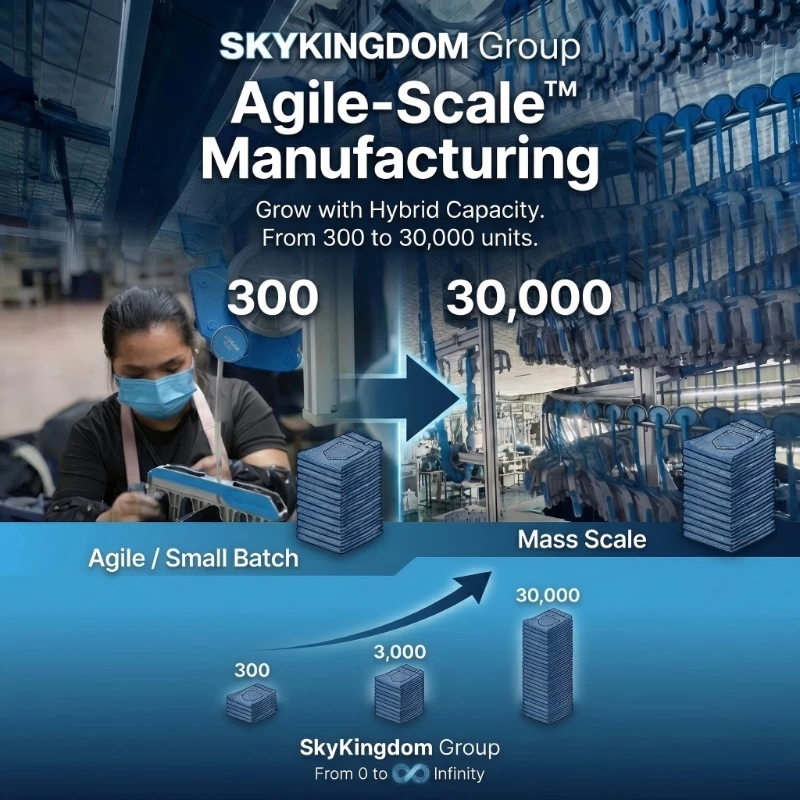
Minimum order quantities too high — this usually means you are talking to a partner optimised for large-volume wholesale, not for brand-stage production. Look for a partner with a small batch capability designed for test runs and capsule drops.
Delayed trim sourcing — finalise your trim list, label artwork, and hardware specifications at the same time as your fabric direction. Trims that are decided after sampling begins create a second sourcing cycle that adds one to two weeks.
Reorder chaos — happens when the original production records are incomplete. If your partner retains the pattern, wash recipe, and shade swatch from the first run, and you track approvals in a version-controlled system, reorders become a fast-track process instead of a rebuild.
Frequently Asked Questions
How do you write a denim brief that reduces sample rework?
Define the target fit, rise, leg shape, wash depth, and trim direction in one document before requesting a sample. Attach front and back visuals or 3D files, list fabric weight and stretch requirements, and confirm labels and packaging specs. A complete brief reduces sample loops because the development team can price, source, and cut without guessing.
What AQL level should a startup denim brand use?
Most denim brands start with the industry standard: AQL 2.5 for major defects, AQL 4.0 for minor defects, and zero tolerance for critical defects. Brands selling at higher price points or to markets with strict compliance expectations may tighten to AQL 1.5 for major defects. A capable production partner should be able to adjust the inspection level based on your specific requirements for each order.
Why should you run a small batch before bulk denim production?
A small batch test lets you validate fit, wash consistency, and real customer response before committing deeper inventory. You can measure sell-through rates, return reasons, and shade feedback from actual buyers. If a style stalls, your exposure stays limited. If it works, you scale with proven data instead of assumptions.
How do you keep denim wash consistent across production runs?
Document the wash recipe for every approved style, including enzyme type and concentration, stone load ratio, cycle time, temperature, and pH range. Approve a physical shade standard before cutting begins, and require a wash swatch from every new production run before the full batch proceeds. Consistency breaks when any of these parameters shift without re-approval.
What is the difference between inline inspection and final inspection in denim?
Inline inspection happens during production — inspectors check stitching, measurements, and construction at the sewing stage before the garment moves to washing. Final inspection happens after washing, pressing, and packing, using AQL sampling to determine whether the finished lot meets your defect thresholds. Both are necessary because some defects only appear after wash, while others are cheaper to catch before the garment leaves the sewing line.
SkyKingdom works with creator-led and DTC denim brands that need development support, wash supervision, and small batch production scaled to their stage. If you are building a fast-response denim workflow and need a partner that can handle the development detail — start a conversation here.