
In This Guide
Why Small-Batch Denim Is Different
Large brands ordering 5,000+ pieces per style have leverage. Production teams prioritize their orders, assign dedicated lines, and absorb setup costs across volume.
When you order 50–300 pieces, the economics change completely:
| Factor | Large Order (5,000+) | Small Batch (50–300) |
|---|---|---|
| Production priority | High | Low — unless the partner is built for it |
| Setup cost per unit | Negligible | Significant — cutting, wash testing, line changeover |
| Fabric sourcing | Direct mill order | Must use stock fabric or pay premium for small yardage |
| Sample investment | Absorbed into order | You pay upfront, may not recover if order cancelled |
| Quality consistency | Easier to maintain | Harder — less room for calibration across fewer units |
The takeaway: Not every production partner that can make denim is set up to handle small batches efficiently. You need a partner whose operations are designed for this order size — not one who reluctantly accepts it.
The 7 Things to Evaluate Before Choosing a Production Partner
1. Real MOQ vs. Advertised MOQ
Many production partners advertise “low MOQ” but add conditions that change the picture entirely:
- “MOQ 50 pieces” — but only if you use their existing patterns
- “MOQ 100 pieces” — but only for basic 5-pocket jeans, not your custom design
- “MOQ 30 pieces” — but the unit price is 3x higher than at 500 pieces
What to ask:
“What is your MOQ for a fully custom design with my own tech pack, including custom wash and labeling?”
The answer to this specific question — not the number on their website — is your real MOQ.
Benchmark: For custom denim with your own design, realistic small-batch MOQs from capable production partners range from 30–150 pieces per style per color.
2. Sample Lead Time and Cost
The sampling stage is where most first-time brand founders lose time and money.
Red flags to watch for:
- Sample takes more than 14 days with no clear explanation
- Partner asks for full payment before showing any previous sample work
- No revision process — “take it or leave it” after first sample
- Sample quality looks completely different from the reference you provided
What good looks like:
- 7 days for a first sample when fabric and trims are already confirmed — this precondition matters, because fabric sourcing or custom trim development can add 1–3 weeks before sampling even begins
- Clear pricing for sampling (typically $50–$200 per sample depending on complexity)
- At least one revision round included
- Partner can show you samples they’ve made for similar products
Pro tip: Ask for a “counter sample” — send them a garment you like, and ask them to replicate it. This tells you more about their capability than any sales pitch.
3. Wash and Finishing Capability
This is where many small production partners fall short. Denim is defined by its wash — it’s not a finishing detail, it is the product.
A production partner’s wash capability directly determines what kind of products you can offer:
| Wash Type | Equipment Needed | Skill Level | Cost Impact |
|---|---|---|---|
| Raw / rinse wash | Basic | Low | Lowest |
| Enzyme wash | Industrial washers + chemicals | Medium | Moderate |
| Stone wash | Pumice supply + large washers | Medium-High | Moderate-High |
| Laser distressing | Laser machine ($50K+) | High | High setup, low per unit at volume |
| Ozone finishing | Ozone chamber | High | Moderate |
What to ask:
“Does your team handle wash development in-house, or is it outsourced? If outsourced, who sets the wash standards and supervises consistency across runs?”
Some production partners outsource washing to specialist laundries. This isn’t automatically a problem — what matters is whether your partner sets and enforces the wash recipe, documents enzyme concentration and stone load per batch, and supervises the laundry’s output against your approved standard. A partner that simply sends garments to a laundry with no written recipe and no QC presence at the wash facility is a risk for inconsistency, especially on reorders.
Related reading: Denim Wash Techniques: A Complete Guide for Buyers
4. Fabric Sourcing Flexibility
For small batches, fabric is often the hardest part of the entire process.
The problem: Premium denim mills (Kurabo, Candiani, Cone) have high minimums — often 1,000+ meters. For a 50-piece order, you might only need 100–150 meters.
Solutions to look for:
- Partner maintains stock fabric inventory (common in the Guangzhou/Xintang production cluster)
- Partner has relationships with mills that offer cut-length orders
- Partner can recommend comparable stock fabrics that match your specifications
- Partner has their own fabric R&D capability for custom developments
What to ask:
“For a 50-piece first order, what fabric options are available without requiring a fabric MOQ? Can you send fabric swatches?”
Related reading: How to Choose Denim Fabric Weight and Composition
5. Quality Control Process
At small-batch volume, quality issues are more painful — a 10% defect rate on 50 pieces means 5 garments you can’t sell.
Minimum QC expectations for any production partner you work with:
- Pre-production: Fabric inspection before cutting (check for flaws, color consistency, shrinkage)
- In-line: Measurement checks during sewing (at least every 20 pieces)
- Post-production: Full inspection before packing (stitch quality, wash consistency, measurements)
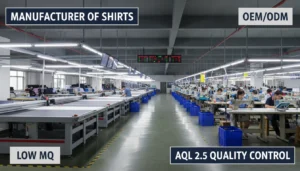
- Final: AQL 2.5 sampling inspection is the industry standard for small-to-mid-size denim orders — for orders under 100 pieces, some partners will do 100% piece-by-piece inspection instead, which is worth requesting
What to ask:
“What is your defect rate on small-batch orders? Can you provide inspection reports from recent orders?”
Reality check: No production partner has zero defects. A good partner has a system for catching and fixing them. A bad one hides them.
Related reading: Denim AQL Inspection: What to Check Before Shipping
6. Communication and Project Management
For first-time brand founders, this is often the deciding factor between a good experience and a nightmare.
Green flags:
- Responds within 24 hours on working days
- Sends progress photos during production without you asking
- Has a dedicated account manager for your project
- Proactively flags issues (fabric delay, color variation, etc.)
- Communicates in your language fluently
Red flags:
- Goes silent for days after receiving payment or deposit
- Avoids video calls or production floor tours
- Different person answers every time you contact them
- No written confirmation of specifications before production starts
7. Pricing Transparency
A common and costly mistake: Choosing the cheapest quote without understanding what’s included.
A proper quote should break down:
- Fabric cost per meter (and consumption per garment)
- CMT (Cut, Make, Trim) cost
- Wash/finishing cost
- Labeling and packaging cost
- Shipping cost (or at least FOB price)
What to ask:
“Can you provide an itemized cost breakdown, not just a total price per piece?”
If a production partner can’t or won’t break down their pricing, you have no way to evaluate whether their price is fair — and no basis for negotiation on future orders.
Benchmark pricing (2025, China-based production, FOB):
| Product | Small Batch (50 pcs) | Medium Batch (300 pcs) | Large Batch (1,000+) |
|---|---|---|---|
| Basic 5-pocket jeans | $18–$28 | $14–$22 | $10–$16 |
| Denim jacket (trucker style) | $22–$35 | $18–$28 | $14–$22 |
| Custom wash jeans (laser/ozone) | $25–$40 | $20–$30 | $15–$22 |
Prices are FOB China, excluding international shipping. Based on 2025 market rates with USD/CNY at approximately 7.2. Actual pricing varies by fabric choice, wash complexity, trim specifications, and order details.
Related reading: Denim Garment Cost Structure: What Actually Drives the Numbers
Where to Find Small-Batch Denim Production Partners
| Source | Pros | Cons |
|---|---|---|
| Alibaba / Made-in-China | Large selection, easy to compare | Quality varies wildly, many trading companies posing as production partners |
| Industry trade shows (Canton Fair, Denim Première Vision) | Meet face-to-face, see real samples | Expensive to attend, limited to show dates |
| Xintang, Guangzhou (China’s denim capital) | Highest concentration of denim production globally, full supply chain access | Requires on-ground visit or trusted local contact |
| Referrals from other brands | Pre-vetted, real production experience | Hard to get if you’re just starting out |
| Manufacturing platforms (Sewport, Maker’s Row) | Curated lists, some vetting | Often charge fees, limited to specific regions |
A Practical Decision Framework
Before you contact any production partner, answer these questions first. Your answers will eliminate 80% of options and focus your search on partners that actually match your needs.
Pre-Search Checklist
- ☐ What is my target retail price? (This determines your max production cost — typically 20–30% of retail)
- ☐ How many pieces do I need for my first order?
- ☐ Do I have a tech pack, or do I need design support from the partner?
- ☐ What wash/finish do I want? (This narrows down capable partners significantly)
- ☐ What is my timeline from sample approval to delivery?
- ☐ Am I willing to visit the production facility, or will I work entirely remotely?
- ☐ What certifications do I need for my target market? (OEKO-TEX, BSCI, REACH, etc.)
5 Common Mistakes First-Time Denim Buyers Make
Mistake 1: Choosing based on price alone
The cheapest quote often cuts corners on fabric quality, stitching, or wash consistency. Your first production run defines your brand’s reputation with early customers — a $3 per unit saving means nothing if customers return the product or leave negative reviews.
Mistake 2: Skipping the sampling stage
Never go straight to bulk production. Always order and approve a pre-production sample first. It costs $100–$200 and can save you thousands in defective inventory. This is non-negotiable.
Mistake 3: Not getting a written production agreement
Before production starts, have written confirmation of: exact specifications (measurements, fabric, wash recipe), delivery date, payment terms, defect policy, and who pays for shipping. Verbal agreements — even with partners you trust — are not enough.
Mistake 4: Ignoring the wash
Two production partners can use the same fabric and same pattern but deliver completely different looking jeans because of the wash. The wash is what customers see, touch, and feel — it’s not a finishing detail, it’s what makes your product look like your product. Ask whether your partner documents the wash recipe (enzyme type, concentration, water temperature, cycle time, stone load) and whether they can reproduce it identically on reorders. If the answer is vague, expect inconsistency.
Related reading: Denim Wash Techniques: A Complete Guide for Buyers
Mistake 5: Not planning for reorders
Your first order is a test run. If it sells well, you need to reorder fast — often within 2–4 weeks. Ask upfront:
- “How quickly can you fulfill a repeat order?”
- “Do you keep my patterns and wash recipes on file?”
- “Is the same fabric guaranteed to be available for reorders?”
Frequently Asked Questions
Next Steps
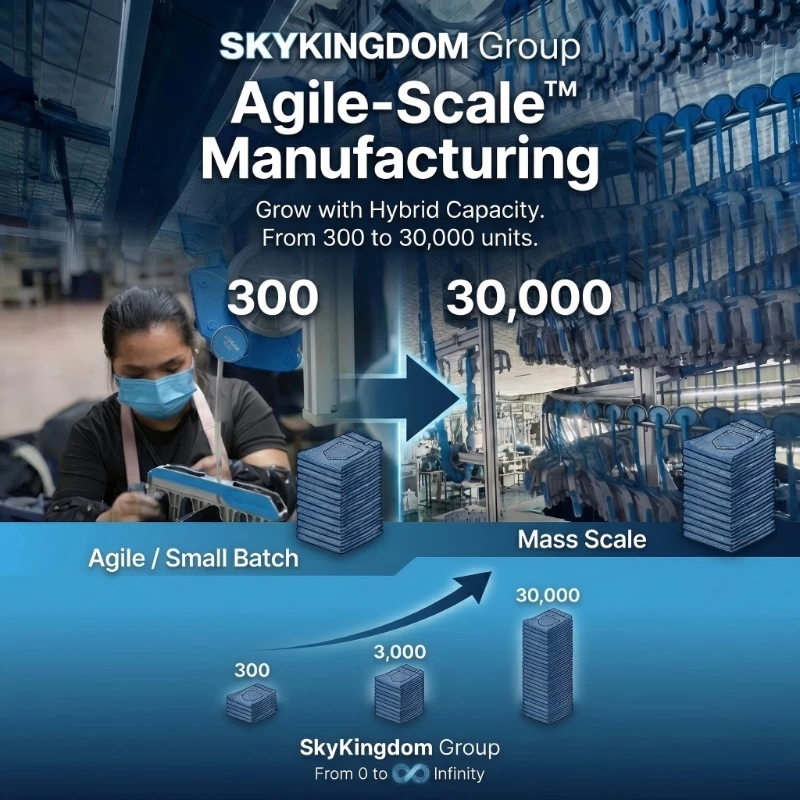
SkyKingdom works with creator-led and DTC startup brands that need small-batch denim development with documented wash standards, AQL 2.5 inspection, and reorder continuity from the first run. If you have a tech pack ready or need development support to get from concept to sample, start a conversation here.