
Author: Sky Lung and the production review team
Reviewed: June 13, 2026
Evidence basis: Reviewed against buyer-side supplier checks: project stage, MOQ exposure, sampling path, QC handoff, communication records, and reorder risk. This page is an educational guide, not a supplier ranking.
What a Full Package Partner Actually Manages
A full package partner coordinates the entire production chain under one accountable structure: fabric sourcing, trim procurement, pattern development, sampling, wash development oversight, cut-and-sew assembly, and quality inspection. For denim specifically, that scope also includes wash recipe documentation, shade approval management, and final garment inspection against an approved standard sample.
The practical value is not that every step happens inside one building. In most full package setups, wash development is handled by external specialist laundries while the partner sets the standards, documents the wash recipe, and supervises execution. What matters is that one entity owns the coordination between stages. When a fabric delay threatens the sampling schedule, the partner adjusts the timeline internally rather than sending you an email asking what to do. When a wash result drifts from the approved shade, the partner manages the correction before it reaches final inspection.
This is especially important in denim because the product is process-heavy. A cotton t-shirt moves relatively cleanly from cut to sew to pack. A pair of jeans passes through pattern grading, fabric cutting, multi-needle sewing, riveting, bar-tacking, wash treatment, finishing, and pressing — each step with its own quality variables. The more handoffs a product requires, the more valuable it becomes to have those handoffs managed by a single coordinating partner rather than by the brand founder.
What Happens When You Source Separately
Separate sourcing means you choose and manage every vendor independently. You select a fabric mill, a trim supplier, a sample maker, a wash house, a sewing factory, and possibly a third-party inspection company. Each relationship is bilateral — between you and that vendor — with no shared system connecting them.
This model can produce excellent results when your team already has sourcing experience, approved vendors, detailed technical packs, and enough weekly bandwidth to chase updates across every supplier. The advantage is granular control: you pick the exact mill for your selvedge fabric, the exact laundry for your signature wash, and the exact factory for your construction standards.
The disadvantage is that every problem must be diagnosed across company boundaries. A fabric delay pushes your sampling schedule. A trim mismatch affects production readiness. A wash inconsistency creates shade variation between the sample and the bulk delivery. When something goes wrong, each vendor tends to point at incoming materials or upstream instructions rather than owning the problem. Root-cause analysis across four or five separate companies is time-consuming and often inconclusive, especially when you are also running marketing, fulfillment, and customer service.
Separate sourcing is not wrong — it is just harder to execute well before your product architecture is stable and your vendor relationships have been tested through at least two or three production cycles.
Where New Brands Typically Lose Time
The coordination failures that slow down a first launch are rarely dramatic. They are small, cumulative, and invisible on any single vendor’s timeline. Here are the most common ones in denim production:
Sampling delays from unconfirmed inputs. A realistic denim sampling timeline is around seven working days, but that assumes fabric and trims are already confirmed. If your fabric is still being sourced or your trim supplier has not shipped buttons yet, sampling cannot begin — regardless of what any partner promises. When evaluating any production partner, ask whether their stated sampling timeline includes or excludes material confirmation. The answer reveals how realistic the promise is.
Wash inconsistency between sample and bulk. Denim washes are chemical and mechanical processes. Enzyme concentration, stone-to-garment load ratio, bleach timing, water temperature, and softener application all affect the final colour, hand feel, and dimensional stability. A wash recipe that produces the right shade on a 20-piece sample batch may drift when scaled to 500 or 2,000 pieces if the laundry does not control variables precisely. This is why wash recipe documentation matters — not as a nice-to-have, but as the literal instruction set that keeps bulk consistent with the approved sample.

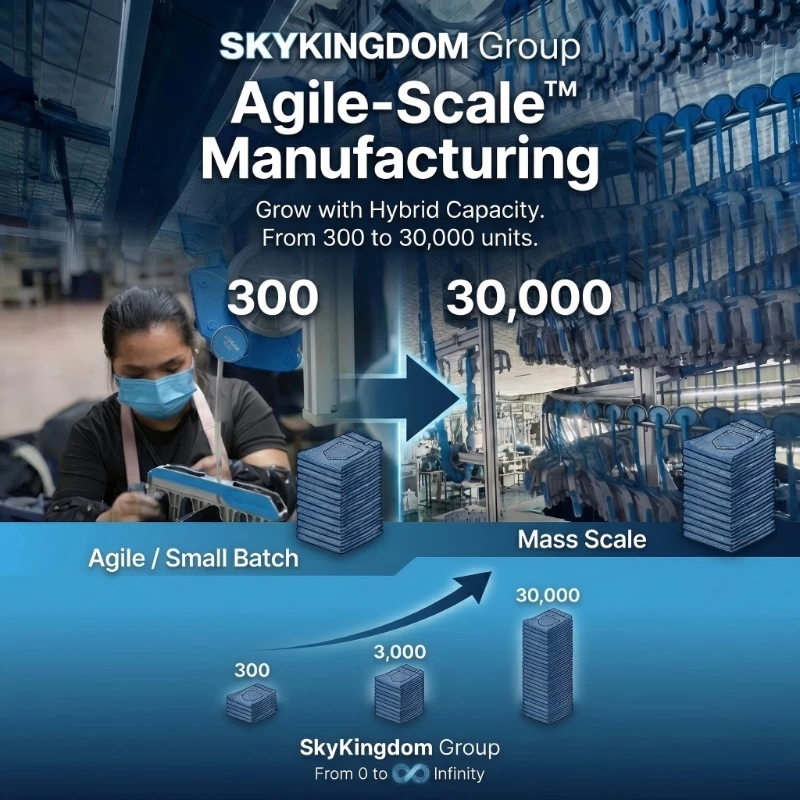
MOQ misalignment across vendors. Your fabric mill may require 300 metres minimum. Your button supplier may need 1,000 pieces. Your sewing factory may want 200 garments per style. These thresholds rarely align with each other or with the 50 to 100-piece test run a new brand actually needs. In a separate sourcing model, you spend significant time negotiating minimums with each vendor individually. In a full package model, MOQ alignment is the partner’s problem to solve — they have already built relationships and ordering patterns that accommodate smaller runs.
QC gaps between vendors. When one partner owns the full production chain, quality inspection can be structured as a continuous process: incoming fabric inspection, inline sewing checks, post-wash evaluation, and final garment inspection before packing. When vendors are separate, each one typically inspects only their own output. The gaps between vendor boundaries — where fabric becomes a cut part, where a sewn garment enters the laundry, where a washed garment returns for finishing — are exactly where defects tend to appear undetected.
How to Evaluate Quality Infrastructure at Any Partner
Whether you choose a full package partner or build a separate vendor stack, the quality questions are the same. Here is what to ask and what the answers should tell you.
What AQL standard do you execute, and at which inspection stages? AQL stands for Acceptable Quality Limit and is defined by ISO 2859-1. The industry standard for denim is typically AQL 2.5 for major defects, AQL 4.0 for minor defects, and zero tolerance for critical defects. A partner that supports multiple AQL levels — including tighter thresholds like AQL 1.5 for premium lines — and applies them at incoming material inspection, inline production, and final pre-shipment is operating a genuine quality system. A partner that only mentions AQL at final inspection is doing the minimum.
How is wash development documented and controlled? Ask to see a wash recipe card. It should specify enzyme type and concentration, stone load ratio, treatment temperature and duration, rinse cycles, softener application, and target shade reference. If the answer is vague or the documentation does not exist, wash consistency across production runs will be unreliable — and shade variation is one of the hardest quality problems to fix after bulk is completed.
What happens when delivered goods do not match the approved sample? This question reveals accountability structure. A full package partner that owns the entire output should have a clear corrective action protocol: who diagnoses the root cause, who bears the remake cost, and what the timeline is for resolution. In a separate vendor setup, the answer is usually more complicated because responsibility is shared across multiple companies. Clarify this before production begins, not after a problem appears.
Is production tracking visible in real time? Some partners provide ERP-based tracking where you can see production status, milestone completion, and inspection results as they happen. Others rely on periodic email updates. Real-time visibility does not guarantee quality, but it does mean you find out about problems sooner rather than later — which directly affects your ability to recover timelines.
Speed Matters More Than Most Founders Expect
In fashion, launch timing shapes sell-through more than product quality alone. A McKinsey analysis of the global fashion industry notes that agile brands capable of adapting quickly to shifting conditions are positioned to outperform in the current market environment. For creator-led and trend-responsive brands especially, a compressed development and production cycle is not a luxury — it is the mechanism that allows a small brand to capitalise on audience attention before it shifts.
This is why production speed and coordination efficiency are not just operational preferences. They directly affect whether your first drop sells through or sits in a warehouse. A full package model typically compresses the timeline because decisions and corrections happen inside one system rather than bouncing between independent vendors. Bulk production timelines in full package denim setups commonly run 15 to 22 working days after sample approval, with reorders moving faster because material specifications, wash recipes, and quality standards are already documented and approved.
Separate sourcing can match this speed, but only if every vendor in the chain is responsive and pre-aligned. In practice, that level of coordination usually takes two or three seasons to build — which means your first and second drops are the ones most likely to suffer from timeline slippage.
A Decision Framework: Which Model Fits Your Situation Right Now
The right choice depends on your coordination bandwidth, not your design ambition. Here is a practical way to evaluate your readiness:
If you are testing your first drop with fewer than 200 pieces: A full package partner is the stronger fit. Low MOQ alignment, unified sampling, and single-point accountability reduce the number of variables you need to manage while you are still validating product-market fit. Some full package partners support runs as small as 30 pieces for initial market tests, which is difficult to arrange through separate vendors.
If your team has no dedicated sourcing manager: Full package makes more sense. Supplier coordination across fabric, trims, wash, and sewing requires 10 to 15 hours per week of active management during production. If that time is not available, handoffs between vendors will slow down.
If you already own a proven vendor network: Separate sourcing can work well. If your fabric mill, wash house, trim supplier, and sewing factory have all delivered successfully on at least two previous orders, the coordination overhead is manageable and the control advantage becomes real.
If your product requires highly specialised inputs: Separate sourcing may be necessary. A proprietary fabric from a specific mill, a signature wash that only one laundry can execute, or a custom hardware supplier — these requirements sometimes cannot be accommodated inside a single partner’s network.
If you are scaling a winner after initial sell-through: Full package is typically better positioned for reorder speed. Because material specs, wash recipes, and QC standards are already documented inside one system, reorders can move 25 to 30 percent faster than a first order — which matters when you are chasing demand on a product that is selling.
What to Confirm Before You Commit to Either Model
Regardless of which path you choose, lock these decisions before production begins. Unresolved details at the start are the most common cause of delays at the end.
Confirm your silhouette, fabric direction, target wash, trim list, and packaging standards. Then confirm who owns each milestone: sample approval, material booking, pre-production review, and final inspection. In a full package model, these milestones sit inside one partner’s project management. In a separate sourcing model, you need to build and maintain this timeline yourself — which is entirely viable, but requires discipline and a clear accountability map.
Ask every partner — whether full package or individual vendor — how QC is performed at each stage, what documentation accompanies the finished goods, and what recourse exists if the delivery does not match the approved standard. The answers to these questions are usually more revealing than the product gallery on their website.
SkyKingdom works with creator-led brands and early DTC labels that need coordinated denim development, low-MOQ production support, and wash consistency across runs. If you are evaluating production partners for your first or next denim collection, start a conversation here.