
Author: Sky Lung and the production review team
Reviewed: June 13, 2026
Evidence basis: Reviewed against buyer-side supplier checks: project stage, MOQ exposure, sampling path, QC handoff, communication records, and reorder risk. This page is an educational guide, not a supplier ranking.
What Should You Lock Before Sampling Begins?
The most common reason trial runs fail is not poor sewing or bad fabric — it is unresolved variables at the start. If your fit block, wash target, fabric weight, or trim specifications are still changing when sampling begins, the sample you approve may not be reproducible at bulk. That makes the trial meaningless as a systems test.
Before requesting a sample, confirm the following: silhouette and fit block with specific measurements and tolerances, denim weight and stretch percentage, hardware type and finish (buttons, rivets, zipper), wash effect and target shade (preferably with a physical or digital reference), label placement and packaging standards, and whether the project is OEM or ODM.
The OEM versus ODM distinction matters more than many founders expect. In an OEM arrangement, the production partner builds exactly to your specs — your pattern, your measurements, your wash direction. You own the design, but you also need to supply detailed technical documents. In an ODM arrangement, the partner contributes development input: they may start from their own fit block, suggest fabrics from their library, or develop wash options based on your direction. ODM is often faster for newer brands that need guidance, but it means shared design ownership unless explicitly agreed otherwise.
Either way, the variables listed above must be locked before sampling starts. A realistic denim sampling timeline is around seven working days, provided that fabric and trims are already confirmed. Complex styles — multiple wash treatments, unusual construction, or non-standard hardware — may take longer and should be discussed separately. Any sampling promise that does not state its preconditions should prompt you to ask what assumptions are being made.
How to Evaluate Wash Consistency During the Trial
Wash development is where denim production diverges most sharply from simpler garment categories. A cotton t-shirt goes from cut to sew to pack. A pair of jeans passes through cutting, multi-needle sewing, bar-tacking, riveting, and then enters a wash process involving chemical and mechanical treatments that fundamentally change the fabric’s colour, hand feel, and dimensional behaviour.
The variables that affect a denim wash include enzyme type and concentration, stone-to-garment load ratio, bleach timing and strength, water temperature, treatment duration per cycle, rinse frequency, softener application, and final tumble drying parameters. Even small changes — a five-degree shift in water temperature, a slightly different enzyme batch, or a shorter rinse cycle — can move the shade or cause uneven fading across the garment.
This is why wash recipe documentation is not a nice-to-have. It is the instruction set that determines whether your bulk delivery matches the sample your customer expects. A competent production partner — whether full package or a separate wash house — should be able to show you a wash recipe card that specifies every variable listed above, along with a target shade reference swatch.
During the trial, ask for a wash panel: a set of garments washed under the approved recipe at the same batch size you plan to produce in bulk. Compare them against your approved sample for shade, hand feel, shrinkage, and any visible inconsistency between units. If the wash panel shows variation at 30 pieces, it will almost certainly show more variation at 500.
It is worth understanding that many production partners do not operate their own wash facilities. The wash is frequently handled by specialist external laundries, while the production partner sets the standards, documents the recipe, and supervises execution. This is a normal operating model and does not indicate a quality problem — what matters is whether the partner takes accountability for the wash result, regardless of who physically operates the machines.
What Quality Checks Should You Run on a Small Batch?
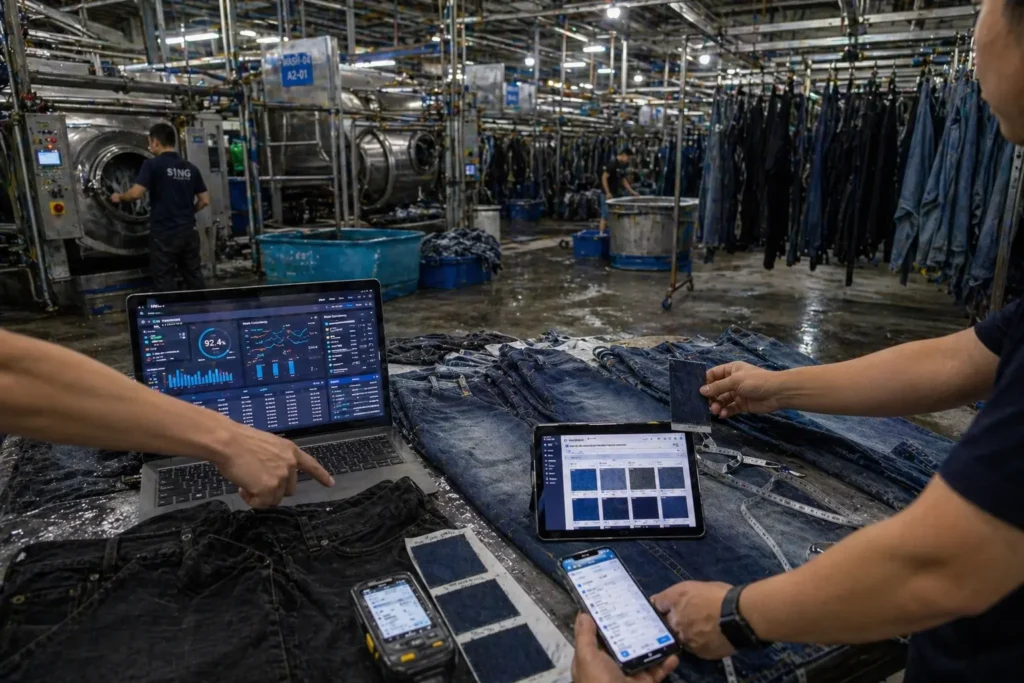
A 30-piece trial run should be inspected with the same rigour as a bulk order. The purpose of the trial is to prove that the production system works — and that means evaluating the QC system itself, not just the finished garments.
The standard quality framework for garment inspection is AQL (Acceptable Quality Limit), defined in ISO 2859-1. It uses statistical sampling to determine how many defective units are acceptable in a given batch. The typical configuration for denim is AQL 2.5 for major defects, AQL 4.0 for minor defects, and zero tolerance for critical defects. A lower threshold like AQL 1.5 is sometimes applied to premium lines or children’s denim where defect tolerance must be tighter.
Understanding the difference between these levels matters because it changes what gets flagged. At AQL 4.0, a loose thread or minor stain may pass. At AQL 2.5, a measurement that falls outside your tolerance range or a visible wash inconsistency triggers a fail. At AQL 1.5, the sampling plan pulls more units and the reject threshold is lower, which catches subtler issues but also increases inspection time and cost. Choosing the right AQL level is a decision about how much quality risk your brand and customer base can absorb — not a fixed industry rule.
Beyond the AQL number, ask where inspection happens in the production sequence. A production partner that only inspects at the final pre-shipment stage is doing the minimum. A stronger quality system includes incoming fabric inspection (checking for weaving defects, weight consistency, and colour uniformity), inline sewing checks (measurement verification, stitch density, bar-tack security), post-wash evaluation (shade match against the approved sample, shrinkage check, hand feel assessment), and final garment inspection (overall appearance, hardware function, label accuracy, packing correctness).
For your trial run specifically, define your own measurement tolerances before production begins. In denim, shade variation and fit drift usually cause more customer returns than obvious stitching defects. If you wait until final inspection to discover that the waist measurement has shifted by 2 cm from the approved sample, correction at that stage means a full remake.
A Decision Table for Evaluating Any Production Partner
Whether you are considering a full package partner, a cut-and-sew operation, or a network of separate vendors, the evaluation criteria for a denim trial run are the same. Use these questions before committing:
| Factor | What to ask | What the answer reveals |
|---|---|---|
| MOQ structure | What is the minimum per style, per wash, and per colourway? | A headline MOQ of 30 pieces loses value if it only applies to one wash in one size run. Calculate MOQ per variant. |
| Sampling timeline | How many working days for first sample, and what must be confirmed first? | A timeline stated without preconditions (fabric and trims confirmed) is not a real commitment. Seven working days with materials confirmed is a realistic benchmark for denim. |
| Wash documentation | Can you show a wash recipe card with enzyme, temperature, timing, and shade reference? | If the documentation does not exist, bulk consistency with the approved sample is unlikely. |
| QC method | Which AQL levels do you execute, and at which inspection stages? | A partner offering AQL 2.5 at final inspection only is doing the minimum. Multi-stage inspection (fabric, inline, post-wash, final) is the standard that protects your trial investment. |
| Production tracking | Is status visible in real time, or do I receive periodic email updates? | Real-time ERP-based tracking means you discover problems sooner. Email updates mean delays are reported after the fact. |
| Reorder path | If the trial succeeds, can the same SOPs, fabric specs, and wash recipes carry into larger orders? | If scaling requires a new team, new wash partner, or new fabric source, you may need to reapprove — which negates much of the trial’s value. |
| Accountability | What happens if the delivered goods do not match the approved sample? | This reveals who bears the correction cost and how quickly the root cause is diagnosed. Clarify before production, not after a problem appears. |
When Should You Scale From Trial to Bulk?
The trial run is successful when three conditions are met: fit is stable within your defined tolerance range across the batch, wash results match the approved shade and hand feel consistently across units, and your initial sell-through confirms real customer demand for the product.
Many founders rush to scale after the first two conditions are met, before demand is proven. This is the most expensive mistake in small batch production — not because the product is bad, but because unsold inventory ties up capital that should fund your next development cycle. The purpose of a small batch is to validate before committing. If sell-through is slow, the correct response is to adjust the product, the marketing, or the price point — not to order ten times more of the same style.
When all three conditions are met and you are ready to scale, verify one more thing: that your production partner can maintain the same SOPs, fabric references, wash recipes, and QC standards at higher volume. If the scale-up introduces a different sewing team, a different wash facility, or a different fabric batch without your approval, the consistency you proved in the trial may not carry forward. A well-structured partner will document all specifications from the trial and use them as the baseline for bulk — which is also why reorders on a proven style typically move 25 to 30 percent faster than first orders.
Sustainability and Small Batch Production
Small batch production and sustainability are more aligned than most founders realise. The U.S. EPA reports that the textile recycling rate was 14.7 percent in 2018, meaning the vast majority of textile waste goes to landfill. Overproduction — ordering large quantities before demand is validated — is a direct contributor to that waste.
A small batch model reduces overproduction risk by design: you produce what you can realistically sell, validate demand, and reorder based on data rather than forecasts. If sustainability is part of your brand positioning, this production model is more credible than vague environmental claims because the output volume itself is the evidence.
On the process side, ask your production partner about specific wash technologies — laser finishing, ozone treatment, and enzyme washes can reduce water and chemical usage compared to conventional stone washing. But ask for specifics rather than accepting broad sustainability claims. What percentage of water reduction does the laser process achieve compared to the conventional alternative? Is the enzyme biodegradable, and is it documented on the wash recipe card? Are recycled cotton or organic fabric options available at your MOQ level, or do they require a higher minimum from the mill?
These questions matter because sustainability at the brand level only works if every supplier in the chain can deliver at the volume you actually need. A recycled cotton fabric that requires a 1,000-metre minimum from the mill is not compatible with a 50-piece trial run — and discovering that mismatch after you have committed to a sustainability marketing message creates a credibility problem.
The Trial Run Is the Real Starting Point
A small batch denim order is not a discounted version of bulk production. It is a deliberate systems test where you evaluate whether your production partner can deliver consistent fit, repeatable wash results, reliable inspection, and a clear path to scale. The answers you get from a 30 to 100-piece trial will tell you more about a partner’s actual capability than any product gallery or capacity claim on a website.
SkyKingdom works with creator-led brands and DTC startups that need small batch denim development, multi-stage QC from fabric to finished garment, and documented wash consistency across production runs. If you are planning a trial run for your first or next denim collection, start a conversation here.