

Can an AI-Generated Denim Design Become a Real Garment?
A Feasibility Framework for Brands Holding AI Denim Concepts
That is how a real conversation with an AI-driven denim brand usually starts. Not “what’s your MOQ” — they already know their image is unusual. The first question is whether it can become a physical garment at all.
This is the wrong question. Almost any AI denim image can be made into one piece, given enough time and money. The right question — the one that decides whether the project is worth starting — is which version of the design your brand stage can actually carry, repeat, and sell.
That gap — between making an AI denim image once and turning it into a brand-ready product — is where most AI denim projects quietly fail. Not because the image was impossible, but because no one mapped what the image actually contained: which parts were real production decisions, which parts were AI hallucinations, and which parts would silently turn into custom development bills.
This article is a feasibility framework. It is for brands holding an AI denim concept and trying to figure out the next move — before asking for production pricing, before approving a sample, and before assuming the AI image is the finished design.
Direct answer: Yes, an AI-generated denim design can become a real garment, but not directly. It first needs a feasibility review that separates translatable details — fabric, pattern, wash, hardware, and construction — from visual effects that only exist in the render. Skipping this step risks approving a sample that cannot be repeated, refined, or scaled.
The Real Problem Is Not “Can It Be Made?”
When a brand sends an AI denim image to a factory, the framing of the question — “can this be made?” — is misleading by default.
Almost anything can be made once. With enough time, enough development budget, and enough patience, a denim sample can be built that physically resembles almost any AI render. That is not the constraint.
The real constraint is what happens after the sample is approved.
A sample is one event. A brand product is a system.
It needs an approved fit. A fabric the mill can supply again. A wash recipe that holds across batches. Hardware that does not require re-tooling every season. Measurement tolerances the production line can actually hit. And enough documentation for the same product to be reordered six months later without another round of trial-and-error.
This is the gap that most AI denim conversations skip over. The image gets approved, the sample gets approved, and only later — at bulk, or at the first reorder — does the brand discover that “approved” never meant “repeatable.” The fabric came from a single lot. The hardware was a one-off. The wash effect happened because of a specific operator on a specific day. None of it is documented as a baseline.
A 2024 peer-reviewed MDPI study on Midjourney in fashion design reached a similar conclusion from the design side: Midjourney’s useful role remains mainly in early-stage fashion design, and the output still requires substantial designer involvement before it can move downstream.
In practical garment development, this missing information often shows up quickly: no back view, no inside construction, no seam logic, no pattern direction, and no clear way to decide which visual details are structural and which are only rendered effects.
This is why the more useful question is not whether a design can be made, but whether the design — in its current form — can be carried by the brand’s current stage. For a one-off display piece, a high-cost, custom-everything development path may be reasonable. For a brand trying to launch a sellable product, that path quietly turns into a financial trap.
The work is not making the image into a garment. The work is figuring out which version of the garment the brand should actually make.
Why AI Denim Images Look Production-Ready When They Aren’t
The visual quality of AI denim images has become deceptively good. Lighting, fabric drape, distressing patterns, indigo gradients, hardware reflections — modern image generators produce results that, at a glance, are hard to distinguish from a finished campaign photo.
This is the trap. The image looks like a photograph of a real garment, so brands instinctively treat it like one.
But AI image generators are not trained on garment construction. They are trained on billions of finished images — photographs, editorials, runway shots, product pages. The output is a statistical pattern of what a denim garment looks like in a photo, not a description of what a denim garment is built from.
In its 2023 report Generative AI: Unlocking the Future of Fashion, McKinsey described generative AI in fashion as a tool that can help fashion businesses become more productive, get to market faster, and serve customers better. That framing matters here: AI can speed up the creative front end, but it does not replace the production decisions underneath a denim garment.
The parts of a denim garment that decide whether it can actually be produced are not visible in any image. Fabric weight. Stretch behavior. Wash chemistry. Seam construction. Hardware tolerance. Fit baseline. Shrinkage allowance. None of these can be inferred from a render. They are decisions made by people with production context.
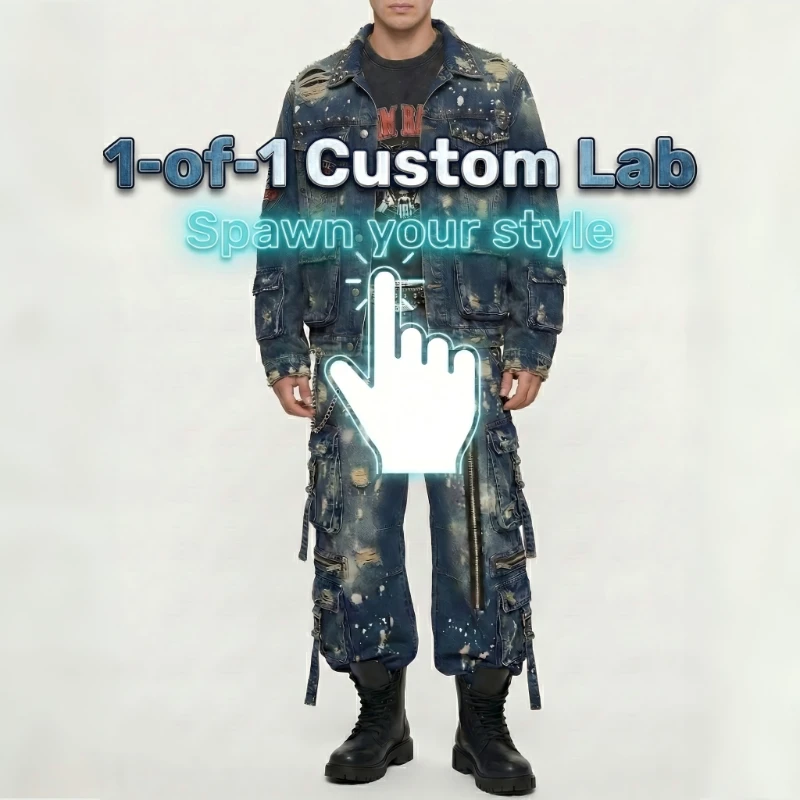
So when an AI image shows a denim jacket with a perfect indigo fade, layered raw selvedge hems, sci-fi hardware, and intricate distressing — what the brand sees is “the design.” What a production team sees is a list of separate development questions:
- Does this fabric exist, or does it need mill development?
- Is the wash effect a known recipe, or does it require a trial cycle?
- Is the hardware off-the-shelf, or does it require new tooling?
- Is the distressing pattern hand-applied, laser, chemical, or a mix?
- Is the silhouette structurally sound in real fabric weight, or does it only hold in render?
None of these questions have wrong answers. But each one is a separate cost line, a separate lead time, and a separate risk surface. An AI image quietly bundles all of them into a single picture and presents the result as one design.
The image is not lying. It just cannot tell the production story.
Eight Denim-Specific Hallucinations Hidden in AI Images
Not every part of an AI denim image is a hallucination. Some details — silhouette direction, color mood, attitude, styling — are useful design signals. The image’s job at the concept stage is to communicate intention, and it often does that well.
The problem is the other category: details that look like real production specifications but exist only in the rendering. These are the parts that quietly turn a “simple sample” into a custom development project. A brand evaluating its own AI image is better served knowing which visual elements belong to which category, before approving anything for sampling.
The table below maps eight common AI denim hallucinations that production teams see most often, what they are in the image, what they actually require in real denim production, and where they tend to break silently if no one flags them at the feasibility stage.

You do not need all eight problems to stop a project. Sometimes one unresolved issue is enough to change the sampling path.
| # | What the AI image suggests | Denim production reality | Silent production risk if not clarified |
|---|---|---|---|
| 1 | Ultra-precise distressing — laser-grade whiskers, perfect 3D break-down, surgical hole edges | Distressing is done by hand sanding, laser, chemical wash, or a combination — and each method has tolerance variance between pieces | Sample looks right; bulk batches show visible piece-to-piece variation |
| 2 | Perfect indigo gradient from deep to mid to near-white in a smooth fade | Indigo wash depends on recipe, water chemistry, fabric lot, and machine load — perfect gradients require a developed recipe, not a guess | Sample passes; bulk wash drifts in shade; reorder six months later cannot reproduce the color |
| 3 | Clean selvedge edges and raw hems aligned perfectly with the silhouette | True selvedge fabric comes from specific narrow-width looms; raw hems shrink and twist after wash and need pattern allowance | Wrong fabric source picked at sample stage; bulk shrinks differently and selvedge alignment is lost |
| 4 | Futuristic or sculptural hardware — irregular rivets, oversized buckles, floating metal elements | Hardware needs to survive wash, resist corrosion, and use existing molds. New shapes may require custom tooling, added approval steps, and longer lead time | Approved sample uses one-off hardware; reorder discovers the part was never repeatable without re-tooling |
| 5 | Single front-facing render with no back, side, or interior view | Real denim needs back yoke, coin pocket, label position, inside care label, fly construction, seam topstitching — all of which must be decided by someone | First sample is built with assumed back details; the brand rejects it because the back was never their intention |
| 6 | Heavy indigo color with light, flowing, airy drape | Deep indigo and structured denim often depend on fabric weight, yarn, dyeing, and finishing choices. A very light, airy drape may not hold the same visual depth or structure shown in the render | Either the weight is wrong or the color is wrong — both lose the original design feeling |
| 7 | Decorative seams and stitches following complex 3D curves over the garment | Industrial sewing machines run straight lines reliably; curved or 3D seam paths require specialized machines, skilled operators, or hand-finishing | Sample is achievable with senior operators; bulk line cannot reproduce the seam path at production speed and quality |
| 8 | Pocket layers, panels, or trims that appear to float on the denim surface | Real attachments need topstitching, bar tacks, and reinforcement points; floating effects require either invisible bonding or hidden internal construction | Either the floating illusion is sacrificed during sample translation, or the attachment fails durability and wash testing |
A useful exercise before contacting any factory: open the AI image and check it against this list. If three or more rows describe what is happening in the image, the project is not a sampling conversation yet — it is a feasibility conversation.
Before asking for production pricing, ask for a feasibility review: which parts can be translated directly, which parts need development, and which parts should be simplified for the brand’s current stage.
That distinction is not pessimistic. It is the difference between starting a project that has a defined path and starting a project that will spend its first three months discovering what the path even is.
Two questions naturally follow. First: if these hallucinations are this common, what happens when a brand with serious denim resources runs an AI denim project? Second: what does that mean for a brand without those resources? The next sections look at both.
What the G-Star Case Actually Tells Smaller Brands
In 2023, G-Star RAW ran a public experiment in AI denim design. Their core design team worked with Midjourney to generate twelve unique denim concepts, then chose to physically produce one of them at their Amsterdam atelier: a sculptural denim cape.
The headline most coverage carried was “the world’s first AI-designed denim garment.” The number underneath the headline tells a different story.
Twelve AI denim concepts were shown. One was selected and physically produced.
That does not mean the other eleven failed. It means G-Star still had to filter many visual directions before committing production resources to one physical piece. And this was inside G-Star — a brand with decades of denim engineering, an in-house atelier, master tailors, fabric resources, and no commercial pressure on the project. Fashion Dive also reported that only one of the dozen AI looks was produced, and that the piece was intended as an in-store display.
Two quotes from the G-Star tailors who built the cape make the gap concrete:
“The back was not existing, so I had to design it myself.”
“It was quite challenging because of so many illogical details. It took a lot of time to discover how the layers were connected and where details began and ended.”
These are not complaints. They are descriptions of what AI-image-to-real-denim work actually involves, even with elite production resources behind it.
For an emerging brand, the implications are direct.
If G-Star — with all its denim expertise — chose one out of twelve AI concepts to physically produce, the question for a smaller brand is not “can my AI denim image be made,” but “which version of it is worth making.” The other eleven designs were not failures. They were directions the brand decided not to spend production resources on. That filtering happened before sampling began, not after.
This is the part the public-facing AI fashion conversation tends to skip. Most coverage focuses on the produced piece, because that is the photogenic outcome. The eleven designs that did not get made are where the real lesson lives — they represent the work of deciding which AI concepts have a production path, and which are better left as visual direction.
The work behind that decision is not only technical. It is editorial: deciding which parts of the AI image express the brand intention, which parts need production translation, and which parts should stay as visual inspiration.
A smaller brand does not have G-Star’s atelier. But that brand can apply the same logic in reverse: before treating an AI image as the design, ask whether the image is something to make or something to learn from. The first category enters sampling. The second category enters the design conversation that decides what enters sampling.
The takeaway is not that AI denim is impossible. G-Star proved it is possible. The takeaway is that even at the top of the industry, the ratio of AI concepts to produced garments is small — and the work that creates that ratio is editorial as much as it is technical.
For a brand without an in-house atelier, that filtering still has to happen somewhere — inside the brand’s own product team, or with an external development partner before sampling starts.
The Hidden Economics: Why AI Sampling Often Becomes a Custom Development Project
A reference photo from a real garment and an AI-generated image look similar on screen. They behave very differently on a production cost sheet.
When a brand sends a photo of an existing garment as reference, the underlying message is: this exists, here is the version I want to make. The factory’s job is matching — fabric source, wash recipe, fit, hardware — to an outcome that has already been produced once in the real world. Most of the cost is interpretation and adjustment, not invention.
When a brand sends an AI image, the underlying message is closer to: this is what I want it to feel like. But the image is not a record of something that exists. It is a render of something that has never been built. Every visual element in it is, by default, a development question — not a matching question.
If the reference is a vintage denim jacket, the team can study an existing garment logic: fabric weight, seam placement, pocket construction, wash direction, and hardware type. If the reference is an AI sci-fi denim jacket, the team first has to decide which of those details exist in the real world at all.
This is the cost shift most brands do not see coming.
In standard denim development, a brand works from a stock library: stock fabric, stock hardware, stock wash recipe, stock trims. The components already exist. Sample costs are predictable because the team is assembling known parts in a new combination.
In AI-driven denim sampling, the same components are not assumed to exist. A unique-looking rivet may need new tooling. A specific leather patch shape may need new die-cutting. A fabric texture may need mill development. A wash gradient may need a recipe trial cycle. A hardware finish may need a custom plating run.
A single AI image can quietly turn into a development project, not a sample order — not because sewing one sample is always expensive, but because each visual element may need to be clarified before any sample can be assembled.
This is also why “what is the price for one sample” is the wrong opening question for AI denim. The honest answer depends on how much of the image needs off-the-shelf components, and how much needs new development. Without a feasibility review separating the two, any quote is either guessed too high or guessed too low — and the brand discovers the real number after committing.
Most of this cost can be reduced. The job of a feasibility review is to figure out which custom items are worth keeping for the brand’s intention, and which can be swapped for existing components without losing the design direction. Sometimes a custom hardware shape is the heart of the design and worth the tooling investment. Sometimes a wash gradient can be achieved with an existing recipe at 80% of the visual impact. Sometimes a fabric can be matched closely enough from a mill’s current range that mill development is unnecessary.
This is the editorial work from the G-Star section, made concrete. Not every visual element in the AI image carries the same weight. Some are the brand intention. Some are AI rendering choices. A useful development process separates the two before any quote is built.
The risky AI denim projects are not always the most ambitious ones. They are the ones where every rendered detail is treated as non-negotiable before anyone has separated the brand intention from the AI decoration.
A Feasibility Review: 6 Checks Before Asking for a Quote
A feasibility review is not a sample order. It is the work that happens before sampling — separating which parts of an AI denim image can move forward, which parts need development, and which parts should be simplified or replaced before a quote is even built.
The six checks below are a working framework. They can be run by an internal product team, by a development partner, or — at a minimum — by the brand itself before sending the image to a factory.
The order matters. Each check filters what passes to the next.
Check 1 — Style translation
Can the silhouette, fit, and basic construction logic be reverse-engineered from the image?
- Is there a clear front view?
- Can a pattern maker infer the side seam direction, hem opening, waistband construction, and back yoke shape?
- Where the back view is missing, can it be designed in a way that respects the brand’s intention?
If the answer to all three is yes, the style is translatable. If the image is so abstract that the silhouette itself is unclear, the project starts with a design conversation, not a sampling conversation.
Check 2 — Fabric availability
For each fabric element visible in the image, where does it sit?
- Already in stock with an existing mill
- Matchable with an existing mill’s current range
- Requires new fabric development by a mill
The first two categories are sampling-friendly. The third category is a development project with its own lead time and minimum quantity rules — often the single biggest cost variable in an AI denim project.
Check 3 — Hardware and trims
Apply the same logic to every visible piece of hardware and trim:
- Rivets, buttons, zippers, buckles
- Leather patches, woven labels, care labels
- Special closures, custom shapes, decorative metalwork
For each item: stock part, modifiable stock part, or new tooling. New tooling is not a refusal — it is an honest line item with its own lead time and approval steps.
Check 4 — Wash and finishing
The most common silent cost in AI denim sampling lives here.
- Is the wash effect achievable with an existing recipe?
- Will it require a recipe trial cycle to develop?
- Are the distressing, fading, and tinting effects achievable by standard methods, or do they require a combination that has to be tested?
A wash that cannot be repeated is a wash that cannot survive bulk or reorder. This check is where silent production risk is most often hidden.
Check 5 — Cost reality check
Add the development items identified in Checks 2, 3, and 4. Compare the total against:
- The brand’s available budget
- The intended order quantity
- The brand’s commercial timeline
This is where most AI denim projects either become real or become honest. If the development cost only makes sense across hundreds of units but the brand is launching with twenty, the math is the signal — not the design.
Check 6 — Brand stage match
This is the editorial check. Not every project the brand can make is a project the brand should make right now.
- A one-off content piece for a campaign or shoot
- A TikTok or creator drop test
- A Shopify or DTC launch style
- A repeatable brand product line
Each of these stages can justify a different amount of development cost. A repeatable product line may absorb custom hardware tooling. A creator drop test probably should not. The brand’s current stage decides which custom development items are investments and which are overreach.
The output of a feasibility review is not “yes” or “no.” It is a sorted list:
- Translate directly — elements that can move into sampling without development
- Develop selectively — elements worth investing in because they carry the brand intention
- Substitute or simplify — elements that can be swapped for existing components without losing the design’s core direction
- Defer — elements that belong in a later version of the brand, not this one
That sorted list is the difference between an AI denim project that has a defined path and one that spends its budget discovering the path.
The Quiet Reversal: When Real Samples Beat the AI Image
Most of this article has framed AI denim images as a challenge to translate — what they hide, what they cost, what they need filtered before they can become real garments.
There is another pattern worth naming, less talked about but consistent enough to matter.
After an AI denim image goes through a feasibility review, after the impossible details are simplified, after the brand intention is separated from the AI decoration, after the wash recipe is built around what the factory can actually repeat — the final sample is, in some projects, preferred by the brand over the original AI image.
Not as a compromise. As an outcome that more closely matches what the brand actually wanted from the beginning.
This sounds counterintuitive. If the AI image was the design, how can the simplified physical version be better than the original?
The answer is that the AI image was never really the design. It was a stand-in for a feeling — a silhouette, a mood, a confidence the brand wanted the garment to project. The image was the closest tool the brand had to describe that intention before working with a production team.
When the translation work actually happens — fabric weight adjusted to support the silhouette, back-view and pocket logic resolved, wash developed on real denim instead of imagined denim, hardware chosen for weight, finish, and durability — the result is no longer trying to match a render. It is solving for the same intention that produced the render in the first place, using materials and methods the render did not understand.
In some projects, that solving lands closer to the brand’s actual taste than the AI image did.
This is the reversal that disappears when a project treats the AI image as the finished design. There is no room for the physical sample to surprise the brand, because the brand is grading the sample against a render that was never built to be matched in real materials.
The brands that get the most out of AI in denim development are not the ones who treat the image as the deliverable. They are the ones who treat the image as a way to communicate intention — and then let the development process arrive at a better expression of that intention than the image itself could carry.

The image asks the question. The sample answers it — sometimes more precisely than the brand could express in the brief.
A Real Project: How a European Brand Found Its v2
The framework above is easier to see in a real project.
An emerging European denim brand approached a development team with an AI-generated denim concept they were excited about. The image was visually striking — a sculptural silhouette with unusual fabric texture, custom-shaped hardware, and a complex wash gradient. The brand’s first message was honest:
Before quoting anything, the team ran a feasibility review.
Check 1 — Style translation: The silhouette was reverse-engineerable. The back view was missing in the AI image, but it could be designed in a way that respected the original intention.
Check 2 — Fabric: The fabric texture in the image did not match any mill the team worked with. It would require new mill development — a separate project with its own minimum quantity and lead time.
Check 3 — Hardware: The hardware shape was unlike any existing mold. Custom tooling was possible, but it would add a significant lead time and a tooling cost line item that only made sense across volume.
Check 4 — Wash: The gradient effect was not achievable with any existing recipe. It would need a full trial-and-error wash development cycle to produce reliably.
Check 5 — Cost reality: Adding the development costs from Checks 2, 3, and 4 — new fabric development, custom hardware tooling, and wash recipe development — the total development investment was high enough that producing one piece had no commercial logic. For a brand at the launch stage, those costs could only be justified if amortized across hundreds of units.
Check 6 — Brand stage: The brand was not at the volume stage. They were testing market direction, building their first sellable styles, not yet ready to commit to a multi-hundred-unit production run for a single SKU.
The first AI version did not pass the feasibility review at the brand’s current stage.
But the conversation did not end there.
The work after the feasibility review was to translate the brand’s intention into a version the brand stage could actually carry:
- The original silhouette direction was kept — that was the core of the design.
- The impossible mill-developed fabric was swapped for an existing mill fabric with similar weight, surface texture, and drape behavior.
- The custom hardware shape was replaced with an off-the-shelf option chosen to read close in character — same weight class, same finish family, same visual logic.
- The complex wash gradient was redesigned around a recipe the factory could repeat across bulk, achieving most of the original visual depth without requiring a new wash trial program.
The first AI version was set aside. A second, production-realistic version was developed in its place. Same brand intention. Different execution path.
The result was a denim style the brand could sample at predictable cost, produce at their actual order quantity, and reorder six months later without re-running development work. The sample no longer matched the AI image exactly. It matched the brand’s intention better than the AI image had managed to.
This is the work that a feasibility review is for.
Not to say no. To find the version of the project that the brand’s current stage can actually carry — and to leave the rejected version on file for later, when the brand’s volume, budget, and timing can support it.
The brand kept moving. The AI v1 stayed useful as a future direction. The v2 became the product the brand could actually launch.
When a Direct Sample Maker Is Enough
Not every AI denim project needs a full product development partner. For some brands and some projects, a direct sample maker — a factory, custom workshop, or sample studio that takes an image and produces a one-off garment — is the right fit.
A direct sample maker may be enough when:
- The project is a one-off content piece. A garment built for a campaign shoot, a brand video, a creator drop event, or a single store display — where the goal is the photograph, not the repeatable product.
- The brand is doing a styled capsule with low commercial stakes. A creator drop of a handful of units, where the brand and the buyer both understand each piece will vary, and where the visual statement matters more than production discipline.
- The brand already has an internal product team. A founder with a pattern maker, a technical designer, and a production manager already on staff has the in-house capacity to do the editorial filtering.
- The AI design is intentionally a one-of-one artifact. An auction piece, an art collaboration, a museum installation, a brand archive object — where the development cost is part of the value.
In these cases, asking a development partner to run a full feasibility review may be unnecessary overhead. The fast path is a direct sample maker who can interpret the image, build one piece, and deliver it.
There are workshops that specialize in exactly this kind of work — taking AI-generated images and turning them into single garments for content creators, capsule drops, or display pieces. For projects that fit the criteria above, that path is faster, cheaper, and appropriate.
The question is not which model is better. It is which model matches the project’s actual goal.
When an External Denim Product Team May Fit Better
A different model fits a different kind of project.
An external denim product team — distinct from a direct sample maker — operates at the level of the product, not the piece. The work is not building one garment from an image. It is moving a brand from concept to a denim product that can be sampled, sold, reordered, and built on.
This model may fit better when:
- The brand is trying to launch a sellable product, not a content piece. The garment needs to enter a store, a website, or a wholesale conversation — which means fit consistency, wash repeatability, and quality baselines have to be defined from the start.
- The brand expects to reorder. A repeatable production path requires documented fabric sources, sealed sample references, recorded wash recipes, and tolerance baselines — work that happens during the first sample, not after.
- The AI image asks for development decisions the brand does not have an internal answer for. Which custom hardware is worth tooling? Which fabric can be substituted without losing the intention? Which wash effects can be simplified?
- The brand is at the Creator / AI Concept Stage and trying to grow. The first AI denim project is rarely the last. A development partner whose work generates documented baselines makes the second, third, and fourth project significantly cheaper to start.
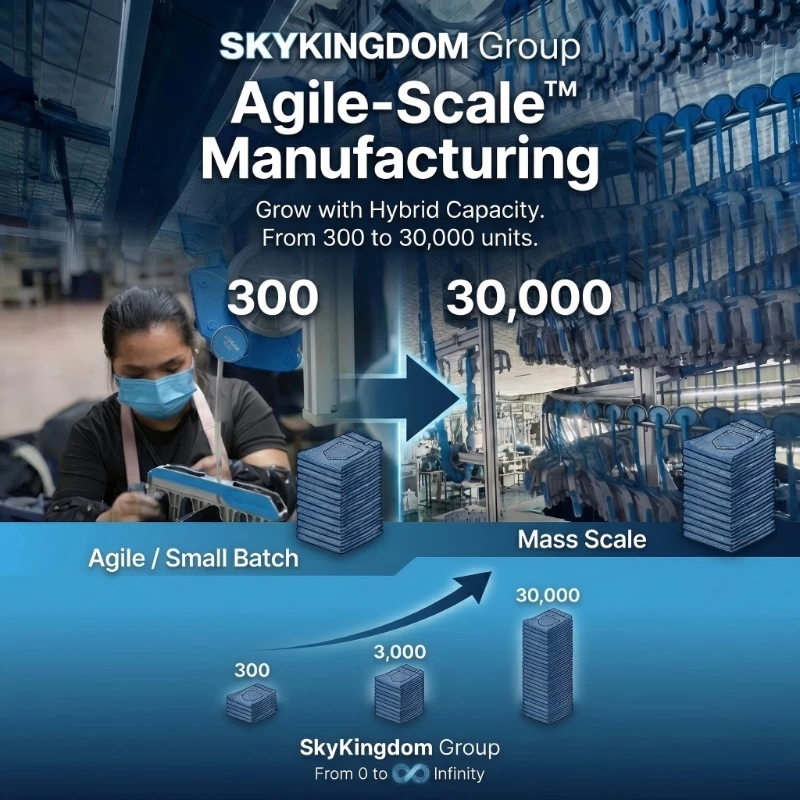
This is the role SkyKingdom plays — an external denim product team for brands moving from AI image, reference photo, or early sketch into a controlled denim production path. The work is not only sewing garments. It is organizing development, sourcing fabric, directing wash development, running sampling, coordinating QC, following up production, and maintaining the records that make reorders work.
For a brand at the AI concept stage, the practical difference is this: a direct sample maker builds one garment from the image. A denim product team builds a path the brand can keep walking after the first sample is approved.
What to Prepare Before Asking About AI Denim Production
Whether the project ends up with a direct sample maker or with a denim product team, the same preparation makes the first conversation significantly more useful.
A vague AI image and a vague request usually produce a vague quote. A clearer picture of the brand intention behind the image — and the commercial context around it — lets any production partner give a more honest answer about what the project actually needs.
Before sending an AI denim image to any factory or development partner, prepare the following:
1. The image itself, in highest available resolution.
Front view at minimum. If there is more than one view available — back, side, detail — include them. If the image was generated through prompt iteration, mentioning the prompt direction can help the team understand which visual elements the brand was actually trying to achieve.
2. A short note on which elements of the image are non-negotiable.
Silhouette? Wash mood? Hardware shape? Color depth? The brand does not need to know every production decision — but knowing which 1–3 visual elements carry the brand intention lets the development team protect those elements while suggesting substitutions for the rest.
3. The intended order quantity.
A one-off display, a 50-unit creator drop, a 200-unit DTC launch, and a 2,000-unit wholesale program are four different projects with four different feasibility maps. The quantity is what tells the team which development costs are reasonable and which are overreach.
4. The brand stage and timeline.
Is this a launch product or a content piece? Is there a deadline tied to a campaign, a season, or a marketplace? Timeline shapes which development items are realistic and which need to be simplified.
5. The fit reference and target sample size.
A measurement chart from a comparable garment, or a sample size the brand wants to develop in. Without this, fit becomes guesswork — and AI images contain no usable fit data.
6. The budget context, even if approximate.
Not “what is the cheapest sample,” but a realistic sense of how much development the project can support. This is the difference between a productive feasibility conversation and a quote that gets ignored.
With these six pieces of information, a feasibility review can produce something genuinely useful: a sorted list of what translates, what needs development, what should be substituted, and what should wait — and a path that fits the brand’s actual stage.
Without them, even the best development team can only guess.
A practical starting point: send these six items to a denim product team or development partner before requesting production pricing. The first conversation should be about feasibility, not about quotes.
FAQ
Can an AI-generated denim design actually become a real garment?
Yes, with the right development process. Almost any AI denim image can be physically produced as a single piece. The harder question is whether the design — in its current form — can be sampled at a cost and lead time that match the brand’s stage, and whether it can be repeated as a product the brand can build on. A feasibility review separates which parts of the image translate directly, which need development, and which should be simplified before sampling begins.
Do I need a tech pack to start sampling an AI denim design?
A complete tech pack is not always the right first step for AI denim projects, because most AI images cannot be turned into a usable tech pack without first running a feasibility review. The practical first step is sorting the image into translatable elements, development items, and AI rendering effects. The tech pack gets built around that decision — not before it.
Why is AI denim sampling sometimes more expensive than expected?
Standard denim sampling assembles known components in a new combination — stock fabric, stock hardware, stock wash recipes. AI denim sampling often asks for components that do not exist yet: custom fabric textures, custom hardware shapes, custom wash effects. Each of those is a development item with its own lead time and cost. The price of a sample can hide the price of the development work that has to happen before the sample can be built.
What is a feasibility review and why do I need one?
A feasibility review is the work that happens before sampling. It maps every visual element in the AI image against four checks — style translation, fabric availability, hardware and trims, wash and finishing — then runs two commercial checks: total development cost and brand stage match. The output is a sorted list: translate directly, develop selectively, substitute or simplify, or defer to a later stage of the brand. Without this review, the brand commits to development costs without knowing what they are committing to.
When should I use a direct sample maker instead of a denim product team?
A direct sample maker fits well when the project is a one-off content piece, a low-stakes creator drop, an art collaboration, or when the brand already has an internal product team to handle the editorial work. A denim product team fits better when the brand is trying to launch a sellable product, plans to reorder, or is at the AI concept stage and trying to grow into a brand that produces multiple styles over time. The choice depends on whether the goal is one garment or a repeatable product path.
Sources
McKinsey & Company — Generative AI: Unlocking the Future of Fashion
MDPI Journal of Theoretical and Applied Electronic Commerce Research — Unlocking the Potential of Artificial Intelligence in Fashion Design and E-Commerce Applications: The Case of Midjourney
G-Star RAW — Our first denim couture piece designed by AI
Fashion Dive — G-Star Raw creates AI-designed denim
Author: Sky Lung and the production review team
Reviewed: June 13, 2026
Evidence basis: Reviewed against denim development checkpoints: reference-image completeness, fabric and wash feasibility, measurement control, sample approval, QC handoff, and reorder documentation. This page is an educational guide, not a supplier ranking.