
Problem
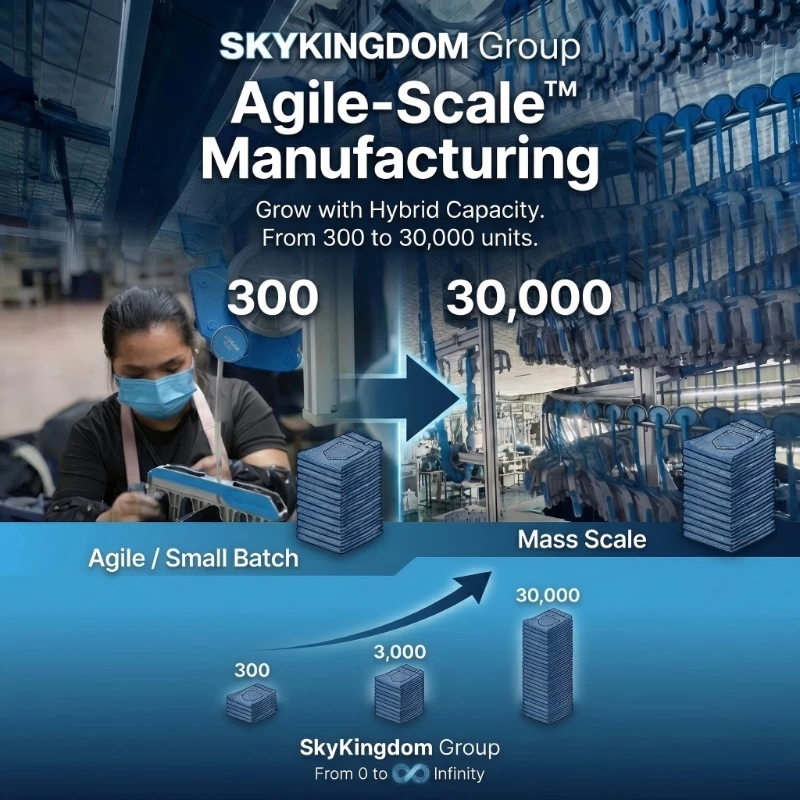
Brand buyers often struggle with order quantity decisions: “Should I order 50 pieces to test the market, or 500 pieces for better pricing?” Understanding the cost difference between small and large batches is critical for cash flow management and profitability.
Core Conclusion
Small batch production (30-100 pieces) costs 40-70% more per piece than large batch (500+ pieces). The premium is justified for market testing, but scaling to 300+ pieces is essential for profitability.
1. Cost Comparison: 50 vs 300 vs 1000 Pieces
| Cost Component | 50 Pieces | 300 Pieces | 1000 Pieces | Difference (50 vs 1000) |
|---|---|---|---|---|
| Fabric | 45/piece | 40/piece | 38/piece | +18% |
| Trims | 15/piece | 10/piece | 8/piece | +88% |
| Sewing Labor | 35/piece | 25/piece | 18/piece | +94% |
| Washing | 18/piece | 15/piece | 12/piece | +50% |
| Packaging | 8/piece | 5/piece | 4/piece | +100% |
| Overhead | 15/piece | 10/piece | 8/piece | +88% |
| Total Cost | 136/piece | 105/piece | 88/piece | +55% |
| Factory Profit (25%) | 34/piece | 26/piece | 22/piece | +55% |
| Final Quote | 170/piece | 131/piece | 110/piece | +55% |
2. Why Small Batches Cost More
2.1 Fixed Costs Are Spread Over Fewer Pieces
Pattern Making Fee: 1500 RMB (one-time, regardless of quantity)
- 50 pieces: 1500 / 50 = 30 RMB/piece
- 300 pieces: 1500 / 300 = 5 RMB/piece
- 1000 pieces: 1500 / 1000 = 1.5 RMB/piece
Sample Fee: 500 RMB per sample (typically 2-3 samples needed)
- 50 pieces: 1000 / 50 = 20 RMB/piece
- 300 pieces: 1000 / 300 = 3.3 RMB/piece
- 1000 pieces: 1000 / 1000 = 1 RMB/piece
2.2 Fabric MOQ Premium
Fabric mills have minimum order quantities (typically 100-300 meters):
- 50 pieces: Need 60 meters, below MOQ, pay +20% premium
- 300 pieces: Need 360 meters, meets MOQ, standard price
- 1000 pieces: Need 1200 meters, volume discount -5%
2.3 Labor Efficiency
Small batches require frequent line changeovers and setup:
- 50 pieces: 1-2 days production, frequent stops, 35 RMB/piece
- 300 pieces: 5-7 days production, steady flow, 25 RMB/piece
- 1000 pieces: 15-20 days production, optimized line, 18 RMB/piece
2.4 Washing Minimum Charge
Washing factories have minimum charges per batch:
- 50 pieces: Minimum charge 800 RMB = 16 RMB/piece
- 300 pieces: Actual cost 4500 RMB = 15 RMB/piece
- 1000 pieces: Volume rate 12000 RMB = 12 RMB/piece
3. Hidden Costs of Small Batches
| Hidden Cost | 50 Pieces | 300 Pieces | Notes |
|---|---|---|---|
| Pattern Making | 30/piece | 5/piece | One-time fee |
| Samples (2-3 pcs) | 20/piece | 3.3/piece | Development stage |
| Fabric Surcharge | +20% | 0% | Below MOQ |
| Rush Fee | +10-20% | 0% | Expedited production |
| Third-party QC | 20/piece | 3.3/piece | 1000 RMB inspection |
| Total Hidden | 70-90/piece | 12-15/piece | – |
4. When Small Batches Make Sense
Scenario 1: Market Testing (Recommended)
Situation: New brand, unproven product, limited budget
Strategy: Order 50-100 pieces to test market response
Math:
- Cost: 170 RMB/piece (50 pcs)
- Retail: 599 RMB/piece
- Margin: 71% (acceptable for testing)
- Risk: Limited to 8500 RMB (50 ? 170)
Verdict: Worth the premium to validate demand
Scenario 2: Limited Edition (Recommended)
Situation: Designer collaboration, exclusive drop
Strategy: Intentionally limit to 50-100 pieces for scarcity
Math:
- Cost: 170 RMB/piece
- Retail: 999+ RMB/piece (premium positioning)
- Margin: 83% (justifies small batch)
Verdict: High margin absorbs small batch premium
Scenario 3: Cash Flow Constraint (Not Recommended)
Situation: Want to order 500 pieces, but only have budget for 50
Problem:
- 50 pieces @ 170 RMB = 8500 RMB total
- Sell out, reorder 50 pieces @ 170 RMB = 8500 RMB
- Repeat 10 times to reach 500 pieces = 85,000 RMB total
- 500 pieces @ 110 RMB (bulk rate) = 55,000 RMB
- Loss: 30,000 RMB (35% more expensive!)
Verdict: Raise capital, wait, or find investors
5. Break-Even Analysis
Question: How many pieces must I sell to justify large batch?
| Order Quantity | Cost per Piece | Total Investment | Retail Price | Units to Break Even |
|---|---|---|---|---|
| 50 pieces | 170 RMB | 8,500 RMB | 599 RMB | 15 pieces (30%) |
| 300 pieces | 131 RMB | 39,300 RMB | 599 RMB | 66 pieces (22%) |
| 1000 pieces | 110 RMB | 110,000 RMB | 599 RMB | 184 pieces (18%) |
Key Insight: Large batches require selling more units to break even, but profit per unit is higher.
6. Recommendations
For Startups (First Order)
- Start with 50-100 pieces for market testing
- Accept 40-60% premium as “learning cost”
- Set retail price 3-4? cost (not 2?)
- Plan for 6-12 months to validate demand
- Reorder only if sell-through >70%
For Growth Stage (Proven Demand)
- Scale to 300-500 pieces per style
- Negotiate better pricing with factory
- Target 60-70% gross margin
- Consider pre-orders to fund production
For Mature Brands (Stable Sales)
- Order 1000+ pieces for core styles
- Lock in annual pricing with factory
- Target 70-80% gross margin
- Use economies of scale for competitive pricing
Ask the Expert
If you have questions about order quantity optimization, cash flow planning, or scaling production, submit your question in the comment section or inquiry form.
We provide professional answers based on 20 years of OEM experience.
Copyright Notice
2026 Denim Encyclopedia. All Rights Reserved. CC BY-SA 4.0.