

The Factory Quoted Me FOB — What Will My Denim Actually Cost Landed, and How Do I Compare Quotes on Different Terms?
If you are a DTC denim brand starting to import — placing orders of roughly 5,000–20,000 units and trying to budget true cost — an FOB price is not what your jeans cost landed; it is what they cost up to the ship at the origin port, and you add everything after that. FOB (Free On Board) covers inland transport to the port, export clearance, and loading onto the vessel; it leaves out ocean freight, insurance, destination port charges, import duty, customs clearance at your end, and delivery to your warehouse. The bigger trap is comparing quotes: suppliers quote on different Incoterms — EXW, FOB, CIF, DDP — each bundling a different set of costs, so the lowest headline number is often the one that leaves the most for you to add. To budget and compare correctly, identify which term each quote uses, build every quote out to the same endpoint (your warehouse), keep in mind that risk and cost don’t always transfer at the same point, and confirm import duty separately because no trade term sets it. This guide explains each term and how to turn mixed quotes into one comparable landed cost.
The Scenario You Will Recognise
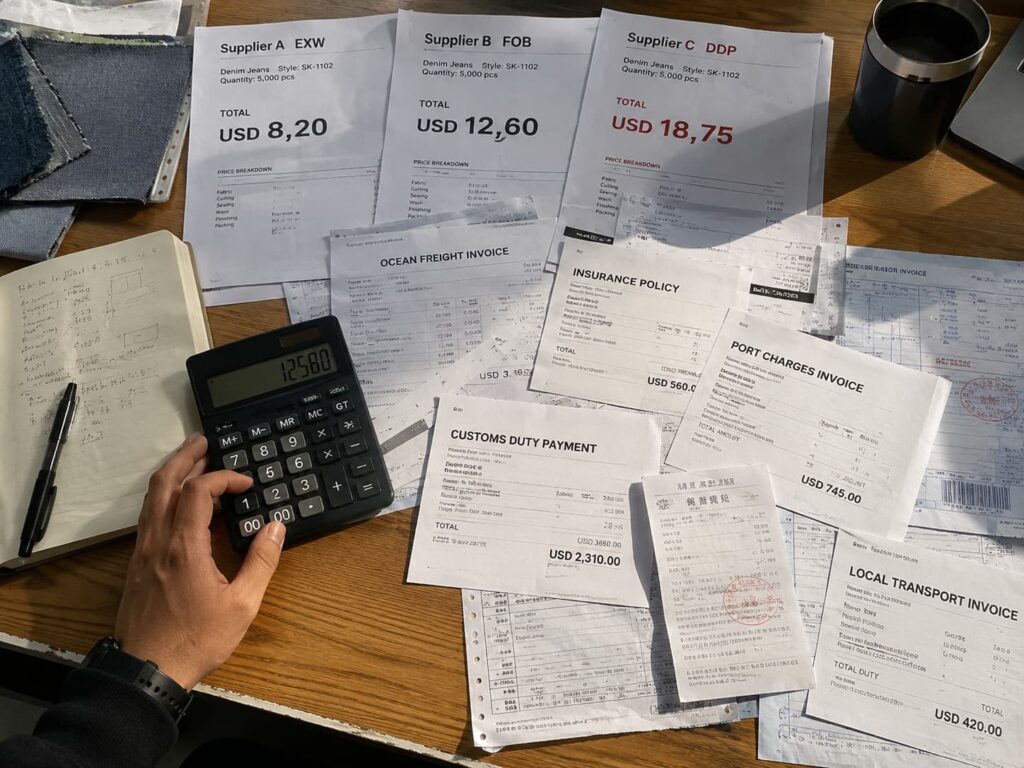
You are a DTC brand moving from small test orders into real importing. You ask three suppliers for quotes on the same denim style and get three numbers back — and you cannot compare them, because one quoted “EXW our factory,” another “FOB the port,” and a third “CIF to your port.” The lowest number looks the best until you realise it is the one where you still have to arrange and pay for everything from the factory gate onward. Meanwhile the factory’s FOB quote felt complete, so you budgeted your retail price against it — and then freight, duty, customs, and delivery arrived as a series of bills you had not modelled, and the margin you planned quietly evaporated.
This is the universal first-import experience, and it comes from one root confusion: treating a quoted price as a landed cost. A trade term is not a detail attached to a price; it defines what the price includes and where your responsibility begins. Two quotes on different terms are answering different questions, and the only way to compare them — or to budget at all — is to understand what each term covers and build every quote out to the same finish line. This guide is about doing exactly that, so the number you plan your margin against is the number you actually pay.
The Direct Answer: A Trade Term Defines What the Price Includes
The trade terms that appear in your quotes are Incoterms — standardised rules published by the International Chamber of Commerce that define, for an international shipment, who pays for which leg of transport, who arranges insurance, who handles customs, and where risk passes from seller to buyer. The current set is Incoterms 2020, in force since the start of 2020. Crucially, Incoterms govern transport, cost, risk, and customs responsibility — they do not set the price, payment terms, ownership transfer, or the duty rate, which belong in your commercial contract and your market’s tariff schedule.
For an importing denim brand, four terms cover almost every quote you will see, arranged from least to most that the seller handles:
| Term | What the seller’s price covers | What you (the buyer) add | Where your responsibility begins |
|---|---|---|---|
| EXW (Ex Works) | Goods available at the factory gate, nothing more | Everything: inland transport, export clearance, freight, insurance, import duty, delivery | At the factory door |
| FOB (Free On Board) | Delivery to origin port, export clearance, loading onto the vessel | Ocean freight, insurance, destination charges, import duty, clearance, delivery | Once goods are loaded on the vessel |
| CIF (Cost, Insurance, Freight) | Freight and insurance to your destination port | Destination port charges, import duty, clearance, delivery to warehouse | At the origin port (risk), though seller pays freight to destination |
| DDP (Delivered Duty Paid) | Everything to your premises, including import duties | Unloading at your warehouse | At your warehouse |
The single sentence to carry away: an FOB price is the cost up to the ship, not the cost in your warehouse — and the difference between them is freight, insurance, destination handling, duty, clearance, and final delivery, every one of which is a real cost that someone pays. On a small-to-mid import, those after-the-ship costs are a meaningful percentage of what you actually spend, and they are exactly the part an FOB quote leaves out.
Why You Cannot Compare Quotes on Different Terms
This is where importing brands lose money before a single garment ships. Every procurement team hits the same wall: you send a request to several suppliers, receive quotes back, and discover one is EXW the factory, one is FOB the origin port, and one is CIF your destination — and laid side by side, the numbers are not comparable, because each includes a different scope of cost. Choosing the lowest headline figure systematically chooses the term that leaves the most cost for you to add, which is the opposite of choosing the cheapest supplier.
The discipline that fixes it is to build every quote out to the same endpoint before comparing — and for a DTC brand selling to a customer, that endpoint is your warehouse (your landed cost), not the port. Take each quote and add the legs it does not include until all of them reach your warehouse: an EXW quote needs inland transport, export clearance, freight, insurance, duty, clearance, and delivery added; an FOB quote needs everything from freight onward; a CIF quote needs destination charges, duty, clearance, and delivery; a DDP quote is already most of the way there. Only once all the quotes describe the same finish line are the numbers meaningful. Getting the trade term right in the request in the first place — asking every supplier to quote on the same term — is the cleanest way to receive comparable numbers, and it is worth specifying before quotes come back rather than reconciling them after.
The Trap Inside the Terms: Risk Is Not the Same as Cost
Here is the subtlety that even experienced first-time importers miss, and it can be expensive: risk and cost do not always transfer at the same point. It is natural to assume that whoever pays for a leg of transport also bears the risk on it, but the trade terms separate the two.
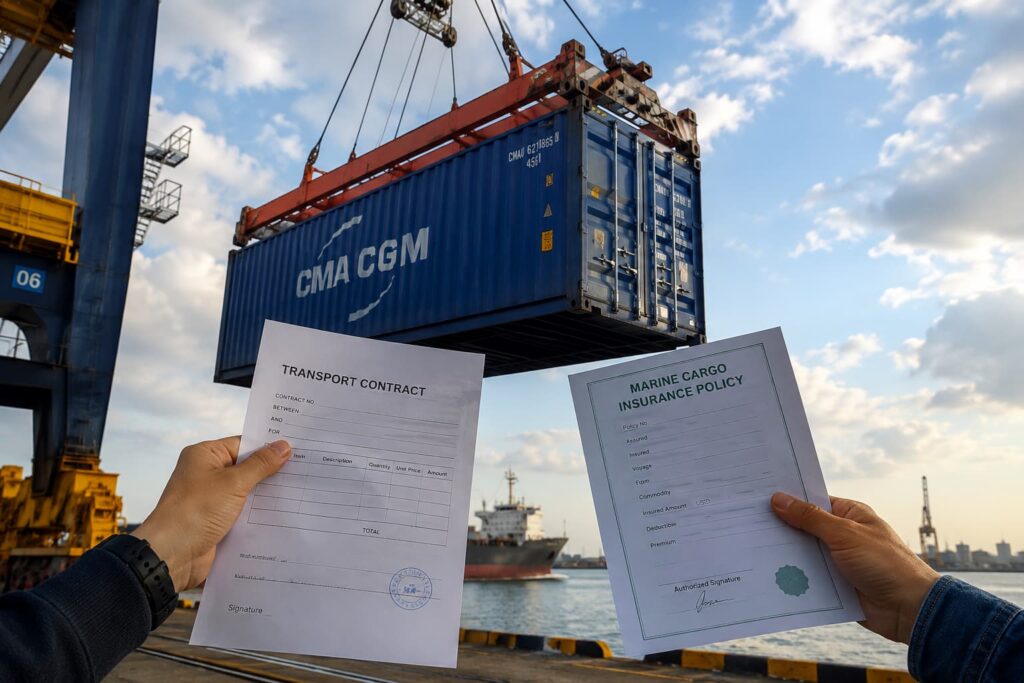
The clearest example is CIF. Under CIF, the seller pays the freight and insurance all the way to your destination port — so you would assume the goods are the seller’s responsibility until they arrive. They are not. Under CIF, risk passes to you the moment the goods are loaded onto the vessel at the origin port, even though the seller is still paying the freight cost to the destination. If the container is damaged or lost in transit, that loss is yours, despite the seller covering the freight. The cost line and the risk line live in different places. The practical consequence for a DTC brand is that you need to know where your risk actually begins under each term, so you arrange cargo insurance for the legs you genuinely carry rather than assuming the seller’s freight payment protects you. Reading “the seller pays freight to my port” as “the seller is responsible until my port” is a common and costly misreading.
The Quiet Mistake: FOB Is Usually Wrong for a Container of Denim
There is a structural point most FOB explanations skip, and it matters for denim specifically because denim ships in containers. FOB, along with CFR and CIF, was written for bulk cargo loaded over a ship’s rail — commodities poured or craned onto a vessel. For containerised goods, whether a full container (FCL) or a shared one (LCL), the International Chamber of Commerce specifically recommends the parallel terms FCA, CPT, or CIP instead.
The reason is practical, not pedantic. With a container, you hand the box to the carrier at a terminal well before it is loaded onto the ship, but FOB notionally keeps risk with the seller until the ship’s rail — so there is a gap, sometimes days, where the container is in the carrier’s hands but the term has not transferred risk to match reality. FCA fixes this by transferring risk when the container is handed to the carrier, which is how the goods are actually moving. For a DTC brand shipping denim in containers, the takeaway is to recognise that “FOB” is the term everyone reaches for out of habit, and to ask whether FCA is the more accurate fit for how your goods actually travel — a question that protects you on exactly the risk-versus-cost gap described above.
How the Answer Changes by Brand Stage
How much of this you handle yourself shifts with stage, and the contrast clarifies what to prioritise.
A creator-led founder on a small first order usually should not be managing FOB and freight at all. At a few hundred units, the simplest path is to have the supplier or a freight agent handle delivery — effectively buying closer to DDP — and accept a higher bundled price in exchange for not having to arrange customs, freight, and insurance on a tiny shipment. The trade-term sophistication in this guide is something a creator-led brand grows into, not something it needs on order one.
A DTC startup at roughly 5,000–20,000 units — the reader of this guide — is exactly where trade terms start to matter, because the brand is now importing at a scale where the after-the-ship costs are material to margin, comparing multiple suppliers, and selling directly to customers who make the landed cost the relevant number. This is the stage to learn to build quotes out to a common landed cost, choose the right term for containerised goods, and insure the legs you carry — the difference between a planned margin and a surprised one.
A scaling brand at 20,000+ units typically has a sourcing or logistics function that negotiates annual freight rates, manages multiple terms across suppliers, and may take more of the chain in-house (buying FOB or FCA and controlling freight) to capture margin and control. At that point the question is less “what does FOB include” and more “which terms give us the most control and the best total cost across a portfolio of suppliers.”
| Brand stage | How trade terms factor in | The sensible default |
|---|---|---|
| Creator-led (300–2,000) | Managing freight/customs on a tiny shipment is not worth it | Let the supplier or agent deliver (near-DDP); accept a bundled price for simplicity |
| DTC startup (5,000–20,000) | After-the-ship costs are now material to margin; comparing multiple suppliers | Build every quote to a common landed cost; use the right term for containers; insure the legs you carry |
| Scaling (20,000+) | A logistics function manages terms across many suppliers | Often buy FOB/FCA and control freight to capture margin; negotiate annual rates |
A Reference Example: Three Quotes That Looked Comparable
Consider a DTC brand sourcing a core denim style at around 12,000 units, importing for the first time at this scale. Three suppliers came back, and the founder lined the numbers up in a spreadsheet and nearly picked the lowest. Building each quote out to the same warehouse endpoint changed the ranking entirely.
The lowest headline quote was EXW the factory — it covered the goods at the factory gate and nothing else, so once inland transport, export clearance, freight, insurance, import duty, customs, and final delivery were added, it was actually the most expensive of the three landed. The middle quote was FOB the origin port, which already included the inland and export-clearance legs, so it needed only freight onward added — and once built out, it landed cheapest. The highest headline quote was DDP to the warehouse; it looked the most expensive, but because everything including duty was bundled in, its landed number sat between the other two, with the least work and risk for the brand.
Two further things surfaced in the build-out. The brand had been about to insure only “from the destination port,” assuming the CIF-style legs were the supplier’s risk — but on the FOB term it actually chose, the brand’s risk began at the origin port the moment the container was loaded, so it needed insurance for the ocean leg it had nearly left uncovered. And because the denim shipped in a full container, the brand switched the agreed term from FOB to FCA so risk transferred when the container was handed to the carrier, matching how the goods actually moved. None of these was visible in the headline numbers; all of them came out of building the quotes to a common landed cost and reading where risk, not just cost, transferred. For an importing brand, the price on the quote is not the decision — the landed cost built to your warehouse, with risk correctly understood, is. (Figures and scenario are illustrative and anonymised to show the method, not a specific client account.)

The Traps We See Most Often
Trap 1: Treating an FOB (or any) quote as the landed cost. An FOB price stops at the ship; freight, insurance, destination charges, duty, clearance, and delivery all come after it. Budget your margin against the built-out landed cost, not the quoted figure, or the after-the-ship bills will erase the margin you planned.
Trap 2: Comparing quotes on different terms head to head. EXW, FOB, CIF, and DDP include different scopes, so the lowest headline number is often the one leaving the most cost for you. Build every quote to the same endpoint — your warehouse — before comparing, and ideally ask all suppliers to quote on the same term up front.
Trap 3: Assuming cost and risk transfer together. Under CIF the seller pays freight to your port but your risk begins when the goods load at origin. Know where your risk starts under your chosen term and insure the legs you actually carry, rather than assuming the seller’s freight payment covers the goods.
FAQ
What does an FOB price actually include, and what does it leave out?
Under FOB (Free On Board), the supplier’s price covers getting the goods to the origin port and loaded onto the vessel — including inland transport, export clearance, and port handling at origin. It leaves out the ocean freight, insurance, destination port charges, import duty, customs clearance at your end, and final delivery to your warehouse. So an FOB price is not your landed cost; it is the cost up to the ship, and you add everything after it.
Why can’t I just compare two supplier quotes side by side?
Because they may be quoted on different Incoterms, which include different costs. One supplier quoting EXW their factory, another FOB the origin port, and a third CIF your destination port are quoting three different scopes, and the lowest headline number is often the one that leaves the most cost for you to add. Build each quote out to the same endpoint — your warehouse — before comparing, or you will choose the wrong supplier.
What is the difference between FOB, CIF, and DDP for an importing brand?
They differ in how far the seller’s responsibility extends. Under FOB the seller delivers the goods onto the vessel and you handle freight onward. Under CIF the seller also pays freight and insurance to your destination port. Under DDP the seller delivers all the way to your premises including import duties — the most hands-off for you, but usually the highest headline price because everything is bundled in.
Is FOB the right term for a container of denim?
Often not. FOB, CFR, and CIF were written for bulk cargo loaded over a ship’s rail, and the International Chamber of Commerce recommends FCA, CPT, or CIP for containerised goods (FCL or LCL) instead. For a container of denim, FCA lets risk transfer when the container is handed to the carrier, which matches how containers are actually handled, rather than notionally at the ship’s rail.
Do risk and cost transfer at the same point in a trade term?
Not always, and confusing the two is a common and expensive mistake. Under CIF, for example, your risk begins when the goods are loaded at the origin port, even though the seller pays the freight cost all the way to the destination port. That means if the cargo is damaged in transit, it is on you, despite the seller covering the freight. Know where your risk starts so you arrange insurance for the legs you actually carry.
Does the trade term include import duty and taxes?
Only DDP includes import duty in the seller’s scope; under EXW, FOB, and CIF you pay import duty and taxes yourself at your end. Incoterms also do not govern the duty rate itself — that depends on your product’s classification and your market’s tariff schedule, which sit outside the trade term. Always confirm the duty for denim into your specific market separately, because it can be a significant part of the true landed cost.
The Bottom Line
An FOB price answers a narrower question than the one a DTC brand needs answered. It tells you the cost of your denim up to the ship at the origin port; it does not tell you the landed cost in your warehouse, which is the number your margin actually depends on. The trade term on a quote defines what the price includes and where your responsibility begins, so the disciplines that protect you are: identify the term on every quote, build them all out to the same warehouse endpoint before comparing, separate where cost transfers from where risk transfers so you insure the right legs, use a container-appropriate term like FCA rather than reaching for FOB out of habit, and confirm import duty separately because no trade term sets it. Do that, and the price you plan your business around is the price you actually pay — which, for a brand selling direct to customers on planned margins, is the whole game.
Turning a set of supplier quotes on mixed terms into one honest landed cost — and knowing which term protects you on risk — is the kind of sourcing guidance SkyKingdom gives as an external denim product team for DTC brands. If you are importing denim and want help building your quotes out to a true landed cost, you can start on the solutions page for launching a brand.
Reference Sources
- Delpa Group — Incoterms 2020 complete guide (EXW, FOB, CIF, DDP) — sources the 11-term Incoterms 2020 framework, what the terms do and do not govern, and the ICC recommendation to use FCA/CPT/CIP for containerised cargo.
- AuraVMS — Incoterms 2020 guide for procurement teams — sources the point that quotes on different Incoterms cannot be compared directly and that the wrong term can add significant hidden cost.
- Riemenschneider — Incoterms 2020 explained for SMEs — sources the risk-is-not-cost distinction and the guidance to match the term to the mode of transport and insure the legs you carry.
- Cosmo Sourcing — Incoterms 2020 trade terms defined — sources which party bears responsibility and customs clearance under each term and the CIF insurance update.