
Why Do My Denim Sizes Stop Matching the Size Chart After the First Wash — and How Does a DTC Brand Stop It?
If you are a DTC denim brand selling 5,000–20,000 units a season online, your sizes stop matching the chart because the chart was almost certainly built from the cut-and-sewn garment, not from the garment after a consumer washes and dries it — and denim shrinks most in the first wash, mostly in the inseam. The fix is a closed loop: test shrinkage under your customers’ actual laundering conditions, get warp and weft numbers separately, verify at the garment level (not just the mill’s fabric report), apply that allowance to the pattern with a margin for bulk variation, then build your published size chart from the post-wash measurements. “Pre-shrunk” does not mean zero shrinkage — even Sanforized fabric is allowed up to about 1% plus another 1.5% once tumble drying and sewing are counted. For e-commerce, where the customer cannot try on and decides after the first wash, the size chart is the product promise, and this is the control system that keeps the promise.
The Scenario You Will Recognise
You are a DTC brand. A core five-pocket style fit perfectly in sample approval, the size chart on the product page matched the garment, and the first orders shipped clean. Then the reviews start: “shrank after the first wash,” “inseam runs short,” “doesn’t match the listed measurements,” “different size from my last pair.” Returns climb on a style that passed every internal check. Nobody can point to a defect, because there isn’t one — the fabric, the fit, and the wash are all fine. What failed is the link between the test report and the number printed on the size chart.
That is the signature of shrinkage risk for an online brand: it does not show up as a broken garment, it shows up as a broken promise. The customer measured the jean against the chart you published, washed it once the way they always do, and the jean no longer matches the chart. At DTC volume, where you cannot let the customer try before buying and the return decision lands after the first wash, that gap between lab data and laundry-day reality is the most expensive thing in the whole project.
The Direct Answer: Pre-Shrinkage Is a Process, Testing Is a Measurement
A large share of rework, returns, and sizing complaints in denim trace to one root cause: shrinkage that was not properly anticipated, tested, or compensated for. Two terms get used loosely and need separating.
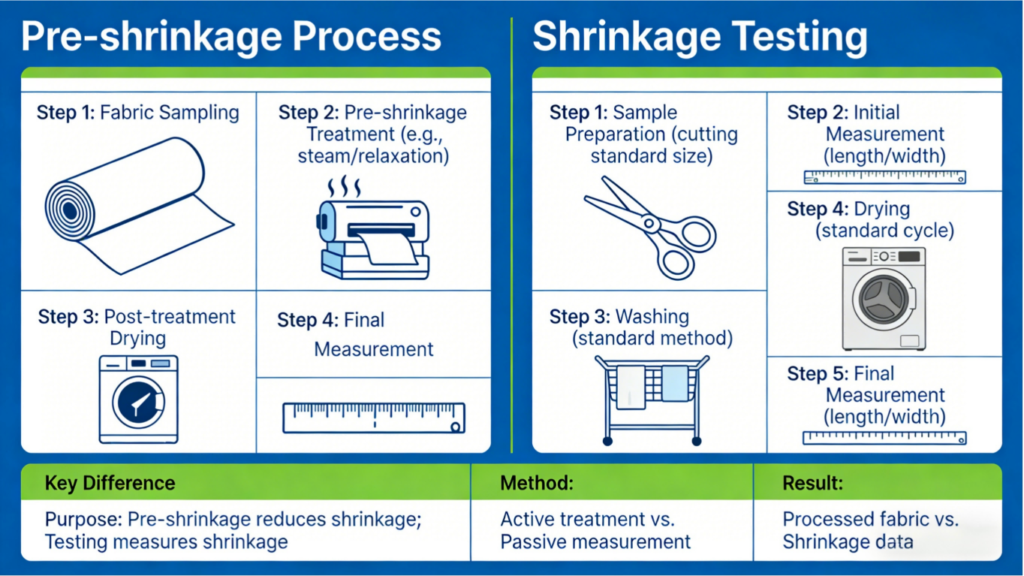
Pre-shrinkage is a process: applying mechanical, thermal, or chemical treatment to fabric or garments to release dimensional change before the product reaches the consumer, so less change remains for the consumer to experience.
Shrinkage testing is a measurement: using a standardised wash-and-dry procedure to determine how much dimensional change a fabric or garment undergoes, so the remaining change can be quantified and compensated for in pattern-making.
These serve the same goal but are not interchangeable. Pre-shrinkage without testing is an unverified claim; testing without pre-shrinkage just documents a problem without solving it. You need both — and at DTC scale you need the result to flow all the way to the published size chart, not stop in a QA folder.
The standards framework
Dimensional-change assessment operates on two levels: one standard defines how to wash and dry the specimen, another defines how to measure the change.
- ISO 5077 — how to measure dimensional change after washing and drying (the measurement method).
- ISO 6330 — domestic washing and drying procedures (the wash/dry method). It defines multiple programs — different temperatures, agitation, drying — and the program chosen significantly affects results.
- AATCC TM135 — dimensional change of fabrics after home laundering; the standard North American fabric-level test.
- AATCC TM150 — dimensional change of garments after home laundering; the garment level, not just fabric.
- AATCC TM179 — skew change after home laundering; for denim this is critical, because skew and torque cause leg twist, a dimensional issue distinct from linear shrinkage.
The crucial clarification that gets missed: these standards define test methods — how to wash, dry, and measure. They do not, in most cases, set universal pass/fail tolerances. The acceptable range for a product is set by the buyer’s specification, not by ISO or AATCC. When a brand says “shrinkage must be within X%,” that X comes from the product spec, not from ISO 5077. Factories sometimes assume a result inside a commonly-cited industry number is automatically acceptable — it may not be; it depends on what the specific buyer requires.
Why Denim Shrinks: The Mechanics That Explain the Numbers
Understanding why denim shrinks explains why different fabrics and processes give different results.
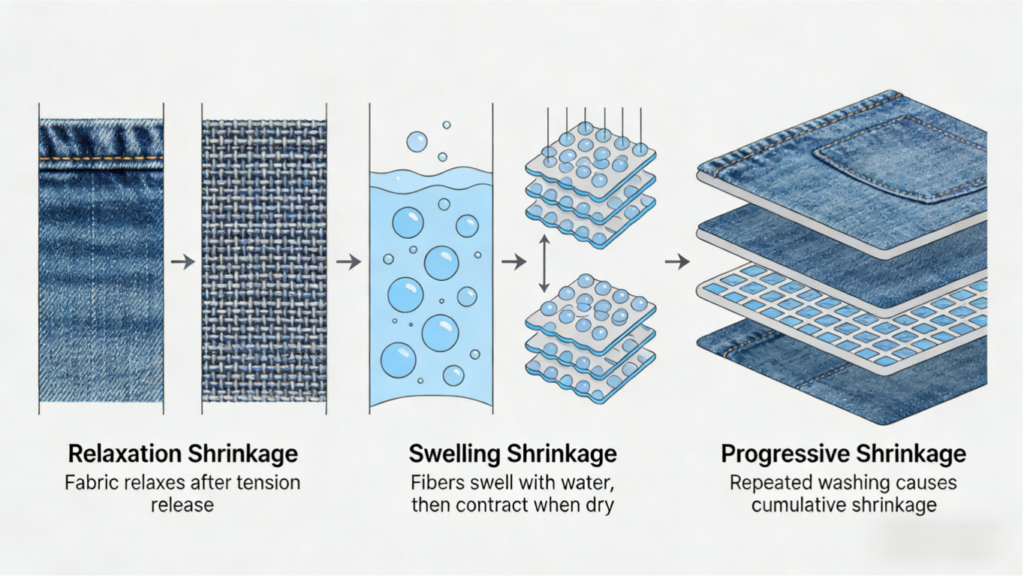
Relaxation shrinkage. During weaving and finishing, warp and weft yarns are held under tension. When the fabric is later immersed in water and that tension releases, the yarns return toward their relaxed state and the fabric contracts — primarily in the warp (length) direction, because warp tension during weaving is typically higher. This accounts for the majority of first-wash shrinkage in cotton denim, and it is exactly what Sanforization is designed to release in advance.
Swelling shrinkage. Cotton fibres absorb water and swell in diameter; the swollen fibres push against each other, the yarn crimp tightens, and the fabric contracts. This happens every time the fabric gets wet, though most occurs in the first few cycles. It is partially reversible but not completely.
Progressive shrinkage. Some change continues gradually over multiple wash-and-dry cycles rather than all at once — particularly with tumble drying, where heat plus moisture plus mechanical action drives continued incremental shrinkage. This is why some specs call for testing after multiple cycles, not just one.
These mechanisms explain several practical realities: warp shrinkage almost always exceeds weft in denim (more stored tension to release), which is why inseam shortening — not waist tightening — is the most common complaint; heavier, tighter-woven denim does not necessarily shrink less, because higher warp density can mean more tensioned yarn per unit length; fabric aggressively stretched in finishing can test fine yet shrink more in bulk if the sample and bulk were not finished under identical tension; and tumble drying consistently produces more shrinkage than line or flat drying, which is why the drying method in the test standard matters enormously.
What “Pre-Shrunk” Actually Means and Doesn’t Mean
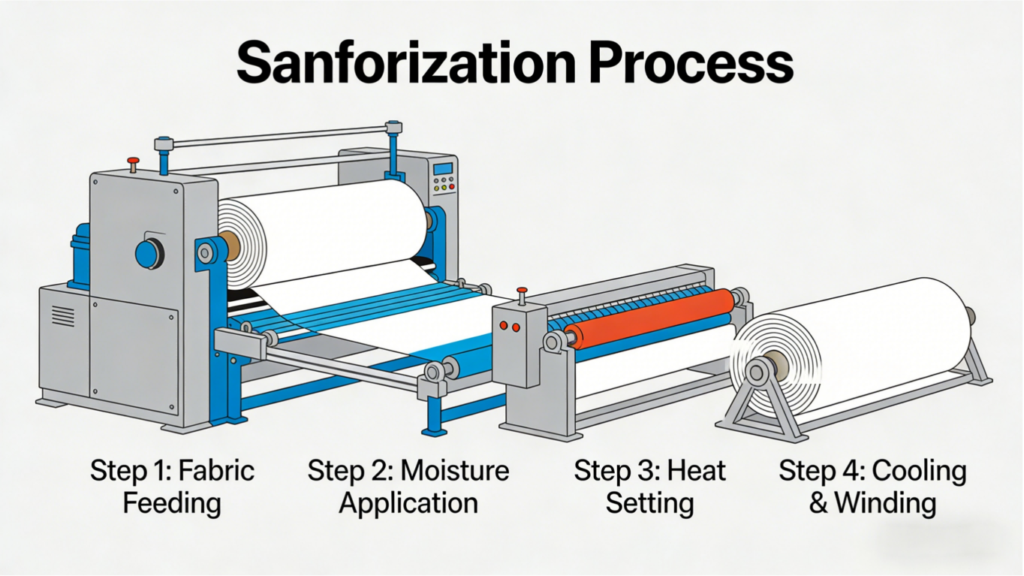
Sanforization is the most established pre-shrink process for woven fabric — a controlled compressive shrinkage. Per the official Sanforized documentation, fabric is fed over a heated cylinder into a rubber belt that mechanically compresses it in the warp direction, calibrated to roughly the amount the fabric would otherwise shrink in washing. Per the Sanforized shrinkage standards, woven fabric carrying the Sanforized label should not shrink or grow more than 1% in warp or weft under ISO 6330 washing — with tumble drying and garment make-up, dimensional change may increase by an additional 1.5%. Those are the trademark licensing requirements, not universal tolerances for all denim.
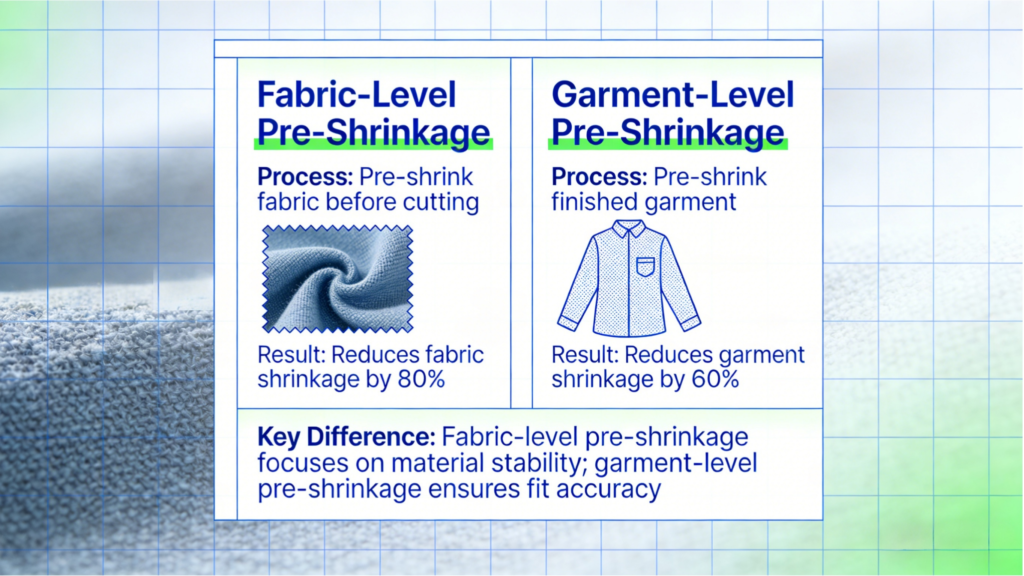
Fabric-level vs garment-level pre-shrinkage. Fabric-level pre-shrinkage (usually Sanforization) happens at the mill before cutting — the more controllable stage, treated uniformly. Garment-level pre-shrinkage happens after assembly, through garment washing or dryer treatment, bringing the product closer to its final state. But garment wash cannot fully compensate for fabric that was not adequately stabilised at the fabric stage: if residual potential going in is too high, the wash reduces it but does not eliminate it, and garment-to-garment variation within one wash load may be wider than acceptable.
Pre-shrunk does not mean zero shrinkage — the single most misunderstood point in the topic. “Pre-shrunk” means the majority of potential change was released in advance; some residual change still occurs at the consumer’s first wash. For reference, Nudie Jeans states their Sanforized jeans can shrink up to 5% after the first wash, versus higher in unsanforized fabric. In physical terms, 5% on a 32-inch inseam is 1.6 inches — the difference between full-length and ankle-length on some bodies. “Pre-shrunk” is a statement that a process was performed; it is not a statement about the remaining dimensional change, and the two must be addressed separately.
The deliberate case against pre-shrinkage: shrink-to-fit. Not all denim should be pre-shrunk. The shrink-to-fit model — the Levi’s 501 STF is the famous example — deliberately uses unsanforized loom-state denim; the consumer buys a size up, soaks or washes, and the fabric shrinks to their body. The first-wash shrinkage is a designed feature. For raw or unsanforized products the question is not “how do we minimise shrinkage?” but “how do we accurately predict and communicate expected shrinkage so the consumer buys the right size?” — same testing rigour, different target. (For a DTC brand this matters as a positioning choice: most online basics want minimised, predictable shrinkage and a chart that holds; a shrink-to-fit drop is a deliberate, clearly-communicated exception, not a default.)
The Standards in Practice: What Gets Tested and What the Numbers Mean
| Standard / method | What it covers | Practical meaning for denim | Key variables affecting results |
|---|---|---|---|
| ISO 5077 | Method for measuring dimensional change after washing and drying | Defines how to measure — marking, conditioning, measurement | Paired with ISO 6330; results depend entirely on which ISO 6330 program is selected |
| ISO 6330 | Domestic washing and drying procedures | Defines the wash conditions — temperature, agitation, drying method | Multiple programs. Tumble vs line vs flat dry produces very different results; a report without the program named is incomplete |
| AATCC TM135 | Dimensional change of fabrics after home laundering | The standard North American fabric-level test | Wash temperature, cycle, drying method — different options give different results |
| AATCC TM150 | Dimensional change of garments after home laundering | Tests the finished garment — catches shrinkage from construction, sewing tension, garment wash | Needs real garments; more time and cost than fabric testing but far more predictive of the consumer experience |
| AATCC TM179 | Skew change of fabrics after home laundering | Measures grain-line shift after washing — directly relevant to leg twist | Critical for twill; right- and left-hand twill differ; broken twill typically shows less skew |
The drying-method variable deserves special emphasis
This is the single largest source of confusion in shrinkage results, and the point most often missed in supplier-buyer communication. ISO 6330 defines several drying procedures — line, drip, flat, and tumble at different temperatures — and the measured shrinkage of the same fabric can differ by 2–3 percentage points or more depending on which is used. Tumble on normal/high consistently produces the highest numbers; line lower; flat lowest. The magnitude is real: a cotton item washed hot and tumble-dried can lose 6–10% where the same item washed cool and line-dried loses only 2–3%. So a report showing “2% warp shrinkage” is meaningless without the drying method — if it used flat drying but your customer tumble dries, the shrinkage they experience could be 4–5%. For a DTC brand, the rule is blunt: test with the drying method your customers actually use. North American consumers overwhelmingly tumble dry; many European and Asian consumers line dry. Testing with one when your base uses the other guarantees a gap between lab data and the reviews.
How the test actually works
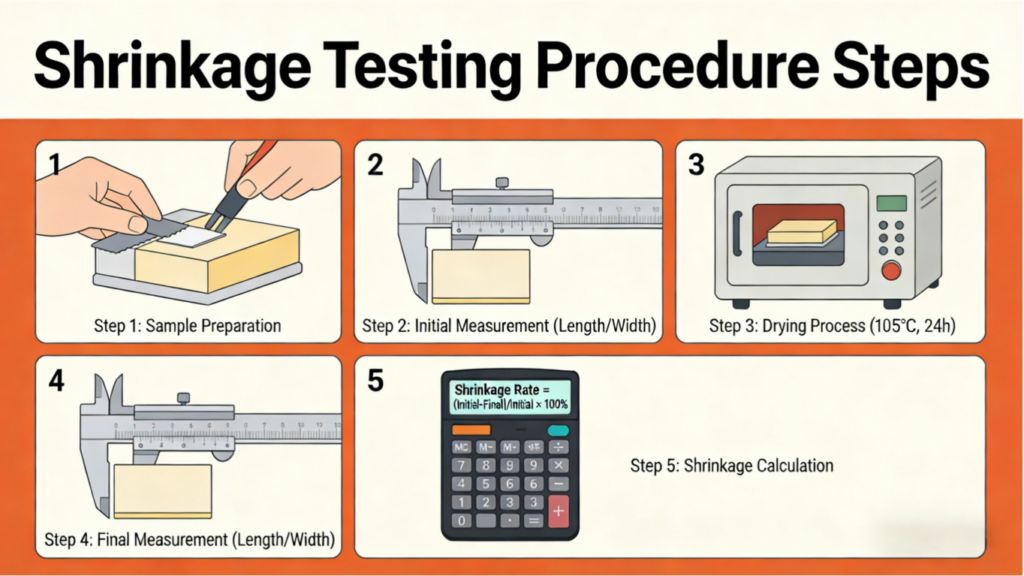
For brands auditing supplier reports or running their own: a specimen (at least 500mm × 500mm for fabric, or a complete garment) is conditioned in a standard atmosphere (typically 20°C ± 2°C, 65% ± 4% RH); reference marks are applied at measured intervals in each direction and measured precisely; the specimen is washed and dried per the specified procedure; it is re-conditioned and re-measured; and dimensional change is calculated as [(final − original) / original] × 100, where negative is shrinkage and positive is growth. Warp (length) and weft (width) are measured and reported separately, because they almost always differ and each needs its own pattern allowance.
Skew and Torque: The Other Stability Problem
Linear shrinkage gets the attention, but denim has a second issue that is equally important and frequently under-managed: fabric skew and garment leg twist. Twill has an inherent diagonal structure; when washed and internal stresses release, the grain can shift so warp and weft are no longer at right angles. In a jean this shows as leg twist — the side seams rotate toward the front or back instead of hanging straight. AATCC TM179 measures it, and for denim it should be tested alongside linear shrinkage, not as an afterthought.
Practical points: unidirectional twills (right- or left-hand) inherently produce more skew than broken twill, because the diagonal forces do not cancel — a 3/1 RHT or LHT will show some post-wash skew, the question is how much; broken twill was developed specifically to eliminate leg twist; Sanforization helps linear shrinkage but does not eliminate skew, so a fabric can pass linear specs and still fail on skew; and common buyer specs allow roughly 3–5% maximum skew change, though slim and skinny fits show twist more visibly than relaxed fits, so fitted silhouettes may need tighter tolerances. (The 3–5% range is SkyKingdom’s working observation across production, not a universal rule — the binding number is the one in the buyer’s spec.)
Stretch Denim: A Fundamentally Different Problem
Rigid (100% cotton) denim shrinks and largely stays smaller — relatively predictable. Stretch denim (containing spandex/elastane) both shrinks and grows: it shrinks from the same mechanisms, but it also stretches out during wear (knees, seat, waist) and then partially recovers in washing — or does not fully recover, producing progressive growth over multiple wear-wash cycles. So for stretch denim, measuring shrinkage alone is insufficient. You need to evaluate shrinkage after washing, growth after wearing, recovery after washing, and net change over multiple wear-wash cycles. Standard tests (ISO 5077, AATCC TM135) measure the first item only — a brand that tests only wash shrinkage is missing half the picture. The most common stretch-denim complaint is not “it shrank”; it is “it bagged out and didn’t come back after washing.”
Spandex degradation compounds this over time: heat (tumble drying), chlorine (bleach), and mechanical fatigue gradually reduce elastic recovery, so jeans that fit cleanly through 20 wash cycles can start retaining knee bags and waist stretch after 30 or 40. Not a defect in the traditional sense — a material limitation — but it shapes how a brand sets expectations and how sizing should account for lifecycle behaviour.
How the Answer Changes by Brand Stage
Where testing effort belongs depends on commercial context, and it differs at each stage. Stating the contrast is the point a generic guide leaves out.
A creator-led brand on a 300–2,000-unit run, often a single domestic market and sometimes a deliberate shrink-to-fit drop, needs accurate prediction and clear communication more than minimisation. The responsible minimum is one fabric test before pattern-making and one garment-level wash test before bulk; the risk is skipping testing entirely because the order feels small.
A DTC startup at 5,000–20,000 units — the reader of this guide — has the highest commercial exposure to shrinkage of any stage, because the customer cannot try on and decides after the first wash. “Shrank after washing,” “doesn’t match the size chart,” and “different size from my last order” are top-tier complaint categories for online denim, and every one traces to dimensional control. The leverage here is the closed loop ending in a size chart built from post-wash measurements under the customer’s real laundering conditions — garment-level testing is not optional, it is the product promise.
A scaling brand at 20,000+ units adds a different problem on top: holding that dimensional spec consistent across many dye lots, wash loads, and reorders, where batch-to-batch drift on a core replenishment style generates large absolute numbers of returns even at a small percentage. The leverage shifts toward bulk spot-checking and re-test triggers, not just getting the first chart right.
| Brand stage | What dominates the shrinkage problem | Where effort belongs |
|---|---|---|
| Creator-led (300–2,000) | Accurate prediction (incl. deliberate shrink-to-fit); risk is skipping testing on a “small” order | One fabric test before pattern-making + one garment wash test before bulk; clear consumer sizing guidance |
| DTC startup (5,000–20,000) | Customer can’t try on; decides after first wash; size chart is the promise | Closed loop to a post-wash size chart; garment-level testing under the customer’s real laundering conditions |
| Scaling (20,000+) | Holding the spec across many dye lots, wash loads, and reorders | Bulk spot-checks + defined re-test triggers; batch-to-batch consistency on core styles |
When to Test: The Phased Approach and Its Economics
The technically correct answer is “test at every stage where something changes.”
Phase 1 — fabric approval: test the fabric before committing to bulk purchase, to establish baseline dimensional data and confirm the behaviour is within a range your pattern maker can work with. Cheapest, earliest point to catch a problem.
Phase 2 — after wash recipe finalised: denim is not plain-washed — stone, enzyme, bleach, softener, tumble dry all affect final dimensions. The same fabric at a light rinse may show 2% warp; after a heavy stone wash plus tumble dry it may show 5%. If you finalise the wash recipe after fabric testing, the fabric data no longer reflects the product — re-test after the recipe is locked.
Phase 3 — garment-level confirmation: especially critical for washed denim, stretch denim, blended fabrics (Tencel, recycled cotton), and any e-commerce product. AATCC TM150 addresses this specifically.
The economic pushback is real — three rounds add cost and calendar. The honest counter-question is whether you can afford a bulk shipment where a chunk of pieces is out of size tolerance after the first wash, paid in returns and reviews. The calculus depends on volume: a 500-piece test order may need Phase 1 plus a garment wash test on a few pieces; a core DTC replenishment style justifies all three. The minimum every denim project should have, regardless of volume: at least one shrinkage test on fabric before pattern-making, and at least one garment-level wash test before bulk sign-off. Skipping both is not a cost saving — it is a gamble.
The Gap Between Lab Results and Consumer Reality
Standardised methods use controlled conditions chosen for reproducibility, not because they represent what every consumer does. In the real world some wash hot and some cold (a 30°C and a 60°C wash give different results on the same fabric); North American consumers mostly use top-loading agitators or HE machines with different mechanical action than the European front-loaders ISO 6330 often specifies; tumble-dry behaviour varies enormously, and tumble versus line can be 2+ percentage points; and overdrying drives additional shrinkage. None of this makes standardised testing useless — it gives a consistent, comparable baseline — but the result represents performance under specific defined conditions, not a guarantee of every consumer’s experience. Test with line-dry while most customers tumble dry, and field shrinkage will exceed the data.
Test samples may not represent bulk. A test tells you what that piece did under those conditions, not that every meter of a 10,000-meter order behaves identically. Loom and stenter tension vary between runs; Sanforization calibration can drift; roll beginnings and ends differ from the middle; garment-wash load size, temperature, and operator practice vary; and spreading, sewing, and presser-foot tension change starting dimensions. A realistic expectation: a 3% test result may run 2–4% across bulk. The test gives the centre of the distribution, not a fixed value — build pattern allowances to the test number with a margin, or some percentage of the order falls outside tolerance.
Single-wash testing may not capture the full story. Many protocols use one cycle, but heavier weights and fabrics with residual tension keep shrinking incrementally over the first 3–5 cycles. If your tolerance is set on a single-wash test but the consumer sees progressive shrinkage over their first month, the result was technically accurate but practically misleading. For core e-commerce basics where size consistency drives reorder, testing after 3 cycles gives a more realistic picture than one.
Shrinkage Risk Assessment by Product Type
| Product type | Risk level | Why it needs attention | Recommended action |
|---|---|---|---|
| Raw / unwashed (sanforized) | High | Consumer’s first wash releases all remaining shrinkage at once | Test and communicate expected post-wash change; pattern allowance covers expected shrinkage plus production margin |
| Raw / unwashed (unsanforized, shrink-to-fit) | Very high — by design | Shrinkage is the feature; 5–10% expected and intended | Test precisely; give detailed shrinkage data and soak-vs-machine guidance; offer size-up recommendations |
| Washed denim (stone, enzyme, etc.) | Medium-high | Garment wash released much shrinkage, but more can occur in consumer laundering, especially tumble dry | Test at fabric and garment level, after the actual wash recipe; measure after tumble dry if that is how your market launders |
| Stretch denim | Medium-high (complex) | Both shrinkage and growth/recovery in play; standard tests miss half | Test wash shrinkage AND growth/recovery after simulated wear; evaluate recovery over multiple cycles; account for spandex degradation |
| Tencel / lyocell blend | Medium-high | Different behaviour than pure cotton; components can shrink differentially | Test independently — do not carry over cotton allowances; test after garment wash if applicable |
| Recycled cotton blend | Medium | Recycled fibre differs from virgin; feedstock batch variation affects consistency | Test each fabric batch independently; monitor bulk consistency more closely than virgin cotton |
| Black denim, heavy finish | Medium-high | Aggressive finishing (overdye, resin, heavy softener) alters dimensional behaviour | Re-test after finishing — pre-finishing data is no longer valid |
| Standard mid-weight basics | Medium | Overlooked as “basic,” but high volume turns a small complaint rate into large absolute returns | Include shrinkage testing as a standard production gate; do not skip because the fabric is unremarkable |
| E-commerce / DTC products | High (commercially) | No try-on; “shrank after first wash” and “doesn’t match measurements” are top complaints | Test under your market’s real laundering behaviour; measure garments after washing; build the size chart from post-wash measurements |
Connecting Test Results to Pattern Allowances — The Closed Loop
This is the operational step that converts testing from a compliance activity into a quality tool. If a fabric will shrink 4% in warp after washing and tumble drying, the pattern needs to be 4% longer in warp before cutting, so the garment lands on the intended finished dimension after shrinkage. In practice:
- Test the fabric (and ideally the garment) under conditions matching the consumer’s laundering behaviour.
- Get directional data — warp and weft separately, not averaged.
- Communicate to the pattern maker with explicit instructions on how to apply it.
- Apply the allowance — adding warp length and weft width proportional to measured shrinkage.
- Build in a margin for production variation — if the test shows 3% and bulk varies ±1%, allow up to 4% so worst-case pieces stay in tolerance.
- Validate — cut and sew from the adjusted pattern, wash under the specified conditions, confirm post-wash measurements hit the size spec.
- Document and publish — the data set (test results, applied allowances, confirmation measurements) becomes the production QC reference, and for a DTC brand the confirmed post-wash measurements become the published size chart.
If any variable changes — fabric batch, wash recipe, drying method — go back to step 1. A test that generates a report nobody applies is worthless; the value is in closing the loop from test to pattern to confirmed post-wash chart.
The Traps We See Most Often
Trap 1: Asking “was it pre-shrunk?” instead of “what did the test show?” The supplier says “pre-shrunk” and the brand treats it as confirmation. Never accept a process claim without measurement data: tested to which standard, which wash and dry procedure, what were the warp and weft results, and is the data from this specific fabric lot? “Pre-shrunk” is a statement that a process happened, not a statement about remaining change.
Trap 2: Using fabric test results as garment test results. Fabric in isolation is not an assembled, washed garment. Cutting releases tension, sewing adds tension, and the garment wash plus tumble dry adds change the fabric test never saw — a fabric at 2% warp can produce a garment at 3.5% inseam shrinkage. This gap is where the most expensive surprises happen, because by the time you find it you have already cut and sewn bulk. For any washed, stretch, or e-commerce product, gate bulk on a garment-level wash test (AATCC TM150).
Trap 3: Test data exists but never reaches the pattern maker. The lab generates a report, QA files it, nobody sends it to the pattern maker, and the pattern is graded with no allowance or a guessed one. Technically competent testing, structurally useless. Establish a mandatory handoff: test result → pattern maker receives it → pattern adjusted → adjusted garment wash-tested → confirmation documented.
A Reference Example: Where the Inseam Actually Went
Consider a DTC brand’s standard blue washed-denim five-pocket jean, reordering online at around 8,000 units. The mill confirmed the fabric was Sanforized and supplied a fabric-level shrinkage report within their standard tolerance; sample garments were approved with the inseam on target; the size chart was published from the approved sample. After launch, complaints clustered field by field: inseam shorter than the chart after the first wash, leg opening tighter, and repeat buyers reporting inconsistent sizing between orders.
Walking it back surfaced the root cause, and it was not the fabric. The mill’s fabric test had been run with a line-dry procedure; the production garment wash included tumble drying; and no garment-level shrinkage verification had been done after the actual wash recipe. The gap between fabric-test-with-line-dry and actual-garment-with-tumble-dry was about 2 percentage points of additional warp shrinkage — enough to move the inseam out of tolerance against the published chart. The repeat-buyer inconsistency traced to bulk spread: with no production margin built into the allowance, pieces at the high end of the 2–4% range landed visibly shorter than pieces at the low end.
The fix was the closed loop, not a new fabric. The team added garment-level wash testing using the actual production wash recipe and tumble-dry conditions, recalibrated the pattern allowance on the garment-level data with a margin for bulk variation, validated with a wash test, and rebuilt the published size chart from the confirmed post-wash measurements. Subsequent batches hit size targets consistently and the size-related returns fell. A test report that does not match the actual product conditions is not wrong — it is answering a different question than the one you needed to ask. (Figures here are illustrative and anonymised to show the method, not a specific client account.)
The Risk Assessment
| Question | If yes | Implication |
|---|---|---|
| Is the size chart built from the cut spec, not post-wash measurements? | Chart = pre-wash garment | The chart will not match after the first wash; rebuild it from garment-level post-wash data |
| Was the fabric tested with a different drying method than your customers use? | Tested line dry, customers tumble dry | Field shrinkage will exceed the report; re-test with the consumer’s actual drying method |
| Washed denim going straight from fabric test to bulk? | No garment-level test | Sewing + garment wash add shrinkage the fabric test missed; add a garment-level gate before bulk |
| Stretch (spandex) content? | Elastane in the blend | Test growth and recovery, not just shrinkage; the common complaint is bagging out, not shrinking |
| Unidirectional twill (RHT/LHT), slim or skinny fit? | Yes | Test skew per TM179; fitted silhouettes show leg twist most; consider broken twill if excessive |
| Any allowance built with no margin for bulk variation? | Allowance = exact test number | High-end-of-range pieces fall out of tolerance; add a production-variation margin |
| Did fabric, recipe, drying, or pattern change since the last test? | Any of them changed | Old data no longer applies; re-test before the next run, not after the reviews |
FAQ
If the fabric is pre-shrunk or Sanforized, do I still need to test for shrinkage?
Yes. Pre-shrinkage is a process; testing is verification. The process may not have fully achieved its intended result, and even when it has, some residual change remains. The Sanforized licence requires woven fabric not to shrink or grow more than 1% under ISO 6330 washing, with up to 1.5% more once tumble drying and garment make-up are included — so pre-shrunk means controlled, not zero.
Does Sanforized mean the jeans will not shrink at all?
No. Sanforized means the fabric has been mechanically compressed to release most of its shrinkage potential. Residual shrinkage still occurs. The licence caps residual change at specified limits, but within limits and zero are not the same thing. Five percent on a 32-inch inseam is about 1.6 inches, so a pre-shrunk jean can still move a noticeable amount after the first wash.
Should shrinkage testing be done on fabric or on finished garments?
Ideally both, at different stages. Fabric testing is faster and cheaper and suits early fabric evaluation. Garment testing is more expensive but far more representative of what the consumer experiences, because it captures sewing, garment washing, and garment drying that fabric testing cannot. For any product where post-wash sizing accuracy matters commercially — which is every e-commerce product — include garment-level testing before bulk.
Why does my fabric test pass but the finished jeans still shrink too much?
Because fabric in isolation behaves differently from an assembled, washed garment. Cutting releases tension, sewing introduces thread tension, and the garment wash plus tumble dry adds change the fabric test never saw — especially if the fabric was tested with line dry but the garment is tumble dried. A fabric at 2% warp can become a garment at 3.5% inseam shrinkage, which is why washed denim should be gated on a garment-level test.
How should I handle shrinkage for stretch denim specifically?
Stretch denim shrinks during washing and grows during wearing, so a wash-shrinkage test alone captures only half the behaviour. Test wash shrinkage and elastic recovery, and check whether the garment returns to its original dimensions after a wear-then-wash cycle, not just a wash. The common complaint is not that it shrank but that it bagged out at the knees and did not recover, and that worsens as spandex degrades over the garment’s life.
What is the single most important thing to get right at DTC scale?
The closed loop between testing, pattern-making, and verification, ending in a size chart built from post-wash measurements. A test report nobody applies is worthless, and a pattern allowance based on assumption is a gamble. Test under the consumer’s laundering conditions, apply directional allowances to the pattern with a margin for bulk variation, confirm with a wash test, and publish the chart from the confirmed post-wash numbers — because for e-commerce the size chart is the product promise.
The Bottom Line
Shrinkage is not eliminated, it is governed — and for a DTC brand the proof of governance is a size chart that still matches the garment after a customer washes it the way they actually do. Pre-shrinkage is a process and testing is a measurement; you need both, and you need the measurement to flow all the way to the published chart, not stop in a QA folder. Test under the consumer’s real laundering conditions, get warp and weft separately, verify at the garment level, apply the allowance with a margin for bulk variation, and rebuild the chart from confirmed post-wash numbers. A sizing problem found in development is a pattern adjustment; the same problem found after launch is a wave of returns and one-star reviews on a product that was never actually defective.
Keeping that closed loop honest — testing under real conditions, verifying at the garment level, and holding the chart to the post-wash truth across reorders — is the kind of sample-to-bulk governance SkyKingdom runs as an external denim product team for DTC brands. If you are tracing where your sizes drift between the sample, the chart, and the customer’s laundry, you can see how that consistency work fits your range on the sample-to-bulk consistency page.
Reference Sources
- ISO 5077 — Determination of dimensional change in washing and drying — the method defining how dimensional change is measured.
- ISO 6330 — Domestic washing and drying procedures for textile testing — the wash/dry programs whose choice (especially tumble vs line dry) drives the result.
- AATCC TM135 — Dimensional Changes of Fabrics after Home Laundering — the standard North American fabric-level shrinkage test.
- AATCC 2026 Technical Manual (TM150 garments, TM179 skew change) — the garment-level and skew/leg-twist methods.
- Sanforized — What is Sanfor — the compressive pre-shrink process description.
- Sanforized — Shrinkage Standards — the 1% (plus 1.5% with tumble dry and make-up) licensing limits referenced for “pre-shrunk.”
- Nudie Jeans — Are your jeans sanforized? — a brand’s published example that Sanforized jeans can still shrink up to 5%.