

Heavyweight, Tencel, Recycled, and Functional Denim: What Do They Actually Do, and Which Fits My Brand?
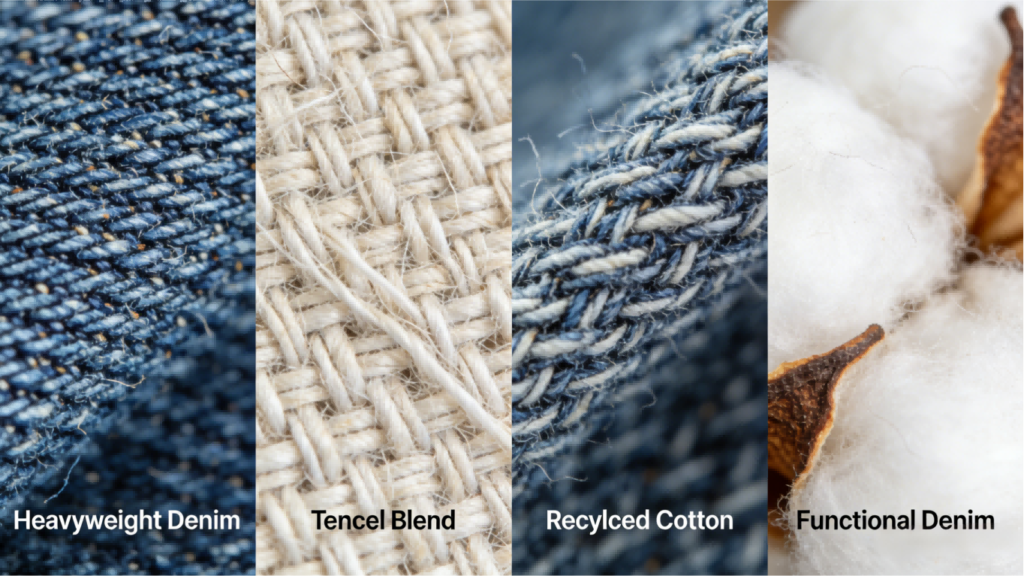
If you are a scaling brand deciding which special denim fabrics to put into a multi-style line, the rule is the same for all four: choose by the fabric’s physical properties, processing reality, supply-chain constraints, and cost — not by the appeal of the concept. Heavyweight (≈14oz+) buys durability, structure, and aging character but costs comfort (lower air permeability, slower drying) and a meaningful cost premium, so it fits structured/loose fits and customers who value the break-in, not warm-climate mass-market e-commerce. Tencel/lyocell blends buy softness, drape, and genuine moisture comfort, but will never feel structurally like cotton denim — that is fibre physics, so position them as a soft denim-look product, not “premium denim.” Recycled cotton is shifting from a marketing story to a market-access requirement in regulated markets, but only with an unbroken GRS/RCS certification chain. Functional denim is only worth it for functions the customer can actually feel — and topical finishes must survive washing. This guide gives the material science, the failure modes, and a selection table for each.
The Scenario You Will Recognise
You are a scaling brand planning a season’s line. The merchandising deck has a heavyweight “statement” jean, a Tencel-blend women’s wide-leg, a recycled-cotton “sustainability” piece, and a functional commuter pant with a list of technical bullet points. Each looked great as a concept and sampled fine. Then the season plays out: the heavyweight comes back tagged “too heavy, too stiff,” the Tencel wide-leg gets returns from customers who expected “premium denim” and found something soft and fluid, the recycled piece draws “how is this actually different?” comments, and the functional pant’s six technologies are remembered by no one.
None of these failures is about a bad fabric. Each is the same root cause: the concept was treated as the competitive advantage, without checking whether the fabric’s actual physical properties, processing constraints, supply-chain realities, and cost matched the intended product and customer. At scale, that mistake is expensive — a special fabric that underperforms ties up development, inventory, and a slot in the line that a proven fabric could have filled. The job at the scaling stage is not to chase novelty; it is to put each special fabric only where its physics earn its place.
The Core Issue: A Concept Is Not a Property
Here is the trap, stated plainly: everyone knows Tencel is “soft” and heavyweight is “thick,” but development decisions cannot be made on adjectives. A fabric category’s commercial success depends on whether its measurable behaviour — air permeability, drape, fibre strength, finish durability, certification status, cost cascade — fits the product and the customer. So the working definition a scaling brand should hold is this: special-fabric selection is the practice of matching a fabric’s physical and supply-chain properties to a specific product, customer, and price tier — then positioning the product around what the fabric actually is. A fabric chosen for its story and positioned against its physics will generate returns no matter how good the swatch looked.
The rest of this guide does two things for each of the four categories: states what it actually is in material terms, and shows where it fits and where it backfires.
The Four Categories in Physical Terms
1. Heavyweight denim (generally ≈14oz and above)
What it physically is. Heavyweight denim reaches its mass through coarse yarn counts (typically around Ne 4–7s) and high warp and weft density. The result is substantially higher tear strength and abrasion resistance than midweight, and aggressive shape-holding — a pair of raw heavyweight jeans can almost stand on its own. The tradeoff is measurable, not subjective: air permeability drops significantly as density rises, so a heavy denim has markedly lower breathability than a light one of comparable construction, and being far thicker it dries more slowly. When wearers call heavyweight jeans “stuffy” or “hot,” they are describing the fabric’s structure.
Processing reality brands discover too late. Cutting needs sharper blades and fewer plies per lay — where a midweight might stack 80–100 plies, a heavy fabric may allow only 40–60 before cut quality drops. Sewing is the hard part: multi-layer intersections (waistband, crotch junction, belt-loop attachments) can stack 8–12 layers, where standard machines, needles, and thread skip stitches, break needles, or stall. Heavy-duty machines, larger needle gauges, and heavier thread are required — and not every factory that claims this capability actually does it well. Washing and finishing take longer and consume more chemicals, water, and energy per piece; a stone-wash cycle that runs in around 20 minutes on a light fabric may need 35–45 minutes on a heavy one for a comparable effect. Shrinkage control is also harder, because coarse yarns under high tension in a dense construction tend to shrink more and less predictably, especially in the warp.
Cost and supply reality. All-in, a five-pocket jean in a heavy (≈15oz+) denim typically costs on the order of 20–40% more than the same design in a midweight, from higher fabric cost per metre, lower cutting efficiency, slower sewing, longer wash cycles, and reduced shipping density. And genuinely good heavyweight denim — where yarn quality, weave, dye depth, and hand are all right — is sourced from a relatively short list of capable mills; many brands decide to “do heavyweight” and then spend months rejecting samples that are too boardy, too flat in character, or too shallow in dye.
2. Tencel / lyocell blend denim
A terminology point that carries commercial weight. “Tencel” is a registered trademark of Lenzing AG for its lyocell fibre. Other makers produce chemically equivalent lyocell, but only Lenzing-sourced fibre can legally be labelled “Tencel™.” Using the Tencel™ trademark on hangtags or listings requires a brand licensing agreement with Lenzing, with an application, compliance requirements, and cost. Non-Lenzing fibre can be labelled “lyocell” but not “Tencel” — a compliance distinction that has tripped up brands, especially where trademark enforcement is strict.
What it physically is. Lyocell is a strong fibre: it has high dry tenacity and — correcting a common misconception — it retains roughly 85% of its dry strength when wet, making it the only regenerated cellulose fibre whose wet strength exceeds cotton’s. Its surface is smoother than cotton at the microscopic level and it is typically finer (around 1.0–1.7 dtex), which is the direct physical reason Tencel blends feel silky. Moisture regain is around 11%, higher than cotton’s ~8%, and combined with efficient wicking this is why lyocell blends feel cooler and drier against the skin — a real, user-perceptible advantage in warm-weather and close-to-body garments. The critical structural point: at equal weight and construction, a lyocell-blend fabric drapes more and stands up less than its pure-cotton equivalent, because the fabric is softer and more fluid. No finishing or construction trick makes a meaningful cotton-lyocell blend behave structurally like 100% cotton. This is physics, not a quality defect.
It is almost always a blend. What the ratio produces:
- Cotton/Tencel ~70/30: noticeably softer than pure cotton but still clearly denim in structure — the sweet spot for “a softer denim” rather than “a denim-coloured soft fabric.”
- Cotton/Tencel ~50/50: dramatically softer and more fluid; denim character is largely gone. This is a fashion fabric with denim aesthetics.
- Above ~50% Tencel: effectively a soft indigo cloth with almost no structural resemblance to conventional denim.
- Three- and four-component blends (adding polyester, or polyester plus spandex) are common; 100% Tencel denim is rare commercially because it has so little denim character.
Processing reality. Lyocell’s well-documented tendency to fibrillate — under wet abrasion the surface develops fine microfibrils, giving a peach-skin or frosted look — can be a desired velvety effect or an unwanted “pilling” appearance, so finishing must control or exploit it deliberately. Indigo behaves differently on lyocell than on cotton; in a blended yarn the two components take and release dye at different rates, so fading can be uneven, manageable at low Tencel percentages but a genuine challenge higher up. Shrinkage differs from pure cotton and needs its own testing — cotton allowances do not transfer. Sewing is generally easier than heavy cotton, though the fabric’s slipperiness may need feed adjustment.
3. Recycled cotton denim
The distinction almost nobody states clearly. There are two very different things called “recycled cotton.” Pre-consumer (post-industrial) comes from manufacturing waste — spinning, weaving, and cutting scraps — so the composition is known and the fibre quality relatively predictable. Post-consumer (PCR) comes from used garments collected, sorted, shredded, and re-processed; those fibres have been worn and washed, are shorter, weaker, and more variable, and the mechanical shredding shortens them further. These two should never be discussed interchangeably, but constantly are.
What it physically is (especially PCR). Average fibre length is shorter than virgin cotton with more short fibres; tenacity is generally lower; yarn from high-percentage recycled cotton has lower strength and poorer evenness (higher CV%) than equivalent virgin-cotton yarn. In practice recycled cotton is almost always blended with virgin cotton or other fibres (common ratios 20/80, 30/70, 50/50). 100% PCR yarn is possible at coarse counts but has real quality limits at current technology. High recycled content can show more surface irregularity — a positive for a deliberately vintage, rough look, a negative if the brand wants clean uniform fabric.
Processing reality. Lower yarn strength means higher weaving breakage and reduced efficiency; residual colour from previously dyed feedstock can affect dye uptake and shade consistency; shrinkage and colour fastness need independent testing (virgin-cotton data does not transfer); and batch-to-batch feedstock variation makes large-order shade and quality consistency harder to control.
Certification and a shifting regulatory landscape. The widely recognised certifications are GRS (Global Recycled Standard) and RCS (Recycled Claim Standard); GRS requires full chain-of-custody traceability with every facility in the chain individually certified. Without certification, a “recycled cotton” claim in regulated markets carries legal risk, and greenwashing enforcement is accelerating — the EU’s Green Claims Directive, France’s AGEC law, and the US FTC’s Green Guides all create exposure for unsubstantiated sustainability claims. Critically for planning: the EU’s Ecodesign for Sustainable Products Regulation is progressing toward minimum recycled-fibre-content requirements for textiles, France already implements Extended Producer Responsibility for textiles, and major European retailers are cascading recycled-content targets to suppliers. For brands selling into European markets or supplying European retailers, recycled cotton is shifting from a “nice-to-have story” toward a market-access requirement — the question is moving from “should we?” to “when must we, and how long will building a certified chain take?”
4. Functional denim
What “functional” actually means. It is not one fabric category but an umbrella over many technologies applied to denim by different methods, with wildly different cost, maturity, and — the decisive factor — user perceptibility. The table below is the practical heart of the category.
| Function | How it’s typically achieved | Maturity | User perceptibility |
|---|---|---|---|
| Stretch / comfort | Spandex/elastane in weft (or warp and weft) | Very mature | Very high — felt the moment you put them on |
| Lightweight / cool feel | Fine yarn + open construction, cool-touch fibre, or topical finish | Mature to moderate | Moderate — perceptible, less immediate than stretch |
| Quick dry / wicking | Synthetic fibre blend or topical finish | Mature | Moderate — needs comparison to notice |
| Anti-bacterial / odour control | Topical finish or functional fibre | Mature | Low — essentially imperceptible directly; requires trust |
| Abrasion resistance | High-tenacity fibre blends | Mature | Low to moderate — only over extended use |
| Water repellent | DWR topical finish or membrane | Mature | Medium to high — the water-on-fabric demo is visually dramatic |
| Thermoregulation | Phase-change materials, functional fibre, or finish | Moderate | Low — hard to perceive outside extreme conditions |
| Wrinkle-free / easy care | Resin finish | Very mature | Moderate — appreciated only over multiple wash cycles |
The insight this table forces. A function can be scientifically real and commercially worthless if the consumer cannot feel the difference. An anti-bacterial finish may reduce bacterial growth in lab testing, but if the wearer can’t tell treated from untreated, the marketing spend needed to convince them outweighs the payoff. The durability question is just as decisive: functions inherent to the fibre (a high-tenacity fibre’s abrasion resistance, spandex’s stretch) are permanent; functions applied by topical finish (DWR, anti-bacterial, cool-touch, odour control) are inherently impermanent. A “water-repellent” denim that stops repelling after a few home washes is not a feature, it is a liability — and in the EU and under US FTC guidelines it can become a false-advertising exposure. The industry benchmark for a “durable” topical finish is broadly on the order of 20–50 home washes before significant degradation; brands must demand wash-durability data and specify the test (industrial vs home wash give very different results). Some functional claims require third-party substantiation (Bluesign, OEKO-TEX, specific AATCC or ISO methods), and an unsupported “anti-bacterial” claim challenged by a consumer or competitor can lead to delisting or regulatory action.
Questioning the Framework: Are These Four Categories as Distinct as They Seem?
The clean “four categories, each with its place” structure hides some assumptions worth pushing back on — and the pushback is where the real decision logic lives.
Heavyweight is not inherently niche. The common assumption that heavyweight is a marginal, image-only category is culturally biased. Established heritage-denim specialists — in some traditional raw-denim communities and markets — have built entire businesses on heavyweight, with loyal repeat customers, high average order values, and real retail distribution. The accurate framing is: heavyweight is not suited to brands whose customers don’t understand or value it — but for brands whose identity and community are built around it, heavyweight is the core of the business, not a risky side project. Relegating it to “image pieces” would be wrong advice for that kind of brand.
Tencel’s “lack of denim character” may not be a problem. Warning that Tencel blends “don’t feel like denim” presupposes the customer is buying denim character. A large segment — particularly in women’s fashion and urban casual — is buying indigo-coloured pants that look like denim in photos, feel comfortable, drape well, and need no break-in. For that customer, a Tencel blend that “doesn’t feel like traditional denim” is succeeding at being a different product. The real risk is not the fabric; it is the brand not knowing which product it is selling. Market a Tencel blend as “premium denim” to a customer expecting traditional behaviour and you get returns; market it as “soft, comfortable, denim-look fabric” and you get fans. Same fabric, opposite outcome — positioning decides it.
Recycled cotton is not “just marketing.” Treating recycled cotton as a storytelling device is already out of date: regulatory pressure is converting recycled content from a voluntary statement into a compliance factor in certain markets, and a brand that dismisses it today may struggle to ship to the EU in a few years without it. The opposite error — treating recycled cotton as automatically virtuous and premium — is equally wrong, because the fibre-quality limits, certification complexity, and cost are real. The useful stance is pragmatism: understand the actual properties, build a certified chain, start at manageable ratios, and evolve with technology and regulation.
Functionality and denim character are not opposites. The most successful functional denim innovation in history — stretch — lost no denim feel at all; the market accepted it so completely that stretch is now the default, especially in women’s denim. The real distinction is not “functional vs denim” but functions compatible with denim’s look and hand versus functions that compromise them. A few percent spandex changes neither look nor hand; 40% polyester does. A DWR finish doesn’t visually alter the fabric; a heavy wrinkle-resist resin changes the hand noticeably. So the question for each function is not “will this make my product less denim?” but “does this specific implementation, at this level, preserve what my customer expects from denim?”
The Selection Decision Table
| Fabric | Core physical character | Key processing constraints | Best-suited products / customers | Primary risks | Cost impact | Recommended strategy |
|---|---|---|---|---|---|---|
| Heavyweight (≈14oz+) | High tear/abrasion resistance, high stiffness, low air permeability | Heavy-duty sewing required; limited cutting plies; longer wash; harder shrinkage control | Vintage straight, workwear, raw, structured jackets; heritage/raw communities, high-AOV culture-driven customers | Comfort barrier (weight, heat, stiffness); short list of quality sources; higher all-in cost | ≈+20–40% vs midweight | If your customer values heavyweight, make it core; if not, use sparingly for image/capsule |
| Tencel / lyocell blend | Strong fibre, smooth hand, superior drape, lower fabric stiffness than cotton; good moisture comfort | Fibrillation control; dye uniformity in blends; different shrinkage; Tencel™ licensing | Women’s wide-leg, shirts, dresses, light outerwear; women’s fashion, urban casual, comfort-led DTC | Cannot replicate cotton denim’s body (physics); dye consistency at higher ratios; expectation management | Fibre ≈+30–80% vs cotton, often offset by lighter weight | Accept it is a different product; design and position around softness and drape as features |
| Recycled cotton | Lower fibre length/strength (esp. PCR); higher yarn irregularity | Higher weaving breakage; shade variability; requires full GRS/RCS chain of custody | Basics, sustainability lines, compliance-driven product; brands selling into EU / certified-required retailers | Quality limits at high %; certification cost/complexity; uncertified claim = legal risk; batch consistency | Varies; pre-consumer can be cost-neutral; PCR + certification adds cost | Start at 20–30%; complete certification chain before any claim; if EU-facing, build the chain now |
| Functional | Varies enormously by function | Topical-finish durability; multi-function compatibility; may need third-party testing | Commuter/travel/daily functional wear; comfort-led or performance-adjacent positioning | Topical functions degrade with washing; imperceptible functions = weak ROI; over-stacking adds cost | Stretch modest; high-performance fibres/finishes significant | Invest only in functions the customer can feel; confirm wash durability; 1–2 functions max per product |
How Variation by Brand Stage Changes the Answer
Which special fabrics make sense, and how to govern them, shifts with stage.
A creator-led brand on a small first run should usually pick one special fabric that matches its identity (heavyweight for a heritage-minded founder, a Tencel blend for a comfort-led women’s line) and prove it on a washed sample, rather than spreading across categories. The failure to avoid is launching several special fabrics at once before any is validated in wear.
A DTC startup at 5,000–20,000 units feels positioning errors directly in returns — the “premium denim” Tencel mismatch, the heavyweight “too hot” complaint. The priority is honest positioning and a perceptibility filter on functional claims, since return rate is the immediate scoreboard.
A scaling brand at 20,000+ units — the reader of this guide — treats special-fabric choice as portfolio and compliance governance: which fabrics earn a recurring slot in the line, which suppliers can genuinely deliver heavyweight sewing or controlled fibrillation or certified recycled content at volume, and which functional claims can be substantiated and re-verified every reorder. The dominant risks at scale are supply capability (a mill or factory that samples well but cannot hold quality at volume), certification continuity (a broken GRS chain on a reorder voids the claim), and finish durability drift. At this stage each special fabric needs a written standard, a named test or certification, and re-verification on every reorder and second source — the same discipline a high-volume basic gets, applied to a higher-variability material.
| Brand stage | Right level of control | The failure to avoid |
|---|---|---|
| Creator-led | One identity-matched special fabric, proven on a washed sample | Launching several special fabrics before any is validated |
| DTC startup (5,000–20,000) | Honest positioning + perceptibility filter on functional claims | Positioning a fabric against its physics, driving returns |
| Scaling (20,000+) | Portfolio + compliance governance: written standard, named test/cert, re-verify each source | Supply that samples well but drifts at volume; broken certification chain |
The Three Traps We See Most Often
Trap 1: Treating the concept as the advantage. A special fabric is chosen because the category sounds compelling — “heavyweight reads premium,” “Tencel feels amazing,” “recycled tells a story” — without checking whether its physics fit the silhouette, climate, customer, and price. The fix is to start from the measurable property (air permeability, drape, finish durability, certification status) and confirm it suits the product before the concept is approved.
Trap 2: Positioning a fabric against its physics. The most common version is selling a Tencel blend as “premium denim” to a customer who then finds it soft and fluid, or selling a heavyweight to a warm-climate e-commerce audience expecting instant comfort. The fabric is not wrong; the claim is. Set the marketing to match what the fabric actually does — soft and drapey, or structured and built to break in — and the same fabric attracts fans instead of returns.
Trap 3: Making a claim the supply chain can’t back. A recycled-content claim without an unbroken GRS/RCS chain, or a functional claim (“water-repellent,” “anti-bacterial”) without wash-durability and third-party test data, is a legal and reputational exposure, not a feature. Confirm the certification chain and the durability data before the claim goes on a hangtag or product page — and re-verify on every reorder, because a second source can break the chain while the shade still matches.
A Reference Example: A Four-Fabric Line, Field by Field
Consider a scaling brand planning the line described at the start — a heavyweight statement jean, a Tencel wide-leg, a recycled-cotton basic, and a functional commuter pant. Running each through the property-first logic surfaces the corrections:
The heavyweight was slated as a mainstream e-commerce skinny for a warm-season drop — a physics mismatch on three counts (heat, stiffness on a tight fit, instant-comfort channel). The fix is to either move it to a structured/straight fit for a cooler-season capsule aimed at the customers who value break-in, or drop it from the mainstream line. The Tencel wide-leg was correct on fabric and fit but was being copywritten as “premium denim”; the fix is positioning it as soft, drapey, denim-look comfort, and confirming the fibrillation strategy and a blend-specific wash test before bulk. The recycled basic had a “made with recycled cotton” claim drafted but no confirmed GRS chain through the dye house; the fix is to complete and audit the chain before any claim, starting at a 20–30% ratio. The functional commuter pant listed six technologies, four of them imperceptible (anti-bacterial, thermoregulation, UV, odour); the fix is to cut to one or two perceptible functions (e.g. stretch plus a demonstrable DWR), with wash-durability data specified.
The replicable method, for any special-fabric line decision: for each fabric, confirm the physical property fits the product and customer; confirm the benefit is perceptible; confirm the supply chain and any certification or licensing; cost the full picture against the price the product can carry; then position honestly and re-verify on every reorder — before the line is locked.
FAQ
Why does heavyweight denim feel hot and stuffy?
Because air permeability drops as fabric density rises, and heavyweight denim achieves its mass through coarse yarns and a dense weave. A heavyweight fabric has substantially lower air permeability than a midweight of comparable construction, and being thicker it also dries more slowly. When customers call heavyweight jeans hot or stuffy they are describing measurable physics, not being dramatic, which is why heavyweight is a poor fit for warm-climate or summer product.
Will a Tencel blend denim feel like normal cotton denim?
No, and that is physics rather than a quality issue. Lyocell fibre is finer and smoother than cotton and gives the fabric more drape and less structure, so a meaningful Tencel blend will always feel more fluid and stand up less than its pure-cotton equivalent. The right approach is not to make Tencel behave like cotton but to design and position the product around softness and drape as features.
Is lyocell weaker than cotton when wet?
No. Lyocell retains roughly 85% of its dry strength when wet and is in fact the only regenerated cellulose fibre with wet tensile strength exceeding cotton’s. It is generally strong, dry and wet. The practical caution with lyocell is not wet weakness but fibrillation — under wet abrasion the surface develops fine microfibrils — which has to be controlled or exploited deliberately in finishing.
What is the difference between pre-consumer and post-consumer recycled cotton?
Pre-consumer (post-industrial) recycled cotton comes from manufacturing waste such as cutting scraps, so its quality is relatively predictable and it can be cost-competitive. Post-consumer recycled cotton comes from used garments that are collected, sorted, and shredded; those fibres are shorter, weaker, and more variable, and the recycling process shortens them further. The two have very different quality and cost profiles and should never be treated interchangeably.
Do I need GRS or RCS certification to claim recycled content?
In practice, yes, for any defensible claim in regulated markets. Without GRS or RCS certification a recycled-content claim is unsubstantiated, and greenwashing enforcement is accelerating in the EU and increasingly elsewhere. The certification chain must be unbroken — fibre recycler, spinner, weaver, dyer or finisher, and garment maker all certified — or the finished product cannot carry a certified recycled claim.
Which functional denim features are actually worth paying for?
The ones the customer can perceive. Stretch is felt immediately and is now a baseline rather than a differentiator; cooling and water repellency are perceptible or demonstrable; abrasion resistance, anti-bacterial, and thermoregulation are hard or impossible for a wearer to notice in normal use. A function can be scientifically real and still commercially weak if the buyer cannot feel it, so prioritise perceptible functions and confirm wash-durability data before committing to any topical finish.
The Bottom Line
Heavyweight, Tencel, recycled, and functional denim are not four marketing stories — they are four sets of physical properties, processing constraints, supply-chain realities, and costs, each of which fits some products and customers and backfires on others. Heavyweight buys durability and character at the price of comfort and cost, and belongs where the customer values the break-in. Tencel buys softness and drape but never cotton’s structure, and succeeds only when positioned as what it is. Recycled cotton is shifting from story to market-access requirement, but only with an unbroken certification chain. Functional denim is worth it only for functions the customer can feel and finishes that survive washing. The discipline that ties all four together is the same: choose by physics, not by concept; position honestly against what the fabric actually does; and at volume, give each special fabric a written standard, a named test or certification, and re-verification every reorder. Put each fabric only where its properties earn the slot, and the special fabric becomes an advantage instead of a return.
Matching special fabrics to products, validating supply and certification before claims, and governing them across reorders is the kind of development work SkyKingdom does as an external denim product team for scaling brands; if you are deciding which special fabrics belong in your line, you can see how that fits your range on the fabric development page.
Reference Sources
- ScienceDirect — Lyocell fibre overview (wet strength, moisture regain, fibrillation)
- BioResources — Regenerated Cellulose by the Lyocell Process (properties review)
- Lenzing — TENCEL™ for denim applications
- Textile Exchange — Recycled Claim Standard (RCS) and Global Recycled Standard (GRS)
- Heddels — Understanding Raw Denim Weights (heavyweight context)
- OEKO-TEX — textile testing and certification (functional claim substantiation)


