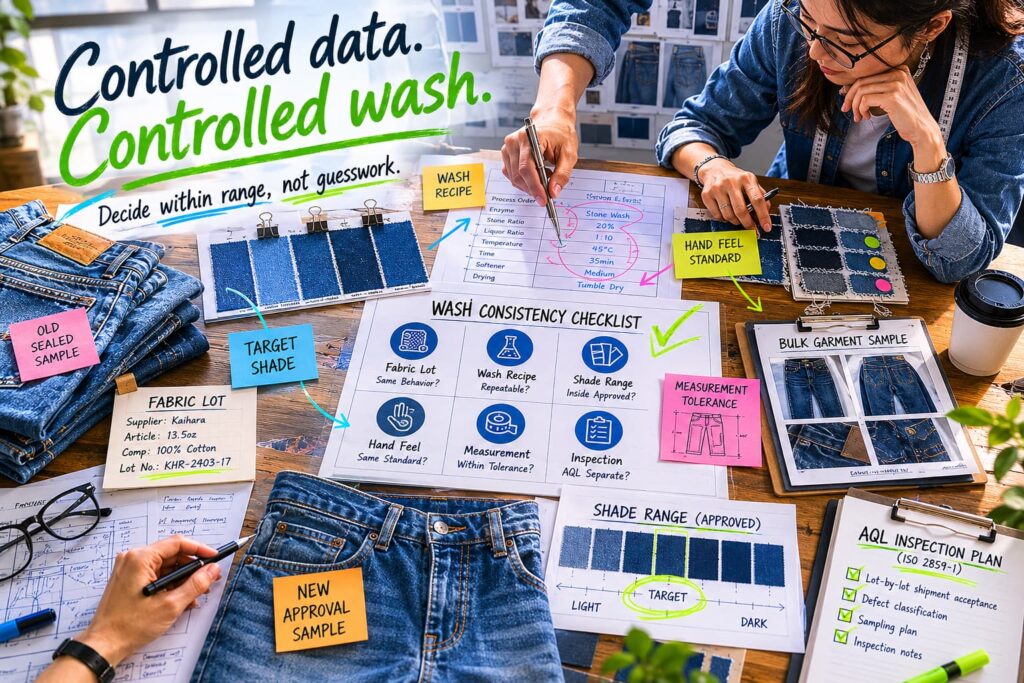
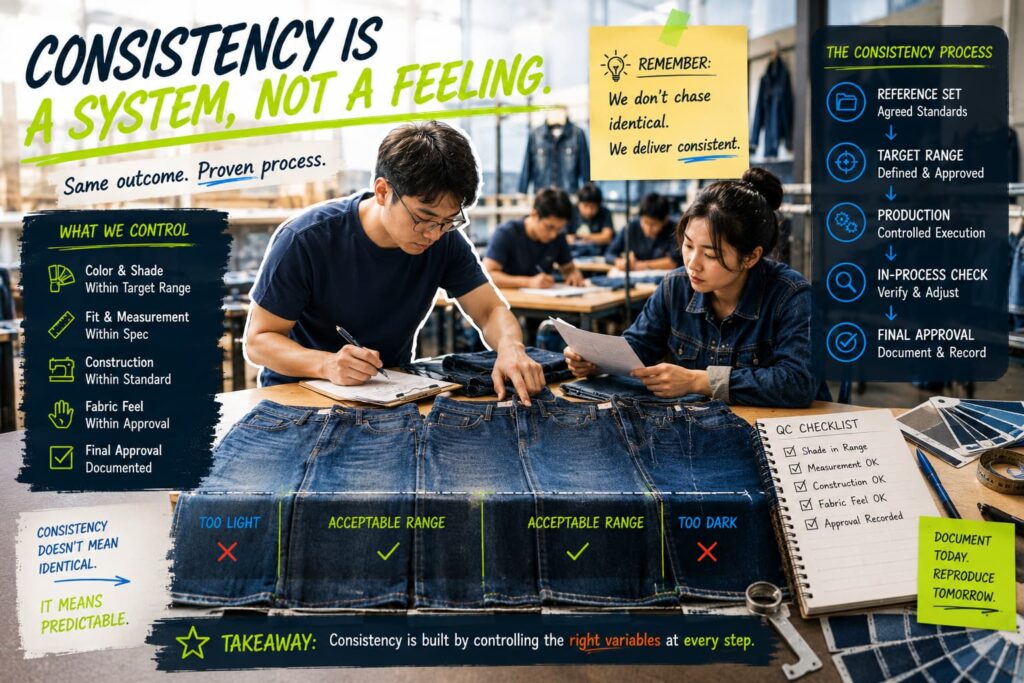
For scaling denim brands, keeping the same wash across reorders means controlling an approved range, not forcing every garment to look identical. The brand needs a reorder wash baseline: old sealed sample, new approval sample, fabric lot record, wash recipe, shade range, hand-feel standard, dry process reference, bulk garment sample, measurement tolerance, and AQL-supervised inspection notes. Each reorder should be re-approved because denim wash results depend on fabric behavior, machine loading, water condition, enzyme reaction, abrasion, drying, and handling.
How this comes up in practice
A growing denim brand usually discovers this problem after a washed style starts selling well. The first production run looks right. The first reorder is still acceptable. Then a later reorder arrives with a slightly different blue cast, a warmer yellow tone, a greyer surface, stronger abrasion, softer hand feel, more shrinkage, or a destruction effect that does not sit exactly like the previous sample.
New denim buyers often treat this as a quality failure. Experienced denim teams know the issue is more precise: denim wash is not a printed color. It is a controlled physical result created by fabric, chemistry, water, friction, machine movement, drying, and operator adjustment.
CottonWorks describes denim finishing as a process that may include stonewashing, enzyme treatment, softening, drying, inspection, pressing, and shipping. That is why a reordered wash cannot be controlled from a phone photo or one old sample alone. CottonWorks denim finishing reference
In denim, perfection is not identical sameness. It is variation that has been understood, approved, and kept within range.
How the decision is actually made
The decision is not “Does every garment look exactly the same?” The better decision is “Does this reorder sit inside the agreed wash range?”
Reorder wash control is the practice of documenting fabric, wash, shade, hand feel, dry process, sealed sample, measurement, and inspection records, then re-approving each run against a shared tolerance range.
That range should be decided before the bulk wash moves too far. If the brand wants a very narrow shade range, it should also expect more sorting, smaller wash lots, more correction rounds, more approval time, and higher cost. Tighter wash control is not free; it requires more process separation and more decision points.
Decision Area
What to Compare
Main Risk
Better Approval Question
Physical reference
Old sealed sample, new approval sample, first bulk garment sample
The team judges the new run only against an old sample that may have aged or shifted
Do all three physical references support the same approved range?
Fabric lot
Supplier, article, weight, composition, shrinkage, stretch, lot number
A new fabric lot reacts differently to abrasion, enzyme, softener, or drying
Is the reorder fabric still inside the approved physical and shade behavior?
Wash recipe
Process order, enzyme, stone ratio, liquor ratio, load size, temperature, time, softener, drying, correction notes
The same wash name is treated as if it were a complete recipe
Can the process be repeated and re-approved, not only named?
Shade and cast
Light / target / dark range, blue / grey / yellow / vintage cast direction
The garment matches depth but not color direction
Is the run inside the approved shade depth and cast range?
Hand feel and fit
Softness, dryness, stiffness, shrinkage, measurement after wash
The color is acceptable but the garment feels or fits differently
Does the new run still meet the approved hand-feel and measurement tolerance?
Are wash approval and shipment inspection being treated as separate decisions?
ISO 2859-1 specifies sampling schemes indexed by acceptance quality limit, or AQL, for inspection by attributes. That makes AQL useful for lot-by-lot shipment acceptance, but it does not replace wash recipe documentation or shade-range approval. ISO 2859-1 reference
Most scaling brands underestimate approval range; in practice, reorder disputes happen because the team asks whether the wash is “the same” before agreeing what acceptable variation means.
What changes by brand stage
For creator-led brands, wash consistency usually means keeping a clear visual reference, basic sample comments, and a record of what the founder approved. A full reorder wash-control system may be unnecessary for a one-off concept sample or non-repeat capsule.
For DTC startup brands, wash consistency starts becoming a documentation problem. At this stage, the brand should begin saving wash recipes, shade comments, sealed samples, fabric lot notes, measurement records, and bulk approval comments. The goal is not to overbuild the system too early, but to avoid losing the first useful production memory.
For scaling brands, wash consistency becomes a reorder continuity system. The brand needs a full wash baseline, renewed approval for every reorder, cross-team sign-off rules, and a clear decision on how much variation it is willing to pay to control.
Most scaling brands underestimate cost escalation; in practice, the closer they try to get to mechanical sameness, the more they must spend on separated wash lots, correction work, approval delays, and production risk.
Three pitfalls we see most often
1. The team uses the old sealed sample as the only truth
A sealed sample is important, but it is still a physical garment. Over time, storage, handling, oxidation, and fabric aging can affect how it compares with a new approval sample. This is especially risky for lighter washes. A mature reorder decision should compare the old sealed sample, the new approval sample, and the first bulk garment sample together.
2. The brand asks for “the same wash” without approving a range
“Same” is too vague for washed denim. One person may focus on blue cast. Another may focus on abrasion. QC may focus on whether it can sign off the shipment without taking responsibility for later sales complaints. A scaling brand should define the acceptable shade, cast, hand feel, shrinkage, measurement, and destruction-effect range before bulk approval.
3. The brand wants tighter control but does not plan for the cost
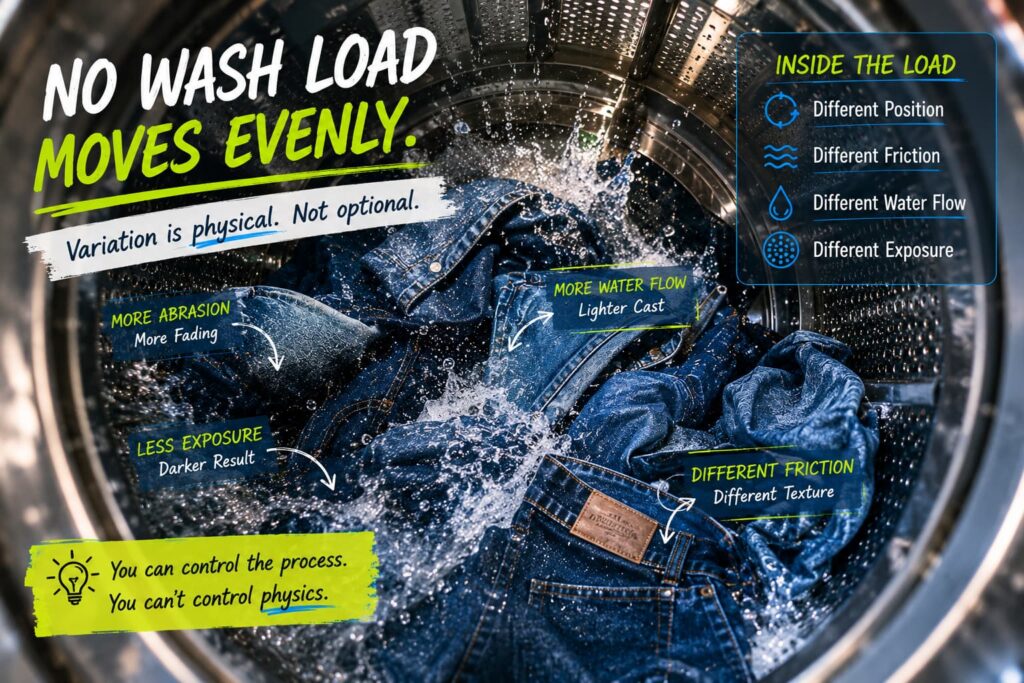
Inside a washing load, garments do not receive water flow, friction, chemical contact, and mechanical action in a perfectly even way. Some pieces sit closer to the drum wall. Some fold, twist, or absorb liquor differently. If the brand wants a very narrow range, it should expect smaller lots, more sorting, more correction steps, and more approval time.
Most scaling brands underestimate internal approval risk; in practice, many wash disputes are responsibility disputes, because design, sourcing, QC, and production are each judging a different version of “same.”
A reference example
A typical scaling-brand situation starts with a washed jean that has already sold well. The brand wants to reorder the same style, but the original approval was handled through a mix of sample comments, photos, chat messages, and buyer taste. The old sealed sample exists, but the new bulk head sample looks slightly warmer and softer. The designer thinks it is acceptable. The QC team is unsure whether it can sign off.
The right next step is not to argue over whether the jean is “identical.” The team should rebuild the approval file: old sealed sample, new approval sample, first bulk garment sample, fabric lot record, wash recipe, shade range, dry process map, measurement after wash, hand-feel standard, and inspection notes.
Once those references are reviewed together, the team can decide whether the new run sits inside the approved commercial range. If it does, the reorder can move forward as controlled continuity. If it does not, the brand must choose between accepting more variation, paying for tighter correction, or re-approving a new wash standard for the next run.
AATCC TM61 is useful here as a boundary reminder. It evaluates colorfastness to laundering under accelerated laundering conditions, while bulk wash approval checks whether the shipment matches the approved production standard. These are related quality concerns, but they are not the same approval step. AATCC TM61 reference
FAQ
Can a denim reorder ever look exactly the same as the approved sample?
Not in the literal sense. Washed denim is affected by fabric behavior, enzyme reaction, stone abrasion, water ratio, machine action, drying, and handling. The practical goal is not identical sameness; it is controlled variation inside an approved range.
Is the old sealed sample enough to control a reorder?
No. The old sealed sample is important, but it should be treated as one reference, not the only truth. A stronger reorder approval compares the old sealed sample, the new approval sample, and the first bulk garment sample together.
Why does the same wash recipe still produce a different result?
A wash recipe controls many variables, but it does not remove all physical variation. Garments in a washing load do not receive water flow, friction, chemical contact, and mechanical action in a perfectly uniform way. That is why each reorder should be re-approved against the current fabric, wash load, and buyer-approved range.
Should a brand approve one good wash sample or a wash range?
A scaling brand should approve a wash range. One sample can show the target, but it cannot represent all acceptable bulk variation. A practical range should define shade depth, color cast, hand feel, abrasion strength, shrinkage, measurement tolerance, and destruction effect.
Does AQL inspection solve wash consistency problems?
No. AQL-supervised inspection helps with shipment acceptance, but it does not create wash consistency by itself. The wash baseline must be defined before inspection starts.
Why does tighter wash consistency increase cost?
Tighter control requires more process separation, checking, correction rounds, and approval time. If a color is too deep, too light, too yellow, too grey, or too blue, extra adjustment steps may be needed. The narrower the tolerance range, the more the brand should expect to pay for control.
For scaling brands that need reorder wash consistency managed as a documented approval system, SkyKingdom works as an external denim product team to help organize wash recipe documentation, bulk approval references, AQL-supervised inspection notes, and reorder continuity across the production runs we manage.