
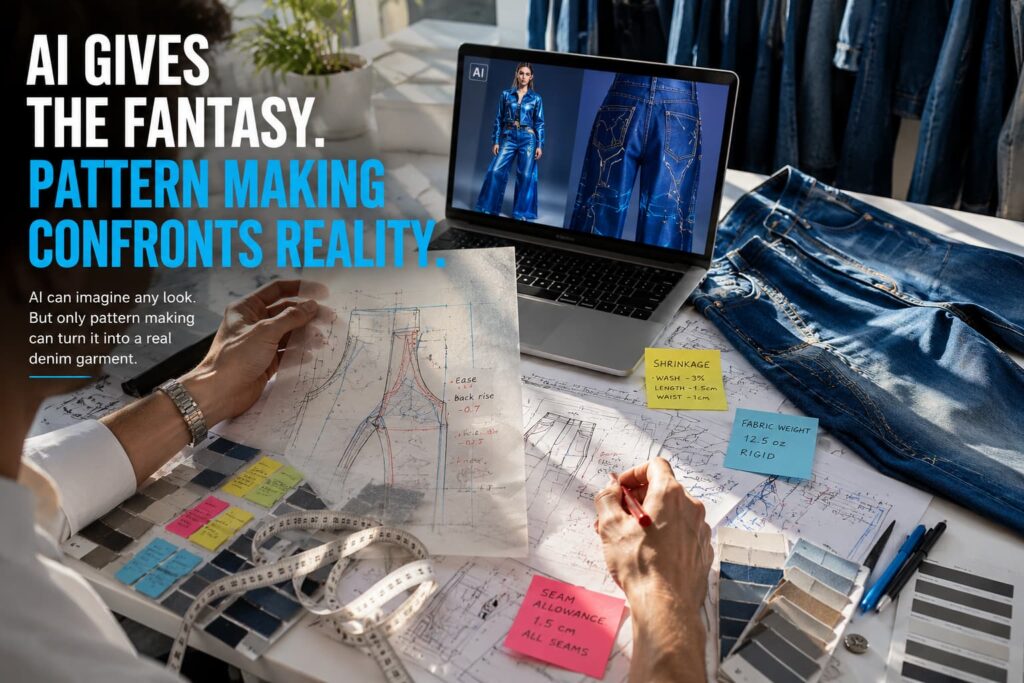

Our previous article mapped eight common hallucinations hidden in AI denim images. This article goes one layer deeper into where most of them actually surface: not in the fabric mill, not in the wash plant, but on the pattern maker’s desk.
Two examples make the gap immediately clear. In the AI image, the indigo is vibrant, saturated, almost glowing. In a real garment, denim rarely reaches that color depth — the wash settles into something softer, greyer, more grounded, no matter what recipe is used. In the AI image, the silhouette stands up on its own — sharp shoulders, structured volume, sculptural drape. In a real garment, the same shape often collapses into something softer, because the fabric weight that supports drape in a render does not exist in the same way in physical denim.
Neither of these gaps is a sampling problem. Both are pattern making problems — decisions a pattern maker has to make before a single piece of fabric is cut, because the image cannot make them. That is the bottleneck most AI denim conversations skip. The image gets generated, the brand falls in love, the project moves toward sampling — and then it stalls for a stretch of time that often surprises the brand. The brand assumes the delay is the factory being slow. It usually is not. The delay is a pattern maker, alone with the AI image, trying to decide what the garment actually is.
An AI image shows what a garment could look like. A pattern maker has to decide what it actually is. The silence between those two questions is where most AI denim projects spend their first few weeks of project time.
Short answer: AI fashion images fail in real pattern making because they communicate appearance but not construction. A pattern maker cannot derive points of measurement, ease, grain direction, shrinkage allowance, seam allowance, or tolerance from any image — and in denim, where wash and fabric weight quietly reshape every fit after cutting, those silent decisions are where the gap between the rendered garment and the physical one is actually made.
The Real Bottleneck Is Not “Drawing” — It’s “Deciding”
When most brands think about pattern making, they picture someone at a desk drawing lines. That mental model treats pattern making as a drawing task — a step that should, in theory, get faster as software gets better.
This is why a new wave of AI pattern tools markets itself around speed: image to pattern in ten minutes, sketch to .DXF instantly, hours collapsed into seconds. The underlying assumption is that pattern making is a translation task — turn the image into a file, ship the file to the cutting room.
But ask any working pattern maker how their time actually breaks down, and the picture inverts. Drawing is the visible part — the part that ends up on screen, on paper, on the cutting table. The work that takes the most time happens before any line is drawn: deciding what the garment is.
A production pattern is not a tracing of an image. Industry research on ready-made garment pattern making notes that a production pattern needs to carry pattern pieces with seam allowance, grain line, style identification, size base, and cutting information — none of which appear in a render. Each of those is a decision, not a drawing.
In a denim project, those decisions stack quickly. What is the body block this pattern starts from? What kind of ease is needed, and how much? Which direction is the grain laid? How much shrinkage allowance is added, and where? What are the seam allowances and the construction order? What tolerance is acceptable for bulk?
A pattern maker who answers these well produces a sample that can survive bulk, wash, and reorder. A pattern maker who answers them poorly — or who is forced to guess because the brief is silent — produces a sample that looks fine, until it doesn’t.
This is the inversion most AI denim projects miss. Pattern making is not where AI denim images fail aesthetically. It is where they fail structurally — because pattern makers translate construction logic, not appearance. Pattern making is not slow because someone is drawing slowly. It is slow because someone is deciding carefully — and the slower they decide, the more reliably the garment will repeat.
AI image generators have accelerated the part of the work that was already fast. The part that was already slow — and is supposed to be slow — is still slow, and now carries more weight than before, because there is no documented brief sitting underneath the image to share the load.
What an AI Image Actually Hands to a Pattern Maker
When an AI denim image arrives at a working denim product team, it does not go straight to the pattern desk. In a typical denim product team, an AI image moves through several roles before any response goes back to the brand. The first stop is usually the front-end product team — the people who handle client briefs. From there, the image fans out to three people in parallel: the pattern maker, the construction specialist, and the wash technician. Difficult AI images often get a second pass by the senior product lead. Only after that internal review does the project come back together with a coherent response to the brand.
This is the part most AI denim conversations never see. The brand sends one image. The team behind the desk reads it as four overlapping briefs at once — and each role spots a different set of gaps.
The pattern maker’s gaps are the most consequential, because everything downstream — fabric, wash, hardware, sample, bulk — is built on top of the pattern. In our internal AI denim project reviews, four observations come up repeatedly when pattern makers describe what they see.
“There is only a front view. Everything behind it, I have to invent.”
Most AI denim images are generated as single-angle renders. The back yoke shape, back pocket placement, side seam direction, inseam balance, fly construction, label position — none of it is shown. The pattern maker has two options: ask the brand to clarify (which often results in “use your judgment, you’re the expert”), or fill in the back of the garment based on what would be structurally reasonable. Both options are decisions the image silently delegated.
“I can see the effect, but I can’t see how it was formed.”
An AI image might show heavy stacking at the ankle, exaggerated volume through the leg, or a sculptural drape around the waist. The visual is unambiguous. The cause is not. Is the stacking coming from pattern length? From fabric weight? From wash shrinkage pulling the leg into that shape? Each cause requires a different pattern decision — different leg length, different fabric specification, different shrinkage allowance. Without knowing which, the pattern maker either picks one and hopes, or builds a sample that needs a second revision to confirm.
“I cannot tell if this is rigid or stretch.”
This is the most consequential silent variable in any AI denim image. Rigid denim and stretch denim are, for pattern purposes, almost two different garments. Ease values change. Knee shaping changes. Hip and seat allowance changes. Hem rebound behavior changes. The wash recipe interacts differently with each. An AI image, however realistic, cannot communicate whether the rendered fabric contains elastane — and the brand often does not know either, because the AI was never asked. So the pattern maker either runs two parallel patterns (which doubles the cost), or commits to one and waits to find out at sample.

“The image is beautiful. The human body does not move like that.”
This is the failure pattern that hides longest. AI image generators are trained on still photographs, not on movement. Renders favor compositions that look striking in a single frame — extreme stacking next to a sharp taper, oversized volume next to clean tailoring, a curved seam that visually flatters the silhouette but runs directly across the knee bend. In a static image, none of these conflict. In a wearable garment, they do. Curved seams that cross active joints distort after wash. Volumes that depend on a specific drape angle collapse the moment the wearer sits down. A pattern maker can tell, often within the first quick scan, which parts of the image will survive a body inside the garment — and which will not.
This is what arrives on the desk. Not a design. Not a spec. A set of visual decisions that have to be quietly translated into structural decisions, by someone who can see what the image cannot show.
Six Decisions a Pattern Maker Must Make Before Drawing the First Line
The previous section described what a pattern maker sees when an AI image arrives. This section is about what they have to decide before any line is drawn.
These decisions are not optional. A pattern that skips them cannot be cut, or can be cut but cannot be reordered, or can be reordered but drifts from the original sample. The decisions exist regardless of who makes them. The only question is whether the brand participates, or whether the pattern maker is left alone to guess.
The six decisions below are not exhaustive — a complete pattern carries dozens of smaller choices — but these are the six that an AI image leaves silent every time, and the six that most directly determine whether the first sample is a starting point or a dead end.
1. Body Block — Where the Pattern Begins
What it is. A body block is the foundational pattern that defines how a brand’s garments sit on the body. Two brands can produce the same silhouette from two different body blocks and end up with two different jeans — different rise, different waist sit, different seat shape, different leg balance.
What the AI image shows. A finished garment on a rendered figure.
What it stays silent on. Which body block the garment was built from. AI images do not carry a base pattern; they only show a result.
Cost of getting this wrong. The first sample fits no consistent body. If the pattern maker picks the factory’s default block, the jean will fit “like the factory’s house jean” rather than “like a Brand X jean.” If the brand has no fit reference garment, this decision gets made for them by default — and only surfaces at fitting, when the silhouette feels wrong and no one can quite say why.
2. Ease — How Much Space the Garment Holds
What it is. The difference between body measurement and garment measurement. Pattern making distinguishes between wearing ease (room to move and breathe), design ease (intentional looseness for style), zero ease (garment matches body), and negative ease (garment smaller than body, used with stretch). A loose-fitting woven garment can carry six to eight inches of bust ease, according to Techpacker’s pattern making guide; a fitted stretch garment may carry negative ease. The difference is not cosmetic — it changes pattern construction entirely.
What the AI image shows. A fit impression on a figure.
What it stays silent on. Whether the looseness is wearing ease, design ease, or the visual result of fabric weight. Whether the tightness is negative ease or simply rendering.
Cost of getting this wrong. Ease errors are usually invisible in the first photo of the sample. They appear when someone tries to sit down, raise their arms, or move at the knee. They also appear after wash, when ease meant for rigid fabric is applied to stretch and the garment ends up smaller than intended.

3. Grain Direction — How the Fabric Is Laid
What it is. The orientation of each pattern piece relative to the warp direction of the fabric. Pattern pieces aligned to the warp behave predictably during wear and wash. Pieces laid off-grain twist, distort, and develop “leg torque” — the visible spiraling of trouser legs that no amount of finishing can correct after the fact.
What the AI image shows. A finished, flat-looking panel.
What it stays silent on. How that panel was oriented during cutting. Whether the image’s “clean” appearance comes from on-grain cutting or from a render that simply did not have to obey grain physics.
Cost of getting this wrong. The garment looks correct at sample and develops torque within the first wear or wash cycle. For denim specifically, this is one of the most expensive errors to discover late — the pattern often has to be re-cut from scratch, because off-grain cannot be corrected through finishing.
4. Shrinkage Allowance — How Much Larger to Cut
What it is. Denim moves after wash. Standardized methods such as AATCC Test Method 150 measure how garments change in length and width across multiple temperatures, agitation cycles, and drying programs — and the answer is rarely “uniformly.” Pieces must be cut larger than the final intended measurement, with the shrinkage factor estimated per panel and per direction.
What the AI image shows. A finished, post-wash garment.
What it stays silent on. What the pre-wash pattern looked like. Whether the shrinkage was even, asymmetric, or directional. For stretch denim in particular, in the AI denim projects we review, the weft and warp directions often shrink at significantly different rates, depending on fabric construction and drying conditions — meaning a uniform shrinkage allowance is almost never correct.
Cost of getting this wrong. The sample fits before wash and fails after. Or the bulk fits at the start of production and drifts as fabric lots vary. This is also one of the most common reasons brands describe an approved sample as “different from bulk” — the pattern’s shrinkage assumption did not hold.
5. Seam Allowance and Construction Order — What the Pattern Doesn’t Show
What it is. How wide each seam is, which seams are flat-felled, which are chain-stitched, in what order the panels are assembled. Production patterns carry seam allowance and cutting information inside the file itself — these are pattern decisions, not finishing decisions.
What the AI image shows. A finished seam line.
What it stays silent on. Whether the seam is felled or topstitched. How wide it actually is. Which side of the seam is the public side. Which seam is sewn first and which is sewn over the top.
Cost of getting this wrong. Two patterns with identical outlines but different seam allowances produce two different garments. Construction order errors show up at sample as awkward seam intersections — a back yoke that does not align with a coin pocket, a side seam that fights the inseam at the crotch point.
6. Tolerance — How Much Variance Is Acceptable
What it is. The allowed deviation between specified measurement and actual measurement on a finished garment. Major body points such as chest and hip commonly carry tolerances around plus or minus half an inch, with smaller details requiring tighter tolerances, as outlined in Techpacker’s apparel sizing guide.
What the AI image shows. One single rendered version of the garment.
What it stays silent on. What range of variance the brand would accept as “the same garment.” Whether a half-inch difference at the waist is fine, or a deal-breaker.
Cost of getting this wrong. Without defined tolerance, every sample becomes a subjective evaluation. Worse, in bulk production, garments that are technically inside spec get rejected by the brand and garments that are technically outside spec get approved — because no one ever agreed on what “matching the sample” actually meant in numbers.
These six decisions live in every pattern, for every garment, in every category. What makes them harder in denim is the next section.
To see what this looks like in a real workshop, picture the same six decisions arriving on a desk all at once, before a single fabric swatch has been pulled. Six open questions, no fabric to test against, an AI image whose colors and weight no one has yet seen in physical form. This is the pattern maker’s actual starting position with most AI denim projects — and it is also where the difference between denim and other categories begins to show.
Why Denim Makes Each Decision Harder Than Other Categories
The six decisions above exist in every garment category. What makes denim different is that, in denim, they cannot be made independently.
The difference is sequence. In most categories, a pattern maker can finalize the pattern first, then send it to production, then send the produced garment to a finisher. The decisions happen in sequence. In denim, that sequence collapses.
Wash changes everything the pattern decided. A denim pattern is cut for a pre-wash garment that will move during finishing. The wash recipe pulls fabric in different directions depending on temperature, agitation, and drying. Industry test methods such as AATCC’s home laundering protocol (TM150) map this movement across multiple temperatures, agitation cycles, and drying programs precisely because the outcome varies so widely. A pattern designed for one wash can produce a garment that fits at one temperature and fails at another.
Stretch and rigid behave as different categories. A pair of rigid jeans and a pair of stretch jeans with identical silhouettes are, from a pattern perspective, almost two different products. Ease values differ. Knee shaping differs. Hip and seat allowance differs. The same wash recipe applied to rigid versus stretch fabric produces different shrinkage outcomes. The AI image cannot show which one it is — and the pattern maker cannot start until that question is answered.
Indigo dyeing reshapes the fabric itself. Heavy indigo washes do not just change color; they change how the fabric drapes, how it shrinks, and how it ages. A pattern that holds the intended fit before wash may produce a different garment after a deep indigo treatment. The pattern maker has to anticipate not only the wash, but the indigo concentration and process.
Grain errors are not recoverable. In a cotton shirt, a slightly off-grain panel can be eased into shape. In denim, off-grain cutting produces leg torque that no finishing step can remove. The grain decision in denim is closer to a tolerance of zero — and the AI image gives no information about which way the fabric is running underneath the rendered surface.
The practical consequence is that in denim, the pattern maker, the wash technician, and the fabric specialist are making one decision together, not three decisions in sequence. A pattern made without knowing the wash will be the wrong pattern. A wash recipe developed without knowing the pattern will fail to repeat. A fabric chosen without knowing both will betray the silhouette.
This is why the four-layer method most denim product teams use — to sort what an AI image is actually asking for — exists.

The Four-Layer Method: How Pattern Teams Sort an AI Image
When a pattern team opens an AI denim image and starts the feasibility conversation, the first move is not “how do we make this?” The first move is sorting — separating what the image is actually asking for from what the image is just visually carrying.
A useful framework for this sort, used internally by denim product teams that handle AI projects regularly, splits an AI image into four layers. Each layer answers a different question, and each layer maps onto the outcome categories from our previous article.
| Layer | Question the team asks | Previous article’s outcome |
|---|---|---|
| Identity Layer | What must stay? What is this design without? | (Buyer-defined; precedes the sort) |
| Feasible Layer | What can be cut today, with current stock fabric, hardware, and recipes? | Translate directly |
| Development Layer | What is worth investing in — custom hardware, mill development, new wash recipes — because it carries the brand intention? | Develop selectively |
| Fantasy Layer | What only works in render — physically impossible structures, conflicting wash effects, hardware that cannot be produced? | Substitute, simplify, or defer |
The four layers solve a problem the six-check feasibility review in the previous article left open: how the brand and the pattern team agree on what gets translated and what gets cut. Without the Identity Layer, brands often watch the team substitute or simplify the wrong things — the parts the brand quietly considered non-negotiable, but never named.
The Identity Layer is the part of the conversation that has to happen first. It does not look like a pattern decision — it looks like an editorial conversation. What is the silhouette doing for the brand? What mood is the wash creating? What does the proportion say? Which one or two visual elements, if changed, would make the garment no longer feel like a Brand X product?
Once Identity is named, the other three layers sort themselves quickly. Feasible elements move forward without debate. Development elements get a cost and a timeline. Fantasy elements get a tradeoff conversation: substitute with an existing component that reads close, simplify the effect to something repeatable, or defer to a future version of the brand when volume can support the development cost.
The honest part of this method is what it admits: the team is not trying to reproduce the AI image. The team is trying to identify which version of the garment, after sorting, the brand actually wanted. The image was a way of asking the question. The sort is how the question gets answered.
A denim pattern team that skips the Identity Layer and starts sorting on its own usually produces a sample that is technically correct and emotionally wrong — the construction is sound, the wash is repeatable, the fit holds across sizes, and the brand looks at it and says, “This isn’t what I meant.”
Naming what must stay, before deciding what can be cut, is what prevents that outcome.
A Real Project: Three Pattern Logics, One Pair of Jeans
The framework above is easier to see in a real project.
An emerging European denim label approached a denim product team with a folder of AI-generated images. Their direction was Y2K-influenced streetwear — sharp, sculptural, with a futuristic edge to the wash. The brand had a clear visual instinct — they could describe the mood, point to Pinterest references, name the silhouette family — but the working materials they brought were limited. No tech pack. No fit reference garment. No measurement spec. No fabric direction. No wash recipe. Just images, references, and a sentence about how the jeans should feel.
Their opening question was the one most AI denim conversations open with:
“Can this be made?”
The honest first answer was that the question itself needed unpacking, because the AI image was carrying at least four separate pattern making problems at once.
Pocket structures with no support path. The AI image showed a clean, almost floating pocket opening — futuristic, sharp, weightless. From the pattern desk, the opening angle did not match how a hand actually enters a denim pocket, and the pocket bag had no anchoring path that would survive sit-down movement. As one of the team described it: the pocket looks beautiful, but in reality it has nothing holding it up.
Leg geometries that fought each other. The same image asked for a sharp knee taper, oversized lower-leg volume, heavy stacking at the ankle, and a rigid denim drape — simultaneously. In a render, all four can coexist because pixels do not obey fabric weight. On a real leg, rigid denim does not stack that way; oversized volume eats taper; heavy stacking redistributes the silhouette upward. The pattern team’s internal reaction was direct:
“The AI wants to hold three pattern logics at once.”
A seam line that crossed the knee. A curved decorative seam, visually striking in the image, ran directly through the knee bend. In a static photo, it read as futuristic. In a wearable garment, the same seam would distort with every step and twist further after wash.
A wash effect that could not coexist with itself. The image showed heavy contrast, ultra-clean fade edges, soft vintage tinting, and sharp whiskering — all at once. The wash specialist reading the image flagged the chemistry: strong enzymes that produce soft vintage tinting tend to undermine clean edge definition; heavy blasting that creates whisker sharpness disturbs tint consistency. The image was visually unified. The wash recipe could not be.
The first internal review concluded that this was not a sampling conversation. It was a sorting conversation.
The team ran the four-layer method with the brand. The opening question was not how to build the jean. It was what must stay. After two rounds of discussion, the brand’s answer became clearer: the Identity Layer was the silhouette attitude and the wash mood — the Y2K weight and the bleached-out futurism. Specific elements they had originally insisted on — the curved seam, the floating pocket — turned out to be Decoration Layer once the conversation went deeper. As the founder said at one point:
“I realize what I actually love is not the seam itself. It’s the future feeling it gives me.”
That single sentence reframed the project. From “reproduce the AI” to “translate the brand intention.” Once that shift happened, the sort fell into place quickly. The silhouette and wash mood were locked first, before any technical decision was made. The pocket opening was redesigned around a real anchoring path that read close to the original feel. The curved seam was replaced with a straighter line that preserved the futurism through proportion rather than through a seam that would not survive movement. The wash recipe was rebuilt around effects that could coexist chemically — accepting that the cleanest edges in the original render were unreachable, and that the closest achievable version would still feel like the brand.
The first sample arrived. The brand’s first reaction was the predictable one — “It doesn’t look exactly like the AI image.” Real denim has weight that renders do not. The indigo settled into a quieter color than the screen suggested. The silhouette held shape without the artificial sharpness of a render.
Two rounds of fitting later, after adjustments to knee volume and pocket balance, the brand sent a message that became the project’s quiet conclusion:
“This jean no longer looks like the AI image. It looks like a real product that belongs to the brand.”
The AI image asked the question. The pattern translation answered it — and the answer turned out to match the brand’s intention more precisely than the image itself had been able to express.
|
Where Brands Can Help the Pattern Maker — And Where They Can’t
The six decisions above are not all the same. Some get faster and more accurate when the brand provides specific information. Others are technical judgments where brand input slows the process or makes it worse.
Understanding which is which changes how a brand prepares an AI denim project — and how quickly it moves through pattern making.
| Decision | Brand can help by providing | Pattern maker decides independently |
|---|---|---|
| Body Block | A fit reference garment + target sample size | — |
| Ease | The same fit reference + a note on intended fit feeling (loose / fitted / structured) | — |
| Wash Direction | 2–3 reference wash photos + a note on which one element matters most (depth / contrast / fade pattern) | — |
| Grain Direction (how the fabric is laid against the warp) | — | Yes (technical judgment based on fabric behavior) |
| Shrinkage Allowance (how much larger to cut so the garment lands at the right size after wash) | — | Yes (technical judgment based on fabric and wash) |
| Tolerance Baselines (how much measurement variance bulk production is allowed to have) | — | Yes (engineering judgment based on production category) |
Where brand input meaningfully shortens the work
The brand can move the needle on three of the six decisions — and only three. Pretending to influence the others usually backfires.
For body block, a fit reference garment — a pair of jeans the brand owns and likes the fit of — gives the pattern maker a measurable starting point. Without it, the pattern maker is choosing between the factory’s house block (which fits like the factory’s house jean) and a custom block built from guesses.
For ease, the same fit reference works, paired with a one-sentence description of intended fit feeling. “I want it to feel like this jean but more relaxed at the thigh” is enough information to move forward. “Make it cool” is not.
For wash direction, two or three reference photos of wash effects the brand likes — paired with a note on which element matters most — keep the wash team and the pattern team aligned during sample. Without references, the wash recipe drifts toward whatever the team interprets as “futuristic” or “vintage,” which may or may not be what the brand meant.
Where brand input often backfires
Three of the six decisions are not open to brand judgment, and trying to specify them usually creates downstream problems.
Grain direction, shrinkage allowance, and tolerance baselines depend on technical knowledge of the specific fabric, the specific wash process, and the specific category — knowledge that lives with the pattern maker, the wash specialist, and the production team. Brands who specify these in advance often lock in assumptions that the chosen fabric cannot honor, the chosen wash cannot maintain, or the production line cannot hit. The fastest path is to communicate intent (silhouette, fit feel, wash mood) and let the technical decisions follow from material reality.
This is what real pattern translation looks like — not a brand sending instructions and a pattern maker executing, but two roles each handling the decisions they are best positioned to make.
When This Becomes a Feasibility Review, Not a Sampling Conversation
There is a practical threshold worth naming. Decision rule: if three or more of the six decisions above are silent in an AI denim image — meaning the brand has no fit reference, no fabric direction, no wash direction, no clear silhouette priority — the project is no longer a sampling conversation. It is a feasibility conversation. Asking for a sample quote at this stage almost always produces a number that is either guessed too high or guessed too low, because the work that has to happen before sampling has not been scoped yet.
This is the moment where it becomes useful to step back and run a structured feasibility review — sorting which parts of the image can be cut directly, which need development, which should be substituted, and which should wait. The first article in this series covers the full feasibility review framework, including the six-check process and how to decide whether a direct sample maker or an external denim product team fits the project.
For pattern making specifically, the takeaway is narrower: silence on three or more of the six decisions is not a small gap. It is the gap that defines whether the next step is sampling or sorting.
What to Send With Your AI Image to Make Pattern Making Shorter
If the project is going to move into sampling, the pattern making step gets significantly shorter when the brand sends the right material with the AI image. This is not a tech pack — that builds during development, not before it. This is the minimum hand-off package that removes the largest sources of guessing.
For a denim project at the AI concept or first-sample stage, six items make the difference between a pattern team that starts sorting and a pattern team that starts guessing:
- The AI image itself, in the highest available resolution. Front view at minimum. Any additional angles, prompt notes, or generation iterations that show what the brand was actually after.
- A fit reference garment. A pair of jeans the brand owns and likes the fit of. Photographed flat. Basic measurements taken: waist, hip, thigh, knee, hem opening, inseam. This single item makes body block and ease decisions move from guesswork to measurement.
- A note on intended fit feeling. One or two sentences. “Same fit as the reference, but more relaxed at the thigh.” “Tighter through the seat, same length.” Specific enough to be actionable. Avoid abstract direction like “make it cool” or “more streetwear” — those are mood notes, not fit notes.
- Wash direction. Two or three reference photos of wash effects the brand likes, with a one-line note on which element matters most — depth, contrast, fade pattern, whisker intensity. The team needs to know which detail to protect when a perfect match is not chemically possible.
- Identity Layer summary. One or two sentences naming what about the AI image cannot change. The silhouette? The wash mood? A specific proportion? This is the single most useful piece of information a brand can send, because it tells the team what to protect when sorting happens.
- Target sample size — and a note on whether this is a one-off, a small drop, or a planned reorder. The pattern team’s decisions change significantly depending on this intent. A pattern built for a one-off display can prioritize visual fidelity. A pattern built for reorder must be documented, repeatable, and tolerance-defined from the start. The same AI image can fit either, but the pattern decisions diverge early.
This is the package that turns an AI image from a question into a brief. Without it, the pattern team starts the project by guessing what the brand actually wanted. With it, the team starts the project by sorting.
Closing
AI image generators have made it faster than ever to ask a question. They have not made it any faster to answer one. The denim image arrives in seconds. The pattern decisions behind it — the body block, the ease, the grain direction, the shrinkage allowance, the seam construction, the tolerance — still take a human at a desk, looking at fabric the render did not have to obey — and making judgments the image was never built to carry.
The work is the same work it always was. Pattern making, in denim, is where appearance becomes a garment. The role of the AI image, used well, is to make the question clearer. The role of the pattern maker, working well, is to make the answer real.
FAQ
How long does pattern making take for an AI-generated denim design?
There is no single answer because the time depends almost entirely on how much information arrives with the image. If the brand provides a fit reference garment, fabric direction, and a clear Identity Layer, pattern making for a denim style can move forward quickly. If the AI image arrives alone, the pattern team often spends a stretch of time on sorting, questioning, and waiting for clarification — sometimes longer than the brand expects. The pattern itself is rarely the bottleneck. The decisions behind it are.
Why does my pattern maker keep asking about fabric before drawing the pattern?
Because in denim, the pattern and the fabric are not independent decisions. Rigid and stretch behave as different categories. Shrinkage allowance changes with fabric weight and wash process. Grain direction depends on the specific bolt. A pattern drawn before the fabric is selected is a pattern built on assumptions — and when the actual fabric arrives, those assumptions usually need to be reworked. Asking about fabric first is not delay. It is the order denim pattern making has to follow.
Can I send my AI image to multiple pattern makers and compare their patterns?
Comparing patterns from multiple pattern makers without a shared brief usually produces noise, not signal. Each pattern maker will fill in the AI image’s silent decisions with different defaults — different body block, different ease, different shrinkage assumption — and the resulting patterns will diverge, sometimes significantly. The comparison reveals which assumptions each pattern maker made, not which pattern is best. If comparison is the goal, a better approach is to send the same hand-off package (fit reference, fabric direction, Identity Layer summary) and ask each team to explain their decisions.
What is the difference between AI pattern generators and a human pattern maker?
AI pattern generators are speed tools. They translate an image or sketch into a draft pattern file faster than a human can draw it. What they do not replace is the judgment layer — deciding which body block to start from, which ease values fit the intent, which grain direction the fabric requires, how much shrinkage allowance to add. A pattern made by an AI tool can be a useful starting point, but the version that goes into production usually requires a human pattern maker to make the structural decisions the AI generator skipped. The two are not interchangeable. They sit at different points in the workflow.
Should I provide a fit reference garment if I only have AI images?
Yes, almost always. A fit reference garment — a pair of jeans the brand owns and likes the fit of — is the single most useful piece of information a brand can add to an AI denim project. It converts at least two of the six pattern decisions (body block and ease) from guesswork into measurement. The garment does not need to match the AI image’s aesthetic; it only needs to match the intended fit. A vintage Levi’s, a beloved Acne pair, a sample from a previous collection — any of these works. The fit reference is what tells the pattern maker where the new garment starts.
Author: Sky Lung and the production review team
Reviewed: June 13, 2026
Evidence basis: Reviewed against denim development checkpoints: reference-image completeness, fabric and wash feasibility, measurement control, sample approval, QC handoff, and reorder documentation. This page is an educational guide, not a supplier ranking.