

How Does a Scaling Denim Brand Keep Dark Indigo From Staining Everything — and Still Pass the Color Fastness and Chemical Tests Each Market Requires?
If you are a scaling denim brand reordering 20,000+ units a season across more than one market, the answer is that you cannot make dark indigo stop transferring colour — ring dyeing makes that physically impossible — but you can hold it to a level your buyers accept, and you do that by writing the targets into the development brief and gating bulk on garment-level tests, not by discovering the problem from customer reviews. The two test families that decide whether a style ships are color fastness (crocking, wash, perspiration) and chemical compliance (azo amines, formaldehyde, heavy metals, pH, APEOs). At your volume the hard part is not running a test once; it is managing one product against several markets’ limits at the same time, because the same parameter is legal in one market and a rejection in another. This guide covers why denim behaves this way, which tests gate production, how the answer shifts by brand stage, and the traps that turn a passing lab report into a shipment hold.
The Scenario You Will Recognise
You are a scaling brand. A dark indigo core style has reordered cleanly for three seasons. Then two things happen in the same quarter: a wave of reviews reports the jeans staining white sneakers and car seats, and a European retailer’s compliance team rejects an inbound shipment over a restricted-substance result on the pocket bags — not the denim. Neither problem is new to the style. Both were latent from the first order, invisible because nobody tested for them in the state and the scope where they actually bite.
That is the signature of color and chemical risk at scale: it does not blow up on the first order, it compounds across reorders and across markets. A wash recipe that drifted one step heavier, a pocket-bag supplier swapped for cost, a dye lot that changed between reorders — each is invisible per unit and material across hundreds of thousands of units sold into markets with different legal limits. This is the stage where testing stops being a pre-shipment checkbox and becomes a structural-visibility discipline built into development.
The Direct Answer: Two Test Families, One Discipline
Two categories of testing in denim consistently cause more commercial damage than brands expect, and both tend to be underinvested in during development, then discovered painfully after shipment.
The first is color fastness. A pair of dark indigo jeans photographs beautifully and the wash development looks perfect. Then consumers report that their white sneakers turned blue, their light handbag has indigo stains, their undershirt picked up dye from sweating. For deep-colour denim — which is most denim — colour transfer during wear is the single most common quality complaint that testing could have predicted and development could have mitigated.
The second is chemical safety and environmental compliance. A brand develops a product, approves samples, ships bulk — and then a buyer rejects the shipment because it fails a restricted-substances test, or a regulator flags a parameter the brand did not know was monitored, or a platform requires a certification nobody arranged. The garment may be perfectly good. It simply cannot be sold, because the paperwork is not in order or a chemical parameter exceeds a limit the brand was not tracking.
These two problems are different in nature but share a common cause when they go wrong: they were not built into the development process from the start. They were treated as final checkboxes rather than as design constraints that should shape decisions about dyeing, washing, and finishing from the beginning of the project.
Why Denim Is Inherently Harder for Color Fastness Than Most Textiles
This is not a quality-control failure or a development oversight. It is a fundamental characteristic of how indigo dye interacts with cotton fibre, and understanding it is essential to setting reasonable fastness targets.
The ring-dyeing mechanism
Indigo dye — the defining colorant of blue denim — bonds only to the outer surface of the cotton fibre. It does not penetrate to the core. Cross-section an indigo-dyed yarn under a microscope and you see a blue ring around a white centre. This is ring dyeing, and it is the single most important fact about denim colour behaviour.
Ring dyeing is what makes denim fade the way it does. When the surface abrades through wear or washing, the indigo layer is progressively removed, exposing the white core — creating the whiskers, honeycombs, and stacking marks that define denim’s identity. Without ring dyeing, denim would not be denim; it would just be blue fabric.
But ring dyeing is also what makes denim transfer colour so readily. Because the indigo sits on the fibre surface rather than locked into the interior, it is physically exposed to anything that contacts the fabric. Rubbing, moisture, perspiration, and pressure all facilitate transfer of surface indigo onto other materials. This is not a defect that can be fully engineered away — it is an inherent consequence of the same mechanism that gives denim its desirable visual properties. Colour transfer in dark indigo is a material property to be managed to an accepted range, not a defect to be eliminated.
What this means for the tests
Wet crocking will always be denim’s weakest parameter. Surface-bonded dye plus moisture plus mechanical rubbing is the worst case for indigo retention. Dark indigo achieving a grey-scale rating of 4 or higher on wet crocking without aggressive fixing is unusual, which is why many buyers set lower wet crocking requirements for denim than for other categories — not because they accept poor quality, but because they understand the material.
Dry crocking is typically 1–2 grades better than wet, because moisture is the key accelerator. Wash fastness improves after the first few cycles, as the loosest surface particles wash away early — which is why some brands’ care instructions recommend washing the jeans alone for the first few washes. Perspiration fastness is the sleeper problem: in hot weather, sweat plus body heat plus sitting pressure plus contact time is ideal for transfer onto car seats, chairs, and light undergarments — a persistent real-world complaint that brands frequently undertest for.
How results are reported: the grey scale
Color fastness results are rated on a 1 to 5 grey scale, where 5 is best (no change/no staining) and 1 is worst (severe change/heavy staining), with half grades (3-4, 2-3). Two scales are defined separately: ISO 105-A02 for change in the specimen itself, and ISO 105-A03 for staining onto the adjacent white cloth. When a report says “wet crocking: 2-3,” the white rubbing cloth picked up a moderate, visible amount of colour. As a working reference for dark indigo: 4+ is excellent and unusual without fixing; 2-3 is common and accepted by many buyers; 1-2 is generally a failure. These are SkyKingdom’s working observations from production, not universal rules — the only number that matters for your project is the one your buyer wrote into the specification.
Sulfur-dyed (black) and overdyed denim
Black denim is typically sulfur-dyed rather than indigo. Sulfur penetrates the fibre more deeply, so ring dyeing is less pronounced — but sulfur black has its own profile: wet crocking can still be problematic (usually somewhat better than dark indigo), and sulfur dyes are susceptible to gas fading, a gradual shift caused by atmospheric NOx and ozone, particularly in storage or retail display, sometimes turning a black reddish or greenish. Overdyed denim (indigo base with sulfur top, or vice versa) has a more complex profile because the two dye systems behave differently under the same test, so each parameter should be tested separately rather than assuming indigo behaviour predicts the combination.
The Fundamental Tension: Denim Aesthetics vs. Fastness Performance
This is the section most testing guides avoid, but it is where the consequential decisions get made. Denim’s commercial value comes substantially from colour instability — fading, ageing, wash-down, contrast. A perfectly colour-fast denim would not fade or develop wear patterns; it would lose most of what makes denim interesting. At the same time, colour that transfers onto skin, garments, or furniture is a defect from the consumer’s view. No amount of “that’s how indigo works” satisfies a customer whose white handbag now has blue stains. This is a genuine engineering tradeoff, not a problem with a clean solution.
Fixing agents: what they do and what they cost you
Cationic fixing agents applied in finishing can improve fastness — particularly wet crocking — by forming a film or cross-links that retain loose dye. A well-executed treatment can lift wet crocking by 0.5 to 1.5 grades. The tradeoffs:
- Hand feel: fixing can stiffen the fabric or alter surface feel; where soft hand is a selling point this may need compensating softener.
- Formaldehyde risk: some chemistries — especially older melamine-based ones — release formaldehyde, directly pitting one passing test (crocking) against a failing one (formaldehyde). Non-formaldehyde fixing agents exist and are increasingly standard, but must be specified explicitly.
- Durability: some treatments wash out over cycles, so a garment passing at finish may not hold by the consumer’s fifth or tenth wash.
- Fade alteration: heavy fixing reduces the denim’s ability to develop natural wear patterns — undermining a brand selling on beautiful ageing.
- Cost: fixing adds a process step, chemical cost, and an extra QC test to verify both effectiveness and chemical safety.
There is no universal right answer to how much fixing to apply. The balance depends on the buyer’s requirement, the product’s aesthetic positioning, the target consumer’s expectations, and the compliance framework. A heritage brand selling raw selvedge to enthusiasts who want transfer decides differently than a mass-market brand selling pre-washed dark jeans through e-commerce to consumers who complain if their sofa turns blue. Most scaling brands set fastness targets to a generic industry benchmark; the higher-leverage move is to set them against the actual end consumer and the strictest market the style sells into.
The Chemical Compliance Landscape: Three Levels That Get Confused
Chemical compliance operates on three distinct levels that are frequently mistaken for each other. Knowing which level a requirement belongs to prevents the miscommunication that leads to wrong tests, wrong certifications, and rejected shipments.
Level 1 — Finished-product safety: “Is the product safe to wear?” OEKO-TEX® STANDARD 100 is the most recognised system here. It tests finished textiles against a defined list of harmful substances — regulated chemicals, pesticides, heavy metals, formaldehyde, certain phthalates — and certifies they fall below limits calibrated to intended use (baby products are stricter than outerwear).
Level 2 — Manufacturing process chemical management: “Are the right chemicals used in production?” The ZDHC Manufacturing Restricted Substances List (MRSL) works here. Unlike product testing, the MRSL governs which chemical formulations are used during dyeing, finishing, washing, and printing — eliminating hazardous chemistry at source rather than testing for residues. Major brands (Nike, adidas, H&M, Inditex and others) reference it. The related ZDHC Gateway database lists formulations screened against the MRSL.
Level 3 — Market-specific regulation: “What does the law require where it is sold?” This is legally binding, not voluntary. The key EU framework is REACH, administered by ECHA. Two parts matter most for denim: Annex XVII (Restrictions), where Entry 43 restricts azo dyes releasing any of 22 carcinogenic aromatic amines above 30 mg/kg, and Entry 72 restricts 33 CMR (carcinogenic, mutagenic, reprotoxic) substances in clothing, textiles, and footwear placed on the market since 1 November 2020; and the Candidate List (SVHC), a continuously updated list triggering supplier information obligations above 0.1% by weight. Other market rules include the US CPSIA (lead limits, especially children’s products) and national regulations in Japan, South Korea, and China, each with its own restricted-substance list and limits.
These levels are not interchangeable. OEKO-TEX certification does not mean ZDHC MRSL compliance (product vs. process). Meeting ZDHC MRSL does not mean satisfying REACH (different legal basis). A scaling brand selling into the EU while supplying a retailer that references ZDHC may need to address all three at once.
The Chemical Parameters That Actually Fail Denim
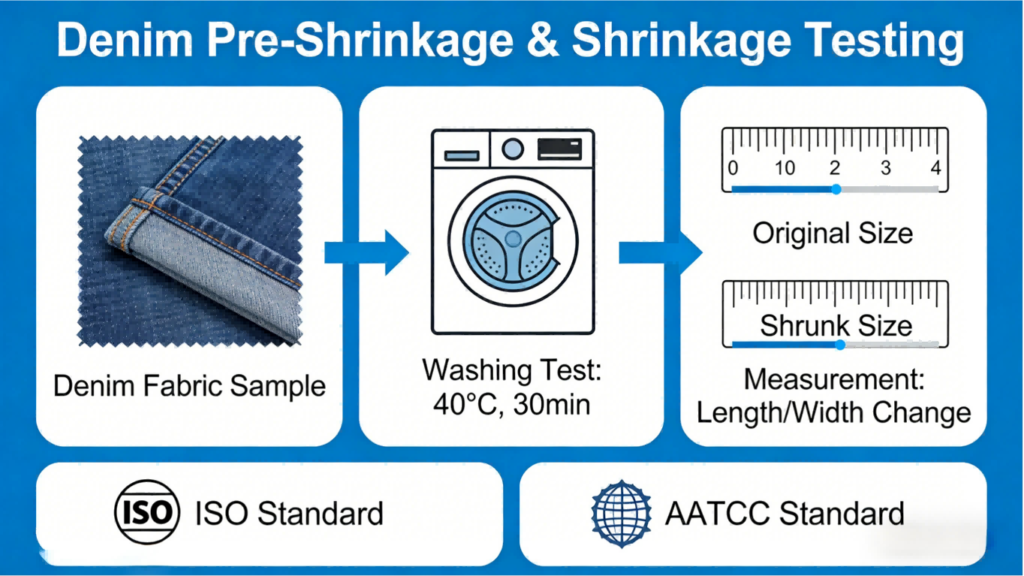
Frameworks are not the same as the specific substances that cause real rejections. These are the parameters most likely to fail a denim article.
Azo dyes releasing restricted aromatic amines. The single most important chemical parameter in denim dyeing. Certain azo dyes can reductively cleave to release aromatic amines, some carcinogenic. REACH Annex XVII Entry 43 prohibits placing on the EU market textile articles that may release any of the 22 listed amines above 30 mg/kg, tested per EN ISO 14362-1 for non-leather textiles. Standard indigo is not an azo dye and does not present this risk — but azo dyes may appear in colored denim, sulfur overdyes, pocket linings, contrast stitching, or printed labels and trims. The restriction applies to the entire article: compliant denim with non-compliant pocket bags still fails.
Formaldehyde. Present as a residue from resin finishes (wrinkle-free, permanent crease, some wash-effect stabilisation), fixing agents, and bonding adhesives. Limits vary by market and product class — OEKO-TEX sets baby products at typically 16 mg/kg, with relaxed limits for no-skin-contact products; China’s mandatory GB 18401 sets limits by category; Japan effectively requires near-zero for infant products. If your denim uses any resin finish, cationic fixing agent, or bonded trim/label, formaldehyde belongs in the standard protocol — failures are not uncommon, particularly when finishing chemistry changes between sample and bulk without re-testing.
Heavy metals. Lead, cadmium, chromium VI, nickel, mercury and others can enter through dyes, finishing chemicals, hardware, and coatings. For denim the fabric is lower risk than the hardware: rivets, buttons, and snaps — especially plated or coated — should be tested. Nickel release on skin-contact metal is regulated under REACH Annex XVII Entry 27; lead in US children’s products is regulated under CPSIA at 100 ppm total lead in substrate materials.
pH value. Reflects residual alkalinity or acidity from wet processing; strongly acidic or alkaline fabric irritates skin. Most standards require roughly pH 4.0 to 7.5 for skin-contact textiles. Strong bleaching or heavy enzyme washes shift pH, so neutralisation must be confirmed in the final garment, not assumed. The test is cheap and belongs in every package.
Alkylphenol ethoxylates (APEOs). Surfactants — chiefly NPEOs and OPEOs — historically used in wet processing; persistent pollutants and endocrine disruptors. REACH restricts them in textile articles (Annex XVII Entry 46a for NPEOs) and ZDHC MRSL prohibits intentional use. They enter through the mill’s wet-processing chemicals, so this requires active chemical-supply-chain management, not just finished-product testing — a factory that has not switched to APEO-free chemistry can fail this even when everything else passes.
How the Answer Changes by Brand Stage
Where testing effort belongs depends on commercial context, and it is different at each stage. Stating the contrast is the point — this is what a generic testing guide leaves out.
A creator-led brand on a 300–2,000-unit run usually cannot afford a full suite and does not need it for a single domestic market. The responsible minimum is the non-negotiables — wet and dry crocking, wash fastness, and (for medium-to-dark denim) perspiration fastness — plus a basic chemical screen if selling into any regulated market. The risk here is not multi-market complexity; it is skipping testing entirely because the order feels small.
A DTC startup at 5,000–20,000 units feels colour fastness through return rates: high online returns mean every crocking complaint is amplified, and the cost of a colour-transfer problem is paid in refunds and reviews, not just rejected shipments. This is the stage to lock garment-level crocking and perspiration testing as a hard gate, and to start a documented chemical baseline as the brand approaches multi-market sale.
A scaling brand at 20,000+ units — the reader of this guide — has a different problem from both: it is selling one product into several markets with different legal limits, reordering across multiple dye lots and wash loads, and answering to multiple buyers’ RSLs at once. The leverage here is not running a test; it is governing one specification against the strictest applicable limit and re-testing on every change. For azo amines that means designing to 20 mg/kg (China) rather than 30 mg/kg (EU) if both markets are in scope, so one compliant product serves all of them instead of a different spec per market.
| Brand stage | What dominates the testing problem | Where effort belongs |
|---|---|---|
| Creator-led (300–2,000) | Risk is skipping testing entirely on a “small” order | The non-negotiable minimum: crocking, wash, perspiration; basic chemical screen if selling to a regulated market |
| DTC startup (5,000–20,000) | Return-rate economics amplify every colour-transfer complaint | Garment-level crocking + perspiration as a hard gate; start a documented chemical baseline before multi-market sale |
| Scaling (20,000+) | One product, multiple markets and buyer RSLs, multiple dye lots and wash loads | Govern one spec against the strictest applicable limit; re-test on every change; spot-check across bulk |
Prioritisation: Which Tests Matter Most for Which Products
The technically complete answer is “test everything the buyer requires and the market regulates.” The practically useful answer recognises that budgets are finite and some parameters carry more risk for specific product types.
Color fastness priorities by product type
| Product type | Highest-priority tests | Why these specifically | Realistic performance expectations |
|---|---|---|---|
| Dark indigo (unwashed or light rinse) | Wet crocking, dry crocking, perspiration, wash | Maximum surface indigo = maximum transfer risk; denim at its highest-risk state | Wet crocking 2-3 typical, 3 good, 3-4 excellent; dry usually 1–1.5 grades better; wash improves after first cycles |
| Dark indigo (medium–heavy wash) | Wet crocking, perspiration, wash | Washing has already removed the loosest indigo, reducing but not eliminating transfer | Generally 0.5–1 grade better than unwashed on crocking |
| Black denim (sulfur-dyed) | Wet crocking, perspiration, wash; gas fading if retail-displayed | Different profile from indigo; gas fading is a specific sulfur-black risk | Wet crocking usually somewhat better than dark indigo but still problematic; gas fading depends on display environment |
| Light wash / heavy vintage | Wash, light, crocking | Heavy processing may expose residual chemicals; lighter shades show colour change more visibly | Crocking usually less of an issue; light fastness becomes more relevant |
| Children’s denim | All standard parameters, stricter limits | Regulatory requirements are stricter for children across virtually all markets | Expect buyer specs 0.5–1 grade stricter than adult product for the same parameters |
| Contrast designs (light panels, stitching, trims) | Staining onto adjacent fabrics (wash-fastness staining component) | Dark dye transferring to light elements within one garment is extremely visible and nearly impossible to fix after the fact | If dark and light elements touch, expect this to be the hardest fastness issue in development |
Chemical safety priorities by market and buyer type
| Scenario | Minimum chemical testing typically required | Additional requirements to confirm |
|---|---|---|
| Selling to EU (direct or via retailers) | REACH Annex XVII restricted substances (azo amines, nickel release on hardware, APEO); formaldehyde; pH | SVHC Candidate List obligations if articles contain listed substances >0.1% w/w; buyer requirements may exceed regulatory minimums |
| Selling to US | CPSIA (especially lead for children’s products); California Proposition 65 labelling scope; formaldehyde | Retailer packages vary widely — Walmart, Target, Amazon each have their own, often above federal minimums |
| Supplying a brand that references ZDHC | ZDHC MRSL at manufacturing level; the brand’s own finished-product RSL | Some require ZDHC wastewater testing; some require factory chemical-inventory disclosure |
| Seeking OEKO-TEX® STANDARD 100 | Full OEKO-TEX parameter list for the product class, via an authorised lab | Annual recertification; certification applies to the tested product/material, not the factory generally |
| Multi-market scaling programme | The strictest applicable limit across all target markets (e.g. azo amines at 20 mg/kg for China, not 30 mg/kg) | One governed specification rather than a different spec per market; re-test on dye-lot, recipe, chemical, or factory change |
The Gap Between Lab Results and Field Reality
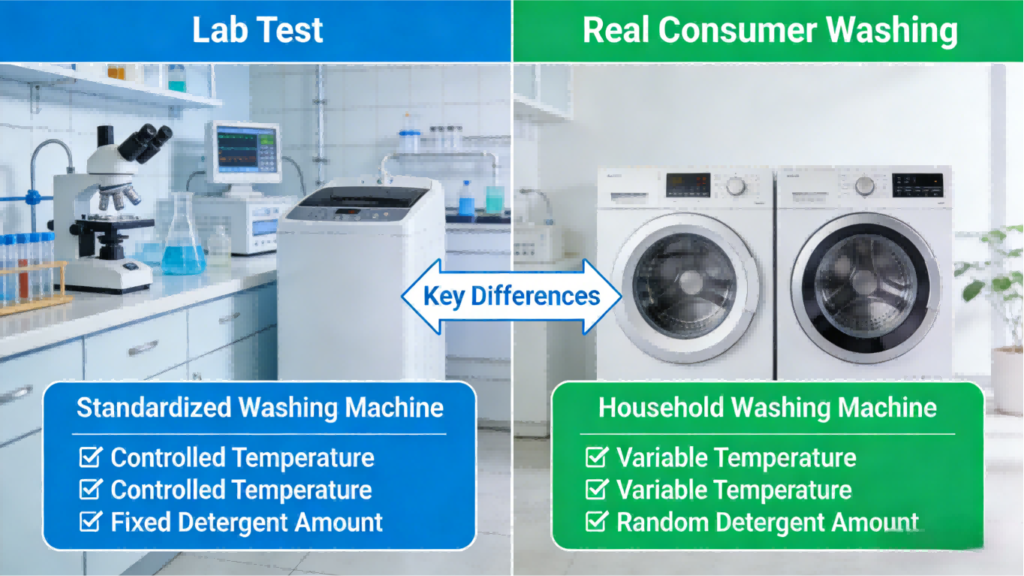
Lab conditions are standardised for reproducibility, not for predicting every real-world scenario — and at scale that gap is where surprises live.
The crocking test does not replicate actual use. AATCC TM8 and ISO 105-X12 rub a standardised white cloth under standardised pressure for standardised strokes — consistent and comparable. But a consumer’s light leather handbag rubbing against jeans on a humid day involves a different substrate, pressure, moisture, contact time, and surface chemistry. A fabric can pass crocking at a buyer-acceptable level and still transfer to that bag. The test was not wrong; the consumer met a different condition. Brands selling dark denim should carry this residual risk into care instructions and customer-service preparation rather than treating a pass as zero risk.
The lab sample may not represent bulk. Testing is done on one dyeing lot finished under specific conditions. In bulk, dye concentration varies between lots, wash parameters vary between loads, fixing application is not perfectly uniform, and machine position changes treatment intensity. A passing lab result proves the process is capable of meeting the spec — it does not guarantee every garment in a 20,000-piece order does. That is why bulk QC must include periodic fastness checks, not a single pre-production test.
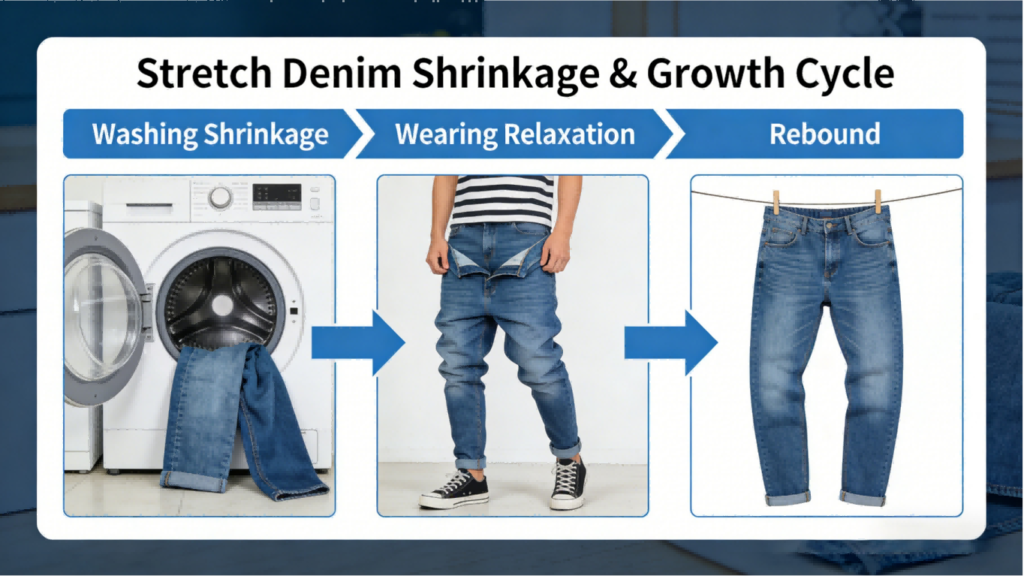
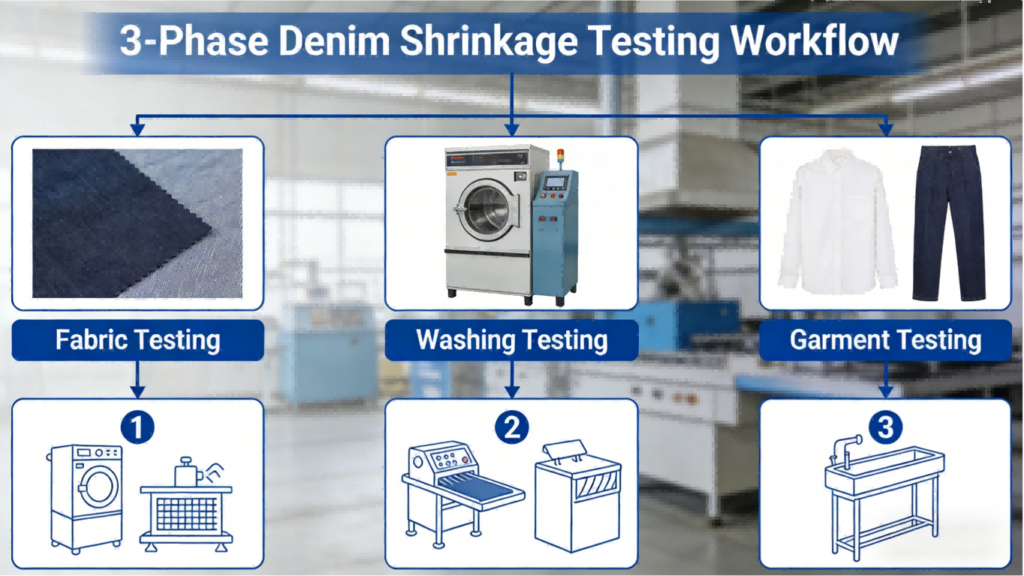
Garment-level differs from fabric-level. A fabric sample can test differently than the same fabric after cutting, sewing, and garment washing, because the wash (stone, enzyme, bleach, softener, tumble) further modifies the surface and dye state. A fabric at grey-scale 3 wet crocking can test 2-3 or worse after a heavy wash — or sometimes better, if good rinsing removed loose particles. Either way, for washed denim, gate production on the garment-level result after the final wash; use fabric-level only for early screening and supplier qualification.
Is Light Fastness Actually Important for Denim?
A genuine question, because it challenges an assumption baked into many standard packages. Light fastness (AATCC TM16 / ISO 105-B02) exposes fabric to a xenon arc lamp to simulate prolonged sunlight — unquestionably important for upholstery, curtains, outdoor apparel, and retail display. For jeans worn, washed, stored in a closet, and worn again, sustained direct light exposure is modest by comparison.
It still matters in two denim scenarios: retail display, where jeans on lit walls or in windows for weeks can fade visibly and unevenly, hurting sell-through on the displayed piece; and outdoor-oriented products like jackets and shorts, where high sun exposure during wear benefits from reasonable light fastness to avoid asymmetric fading. For most standard jeans in a normal retail-and-wear cycle, light fastness is a lower priority than crocking, wash, and perspiration — if budget forces prioritisation, it is usually the first to defer, not the last.
The Minimum Viable Testing Program
Comprehensive testing — full fastness suite, OEKO-TEX certification, ZDHC MRSL audit, full REACH Annex XVII screening — costs real money and time. For a scaling brand with a multi-market programme, most of this is justified; the question is sequencing it sensibly rather than skipping it.
Minimum color fastness for denim: wet and dry crocking (AATCC TM8 / ISO 105-X12) — non-negotiable; wash fastness (AATCC TM61 / ISO 105-C06) — non-negotiable; perspiration (AATCC TM15 / ISO 105-E04) — strongly recommended for medium-to-dark and warm-weather product; light and water fastness — include if the buyer or category warrants, otherwise deferrable in round one.
Minimum chemical safety for denim: azo amines — non-negotiable for any regulated market; formaldehyde — non-negotiable if any resin finish, fixing agent, or bonded component is used; pH — cheap, catches obvious processing failures; heavy metals on hardware (rivets, buttons, snaps) — non-negotiable for EU (nickel) or US children’s product (lead). This is the baseline below which you carry unquantified risk; as volume and market reach grow, the programme grows with them.
A Reference Example: Where the Failure Actually Was
Consider a scaling brand’s dark indigo core jean reordering at 22,000 units into both the EU and the US. The style had shipped for three seasons. Two failures surfaced in one quarter; walking the records field by field showed where each one actually originated, and that neither was in the denim itself.
The colour-transfer complaints traced to a wash-recipe drift: a softener-and-tint step added during a prior “make it look richer” review left more mobile surface indigo, and wet crocking on the current garment tested 1-2 where the original approved sample had tested 2-3 — but no one had re-tested the garment after the recipe changed. The EU shipment rejection traced to the pocket bags: a sourcing team had swapped the pocket-lining supplier for cost between reorders, and the new lining used an azo dye releasing a restricted amine above 30 mg/kg. The denim shell passed every parameter. The article failed because chemical testing had been scoped to the shell fabric only, and because re-testing was never triggered by the component swap.
Neither failure was a single person’s mistake; each was a defensible local decision made without a gate that re-tested on change and tested the whole article across every target market. The corrective method is the same one that prevents it: write fastness and chemical targets into the brief on day one, gate bulk on garment-level results after the final wash, test every component not just the shell, design to the strictest applicable market limit, and define the trigger events — new dye lot, recipe change, chemical change, component swap, factory change — that force a re-test before the next run, not after a buyer’s audit. A test report certifies a specific sample at a specific moment; only a re-test discipline certifies the product you are actually shipping now.
The Cost Risk Assessment
| Question | If yes | Compliance / quality implication |
|---|---|---|
| Dark indigo or dark-washed core style? | High surface indigo | Wet crocking and perspiration are the gating tests; set the target against the actual end consumer, gate bulk on garment-level results |
| Selling into more than one market? | EU + US + Asia, etc. | Govern one spec against the strictest applicable limit (e.g. azo amines 20 mg/kg for China); do not run a different spec per market |
| Any resin finish, fixing agent, or bonded trim? | Chemistry beyond basic wash | Formaldehyde testing is non-negotiable; confirm fixing agents are non-formaldehyde and verify by test, not by claim |
| Branded or coated hardware, leather patch? | Metal or leather components | Test nickel release (EU), lead (US children’s), and chromium VI on leather; the article fails on a component even if the denim passes |
| Component or supplier swapped between reorders? | Pocket bag, lining, trim, factory changed | Trigger a full re-test; a component swap is one of the most common causes of a shell-compliant article failing audit |
| Wash recipe changed since the approved sample? | Any step added or modified | Re-test garment-level crocking; recipe creep is the most common cause of latent colour-transfer complaints |
| Buyer specifies “international standards” only? | No method or grade named | Get the exact method, conditions, and pass grade in writing before testing — not after a dispute |
FAQ
Which color fastness parameter causes the most consumer complaints for dark denim?
Wet crocking and perspiration fastness, especially for dark indigo and dark-washed denim. Colour transferring onto light-coloured shoes, bags, furniture, and undergarments during wear is the dominant complaint pattern. Wash fastness complaints are less common, because most consumers expect some colour loss in the wash but do not expect a car seat to turn blue from sitting down.
If I have OEKO-TEX certification, am I automatically REACH compliant?
Not automatically, though there is significant overlap in the substances tested. OEKO-TEX STANDARD 100 covers many of the same parameters as REACH Annex XVII. But REACH carries specific obligations, particularly around SVHC notification and communication down the supply chain, that an OEKO-TEX certificate alone does not address. For EU market compliance, treat REACH as a separate checklist item rather than assuming OEKO-TEX covers everything.
Do I need to test every colour in my collection, or can I test one and assume the rest?
Different colours use different dye systems with different fastness profiles. Indigo blue, sulfur black, and colored denim using reactive or direct dyes behave differently on the same tests, so test each distinct dye system. Within one dye system at several wash-down levels, testing the darkest shade is usually sufficient for crocking and staining, since the darkest shade is the worst case.
Why does the same restricted substance have different limits in different markets?
Because each market writes its own regulation. For azo amines, the EU restricts 22 amines at 30 mg/kg, China restricts 24 amines at 20 mg/kg, and Japan and South Korea restrict 24 amines at 30 mg/kg. A scaling brand selling into several markets should manage one product against the strictest applicable limit, rather than testing a different specification per market.
Can I improve wet crocking without affecting hand feel or fade development?
Partially. A well-chosen non-formaldehyde fixing agent at a moderate level can improve wet crocking by about 0.5 to 1 grade with minimal hand-feel impact. But there is always a tradeoff: anything that helps retain surface dye also reduces the dye mobility that creates fade patterns. Heavy fixing that delivers excellent crocking numbers produces denim that fades more slowly and less dramatically, so the right balance depends on the product’s positioning.
What is the single most valuable step to reduce colour complaints and compliance failures at scale?
Write the color fastness and chemical safety targets into the product development brief at the start of the project, not the end. When the QA team, the wash developer, the finishing technician, and the supplier all know the targets from day one, they make different decisions than when a requirement appears as a surprise after bulk. Testing should verify the process hit its targets, not be the moment anyone first learns what the targets were.
The Bottom Line
Color and chemical risk in denim is not eliminated, it is governed. Colour transfer in dark indigo is a material property to be held to an accepted range, not a defect to be designed out — so the work is setting the right target and proving you hit it in the product’s delivery state, not chasing a number that contradicts the look you are selling. Build both test families into development from day one; gate bulk on garment-level results after the final wash; test the whole article, not just the shell; and at scale, govern one specification against the strictest market you sell into and re-test on every change. A cost or compliance problem found in development is a design decision; the same problem found after shipment is a write-off, a recall, or a rejected container.
Keeping that discipline honest across reorders and across markets — re-testing on every change, testing every component, holding one spec to the strictest applicable limit — is the kind of compliance and production governance SkyKingdom runs as an external denim product team for scaling brands. If you are mapping where colour and chemical risk could surface across your high-volume styles, you can see how that traceability fits your range on the traceability and compliance page.
Reference Sources
- ISO 105 series — Textiles: tests for colour fastness (C06 laundering, X12 rubbing, E04 perspiration, B02 artificial light, E01 water, A02 grey scale for colour change, A03 grey scale for staining) — defines the colour fastness test methods and the grey-scale rating system referenced throughout.
- AATCC Test Methods (TM8 crocking, TM15 perspiration, TM16 light, TM61 laundering, TM107 water) — the North American counterpart methods buyers specify alongside or instead of ISO.
- OEKO-TEX® STANDARD 100 — the finished-product safety certification and its product-class limits, including formaldehyde.
- ZDHC Manufacturing Restricted Substances List (MRSL) — the process-level chemical management system major brands reference in supply-chain requirements.
- ECHA — REACH Annex XVII Restrictions — the legal basis for Entry 43 (azo amines, 30 mg/kg) and Entry 72 (33 CMR substances).
- ECHA — REACH Candidate List (SVHC) — the substances triggering supplier information obligations above 0.1% by weight.