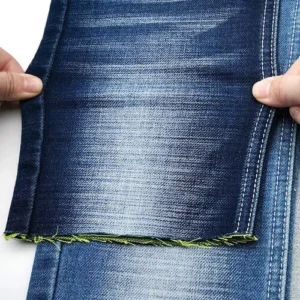


Wash recipe documentation is the practice of recording every process variable behind an approved wash — chemical, mechanical, and thermal — so the result can be reproduced on a later production run instead of re-developed from a reference sample. In denim that means the chemicals and dosages, temperatures, times, liquor ratio, machine load, dry-process steps, and drying method behind the wash you signed off. For a DTC brand founder running 5,000–20,000 units a season without an internal product or QC team, the approved sample tells you what you want; the documentation is what lets you get it again. Without it, every reorder effectively restarts wash development from a photo and a memory — which is why a style that sold perfectly in its first run can come back months later in a noticeably different shade.
The real problem isn’t the wash. It’s repeatability.
Most brands judge a wash by looking at one sample. The laundry sends back a pair that hits the wash you imagined — the right fade, the right contrast, the right hand feel — and you approve it. That moment feels like the finish line. You found the wash, you signed off, the hard part is over. In reality, it is the start line for the question that decides whether a wash survives at scale: can this exact result be produced again?
Approving a sample answers one narrow question: can this wash be made once? It says nothing about the harder one: can it be made again, in bulk, six months or two years from now, possibly on a different fabric lot, possibly by a different operator on a different day? Those are genuinely different problems. The first is about whether the look is achievable. The second is about whether the conditions that achieved it were captured. A brand that confuses the two will keep being surprised, because the thing it approved and the thing it can reorder are not the same object.
A denim wash is not a fixed property of the garment, the way weight or fiber content is. It is the output of a process, and that process has variables. The same indigo fabric, washed at a different temperature, for a different time, at a different liquor ratio, or with a different enzyme dosage, comes out a different shade with a different hand. This is not a quality problem; it is physics. Academic testing bears it out directly: varying enzyme concentration, temperature, and treatment time on the same denim measurably changes fade level, softness, and even fabric strength. Consider what that means for an approval. The pair you signed off was the result of one specific combination of those variables on one specific day. If that combination was never written down, you did not actually lock the wash — you locked a memory of it. And a memory cannot be sent to a production floor.
This is why, in practice, the wash itself is rarely the thing that fails. A competent production partner can almost always reproduce one good sample on request; making a single nice pair of washed jeans is a solved problem. What fails is repeatability — the ability to land the same result on run two, run five, and run nine. And repeatability does not live in the skill of the wash house or the quality of the chemicals. It lives entirely in one place: whether the variables behind the approved sample were recorded with enough precision that someone could follow them. Everything else in this article is downstream of that single idea.
Why an approved wash looks ready when it isn’t
The trap is that an approved sample looks like a finished decision. You are holding a physical pair of jeans in the exact wash you wanted. Nothing about that object signals risk. There is no warning label that says “this result is conditional on variables nobody recorded.” So the brand moves on, mentally files the wash as “done,” and treats the next order as a logistics step rather than a reproduction problem. The confidence is real, and it is misplaced for a specific, knowable reason.
Here is the reason. An approved sample is evidence of an outcome, not a record of the inputs. It proves the wash house can reach the target; it does not tell you which dial settings got them there. In most first-time approvals, those settings live in the wash house’s heads and bench notes, not in anything the brand owns. The brand approved the destination without keeping the map. As long as the same operator, same machine, same fabric lot, and same chemicals all happen to line up again, the wash repeats and everyone concludes the approval was sufficient. That apparent success is the dangerous part — it teaches the wrong lesson.
The illusion holds right up until one of those conditions quietly changes, which it always eventually does. A common version, as an illustrative example: a brand approves a medium-stonewash sample, reorders some months later, and the result comes back visibly darker. Nobody made a mistake anyone can point to. The wash house ran “the same wash.” But the fabric came from a new lot with slightly heavier indigo, and because the recipe was never anchored to a fabric reference, the same process landed differently. The brand experiences this as “the factory changed something.” What actually happened is that nothing was ever fixed in the first place — the approval captured a result that only stayed true while its hidden conditions stayed constant.
The lesson is uncomfortable but clean: an approval tells you a wash is possible, not that it is repeatable. Those are different claims, and only one of them survives a reorder. A wash you approved once is not a wash you can repeat — unless the variables behind it were written down.

Why the same recipe still drifts on reorder
Now flip the situation. Suppose you did record the recipe, and the reorder still drifts. Brands find this genuinely confusing — the recipe was followed, so why did the color move? Understanding the answer is what separates a recipe sheet from real documentation, because a recipe alone covers only one of three drift mechanisms. Each looks harmless on its own, and each compounds with the others across runs.
The fabric underneath changed. A wash recipe does not act in a vacuum; it acts on a specific fabric. When a style is rewoven across different lots, or dyed in different indigo batches, the starting canvas is no longer identical, so the same process lands on it differently. This is the quiet driver behind most multi-year reorder drift: nobody touched the recipe, but the surface it was painted on shifted underneath it. In one anonymized case we worked on, a core indigo five-pocket was reordered annually — across roughly three years the recipe never changed, yet the fabric drifted lot by lot until the latest run sat visibly darker than the first. The fix is structural: documentation has to anchor to a fabric reference and a sealed garment, not just a chemical sheet, so each new lot is washed toward a fixed target rather than processed in isolation.
The recipe was partial, so someone filled in the blanks. A recipe that lists chemicals and times but omits load weight, machine type, RPM, or dry-process detail is not a complete instruction — it is a complete instruction for some of the steps and an invitation to improvise on the rest. Those blanks get filled by whoever runs the batch that day, usually with reasonable defaults, but not necessarily your defaults. Picture a recipe that specifies the enzyme dose and temperature but says nothing about load size; as an illustrative example, one operator runs a lighter load per drum and the next runs a heavier one, and the heavier load abrades less per garment, so the second batch comes out darker with no “error” anywhere. Each unspecified line is a place the result can move while everyone follows the document faithfully. A recipe is only as repeatable as its least-specified line.
There was no physical baseline to check against. A recipe describes intent; it does not prove the output. Without a sealed reference sample and an approved shade band, there is nothing objective to hold a new run beside, so “close enough” gets judged against memory — and memory is exactly the thing that drifts. The remedy is to make “acceptable” measurable. Visually, shade is assessed against a shade band and a gray scale; objectively, a color difference below roughly Delta E 1.0 is the point at which most people stop being able to see a shift at all. Either way, the brand needs a fixed physical thing to measure against, not a recollection of how the first run looked. Take a real case: a reorder came back that everyone felt was “off,” but with a sealed swatch in hand the team could see it was actually inside tolerance — the drift was in their memory of the original, not in the goods.
The pattern across all three is identical, and it is worth internalizing: drift rarely comes from one big, catchable error. It comes from an unrecorded variable, an unanchored fabric, or a missing baseline — small gaps that each look harmless in isolation and only become visible once they have compounded across several runs. Documentation earns its place precisely because it closes all three gaps at once.

Where brands usually misjudge the decision
Three specific misjudgments show up again and again as brands move from first runs into regular reordering. None of them looks like a mistake at the time — each feels like reasonable, even prudent, behavior. That is what makes them expensive.
1. Treating “sample approved” as “bulk locked.” A brand approves a beautiful wash sample and reasonably assumes the decision is closed. But approval confirms the wash can be made once; it does not capture how. The recipe behind that sample still has to be recorded and tied to a sealed reference, or the approval protects nothing past that single pair. The gap surfaces at the worst possible moment — in bulk, or on the first reorder — when the result is “close” but not the same, and there is no documented standard to adjudicate the difference.
2. Treating a reorder as “just placing the order again.” A reorder feels like a repeat purchase: same style, same supplier, push it through. But months or years later the fabric lot is different, the wash target lives in memory, and there is often no fixed baseline to check the new run against. A reorder is not a transaction — it is a re-approval against a standard. If the standard was never written down, the reorder is really a quiet re-development wearing the costume of a repeat order, and it drifts accordingly while everyone assumes it is routine.
3. Accepting test results with no standard codes. A report says the color “holds up fine” or the fabric “won’t shrink much,” and the brand takes it at face value. But a result without a method behind it is an opinion, not a test. Post-wash performance is measured against named standards — colorfastness to laundering (AATCC TM61), crocking (AATCC TM8), dimensional change after laundering (AATCC TM135/TM150). A report that does not cite the standard it used cannot be compared to anything later, which is exactly when you will need it: on the reorder, when you are trying to prove this run matches the last and have nothing but adjectives to do it with.
The common thread is that all three feel safe in the moment and only reveal themselves a season or two later — by which point the wash that was supposed to be locked has quietly moved, and the evidence needed to pull it back was never collected. Each misjudgment is really the same error in a different costume: trusting a result without keeping the conditions that produced it.
What a wash recipe actually records
If documentation is what makes a wash repeatable, the obvious question is what goes into it. The mistake most brands make is thinking a wash is defined by its color. Color is the result. The recipe is the set of variables that produced the color — and every one of them can move the outcome on its own. A complete wash recipe records the variables a production partner would need to reproduce the result without guessing:
| Variable | What it controls | Why it has to be recorded |
|---|---|---|
| Liquor ratio (water : garment weight, e.g. 1:10) | Chemical concentration and mechanical action | The same chemical at a different liquor ratio acts differently on the shade |
| Chemical + dosage (g/L or % on weight of garment) | The core treatment — enzyme, bleach, etc. | Same chemical, different dosage = different result |
| Temperature (°C, per step) | Enzyme activity, bleach rate, dye behavior | Wash-down is temperature-dependent; higher temp acts faster |
| Time (minutes, per step) | Degree of fade and softening | Longer exposure removes more color |
| Machine type + load weight (kg/load) | Movement pattern and abrasion uniformity | Under- or over-loading changes how evenly the wash takes |
| Agitation / RPM | Intensity of mechanical action | More agitation = more abrasion, more wash-down |
| Dry-process steps (whiskering, sanding, PP spray, laser, grinding) | Localized effects before/after wet wash | Position and intensity define the look as much as the wet recipe |
| Drying method + temperature | Final shrinkage, hand feel, crease set | Pre-shrunk denim typically moves about 3–5% and raw can reach 10–15% (per Cotton Incorporated garment-washing data; see Sources); drying changes measurements, not just dampness |
No published standard formally lists these eight as a fixed schema — this is how the variables behave in practice, synthesized from neutral technical references and how wash houses actually run. But the principle underneath them is settled, and it gives a clean working definition:
Wash recipe documentation is the practice of recording every process variable behind an approved wash — chemical, mechanical, and thermal — so the result can be reproduced on a later production run instead of re-developed from a reference sample.
Two things are worth underlining. First, the recipe is only half of the control system; it pairs with a sealed physical sample and an approved shade band, because a number on paper and a thing you can hold answer different questions. Second, “recorded” has to mean with units and standards. A line that reads “enzyme wash, medium” is not documentation — it is a label, and a different floor will interpret “medium” its own way. A line that reads “2% acid enzyme on weight of garment, 45°C, 40 minutes, liquor ratio 1:8” is something a different production partner could actually act on. The gap between those two lines is the entire difference between a wash you hope repeats and a wash you can require to repeat.
How much you should document depends on your stage
Documentation is not all-or-nothing, and treating it that way is its own mistake — over-documenting a throwaway capsule wastes money, under-documenting an evergreen core style loses it. The right level scales with one thing: how likely you are to need this exact wash again. That likelihood, and therefore the right depth, looks different at each brand stage.
| Brand stage | Typical situation | What to document | Why this level |
|---|---|---|---|
| Creator-led (first runs, ~500–2,000 units) | One drop, reorder uncertain | A sealed sample + a photo reference + the final recipe if the partner provides it | The risk isn’t repeatability yet — it’s losing the only record of a wash that might suddenly need restocking |
| DTC startup (5,000–20,000 units/season) | Core styles starting to reorder, crossing fabric lots | Full recipe variables + sealed sample + approved shade band + pre/post-wash measurements | This is where drift starts costing real money; “close enough” reorders begin to show |
| Scaling brand (20,000+ units/season) | Multi-year reorders, possible second source | Everything above, owned as a portable package, plus test reports with standard codes | At this volume the wash may outlive the original supplier relationship; the documentation has to survive a production change |
The through-line, and the stage this article is written for, is the DTC middle. The three stages each document for a different reason. A creator-led brand documents mainly to avoid losing a good wash — the danger is that a surprise restock arrives and the only record of a sold-out wash was a phone photo and a vendor who has since changed staff. A DTC brand documents to stop drift on styles that are now reordering across fabric lots, where “close enough” errors start stacking into visible mismatches and real return rates. A scaling brand documents so the wash can be moved — re-approved against a fixed baseline if production ever shifts to a second source, instead of redeveloped from scratch under deadline.
To make the DTC case concrete, take an illustrative example: a brand selling around 8,000 units a season of a signature black-overdye style that reorders twice a year. By the third reorder the dye house has had a staff change and the fabric is on a new lot. With a full recipe, sealed sample, shade band, and pre/post measurements on file, each reorder becomes a short re-approval against a known standard rather than a fresh investigation. Without them, each reorder is a fresh negotiation about what “the black” was supposed to look like — conducted from memory, under a ship date. That is the point where documentation stops being paperwork and becomes leverage: when the variables are recorded against a sealed reference, a new run, a new lot, or a new partner starts from a real target instead of a blank page. The record is what makes a wash transferable; without it, every move starts over.
What to check before your next bulk or reorder
Before a wash goes to bulk — or before you place a reorder on a style you have run before — these are the things worth confirming. Most cost nothing but a question asked at the right moment; their absence is what later shows up as drift no one can explain.
- Is the full recipe recorded, with units? Chemicals and dosages, temperatures, times, liquor ratio, machine type and load, dry-process steps, drying method — not “enzyme wash, medium,” but numbers a different partner could act on.
- Is there a sealed, dated reference sample? A physical pair, sealed and stored out of light, that proves what was actually approved — not just a photo on someone’s phone.
- Is there an approved shade band? A light-to-dark tolerance range the bulk fabric is checked against before cutting, so “acceptable” has a hard edge instead of being a judgment call.
- Are pre-wash and post-wash measurements both on the spec? Washed denim shrinks roughly 3–5% pre-shrunk and up to 10–15% raw (per Cotton Incorporated garment-washing data; see Sources); without both numbers, the finished garment can land a full size off the intended fit.
- Do the test reports cite standard codes? Colorfastness (AATCC TM61), crocking (AATCC TM8), dimensional change (AATCC TM135/TM150) — a result without a named method behind it is an opinion, not a test.
- For a reorder: is the original reference still trustworthy? If the gap has been a year or more, confirm the sealed sample and fabric reference still hold before assuming the run will match on its own.
If you can tick all six, your wash is genuinely locked and a reorder is a checking exercise. If you cannot tick one of them, you have just found the exact line where the next reorder is most likely to drift — which is useful, because it is far cheaper to close that gap now than to diagnose it after the goods arrive.
When a direct factory or laundry may be enough
None of this means every brand needs a layer of product management around every wash. Working directly with a factory or laundry can be entirely sufficient, and adding overhead where it is not needed is just cost. The direct route fits when the conditions are genuinely simple: a one-off drop with no reorder intent, a straightforward rinse or light enzyme wash with wide tolerance, a single production run that will not cross fabric lots, and someone in-house who already knows how to read a recipe and seal a reference.
Take a creator launching a 600-unit capsule in a basic rinse wash, with no plan to restock. The wash is forgiving, the run is one lot, and the founder can photograph and seal a pair themselves quickly. Routing that through an external product layer would add cost and time for risk that barely exists. In that situation the documentation discipline still applies — record the recipe, seal a sample — but the brand can own it directly without much overhead. The direct relationship is faster and cheaper, and the risk it leaves on the table is small precisely because there is no plan to reproduce the wash later. The simpler and more disposable the wash, the more a direct relationship makes sense.
When an external denim product team may fit better
The calculation changes the moment a wash has to survive time and scale. Once a style is going to reorder across seasons, cross multiple fabric lots, or possibly move to a second source, someone has to own the documentation as a living standard — recording the variables, holding the sealed reference, and re-approving each run against a fixed baseline rather than a memory. For a DTC brand without an internal product or QC team, that ownership is the precise gap: the brand knows what it wants the wash to look like but has no one whose job is to keep it reproducible across years.
Consider the illustrative 8,000-unit overdye example again. The work that keeps it consistent — maintaining the recipe, checking each lot against the shade band, supervising inspection, re-approving each reorder — is ongoing and specialized, and it is nobody’s job at a three-person brand. This is the role an external denim product team fills: not the factory floor, but the layer that develops the wash, documents the recipe, supervises the inspection, and keeps the reorder consistent — so each run can be checked back against the same approved standard. SkyKingdom works in this position for creator-led, DTC, and scaling brands, acting as the external product team they do not have to build in-house. The more a wash has to repeat, the more it pays to have someone whose entire job is making sure it does.
What to prepare next
If you are about to run or reorder a wash you care about, the practical next step is to assemble the reference set before bulk, not after a problem appears. Gather the recipe in recordable form with units, seal and date a reference sample, get the shade band approved, and make sure both pre- and post-wash measurements and standard-coded test reports are on file. None of these steps is expensive on its own; the cost only appears when you skip them and have to reconstruct the wash later from memory. That small package is what turns “the wash we liked that one time” into “the wash we can reorder for years” — and it is far easier to build at approval than to recover after a reorder has already drifted.

A real reorder, walked through field by field
Consider an anonymized case: a brand we supported on a single wash that reordered steadily for around three years. The style worked, so it kept coming back — and the real test was never the first production run, it was the eighth or ninth, long after the original sample had become a memory for everyone involved. What follows is how that wash stayed consistent, broken down field by field, because the answer was not a better wash; it was a better baseline.
Five things were fixed at the start and checked against on every reorder:
- The recipe was recorded with units. Not “enzyme wash,” but the chemicals, dosages, temperatures, times, liquor ratio, and dry steps — specific enough that a later run could be dialed toward the target instead of guessed at.
- A reference sample was sealed and dated. A physical pair, stored, that proved what “approved” actually looked like — so no one had to trust a three-year-old memory or a photo taken under whatever light happened to be in the room.
- A shade band defined the tolerance. Each reorder’s bulk fabric was checked against an approved light-to-dark range before cutting, so “acceptable” had a hard edge rather than being relitigated each time.
- Pre- and post-wash measurements were both on file. When a new fabric lot arrived, its shrinkage behavior could be compared against the baseline, not rediscovered from scratch.
- Test reports carried standard codes. Colorfastness and dimensional-change results were tied to named methods, so one reorder’s report could actually be compared to the last instead of read as a fresh opinion.
Here is where the baseline earned its keep, drawing on anonymized cases from styles we have supported. On one later reorder, the fabric arrived from a new lot and the first bulk wash came back slightly light. Because the sealed sample and the recipe both existed, the correction was contained: re-approve against the band, adjust the recipe a step, re-run. Now contrast a different style, where the gap between reorders had stretched past about two years and the original reference could no longer be trusted on its own. There the honest call was the opposite — stop, re-confirm the color with the brand before committing bulk, and treat it almost like a new development rather than pretend an older memory still held. Same company, two opposite decisions, and the deciding factor each time was not the wash house’s skill.
The difference between those two outcomes was never the wash. It was whether there was a baseline to return to. Documentation does not make drift impossible — fabric still moves, lots still vary — but it gives you something to correct back to. Without it, there is nothing to return to, and every reorder quietly becomes a new development with an old style number.
FAQ
Why does my reorder come back a different color when I used the same supplier?
Because a wash is reproduced from recorded variables, not from supplier loyalty. The same factory running the same recipe can still drift if the fabric was woven or dyed in a new lot, because the recipe acts on a different starting point and lands differently. It also drifts if parts of the recipe were never written down, leaving blanks the floor fills with its own defaults. The reliable fix is not switching suppliers — it is a recipe documented with units, tied to a dated sealed sample you re-approve each run against.
Isn’t approving the sample enough?
Approving a sample confirms one thing only: the wash can be made once. It does not record how it was made, so it does not guarantee the wash can be repeated in bulk or on a later reorder. Approval and documentation are two separate steps. The approved sample tells you the target was hit; the documentation is what lets a later run hit it again without rebuilding the wash from scratch. Treat approval as the start of documentation, not the end of the decision.
What’s the difference between a wash recipe and a wash specification?
A specification is the target: the look, the shade band, the standards you want the finished wash to meet. The recipe is the set of process variables that actually produce it — chemicals, dosages, temperatures, times, machine type and load, dry-process steps, and drying method. Documentation records the recipe so the specification can be met again on a later run. Put simply, the spec is what good looks like; the recipe is how you get there; documentation is what lets you get there twice.
How long are a sealed sample and a wash standard good for?
A sealed physical reference is most reliable when it’s dated and stored out of light and heat. In our internal practice, shade references are often treated as a useful reference for roughly six months and wash standards for about a year, after which they’re worth re-checking rather than trusting blindly. These are working conventions, not hard rules. The key point for a brand is simple: the longer the gap before a reorder, the more a physical sealed sample matters, because memory and screen colors drift faster than a stored swatch does.
Do I need full documentation for a one-time drop?
No. For a genuine one-off with no reorder intent, a photo reference and clear production notes are usually enough, and building a full eight-variable package is effort spent on a wash you’ll never make again. The judgment call is honest intent: if there’s any real chance the style comes back, the cost of sealing a sample and recording the recipe now is far smaller than redeveloping the wash later. Full documentation earns its keep on styles you expect to reorder, especially across fabric lots.
The color came back way off from the original — can it be fixed?
It depends on what was kept. If a sealed reference and a recorded recipe exist, yes — there’s a fixed baseline to correct toward, and the gap can usually be narrowed by adjusting the recipe against that reference. How many rounds that takes depends on how far the run drifted and how complete the records are. If nothing was documented and the original sample can’t be found, there’s nothing objective to return to, and the realistic path is to re-confirm the color with the brand from scratch and treat it as a new development. That’s slower and avoidable, which is exactly why the sealed sample is worth keeping before the problem ever appears.
Keeping a denim wash consistent from first sample through years of reorders is less about the wash itself and more about what gets recorded and sealed before bulk ever runs. That documentation discipline — recording the variables, sealing a reference, and re-approving each run against a fixed baseline — is the kind of work we do for DTC brands at SkyKingdom, as their external denim product team.
Sources
- AATCC TM61 — Colorfastness to Laundering: Accelerated. Defines accelerated wash testing of color loss, where one test approximates several home launderings; supports the colorfastness standard referenced above.
- AATCC TM8 — Colorfastness to Crocking. Measures dye transfer by wet and dry rubbing, graded against a staining scale; directly relevant to indigo rub-off on denim.
- AATCC TM135 / TM150 — Dimensional Changes after Home Laundering. Standardized methods (fabric and whole garment) for measuring shrinkage after laundering across set temperatures, agitation, and drying procedures.
- ISO 6330:2021 — Domestic washing and drying procedures for textile testing. Establishes that machine type, detergent, time, and temperature must be standardized because they materially affect test results.
- Cotton Incorporated — Garment Washing Techniques for Cotton Apparel. Neutral industry reference categorizing garment-wash processes such as stonewash, chlorine stonewash, ice wash, and cellulase (enzyme) wash.
- Peer-reviewed enzyme and liquor-ratio studies (Fashion & Textiles). Demonstrate that varying enzyme concentration, temperature, time, and liquor ratio measurably changes fade, hand feel, and fabric strength on the same denim.
- X-Rite — Understanding Delta E. Establishes Delta E below roughly 1.0 as the threshold under which a color difference is generally imperceptible to the human eye.