

For DTC denim brands running seasonal bulk — how to tell normal wash variation from a real failure signal before you sign off or reorder.
You approved the wash. You held the sample garment in your hands, checked it against your reference, signed off, and placed the bulk order. Then the production run arrives — and something looks off. The blue reads a shade lighter. Or the whiskers sit differently. Or the color looks fine but the hand feels stiffer than the piece you approved.
The instinct at this point is to assume someone made a mistake. Often, no one did.
A washed denim color is not painted onto the fabric and locked in place. It is pulled out of the yarn during washing — and that process behaves a little differently every time it runs, at every scale, in every operator’s hands. Some amount of movement between your sample and your bulk is not a defect. It is the nature of the material.
The real risk for a growing brand is not that the wash moved. It is signing off — or rejecting — without knowing which kind of movement is normal and which is the one that should worry you.
Short answerThe same denim wash looks different because denim color is washed out of the yarn, not dyed onto the finished garment — so it shifts with fabric lot, machine scale, and the hands doing the finishing. For a DTC brand running seasonal bulk of roughly 5,000–20,000 units, small movements in shade, contrast, and hand-feel are expected; your bulk should not be judged against one sample piece as an exact point match. What matters before sign-off is whether the run stays inside the approved range you defined up front. Approve a single sample and you have no range — so normal variation will look like failure.
The Real Problem Is Not “The Wash Moved”
Most brands meet this problem the same way. The bulk arrives, it doesn’t match the sample on the desk, and the conversation immediately becomes a dispute: did the factory cut a corner? Was the wrong recipe run? Should this whole lot be rejected?
That framing almost always sends the brand to the wrong question. Because for a washed denim color, “did it match the sample exactly” is a question that has no good answer — the honest answer is no, and it was never meant to. Two garments run through the same wash, in the same batch, will not be identical to the eye. Two batches, weeks apart, on different fabric rolls, will move further still.
So the useful question is not did it match? It is: did it stay inside the range I approved?
That single shift changes everything downstream. If you approved a range — a defined acceptable spread of color, not a single point — then a bulk run that lands inside that spread is a pass, even though it doesn’t look identical to your desk sample. And a bulk run that lands outside it is a real signal worth acting on. Without that range, every normal variation looks like a failure, and every genuine failure can be argued away as “just normal variation.” You lose the ability to tell them apart — which is the one ability you actually need.
This is the gap almost no one hands a growing brand. Plenty of sources explain why denim wash varies. Very few give the buyer a way to judge the variation once it’s in their hands. The rest of this guide is built around that judgment.
Why a Washed Color Drifts
To judge drift, you have to understand where it comes from. A washed denim color moves for four reasons, and they are not equally serious — which is exactly why a single “it changed” verdict is useless.
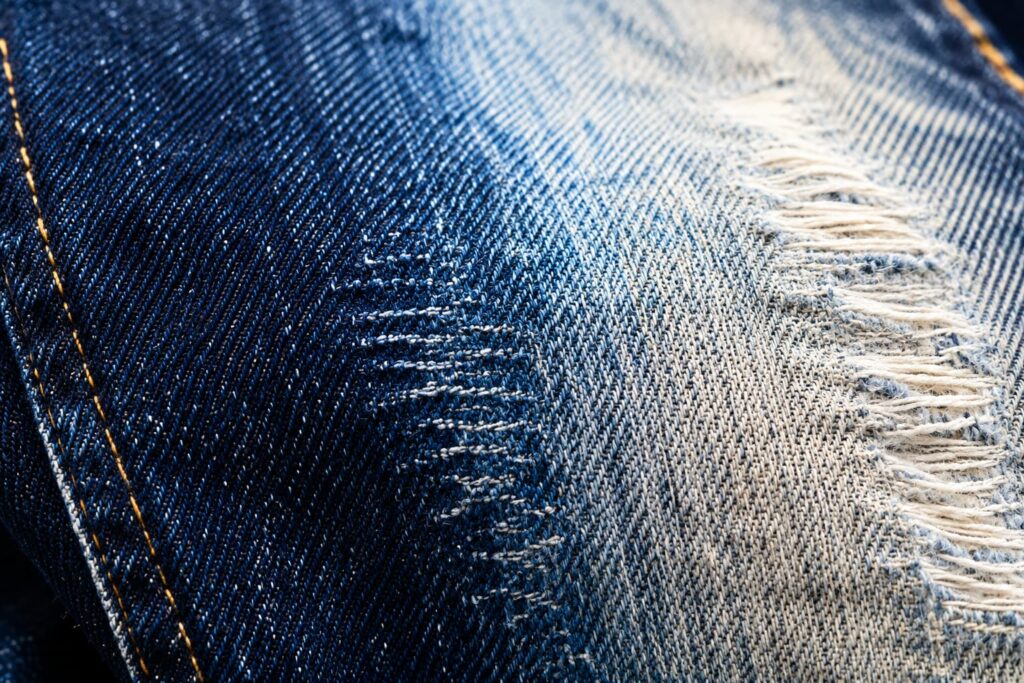
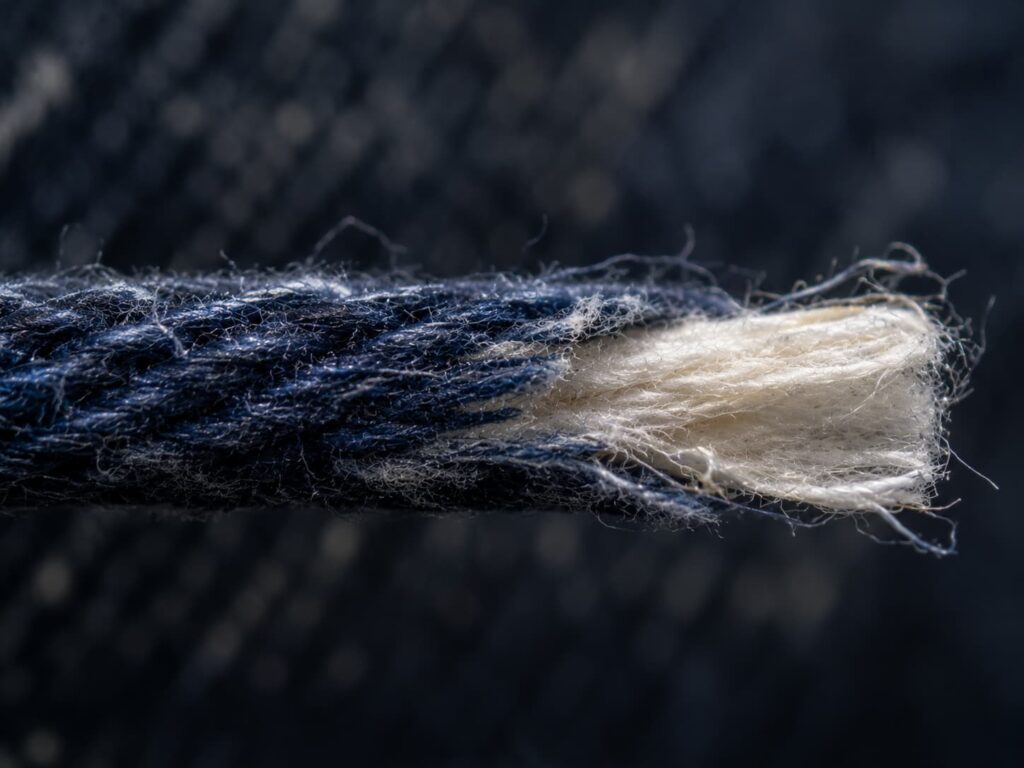
First, the color was never in the garment to begin with. Most denim is yarn-dyed with indigo before it’s ever woven, and indigo doesn’t penetrate the yarn evenly. It ring-dyes: only the outer ring of each yarn takes up color, while the inner core stays white, so denim’s faded look is created by abrading that dyed surface away during finishing, not by applying a flat color to the garment [CottonWorks]. The lived-in look you approved isn’t a layer of color sitting on the surface — it’s the pale core showing through where washing removed the dyed ring. This is the single most important thing to internalize: the color isn’t dyed in, it’s washed out. A process that works by removing material is inherently a process of degree, not of exact replication. Asking it to hit the same point twice is asking the wrong thing of it.
Second, the fabric itself arrives in lots, and lots differ. Cotton is a natural fiber, and indigo dyeing is hard to hold perfectly steady across a production run — denim mills work to keep the same dye lot together, and often sample each roll, wash it with the customer’s recipe, and shade-sort the rolls to reduce panel-to-panel variation after washing [CottonWorks; Denimsandjeans]. When your sample was made on one roll and your bulk runs across several, the starting color under the wash is already not identical. This is also the most overlooked source of drift, because it often shows up not as a color change you can see, but as a hand-feel you can only feel — a different roll can wash to the same shade and still finish stiffer or softer.
Third, scale changes the wash. A sample is typically washed in a small load; bulk runs in far larger loads in larger machines. The variables that govern a wash — machine size and load, liquor ratio, chemicals, time, temperature, and mechanical action — don’t scale up in a perfectly linear way [CottonWorks]. The same recipe, run at production volume, does not reproduce the sample’s conditions exactly. (This scale effect is well understood in production practice, even though it isn’t written down as a formal industry rule.)
Fourth, much of the finish is done by hand, and hands differ. Whiskers, hand-sanding, grinding, and PP spray are manual operations on most distressed denim, and manual grinding leads to variation from piece to piece because each operator’s pressure, angle, and timing are slightly their own [CottonWorks]. Hand work is what gives quality distressing its character — and it is, by definition, what makes two pieces non-identical. Some washes amplify this more than others: a simple rinse or enzyme wash moves very little, while heavy distressing with hand layering moves the most. In our production experience, darker shades like black sit at the harder end, because black tends to drift toward a red or green undertone — a documented characteristic of sulfur and indigo dye chemistry [Denimsandjeans] — which leaves a narrower control window than a stable indigo blue.
Put those four together and the picture is clear: a washed color is the product of timing, place, and human hands — fabric that arrives slightly different, a process that behaves slightly different at scale, finished by people who are not machines. It was never going to land on a single point. The point was never the goal. A controlled range is.
Where DTC Brands Misjudge It
Knowing why a wash drifts isn’t enough. The brands that get burned aren’t the ones whose wash moved — every wash moves. They’re the ones who set themselves up with no way to judge the movement when it arrived. At the DTC stage especially — past the first tiny drop, into seasonal runs of 5,000 to 20,000 units, but before a real product system is in place — three setup mistakes do the damage.
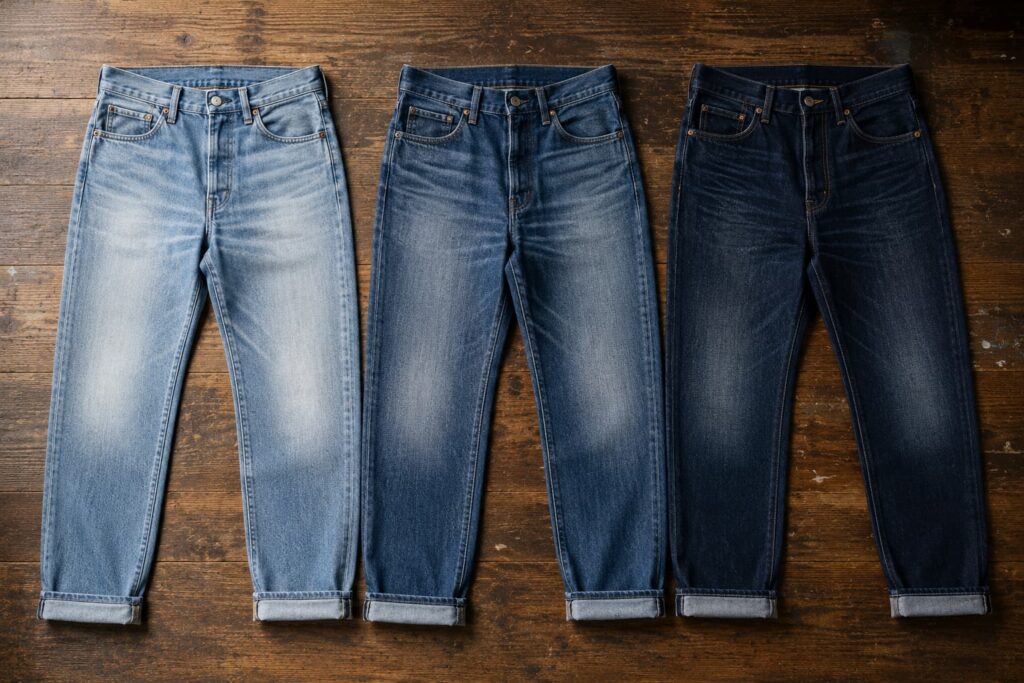
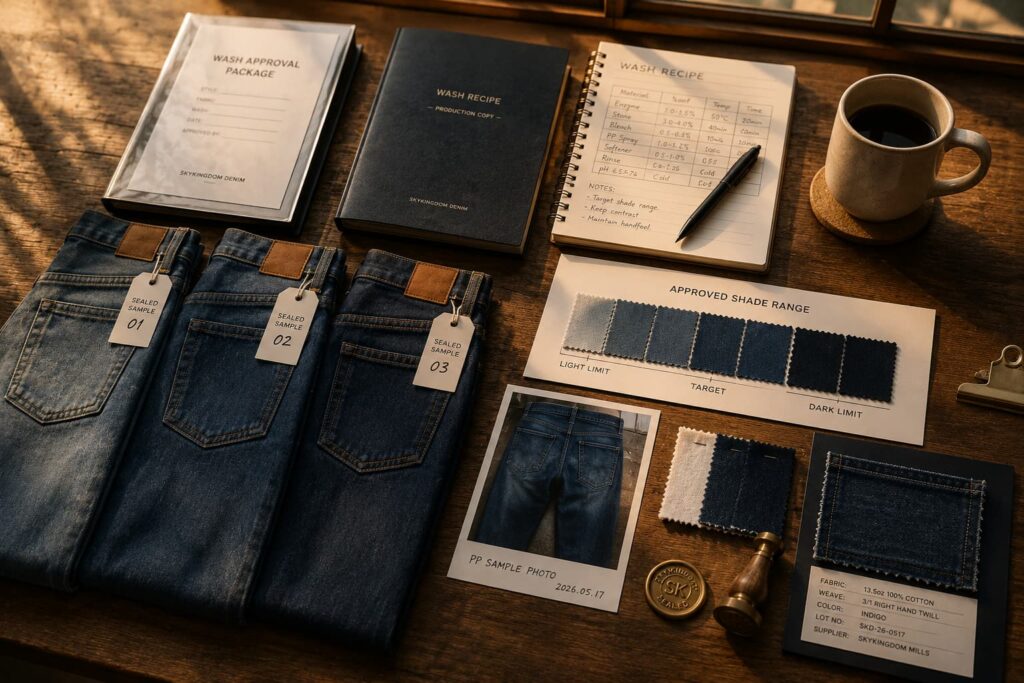
They approve a single sample. This is the most common and the most costly. A founder washes one beautiful sample, loves it, signs off on that exact piece, and treats it as the target. But one piece defines a point, and a wash-down process cannot be held to a point. With a single approved sample, there is no spread, no upper and lower bound, nothing to measure the bulk against — so the moment bulk looks even slightly different, which it will, the brand has no basis to say whether that’s acceptable. In our production practice we require two to three approved color samples for exactly this reason: two or three pieces define a range, and a range is the only thing a washed color can actually be held to. A single sample doesn’t give you a stricter standard. It gives you no standard at all.
They treat a color card as the standard. A Pantone chip or a printed swatch feels authoritative, so brands reach for one to “lock” the color. But a color card describes a dyed color — pigment laid down to hit a number. A washed denim color is pulled out of yarn through a physical process; it has texture, contrast, high and low points across a single leg. Holding a wash to a flat color chip compares two different things. The standard for a wash is better set by an actual washed garment — a real, sealed, dated sample piece — than by a card that was never washed.
They keep no sealed reference and no record. When bulk arrives and the question becomes “is this within range or not,” the brand that kept a sealed, dated approval sample and a written wash recipe can answer it in minutes. The brand that kept neither is left arguing from memory against a supplier’s memory — a dispute no one wins. The absence of a reference doesn’t just slow the decision; it removes the possibility of a clear decision at all.
Notice that all three mistakes share one root: they leave the brand without a defined acceptable range to judge against. Fix that one thing up front, and most sample-to-bulk panic disappears — not because the wash stops moving, but because you can finally tell whether its movement matters.
A Better Framework: Normal Variation vs Failure Signal
So here is the framework that replaces “did it match?”
A washed denim color was never meant to land on a single point — so the real question isn’t did it match, but did it stay inside the range you approved? Color difference in textiles is formally evaluated this way too: against an agreed acceptable range, graded on a standard scale or measured as an instrumental tolerance, not as a single exact value [AATCC EP1; ASTM D2244]. Everything you need to judge a bulk run flows from that one question, and it sorts every drift you’ll ever see into two piles.
Normal variation is movement that stays inside the spread defined by your approved samples. The overall shade sits between your lightest and darkest approved pieces. The hand-distressed elements vary slightly piece to piece. There’s texture and contrast across a leg. None of this is a defect — it’s the wash-down process behaving as it should. The standard for judging it is your sealed, dated sample range, evaluated on a real washed garment, in consistent lighting — not a color card, not a screen, not memory.
A failure signal is movement that leaves the range, or that points to a cause you didn’t sign up for. The shade falls outside your approved spread entirely. The hand-feel changes noticeably between pieces — often a sign of a fabric-lot or finishing-condition difference, not the base wash. The whole tone shifts in a direction the samples never showed, like a black reading visibly red or green. Variation within a single batch is wide enough to see at a glance across a table. These aren’t “the wash moved a little.” These are signals worth pausing on and asking about before you accept the lot or place a reorder.
The difference between the two piles is not how much the color moved. It’s whether it moved outside the range you approved — and whether the cause is the wash doing its normal work, or something upstream you need to flag. The table that follows turns that into something you can hold a bulk run against.
Is This Drift Normal? A Buyer’s Judgment Table
This is the table to hold a bulk run against. Find the kind of drift you’re seeing, check it against the likely cause, and use the last column to decide whether to accept it or pause and ask.
| What you’re seeing | Likely cause | Normal variation if… | Failure signal if… | What to do |
|---|---|---|---|---|
| Overall shade lighter or darker | Wash-down at scale; fabric lot | …it sits between your lightest and darkest approved samples | …it falls outside the spread of your approved samples | Compare against sealed range first; if outside, ask for re-wash to range or shade-sort the lot |
| Piece-to-piece differences in whiskers / sanding / distressing | Manual hand-finishing | …each piece still reads as the approved style; differences are subtle | …placement or intensity departs from the approved samples, or differs sharply piece to piece | Accept subtle variation; flag if the approved style itself drifted |
| Color looks right but hand-feel is different | Often fabric-lot or finishing-condition difference | …(rarely expected — investigate) | …pieces feel clearly stiffer/softer than the approved sample | Pause. Ask which fabric lot(s) ran, and whether finishing conditions changed |
| Whole tone shifted (e.g. black reading red or green) | Dye/undertone drift (harder on black, in our experience) | …(not expected — tone should track your approved samples) | …the tone moved in a direction your approved samples never showed | Pause. Treat as an upstream color issue, not a finishing one |
| Wide variation within one batch | Mixed fabric lots or uncontrolled wash | …differences are subtle and all within the approved spread | …the spread is visible at a glance across a table | Pause. Ask whether lots were mixed in one wash load |
Two things to read off this table. The drifts in the top two rows are usually the wash doing its normal work — accept them once they’re inside your approved range. The drifts in the bottom three rows point upstream, to fabric lots or dye, not to the finishing wash — those are worth a conversation before you sign off. Most brands waste their energy disputing the top two and wave through the bottom three. This table is built to flip that.
The Verdict Flow: Accept, Pause, or Reject
The table tells you what kind of drift you’re looking at. This is the order to act in, so a judgment call becomes a repeatable check rather than an argument.
- Compare against your sealed range, in consistent lighting. Lay the bulk piece beside your lightest and darkest approved samples under one fixed light source. This is always step one — before any email, any dispute.
- If it sits inside the range → accept. It’s normal variation. Document that it passed against the sealed samples and move on.
- If it sits outside, or hand-feel/tone is off → pause, don’t reject yet. Ask two questions before anything else: which fabric lot(s) did this run on, and did anything change in the wash or finishing conditions? Most “failures” resolve here into a known, fixable cause.
- Then resolve by cause, not by blame. Shade outside range → re-wash toward range or shade-sort the lot. Hand-feel or tone off → trace the fabric lot. Wide within-batch spread → check whether lots were mixed in one load.
- Reject only when it’s outside range and the cause can’t be brought back. Rejection is the last step, not the first reaction — and with a sealed range on file, it’s a decision you can defend.
The point of the order is that pause sits between accept and reject. Most sample-to-bulk disputes are really a missing pause — a brand jumping from “this looks different” straight to “reject,” with no range to check against and no lot question asked.
A Worked Example: The Same Recipe, Two Different Outcomes
To see how the flow works in practice, here’s the approval process we run, walked through with one outcome that passed and one that didn’t. (Illustrative of our standard practice; no client identified.)
The baseline we set before bulk, every time:
- A written wash recipe, with the process steps and chemicals recorded — not a wash “menu choice,” an actual documented recipe.
- Two to three approved color samples, sealed and dated, defining the acceptable range — not a single piece.
- A pilot wash head-sample run — a small first run of a few pieces before full bulk — to confirm the recipe holds before committing the lot.
- Pre- and post-wash measurements recorded, so shrinkage and shade are anchored to numbers, not impressions.
The outcome that passed. A DTC brand we supported approved a mid-blue enzyme wash across three sealed samples. The bulk came back a touch lighter than the middle sample — but still sitting between the lightest and darkest approved pieces. Under the flow, that’s step two, inside range: accept. The brand’s first instinct was to reject it for “not matching.” Because they had a defined range, not a single target, we could show it was normal variation against the sealed samples, and the lot shipped on time.
The outcome that didn’t. A heavier distressed wash came back with the right overall shade — but the hand-feel was clearly stiffer on part of the run. That’s the pause step: color right, hand-feel off. We didn’t reject; we asked the lot question first, traced it to a second fabric lot that had entered the run, and resolved it by sorting the affected pieces rather than accepting a mixed bulk. The wash recipe was never the issue — but without the baseline, it would likely have been blamed anyway.
The recipe was the same in both cases. What made one an accept and one a pause wasn’t the wash — it was having a defined range and a sealed reference to judge against.
A Pre-Sign-Off Checklist
Before you approve bulk — or place a reorder — run this. It’s the difference between judging a lot in minutes and arguing about it for weeks.
- Approve a range, not a point. Two to three sealed, dated wash samples, not one. This is the single highest-leverage thing on the list.
- Make the standard a washed garment, not a color card. Judge bulk against a real washed sample piece, not a Pantone chip or a screen.
- Get a pilot/head-sample run before full bulk. A small first run surfaces drift while it’s still cheap to fix.
- Keep a written wash recipe on file. So “run it the same way” means something specific next season.
- Record pre- and post-wash measurements. Shrinkage and shade anchored to numbers — this matters most for stretch denim, which typically shrinks more than rigid denim and so needs its movement confirmed on bulk fabric, not assumed from sample yardage [Textile Today].
- Evaluate in consistent lighting. Same light source every time; color read under a store light and a window will not agree.
- Hold drift against the table and the verdict flow, not against your memory of the sample. Sort what you see before you react.
If you can check all seven, sample-to-bulk drift stops being a panic and becomes a decision.
Can You Judge This Yourself, or Do You Need Deeper Support?
Not every brand needs help with this, and it’s worth being honest about where you sit. The judgment in this guide — approve a range, keep a sealed reference, hold drift against the table and the verdict flow — is something many founders can run themselves once they know to do it. The question is whether your setup gives you the inputs that judgment depends on.
You can likely handle this yourself if: your washes are simple (rinse, light enzyme), your volumes are modest, your factory already gives you two to three sealed samples and a written recipe, and you have a clear point of contact who can trace a fabric lot when you ask. In that case, this guide is mostly a matter of putting a process around what you’re already getting.
You may need deeper support if: your washes are heavy or hand-layered, you’re scaling across multiple fabric lots and reorders where consistency compounds, you’re getting a single sample and no recipe, or no one on the other side can answer “which lot did this run on?” Those are the conditions under which normal variation and real failure blur together — and where having someone own the range, the records, and the lot tracing on your behalf changes the outcome.
When a Direct Factory May Be Enough
If you have the inputs above — sealed sample ranges, written recipes, a responsive contact, simple washes at manageable volume — a direct factory relationship can carry you well. The framework in this guide is portable: you can require the two-to-three-sample range yourself, ask for a pilot run yourself, and keep your own sealed references. A capable wash house running a documented recipe will hold a range for you, and for many creator-led and early DTC brands that is genuinely enough. The goal isn’t to add a layer for its own sake — it’s to make sure the range, the records, and the judgment exist somewhere.
When an External Denim Product Team May Fit Better
The gap tends to open as you scale. When you’re running seasonal volumes across multiple fabric lots, reordering against last season’s color, and managing several washes at once, holding the range becomes a job in itself — defining the approved samples, documenting recipes, running pilot head-samples, tracing which lot a drift came from, and deciding accept-versus-pause on each lot. Some brands build that capability in-house; others bring in an external denim product team to own it, so that the range, recipe records, lot notes, and approval checkpoints are maintained across production and reorder cycles. This is the type of work SkyKingdom does for creator-led, DTC, and scaling brands that don’t have an in-house product team.
What to Prepare Next
Wherever you sit, the next step is the same: build the range and the records before your next bulk run, not after it drifts. Three things to put in place now:
- Define your approved range. Get two to three sealed, dated wash samples on your next development round — and if you’re still working from a single sample, fix that first.
- Document the recipe. A written wash recipe is what makes “the same as last time” mean something next season. For why that matters, see our guide on what wash recipe documentation is in denim production.
- Decide how you’ll hold consistency. If you want the full approval-to-bulk control flow, see our guide on how to keep denim wash color consistent from sample to bulk. This guide tells you how to judge drift; that one tells you how to control it.
Get those three in place, and the next time your bulk looks a little different from your sample, you won’t be guessing whether it’s a problem. You’ll know.
Frequently Asked Questions
- 1.Why doesn’t my bulk denim match the sample exactly?
- Because denim color is washed out of the yarn, not dyed onto the finished garment — and that wash-down process behaves slightly differently at production scale, across fabric lots, and in each operator’s hands. Two pieces from the same batch won’t be identical, and two batches will move further still. Exact visual matching isn’t a realistic production standard for washed denim. What matters is whether the bulk stays inside the range you approved, not whether it matches one sample piece on your desk.
- 2.Is some color variation between sample and bulk normal?
- Yes. Movement that stays inside the spread of your approved samples is normal variation, not a defect — it’s the wash-down process working as it should. The problem mainly arises when you approved a single sample instead of a range, because then you have nothing to measure “normal” against. With two to three approved samples defining a range, you can tell at a glance whether a bulk run is acceptable or genuinely off.
- 3.How do I tell normal variation from a real problem?Sort what you see, then act in order: compare against your sealed range, pause if it’s outside or if hand-feel or tone is off, and reject only if the cause can’t be brought back. Overall shade inside your range, and subtle piece-to-piece differences in hand-distressing, are normal. A shade outside your range, a clearly different hand-feel, a tone your samples never showed, or wide variation within one batch are signals worth pausing on. The difference isn’t how much the color moved — it’s whether it left your approved range.
- 4.Should I approve one wash sample or several?Several — two to three sealed, dated samples, not one. In our production practice this is a requirement, because a single sample defines a point, and a washed color can’t be held to a point; it can only be held to a range. Two or three pieces define the acceptable spread your bulk is judged against. Approving a single sample doesn’t give you a stricter standard — it leaves you with no standard at all, and makes normal variation look like failure.
- 5.Can I use a Pantone or color card as my wash standard?It’s not the right reference on its own. A color card describes a dyed color — pigment laid to hit a number — while a washed denim color is pulled out of the yarn through a physical process, with texture and contrast a flat chip can’t represent. It’s better to hold a wash to an actual washed garment: a real, sealed, dated sample piece. Judging bulk against a color card alone compares two different things and can mislead you.
- 6.Why does the color look right but the fabric feels different?That often points to a fabric-lot or finishing-condition difference rather than the base wash. A different roll of fabric can wash down to the same shade and still finish stiffer or softer, because the base fabric isn’t identical lot to lot; softeners, resins, and dry-process conditions can shift hand-feel too. It’s one of the most overlooked forms of drift because you feel it rather than see it. If hand-feel changes noticeably across a run, pause and ask which fabric lot or lots the bulk ran on, and whether finishing conditions changed.
Sources
- Cotton Incorporated / CottonWorks™ — Denim Construction & Denim Finishing. Supports indigo ring-dyeing of the yarn surface, wash-down removing that surface color, the wash variables (machine, load, liquor ratio, time, temperature) that affect results, manual finishing variation, and mill shade-sorting of rolls. cottonworks.com/learning-hub/denim/denim-finishing
- AATCC EP1 — Gray Scale for Color Change. Supports that color change is evaluated as a graded range against a standard, not an exact point match. members.aatcc.org/store/ep1
- ASTM D2244 — Calculation of Color Tolerances and Color Differences. Supports that instrumental color tolerance is a buyer-seller agreed acceptable range, not a single exact value. astm.org/d2244-25.html
- Denimsandjeans / Harry Mercer — Shade Control in Indigo Dyeing; Problems in Denim Color: Sulfur Black. Supports indigo dye-lot shade variation as a recognized cause, and the red/green undertone-drift mechanism in black denim. denimsandjeans.com/denim/manufacturing-process/shade-control-in-indigo-dyeing-part-1
- Textile Today — Making Shrinkage Percentage Consistent in Denim. Supports that stretch denim shrinks more than rigid denim and that shrinkage is confirmed on production fabric. textiletoday.com.bd/making-shrinkage-percentage-consistent-denim-garments-manufacturing-washing-processes
- HunterLab — Defining Color Tolerances. Supports that a small instrumental color difference is an accepted, often imperceptible variation — color judged as a tolerance range. hunterlab.com — defining color tolerances
- PowerReviews — Apparel Merchandise Returns. Buyer-side risk framing that appearance not matching expectation is among reasons shoppers return apparel (soft framing only; not a wash-specific statistic). powerreviews.com/research/apparel-shopping-trends-2023/merchandise-returns