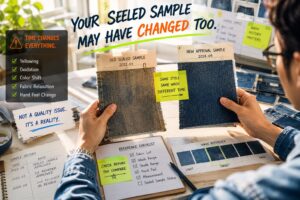


A washed sample sets the standard — but bulk holds a range, not a single shade.
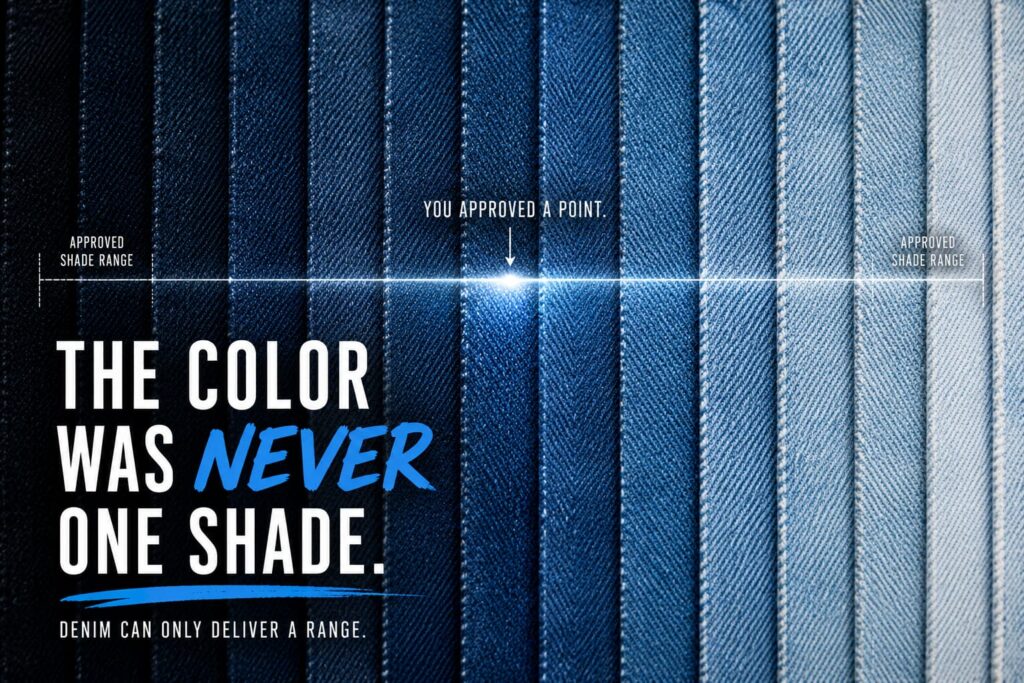
A growing DTC denim brand holds wash color from sample to bulk by approving a real washed sample as the standard — then defining an acceptable color range around it, not chasing an identical match on every piece. In denim, color isn’t dyed in; it’s washed out, so some variation is built into the process: the goal is a controlled range, not perfect uniformity. The practical method is to approve a washed garment sample, then have the maker run a small pilot wash before bulk and select two to three reference shades that bracket the range bulk production must stay within. A single reference shade can’t be held in denim washing — only a range can.
“The sample looked perfect — so why does my bulk run look off?”
Picture a creator-led brand placing its first real denim order: 800 units of a black wash skinny, built off a sample the founder loved and approved. The sample looked exactly right — deep, clean, expensive. Then the bulk arrives, and something feels off. Some pieces read slightly red under store lighting. A few look almost faded next to the approved sample. Nothing is wrong, exactly, but it no longer feels like the one piece the founder signed off on.
This is the most common color surprise a first-time denim brand hits, and black is where it bites hardest. Black is the hardest wash color to hold, because black isn’t really one color — depending on the dye and the wash, it can lean red or lean purple, and that undertone is extremely difficult to control across a production run. A founder who approved a single black sample and assumed bulk would clone it has, without realizing it, approved a point when denim can only deliver a range.
The deeper issue isn’t the factory cutting corners. It’s that the sample and the bulk were never made the same way — and no one told the founder that upfront. A sample is washed in tiny quantities under close watch; bulk is washed in large loads under production conditions. Expecting them to match perfectly, piece for piece, is expecting something the process was never built to do.
Why a sample that looks perfect can’t promise a matching bulk run

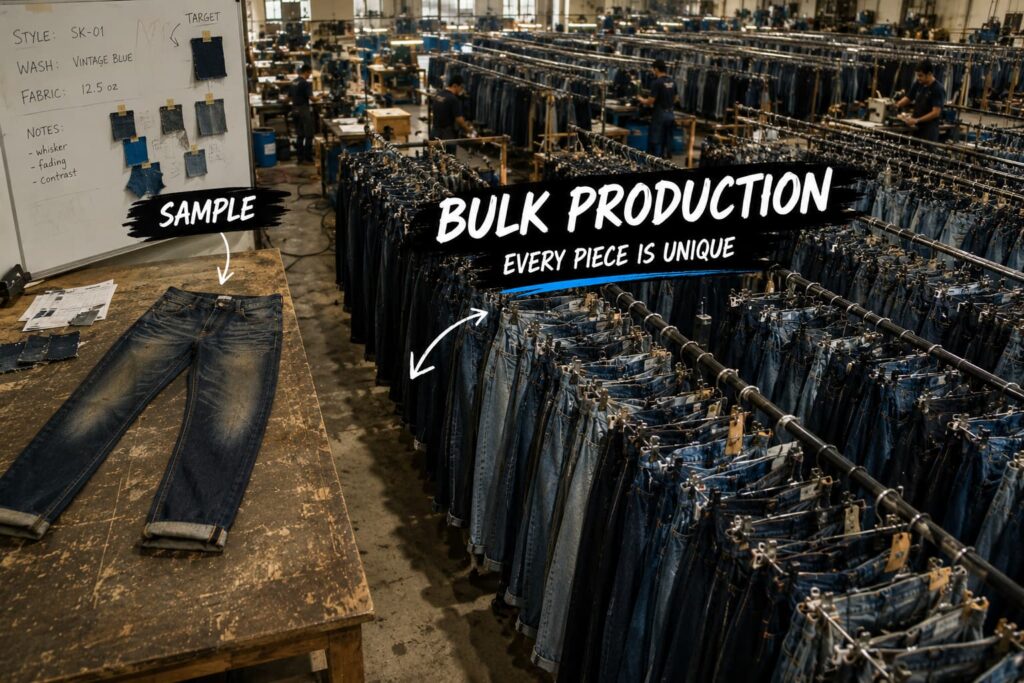
The single most useful thing a first-time denim brand can understand is this: a wash sample and a bulk run are not the same process at a different size. They are two genuinely different physical events, and treating the first as a promise of the second is where most color disappointment begins.
Start with how a sample is actually made. A wash sample is processed in very small quantities — often a single garment, or just a handful — in a small machine, watched closely by one experienced technician who can adjust as it goes. The conditions are tight, controlled, and forgiving. That’s exactly why the result looks so good: it’s the wash under near-ideal supervision. Bulk is a different world. Bulk is washed in large loads — well over a hundred pieces in a single drum is normal — in standard production machines, where controlling chemical dosing, temperature, and timing consistently across the whole load is a far harder technical task. The same recipe, run at a hundred times the scale, simply does not behave identically.
On top of scale, there’s chemistry. Every wash load is effectively its own small chemical event. Even with an identical recipe, small shifts in temperature, chemical concentration, water, and mechanical action change the final result — which is why the same wash run on different days or different machines can land in slightly different places. And denim has an extra twist most fabrics don’t: the color is created by the wash. It isn’t a dyed cloth that you’re trying to keep stable; it’s a finish that’s actively produced during processing — and even after the main wash, enzyme, softening, and finishing steps can shift the shade further. There are more moving parts, and more of them act on the color, than in a conventional piece-dyed garment.
This is why the honest unit of control in denim is a range, not a number. A sample tells you the target. It cannot tell you that every piece in a 100-piece drum will land on exactly that target, because the process that produces the color is variable by nature. A flat, perfectly even wash is the easy one to repeat. The washes worth buying are the ones that breathe — and those live inside a tolerance, not on a single point.
Why some washes are harder to hold than others
Not all washes carry the same color risk. Before you worry about consistency, it helps to know where your specific wash sits on the difficulty scale — because a simple rinse and a heavily hand-finished black sit at opposite ends, and they need very different expectations.
At the easier end are basic washes — a standard rinse or a light enzyme wash. These are largely machine-driven and forgiving, so they hold a tighter range more naturally. As you move up, processes that lean on chemistry under tight conditions — high-manganese bleaching, blasted or “snow” effects — get harder, because small shifts in time and temperature move the result. The hardest sit at the top: heavily blasted dark washes and anything built from layered hand-finishing — hand-sanding, whiskering, abrasion, tinting and overdye. As a rough rule, the more hand-work and the more steps stacked on top of each other, the wider the natural spread between pieces. And black, again, is the most demanding of all — a heavily processed black wash combines the hardest color to control with the most hands touching it.
The reason comes down to a simple truth about denim: these effects are produced by hand, by people. Every technician’s judgment, skill, and experience is slightly different, so the output is slightly different — and even with a documented recipe, ambient temperature, humidity, the room, and the raw material itself all move the result. This is the part most brand owners never hear, and it’s worth stating plainly:
A pair of jeans is a product of timing, place, and human hands coming together.
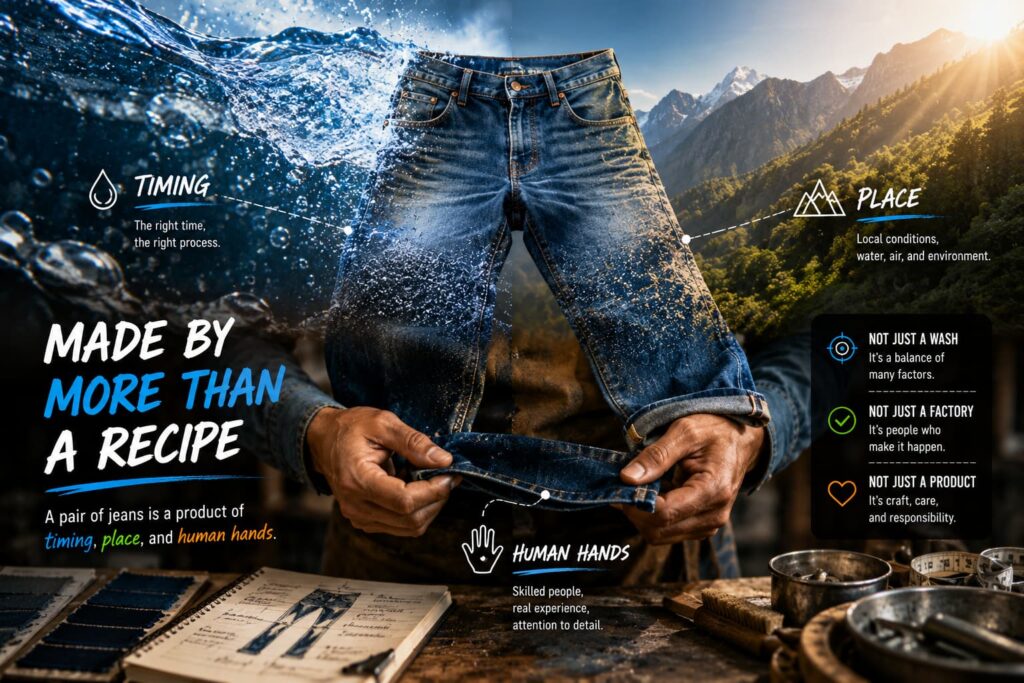
A Great Wash Happens When Timing, Place, and Human Hands Align(牛仔裤,是天时、地利、人和的产物。这不是工艺的瑕疵,这就是工艺本身)
That isn’t a flaw in the process; it is the process. The character that makes a hand-finished wash worth buying is the same character that makes it impossible to clone piece for piece.
So holding a hard wash isn’t about eliminating that variation — it’s about managing it deliberately. In practice that means breaking the wash into defined, quantified steps rather than treating it as one artistic act, and matching the right technician to the right step, since each has their own strengths. It also means leaning harder on the pilot wash: if the first trial already shows a wide spread, that’s the moment to go back to the brand and agree the acceptable range before bulk — not after. From there, pieces are selected against that agreed range, and ones that drift are corrected in the obvious direction: if a piece comes out too light, color is added back; if it comes out too dark, it’s washed down. The harder the wash, the more this disciplined range-management — not a promise of uniformity — is what protects the result.
The color misreads we see most often from first-time brands
Most color disappointment doesn’t come from a bad maker. It comes from a few specific, very understandable assumptions a founder brings to their first order — each of which quietly sets up the gap between what they approved and what arrives.
“The Pantone matched, so the color is locked.” A Pantone reference is useful, but in denim it sets direction and an approximate range at the development stage — it is not a guarantee of the finished, washed color. The real color is decided by the wash, on the actual fabric, not by the chip. A brand that approves a Pantone and assumes bulk is now settled has confirmed a starting point, not a result.
“The sample is the color, so bulk will be the color.” This treats a single approved piece as a clonable master. But a single sample is one point, and washing produces a spread around any point. Approving one shade and expecting every bulk piece to match it exactly is asking the process for something it can’t physically deliver — which is why a brand needs to approve a range, not a lone sample.
“Tighter tolerance means safer.” This one feels responsible and backfires. Some brands, trying to help the maker “get it right,” squeeze the acceptable color range as narrow as possible to reduce the chance of error. In reality, an over-tight tolerance is an idealized state, not a realistic one — and chasing it drives cost up, not risk down, through re-washing, fabric sorting, and higher reject rates. A sensible range protects the look and the budget; an unrealistically tight one protects neither.
“Black is just black.” Black is the hardest wash color to hold. It can lean red or lean purple depending on dye and wash, and that undertone is genuinely difficult to keep stable across a run. A founder treating black as the “safe, simple” choice is often picking the single most demanding color to reproduce.
Each of these is fixable — but only before bulk, by agreeing on what’s actually being approved and how wide the accepted range is.
The method: approve a real washed standard, then bracket the range
If perfect uniformity isn’t the goal, the practical question becomes: what do you approve, and how do you hold it? The method that actually works treats color as a standard plus a range, locked through real washed material at each step — never a chip or a single sample carrying the whole decision.
It runs in a clear sequence. First, select the fabric and lock the base color. Before any garment is made, fabric is chosen and washed — typically cut into leg panels and washed to show the color at different depths. Two to three washed fabric shades are put in front of the brand, so the founder can see and physically handle the real color, texture, and hand — not approve from a screen or a chip. Second, make and wash the garment sample. Only once the fabric direction is confirmed does sample-making begin. After the sample is washed, the leg panel and the washed sample are reviewed together — because the finished garment can land slightly off the panel, especially on hard colors like black. Third, run a pilot wash before bulk. A small first wash batch is produced ahead of full bulk, sized to the order. Fourth, and most important, bracket the range. The brand selects two to three shades from the pilot that mark the acceptable spread, and bulk is held inside that bracket.
That fourth step is the one most brands have never been walked through, so it’s worth stating plainly why two or three — never one.
| What the brand approves | What it actually controls | Result in bulk |
|---|---|---|
| A Pantone chip only | Direction at development stage | Color decided later by the wash; high surprise risk |
| One washed sample | A single target point | Process can’t hold a point; pieces spread around it |
| Two to three pilot shades (a range) | An accepted band with a top and bottom | Bulk judged against a real, agreed spread — holdable |
The logic is simple once you see it: washing always produces some spread, so a single approved shade gives the maker no defined edges to hold to. Two or three shades draw the top and bottom of an acceptable band — and that a production run can actually be measured against and kept inside. In denim, color isn’t dyed in — it’s washed out. So perfect uniformity was never the goal; a controlled range is.
The same color decision changes by brand stage
“Approve a range, not a point” holds at every stage — but how much process a brand should put behind it changes as the brand grows. A creator-led founder and a scaling brand are solving different versions of the same problem, and matching the effort to the stage is what keeps color control from being either too loose or needlessly expensive.
| Creator-led (first 500–2,000 units) | DTC startup (5,000–20,000/season) | Scaling brand (20,000+/season) | |
|---|---|---|---|
| Core color worry | “Will bulk look like the sample I loved?” | “Will it hold across SKUs and re-runs?” | “Will order #4 still match order #1?” |
| What to approve | Washed sample + 2–3 pilot shades as the range | Range plus a written, retained standard | Range + retained standard + measured tolerance on record |
| Where the risk lives | Approving a single sample as a clone | No documented standard to repeat against | Drift across dye lots, seasons, and second sources |
| Right level of effort | Get the range right once, in person | Start documenting so the range is repeatable | Govern the range so it survives scale and time |
For a creator-led brand, the job is mostly getting the first approval right: see the real washed shades, handle the fabric, and approve a range instead of a lone sample. At this size, the standard can live in a clearly approved physical set — the discipline is simply not collapsing it to one piece.
For a DTC startup ordering across SKUs and starting to re-run styles, the range has to become repeatable. That means the approved standard gets written down and a reference is retained, so the second run has something concrete to be judged against rather than a memory of the first. This is exactly where wash recipe documentation starts to matter — the approved color range becomes part of a written standard, not a one-time conversation. (See our companion piece on what wash recipe documentation actually is.)
For a scaling brand, the same range now has to survive dye-lot changes, seasons, and possibly a second supply source. The control doesn’t change in principle — it just has to be governed: a retained standard, a recorded tolerance, and consistent judgment against both, every run.
What to lock before bulk: a first-order checklist
Color control is mostly won or lost before bulk ever starts. By the time a run is on the machines, the standard and the accepted range should already be settled in real washed material. Here’s what a first-time brand should have locked — and confirmed in writing — before approving bulk.
- Approve washed fabric first, in hand. See and physically handle two to three washed fabric shades before any garment is made. Approve the base color from real material, not a screen or a Pantone chip.
- Review the washed sample against the fabric. Once the garment sample is washed, check it alongside the approved fabric panel — confirm the finished wash, not just the intended one. Expect some shift here, especially on dark colors.
- Require a pilot wash before full bulk. Ask for a small first wash batch ahead of the main run, so the bulk wash is verified on production conditions, not assumed from the sample.
- Approve a range of two to three shades, never one. Select the shades that mark the top and bottom of what’s acceptable. This is the standard bulk will be judged against — a single shade gives no edges to hold to.
- Set a realistic tolerance, not the tightest possible. Agree a band that protects the look without forcing re-washes and sorting. An over-tight range raises cost without making the result more achievable.
- Treat black (and other deep shades) as the hard case. Build in a slightly wider, explicitly agreed range for colors prone to undertone shift, rather than assuming dark colors are the safe default.
- Get the approved standard documented and retained. Make sure the approved range is written down and a physical reference is kept — this is what a re-order or second run will be measured against.
If those seven are settled before bulk, the run has a real standard to hold to — and “does this match what I approved?” becomes a question with an answer, not an argument.
When working directly with a factory may be enough
Not every brand needs a layer of product oversight to get color right. For some, a direct relationship with a capable wash house is the sensible, cost-efficient choice — and it’s worth being honest about when that’s true, because paying for help you don’t need is its own kind of waste.
A direct factory relationship tends to be enough when a few things line up. If you’re reordering a wash you’ve already produced and approved — the fabric, recipe, and range are settled, and you simply need the same thing again — much of the hard judgment is already done. The standard exists; the run is about holding it. Similarly, if your wash is simple and forgiving — a clean rinse, a light shade, nothing that leans on subtle undertone or heavy hand-finishing — there’s less that can drift, and less that needs interpreting between you and the machine.
It also works when you already have the internal expertise. A founder or team member who has run denim production before, who knows to approve a range rather than a point, who can read a pilot wash and set a sensible tolerance, can often deal with a factory directly and well. The skill that makes oversight valuable is the skill of translating “the look I want” into “the standard and range a production floor can hold” — and if you already have that skill in-house, you may not need to buy it.
And for some brands it’s simply a question of stakes and stage. A very small first run of a straightforward style, where the brand can absorb some variation and treat the first order partly as learning, doesn’t always justify a heavily managed process. Getting started and seeing real product in market has its own value.
The honest test is this: do you have someone who can turn a vision into a defined, holdable color standard — and is your wash simple enough that little will be lost in translation? If yes, a direct factory relationship may serve you well. The case for an external product team gets stronger as the answer shifts toward “no” — which is what the next section is about.
When an external denim product team may fit better
The flip side of that test is straightforward: the case for an external denim product team gets stronger exactly where the direct-factory case gets weaker. If you don’t yet have someone who can turn a vision into a holdable color standard, or your wash is complex enough that a lot can be lost between intent and production, an added layer of product judgment usually earns its place.
A few situations make this clear. The first is a complex or signature wash. If your look depends on undertone, on a multi-depth wash, on hand-finishing, or on a hard color like black, the gap between “the sample I love” and “a bulk run that holds” is wide — and crossing it reliably takes someone whose job is to set the range, run the pilot, and judge bulk against a real standard, not just book the machine time.
The second is no internal product function. Most creator-led and early DTC brands don’t have a denim person on staff — and shouldn’t need to hire one to launch. An external product team is, in effect, that expertise rented for the runs that need it: the people who know to approve two to three shades instead of one, who set a realistic tolerance instead of an over-tight one, and who know that black needs a wider, explicit band.
The third is anything you intend to repeat. The moment a style is meant to come back — a second drop, a hero product, a re-order next season — the value isn’t only in getting this run right, but in capturing the approved range as a documented standard so the next run has something concrete to hold to. That continuity work is precisely what tends to fall through the cracks in a direct, run-by-run factory relationship, and precisely what a product team is set up to hold.
And the fourth is when the cost of getting color wrong is high relative to the order. A brand whose reputation rides on a signature wash, or whose margins can’t absorb a mismatched bulk run, is usually better served paying for the judgment up front than paying for re-washes, sorting, and disappointed customers after. The right question isn’t “factory or product team?” in the abstract — it’s “how much does it cost me if this color lands outside the range I imagined?”
What to prepare next
Whichever route you take — a direct factory relationship or an external product team — the preparation is largely the same, and doing it before you start saves the most expensive surprises. Having these ready makes any color conversation faster and more honest.
- A clear color reference, and the right expectations for it. Bring whatever you have — a Pantone, an image, an existing garment — but treat it as direction, not a finished guarantee. Know that the real color will be set by the wash on your actual fabric.
- Your fabric direction, or willingness to approve it from washed material. Be ready to choose base color from real washed fabric in hand, rather than locking it from a screen. Two to three washed options is the normal starting point.
- A realistic view of your wash’s difficulty. Be honest about whether your look is simple and forgiving or complex and undertone-dependent. If black or a signature multi-depth wash is involved, plan for a wider, explicitly agreed range from the start.
- A decision on who holds the standard. Decide whether you have someone internally who can approve a range, read a pilot wash, and set tolerance — or whether that judgment needs to come from a product partner. Either is fine; what matters is that someone owns it.
- A plan to document and retain the approved range. Even on a first run, decide how the approved standard will be recorded and kept, so a re-order isn’t starting from memory. This is the single cheapest thing you can do now to protect every future run.
None of this requires a big budget or a denim background. It requires deciding, before bulk, what you’re approving and how wide the accepted range is — and making sure the standard is written down and held by someone, whether that’s you, your factory, or a product team working alongside you.
Where this fits
Approving a real washed standard, running a pilot before bulk, and bracketing an acceptable range — then keeping that standard documented for the next run — is the kind of work an external denim product team does alongside creator-led and DTC brands that don’t have a denim function in-house. SkyKingdom works this way with creator-led and DTC brands: selecting washed fabric in hand, approving a range rather than a single shade, and holding bulk against a real, retained standard. If you’re preparing a first denim run — especially a complex or dark wash — and want the color decision held to a standard you can actually repeat, see how we support brands at your stage.
Frequently asked questions
Will every piece in my bulk order be exactly the same color?
No — and in denim, that’s expected, not a defect. Color is created by the wash, so every run produces some natural spread around the target. The goal isn’t identical pieces; it’s keeping the whole run inside an approved, acceptable range. That’s why you approve a range of shades before bulk rather than a single sample, so production has a defined band to hold to.
Isn’t a Pantone color enough to lock my denim color?
A Pantone sets direction and an approximate range at the development stage, but it doesn’t decide your finished color. In denim, the real color is produced by the wash on your actual fabric — not by the chip. Treat a Pantone as a useful starting reference, then approve the final standard from real washed material, because that’s what bulk will actually be judged against.
Why do I need to approve two or three shades instead of one?
Because washing always produces some spread, a single approved shade gives production no defined edges to hold to. Two or three shades mark the top and bottom of an acceptable band, and a bulk run can be measured against that band and kept inside it. A lone sample is a single point, and the process physically can’t hold a point — only a range.
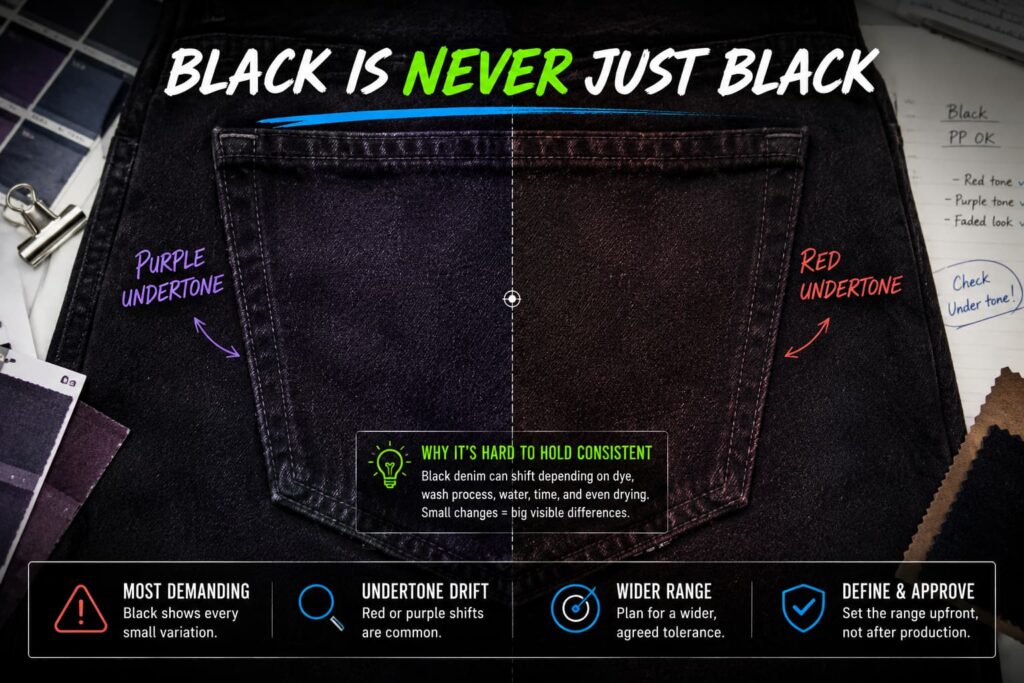
Why is black denim so hard to get consistent?
Black is the most demanding wash color to hold because it isn’t really one color. Depending on the dye and wash, black can lean red or lean purple, and that undertone is difficult to keep stable across a production run. If you’re producing a black wash, plan for a slightly wider, explicitly agreed range from the start rather than assuming black is the safe, simple choice.
Should I make my color tolerance as tight as possible to be safe?
No — an over-tight tolerance tends to backfire. Squeezing the range as narrow as possible is an idealized state, not a realistic one, and chasing it drives cost up through re-washing, fabric sorting, and higher reject rates. A sensible range protects both the look and your budget; an unrealistically tight one protects neither. Aim for realistic, agreed limits instead.
How do I make sure my reorder matches my first run?
Have the approved color range documented and a physical reference retained from the first run, so the reorder is judged against a concrete standard rather than a memory. A new run produced against a written, retained standard has something real to hold to. Without a documented range, each reorder effectively starts over — which is the most common reason a fourth order drifts from the first.
Sources
The following external sources support the technical claims in this article. SkyKingdom’s process details (fabric selection in leg panels, two-to-three-shade approval, pilot wash before bulk) are drawn from verified internal production practice.
- Apparel Wiki — Why does bulk production color not match the color card? Supports the core mechanism that a color card represents an idealized shade derived from lab dips or small batches, and that scaling to bulk introduces shade shifts through machine size, chemical concentration, water, and temperature; also that every dye bath is its own chemical event and finishing steps can shift shade further. apparel.wiki/blog/why-does-bulk-production-color-not-match-the-color-card
- AATCC — Test Methods (colorfastness and dimensional stability). Lists the standardized methods (incl. TM61 colorfastness to laundering, TM8 crocking) that make wash color and fastness measurable against a defined standard rather than opinion. aatcc.org/testing-archive
- X-Rite — Defining a Realistic Pass/Fail Tolerance. Supports that a color tolerance must reflect the production process’s real capability, and that setting it too tight makes consistent, accurate color harder and more wasteful to achieve — the basis for “an over-tight tolerance backfires.” xrite.com/blog/tips-to-define-tolerances
- X-Rite — Color Tolerancing & Delta E. Supports that color difference can be quantified objectively via Delta E, and that less-saturated shades show differences more visibly — relevant to why some colors need wider agreed bands. xrite.com/blog/mastering-color-consistency-with-quality-control-software
- ISO 105-C06:2010 — Colour fastness to domestic and commercial laundering. Supports the use of an internationally standardized method for assessing how color holds through washing, underpinning agreed tolerance and pass/fail in production. (Last reviewed and confirmed current, 2026.) iso.org/standard/51276.html