
The situation a first-time brand keeps running into
You have one style, a small budget, and no production history. You send the design to several producers. Some decline a small order outright; others quote a price that feels punishing; one quotes low and friendly and says “no problem, don’t worry, definitely on time.” That last one is often the most dangerous. Without a way to verify capability and a contract that bites, a first-time brand can lose the deposit, miss the sales window, and end up with bulk that looks nothing like the sample — the three fears that actually keep new founders up at night.
This is a creator-led-specific problem. A DTC brand with order history has leverage and references; a scaling brand has audited, second-sourced supply. The first-time brand is verifying a relationship from zero, on the order where a mistake hurts most. So the goal is not to find a producer who will say yes cheaply — it is to build verification into every step.
Why small batches legitimately cost more
Before treating a high small-batch quote as a scam, understand what is real about it:
The small-batch premium is mostly fixed-cost amortization, not a producer padding margin. Pattern making, machine setup, sampling and quality oversight cost roughly the same on 30 pieces as on 300, so the per-piece share of those fixed costs is many times higher on a small run — while fabric and sewing cost per piece barely change.
Pattern making and machine setup are one-time costs incurred regardless of quantity; a small order also frequently sits below fabric mill and laundry minimums, so you pay minimums that a larger run would absorb. None of that is a trap — it is the honest economics of small production. Recognising it lets you tell the difference between a fair premium and a quote that is suspiciously low because something has been cut.
The four traps inside a small-batch quote
| Trap | How it shows up | What it really is |
|---|---|---|
| The low-price trap | A quote well below others, offered eagerly | Cost gets recovered later — stock fabric in the wrong weight/colour, skipped reinforcement or inspection, or quiet subcontracting to an uncontrolled workshop |
| The payment trap | Pressure to wire 100% upfront with no structure | Removes your only leverage if quality or delivery slips |
| The sample trap (quality fade) | A beautiful sample, then bulk that “is within normal range” | Standards decline between sample and bulk; without a written tolerance there is no agreed line to enforce |
| The verbal-promise trap | “No problem, don’t worry, on time” — never written down | Chat messages carry limited weight; without a contract there is no enforceable recourse |
Quality fade deserves special attention because it is the most common and the hardest to argue after the fact. It is the gradual decline in standards between a carefully made sample and bulk production, frequently paired with fabric substitution — premium material swapped for cheaper stock to save cost (Athleisure Basics, 2026). The defence is documentary: keep signed control samples from prototyping to hold the producer accountable at delivery, and make tolerances explicit so “within normal range” is replaced by a number both sides agreed to.
The fix: staged verification
The single most protective move for a first order is to refuse to treat it as one all-or-nothing transaction. Break it into stages, where each stage verifies the next:
| Stage | What it verifies | What you lock |
|---|---|---|
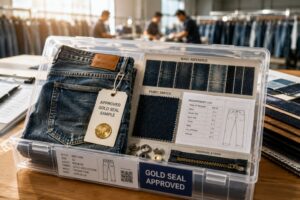
| 1 — Sampling | Technical capability and willingness to disclose limits honestly | A signed, dated golden sample that will govern bulk; tolerances in the tech pack |
| 2 — Trial run (small) | Whether bulk-process output matches the sample at small scale | Control samples; first read on quality fade before you commit fuller volume |
| 3 — Fuller production | Delivery reliability and consistency at quantity | Pre-shipment inspection against the golden sample before final payment |
Independent guidance is consistent: treat each production stage as a checkpoint, and verify bulk against your golden sample with a pre-shipment inspection before the final balance is paid and goods leave the premises (Athleisure Basics, 2026). Industry practice even suggests starting with a small trial run — on the order of a few hundred units — to test the producer’s systems at low risk before scaling (Shanghai Garment). Sampling is not a cost to cut; every error caught at the sample stage avoids exponential cost and timeline overruns later (Ninghow Apparel, 2026), and it is fair to ask that the sample fee be credited against a confirmed bulk order.
A first order is a verification sequence, not a purchase. Sample to prove capability, trial-run to expose quality fade early, then scale — and never release the final payment until bulk has been checked against the sample you signed.
How to verify a production partner — on evidence, not claims
The reliable signals are things you can independently check, not self-reported credentials:
- Capacity and process evidence: ask to see real production capability and quality-control process — in-line checks, AQL tables, defect logs — rather than accept a headline claim about lines or volume.
- References at your order size: a partner who has served brands at a similar small-batch scale is a better fit than a large export operation that treats your order as a nuisance.
- Third-party QC access: a credible partner will agree in writing to an independent inspection. Third-party QC — independent of both buyer and producer, following AQL sampling under ISO 2859-1 with defects classed critical, major or minor — is the most effective way to verify quality before you commit to shipment (Tetra Inspection; QIMA).
- Honest disclosure: a partner who tells you what cannot be done at scale (“we can’t hold this collar detail at volume”) is signalling transparency; one who promises everything is signalling a sales motive (Ninghow Apparel, 2026).
- Sample discipline: careful sample packaging and logged adjustments hint at overall production discipline; careless handling hints at the opposite.
Note what is not on this list: a self-published list of honours or endorsements proves little, because anyone can assert one. What protects you is evidence you can verify and an inspection right you can exercise.
Turn verification into an enforceable contract
A contract is the final verification stress test — serious partners pause to negotiate terms they can meet, while bad actors disappear when faced with specific, enforceable penalties (LeelineWear, 2026). Convert your verification into hard clauses rather than a generic template:
| Clause | What to write |
|---|---|
| Product specs | Fabric composition, weight and colour; full size chart with measurement tolerances (±) — a tech pack is only legally binding if it states tolerances |
| Quality standard | An AQL level (e.g. AQL 2.5 for critical defects) with a clause that the supplier reworks 100% of the lot at their own expense if defects exceed it |
| Sample control | A signed, dated top/golden sample that legally governs bulk and overrides any prior digital spec or verbal discussion |
| No subcontracting | A clause that unapproved subcontracting voids the deposit and triggers an immediate refund |
| Delivery terms | Specific delivery dates with a defined remedy for delay |
| Inspection right | Written permission for third-party QC inspection using your stated standard |
Each line above is a verification result made enforceable. The AQL clause turns “good quality” into a measurable threshold; the golden-sample clause turns “looks like the sample” into a legal reference; the inspection right turns trust into something you can check before paying.
How this changes by brand stage
This article is written for the first-time, creator-led brand. The same sourcing-risk question is managed differently as a brand matures — the contrast confirms which column you are in.
| Question | Creator-led (first order) — you | DTC startup (5,000–20,000/season) | Scaling brand (20,000+/season) |
|---|---|---|---|
| Main risk | Verifying a partner from zero on the order that hurts most | Holding quality consistent across a SKU matrix | Supply resilience and second-source equivalence at volume |
| Primary tool | Staged verification + a contract with hard clauses | Documented standards and recurring inspection | Audited supply, governed QC, second sourcing |
| Leverage | Long-term intent + an enforceable first contract | Repeat-order volume | Scale and multi-source options |
| Biggest trap | Chasing the lowest quote and skipping the contract | Letting standards drift between styles | Single-source dependency |
The three mistakes we see most often
Mistake 1 — Treating the premium as evidence of a scam. A first-time founder sees a small-batch quote several times the per-piece cost of volume and assumes someone is gouging them, then chases the lowest quote instead. The low quote is the actual risk. The fix is to accept that a fair small-batch premium is real amortization, and spend your scrutiny on verification and contract terms, not on driving the price to where corners must be cut.
Mistake 2 — Skipping sampling to save time or money. Going straight to bulk on a small run removes the one stage where you verify capability and lock the reference that governs production. When bulk arrives wrong, there is no signed sample to enforce against. The fix is to treat sampling as non-negotiable and credit its fee against the bulk order.
Mistake 3 — Relying on verbal promises. “Don’t worry, on time” is not a delivery term, and chat messages carry limited enforceable weight. The fix is to put every commitment — specs, tolerances, AQL, delivery, inspection right — into a signed contract. If a partner won’t sign specific terms, that refusal is itself the verification result.
A worked example, field by field
The following is an illustrative composite, not a specific client order. The approach is drawn from the published references cited above, not from a single quoted job.
A creator-led brand wants a first run of a five-pocket jean and has three quotes: one suspiciously low, one mid, one high. Rather than sort by price, the founder runs each through verification:
| Step | What the founder does | What it reveals |
|---|---|---|
| Read the quote | Asks each to split fixed vs per-unit cost | The low quote can’t explain how it covers pattern, setup and wash minimums — first red flag |
| Sample | Pays a sample fee (credited to bulk), signs a golden sample, writes tolerances into the tech pack | One producer discloses a wash limit honestly; another over-promises |
| Trial run | Orders a small trial, keeps control samples | Checks for quality fade before committing fuller volume |
| Contract | Inserts AQL 2.5 + rework clause, no-subcontracting, inspection right | The over-promising producer balks at signing — verification complete |
| Pre-shipment | Books a third-party PSI before final payment | Bulk verified against the signed sample before money is released |
The brand does not choose the cheapest quote or even the most reassuring conversation. It chooses the partner who survives verification and signs enforceable terms — and it never releases the final payment until an independent inspection confirms bulk matches the sample.
The cheapest quote and the most confident promise are the two signals least correlated with a good outcome. The partner worth choosing is the one who negotiates a contract with real penalties and agrees to be inspected.
FAQ
Why do small denim orders cost so much more per piece?
Because fixed costs do not scale. Pattern making, machine setup, sampling and quality oversight cost roughly the same whether you run 30 pieces or 300, so on a small run the per-piece share of those fixed costs is far higher. A small-batch premium is mostly that amortization, not a producer taking extra margin. The variable cost of fabric and sewing per piece barely changes; the fixed-cost share is what moves.
Is paying 100% upfront on a first order normal?
Independent guidance for apparel brands recommends structured payment terms such as 50/50 or 30/70 and warns against wiring 100% upfront, because staged payment is one of your few points of leverage if quality or delivery slips. Some producers do require full payment on very small first orders; if so, offset the risk by holding a signed golden sample, writing AQL terms into the contract, and reserving the final payment against a pre-shipment inspection.
What is quality fade and how do I prevent it?
Quality fade is the gradual decline in standards between a carefully made sample and bulk production, often alongside fabric substitution where premium material is swapped for cheaper stock. You prevent it by keeping signed control samples from prototyping, making the golden sample contractually govern bulk, writing tolerances into the tech pack, and verifying bulk against the sample with a pre-shipment inspection before final payment.
How should a first-time brand verify a production partner?
On evidence, not claims. Ask for capacity and process evidence you can check, references from brands at a similar order size, and permission for third-party QC. Run a staged process — sampling, then a trial run, then fuller production — so each stage verifies the next. A transparent partner who discloses limits honestly is a better signal than one who promises everything.
What must be in the contract for a small denim order?
Convert your verification into hard clauses: product specs with measurement tolerances; a quality standard such as AQL 2.5 with rework-at-supplier-expense if exceeded; a signed top or golden sample that legally governs bulk; a no-unapproved-subcontracting clause; defined delivery dates with remedies for delay; and written permission for third-party inspection. A contract with enforceable penalties is itself a verification test — serious partners negotiate it, scammers vanish.
Should I skip sampling to save money on a small run?
No. Sampling is where you verify technical capability and lock the reference that governs bulk, and every error caught at the sample stage avoids far larger cost and timeline overruns later. Paying a sample fee is standard because it covers skilled labour; it is fair to ask that the fee be credited against a confirmed bulk order. Skipping sampling on a small run removes your main protection just when you can least afford a failed batch.
Sources
- Athleisure Basics, “How to Avoid Getting Scammed by Manufacturers: A 2026 Guide” — staged checkpoints, structured payment terms, pre-shipment inspection, tech-pack tolerances, quality fade and fabric substitution, control samples.
- LeelineWear, “How to Verify Clothing Manufacturer” (2026) — converting verification into hard contract clauses: AQL 2.5 rework, signed top sample governing bulk, no-subcontracting clause.
- Tetra Inspection, “Garment & Textile Inspection” — third-party QC, AQL sampling under ISO 2859-1, critical/major/minor defect classification.
- QIMA, “Garment Quality Control & Inspection Procedures” — accessory and construction inspection points where corners are commonly cut.
- Ninghow Apparel, “Sample Quality: Proven Ways to Vet Manufacturers” (2026) — honest disclosure as a trust signal, sampling discipline, sample fee credited against bulk.
- Shanghai Garment, “How to Audit Your Potential Clothing Manufacturer” — small trial run to test systems at low risk; capacity and in-line QC verification.
SkyKingdom works as an external denim product team for creator-led brands placing a first order — running the staged verification (sample, trial run, pre-shipment inspection), translating your requirements into a tech pack with enforceable tolerances and AQL terms, and supervising independent QC so the bulk you receive matches the sample you signed. If you are about to place a small first denim order and want it protected end to end, see how we approach a first denim order with creator-led brands.