

For DTC denim brands that reorder — the difference between a wash record that can rebuild the wash and one that only proves it once existed.
You did everything right. You recorded the wash. When the style sold through and it was time to reorder, you sent the factory your notes: “enzyme wash, medium blue, light whiskering.” And the reorder came back wrong — lighter, or flatter, or just off in a way you couldn’t quite name.
So you pull up your records to prove what was approved. And that’s when you notice the problem. Your notes describe what the wash looked like. They don’t contain what it was. There’s nothing in them a different operator could actually follow to rebuild the result — no dosage, no temperature, no measured shade, no sealed reference. You didn’t fail to document the wash. You documented the wrong layer of it.
This is the quiet gap that catches growing brands — and it bites hardest at the DTC stage, where the same styles start reordering across seasons and fabric lots. Not the brands that kept no records — those brands know they’re exposed. It’s the brands that kept records that look complete, never tested whether they could actually reproduce anything from them, and only find out the answer the first time they need to.
Short answerA wash record is only useful if someone who has never seen the garment could rebuild the result from it. By that test, most “records” are really labels. “Enzyme wash, medium” is a label — it describes the look but contains none of the variables that produce it. A record specifies the variables: chemical type and dosage as a percentage on weight of goods, temperature, time, liquor ratio, the measured shade against a sealed sample, and the test codes behind any shrinkage or colorfastness number. For a DTC brand reordering across seasons and fabric lots, that difference is what decides whether your next reorder is a controlled re-approval or a redevelopment from scratch.
One term used throughout this guide: an approved range means a tolerance defined before bulk or reorder approval, using sealed physical wash references plus method-coded test values where relevant — not a verbal judgment like “close enough.”
The Question Isn’t Whether You Documented It
Almost every guide on wash documentation asks the same question: did you write it down? That’s the wrong question, because it’s too easy to pass. A photo, a swatch, a line in a tech pack — all of it counts as “writing it down,” and none of it necessarily lets anyone rebuild the wash.
The question that actually matters is narrower: could someone who has never seen this garment reproduce the result from what you wrote down? That single test sorts everything you’ve recorded into two piles.
A label describes the outcome. “Medium blue enzyme wash, light whiskers” is a label. It’s useful for talking about the wash — for a buyer, a designer, a line sheet. But it contains no instructions. Hand it to a new operator on a new fabric lot and they have nothing to act on; they’d have to reverse-engineer the look from a worn sample and hope. A label is a name for the wash, not a recipe for it.
A record contains the variables that produce the outcome. Chemical type and dosage, temperature, time, liquor ratio, the measured shade range, the test codes behind the numbers. A record is reproducible by definition — that’s the whole point of it. Hand it to a different operator, a different lot, even a different supplier, and they have a real starting point instead of a blank page.
Here’s the line worth keeping: a record you can’t reproduce from isn’t documentation — it’s a souvenir. It proves the wash once existed. It does nothing to bring it back. And for a DTC brand whose best styles are the ones that reorder, bringing it back is the entire job of the record.
The rest of this guide goes through the four things brands actually record — the recipe, the sealed sample, the color range, and the measurements — and for each one, draws the line between the label version that feels like documentation and the record version that can actually rebuild the wash.
Recipe: The Difference Between a Label and a Spec
Start with the recipe, because it’s where the label problem is most expensive and most invisible.
“Enzyme wash, medium” feels like a recipe. It isn’t one. It names a category of wash and a vague intensity, and it leaves out every variable that determines what actually comes off the garment. A wash is a chemical process, and a chemical process is defined by its parameters — change any one of them and the result moves. Leaving them unrecorded doesn’t make them irrelevant; it just means the next operator picks them by guesswork.
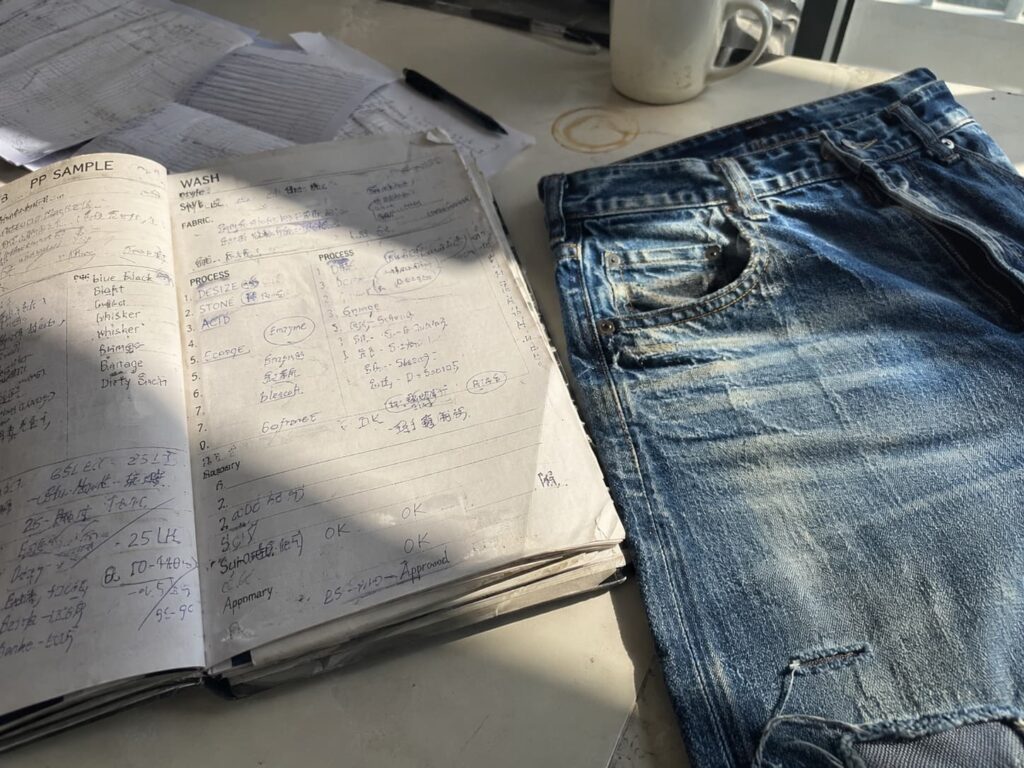
Here is what the same wash looks like as a record rather than a label. The chemical: not “enzyme” but which enzyme — acid cellulase and neutral cellulase behave differently, with acid enzyme generally giving more aggressive abrasion and more back-staining, neutral enzyme needing no pH control [CottonWorks]. The dosage: not “medium” but a percentage on weight of goods (%OWG) or a concentration, because two grams of enzyme per garment and four grams are two different washes. Then the conditions that govern how the chemistry acts: temperature, process time, pH where it’s relevant, and liquor ratio — the ratio of bath liquid to goods weight, a standard wet-processing parameter that materially changes the abrasion you get [CottonWorks]. A line a different partner could actually run looks like this:
2% acid cellulase (OWG), 45°C, 40 minutes, liquor ratio 1:8, pH 5.5 — illustrative format, not a prescription
That’s the difference between a label and a spec: the label tells you what the wash was called; the spec tells you how it was made. Note two things about the record version. First, it isn’t longer for the sake of being longer — every value on that line changes the outcome, which is exactly why leaving it off makes the wash unreproducible. “Enzyme wash, medium” isn’t a shorter version of that spec; it’s a different thing entirely, missing the parts that do the work.
Second — and this matters for staying honest — there is no official standard that dictates “a wash recipe must contain these fields.” These are the variables that physically govern the result, documented across textile-processing references [CottonWorks]; recording them isn’t compliance with a rule, it’s the practical condition for reproducibility. The test is never “did you fill in the official form.” The test is always: could someone rebuild this from what you wrote? A spec passes that test. “Medium” doesn’t.
The Sealed Sample, the Color Range, and the Numbers
The recipe is one of four things worth recording, and the same label-versus-record line runs through the other three. Each has a version that feels like documentation and a version that can actually rebuild the wash.
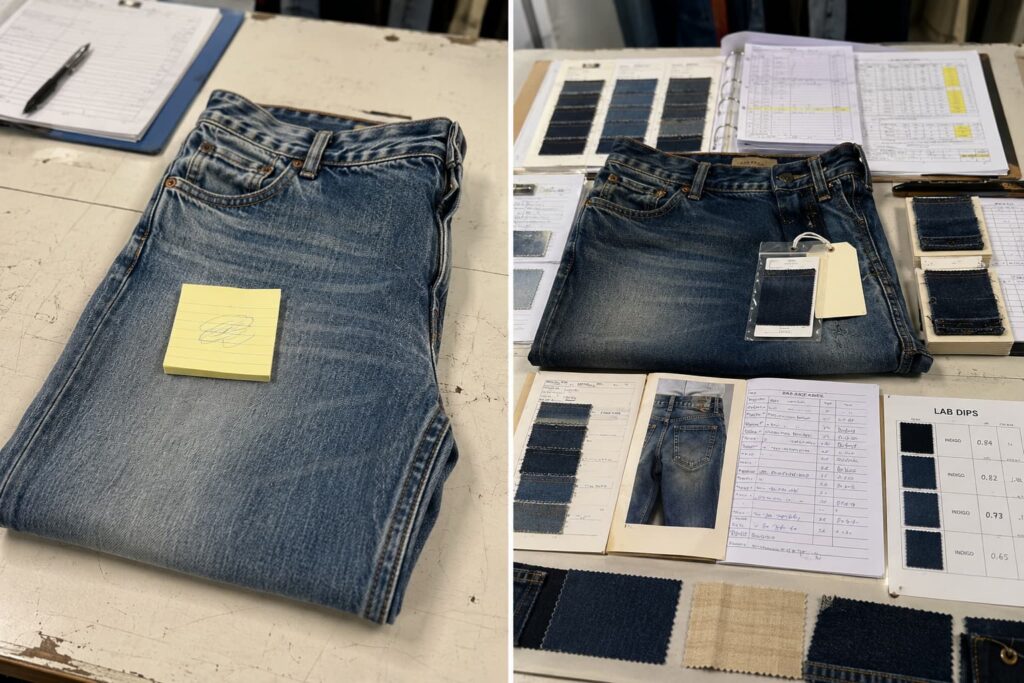
The sealed sample. The label version is a nice approved garment sitting in a drawer. The record version is a physical sample that is sealed, dated, and tied to the recipe version, sample round, and fabric lot it represents — a “seal sample,” in the standard production term, that serves as the agreed reference a bulk run is judged against. The difference shows up the moment there’s a dispute: a sealed, dated sample answers “is this within what we approved?” in minutes, while an unsealed, undated one starts an argument about which version it even is. And it has to be an actual washed garment, not a color card — because a washed denim color is pulled out of the yarn through a physical process, and a flat printed chip was never washed and can’t represent it. (That’s the trap covered in our guide on why the same wash looks different between sample and bulk; the short version is that the sealed garment, not the card, is the standard.)
The color range. The label version is a single target color — the one piece everyone fell in love with. The record version is a range: two to three sealed, dated color references — typically a lightest, a target, and a darkest — that define the acceptable shade spread, which in our production practice we require for exactly this reason. A single sample defines a point, and a washed color can’t be held to a point; it can only be held to a range. Recording one color isn’t a stricter standard than recording three — it’s no standard at all, because when the reorder lands slightly different, which it will, a single sample gives you nothing to measure “acceptable” against.
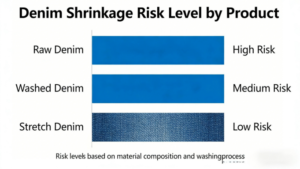
The numbers. The label version is “passed testing” and “shrinks a bit.” The record version is a number attached to a test code. Colorfastness recorded as a grade against a named method — Grade 4 per AATCC EP1 — not the word “pass.” Shrinkage recorded as a measured percentage against a named method — −3.2% on the warp per AATCC TM135 — not “a little” [AATCC]. The reason is the same as everywhere else in this guide: “pass” can’t be reproduced or checked against, but a method and a number can. This matters most on stretch denim, which often needs separate shrinkage confirmation because its behavior can differ from rigid denim, so its movement is worth writing down as a figure rather than assumed [Textile Today].
Across all three, the pattern is identical to the recipe. The label is a description aimed at a human who already knows the wash. The record is an instruction aimed at someone who doesn’t — and that someone is exactly who shows up on reorder number four, when the original operator has moved on and all that’s left is what you wrote down.
What “Reproducible” Actually Means
This whole guide rests on one word — reproducible — so it’s worth pinning down precisely, because it’s easy to set the bar in the wrong place.
Reproducible does not mean “produces an identical result.” As the companion guides in this series cover, in commercial production a washed denim color is controlled as a range, not a single exact point — it moves with fabric lot, machine scale, and the hands doing the finishing. Holding a record to “makes an exact copy” would set a bar no real wash meets. That’s the wrong bar.
Reproducible means something more useful and more achievable: someone who has never seen the original garment could, working only from your record, produce a result that lands inside the approved range. Not identical — inside the range. The recipe gets them to the right process. The sealed sample and the two-to-three-color range tell them what “inside the range” means. The measurements and test codes let them verify they got there. Take any one of those away and reproducibility breaks: a recipe with no sealed range produces a wash but no way to know if it’s the right one; a sealed sample with no recipe shows the target but gives no route to it. The four records are reproducible together — that’s why a real record is a set, not a single line.
There’s also a deliberately practical test hidden in that definition: the stranger test. Could you hand your records to an operator you’ve never worked with — at a second supplier, in a different country, a year from now — and have them work from your documentation toward the approved range, instead of reverse-engineering your look from a worn sample? If yes, you have records. If the honest answer is “no, they’d really need to talk to the person who ran the original,” then what you have is a label with extra detail, and you’re one personnel change away from redeveloping a wash you already paid to perfect.
And to be clear about what reproducibility is not: it isn’t compliance with some official “wash record standard.” No such standard dictates the fields — standards exist for the tests and evaluations a record cites (color change, dimensional change, instrumental color difference), not for a universal record template. Reproducibility is a functional property of your records, not a checkbox — the question is always whether they actually let someone rebuild the result, never whether they match a prescribed form.
Label vs Record: A Field-by-Field Table
Here is the whole guide in one view. For each of the four things brands record, this is the label version, the record version, the test that tells them apart, and what to ask your supplier for.
| What you’re recording | Label version (feels documented) | Record version (reproducible) | The test it has to pass | What to ask your supplier for |
|---|---|---|---|---|
| Wash recipe | “Enzyme wash, medium blue” | Enzyme type + dosage (%OWG), temperature, time, liquor ratio, pH | Could a new operator run it without seeing the original? | Enzyme type, dosage %OWG, temp, time, liquor ratio, pH |
| Physical sample | An approved garment in a drawer | A sealed, dated washed garment, tied to its recipe version | Does it say which version, approved when? | Sealed garment tied to sample round / PO / fabric lot |
| Color | One target color everyone liked | Two to three sealed references defining an accepted range | Can you judge “in range” without the original designer? | 2–3 sealed references (lightest / target / darkest) |
| Test results | “Passed testing,” “shrinks a bit” | A number against a method code: Grade 4 per AATCC EP1; −3.2% warp per AATCC TM135 | Can someone verify it, or just take your word? | Method code + numeric result + lab and date |
Two things to read off this table. First, the record column is never just “more words” than the label column — each entry is the specific information a stranger would need and the label leaves out. The gap between the two columns isn’t effort; it’s reproducibility. Second, the rightmost columns are the ones to act on: the test tells you whether what you have is a record, and the last column is exactly what to request if it isn’t. Run every record you keep through that test. The ones that fail aren’t records yet — they’re labels wearing more detail.

A Worked Example: Reorder Number Four
To see what the difference is worth, follow one style across its reorders. (Illustrative of patterns we see; no client identified, figures rounded.)
A brand runs an 8,000-unit black overdye style — a hard wash to hold, because black is among the harder shades to keep stable, in our production experience. It sells through. They reorder twice over the following months, and both reorders go smoothly. Then, on the fourth run, the situation changes underneath them: the wash house has rotated staff, and the fabric has come in on a new lot.
This is the exact moment a label fails and a record holds — and the same style can go either way depending only on what was written down.
The record version. The brand had kept a real record: the full recipe with dosages and liquor ratio, two to three sealed and dated color references defining the approved range, and shrinkage and shade numbers against their test codes. The new operator, who had never run this style, worked from the recipe, matched the pilot run against the sealed range, and confirmed the numbers. Re-approval could stay a re-approval — checking a pilot against a fixed reference — because there was a fixed reference to approve against. The personnel change and the new lot were absorbed by the record.
The label version. Had the same brand kept only “black overdye, medium, deep” and one loose approved sample, reorder four becomes a redevelopment. The new operator has no dosages to run, no range to judge against, no numbers to hit — so they reverse-engineer the look from a worn three-season-old sample and send approximations, and the controlled re-approval turns into rebuilding a wash the brand had already paid to perfect once.
Same style, same factory, same wash. The only variable that changed the outcome was whether what got written down could be reproduced from. That’s the entire return on the difference between a label and a record.
A Self-Check: Is Yours a Record or a Label?
You can test your own documentation right now, without the factory, in a few minutes. For your most important reordering style, ask:
- The recipe: Does it have actual values — a dosage, a temperature, a time, a liquor ratio — or does it have words like “medium,” “light,” “deep”? Values are a record; words are a label.
- The sample: Is there a physical washed garment that is sealed and dated, and do you know which recipe version, sample round, and fabric lot it matches? An unsealed, undated sample can’t anchor an approval.
- The color: Do you have two to three references defining a range, or a single “this is the one”? One sample is a target, not a standard.
- The numbers: Are colorfastness and shrinkage written as figures against test codes, with a lab and date, or as “passed” and “a bit”? A method and a number can be checked; a word can’t.
- The stranger test: Could you hand all of it to an operator you’ve never met and expect them to work toward your approved range without the original maker in the room? If the honest answer needs that person, it’s a label.
If every answer lands on the record side, your best styles are protected — a reorder is a re-approval, not a rescue. If they land on the label side, you don’t have a documentation problem to fix someday; you have an exposure that surfaces the next time a wash house rotates staff or a fabric lot changes, which is to say, routinely.
When a Direct Factory May Be Enough
Not every brand needs to outsource this, and some don’t need the full version of it at all. If you’re running a one-off capsule with no plan to reorder, the deep record set is more than the situation calls for — a sealed sample and a recipe line are a reasonable stopping point. The four records earn their keep specifically when a style is going to repeat.
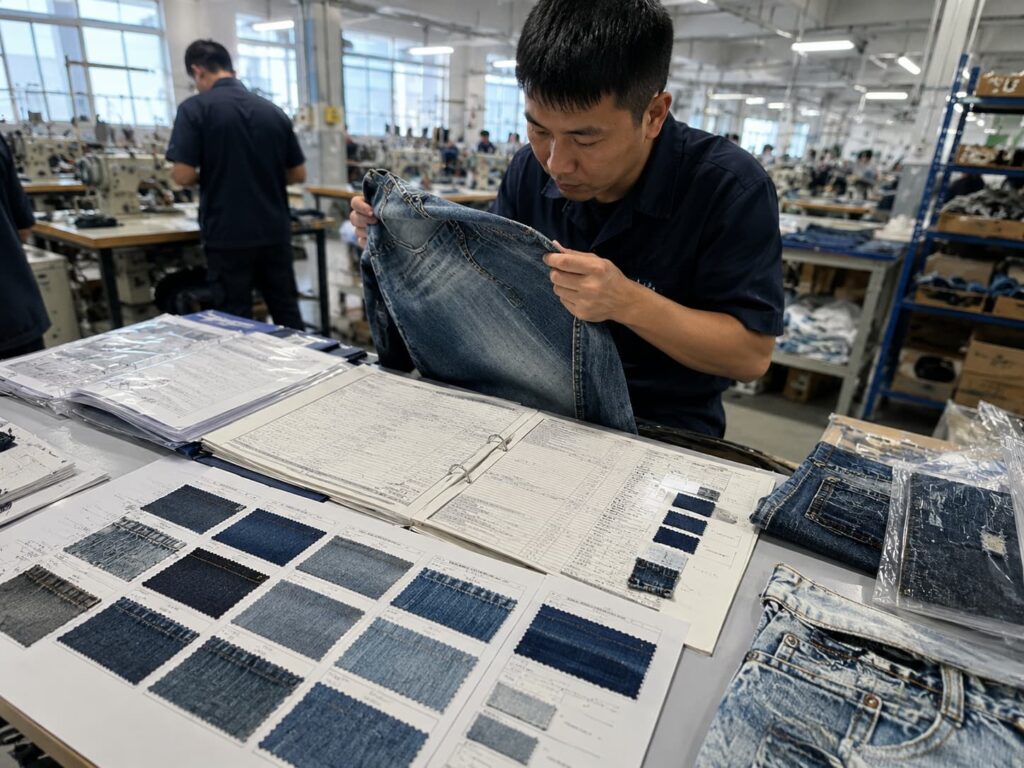
For brands that do reorder, the records and the stranger test are portable — you can apply them yourself, no matter who runs your wash. If your factory already gives you recipes with real values, seals and dates your samples, works to a two-to-three-color range, and reports test results as numbers against codes, then your job is mainly to keep those records in your own hands rather than leave them on the factory’s server. For many creator-led and early DTC brands running a few simple, stable washes, that’s enough: require the record version of each field, store it where a personnel change can’t erase it, and you’ve closed most of the exposure. The discipline matters more than who holds the pen.
When an External Denim Product Team May Fit Better
The harder case is when reproducibility has to survive things you don’t control. The decision rule is simple: a direct factory may be enough if it gives you portable records you can keep; an external product team becomes useful when no one on the brand side owns the recipe version, the sealed range, the test values, and the reorder transfer file. As you scale across multiple washes, fabric lots, and reorder cycles — and especially if you ever need a second supplier — that ownership gap is where reproducibility quietly breaks. If your supplier cannot provide portable recipe values, sealed references, and method-coded test records, the issue is no longer just production — it’s record ownership. Some brands build that ownership in-house; others bring in an external denim product team to hold it on their behalf, keeping the records with the brand and reproducible across suppliers and seasons. This is the type of work SkyKingdom does for creator-led, DTC, and scaling brands that don’t have an in-house product team.
What to Prepare Next
Whatever you decide about who holds the records, the work to do this week is the same: turn your labels into records before your next reorder, not during it. Three steps:
- Audit your top reordering style against the stranger test. Pull its records and run the five questions in the self-check above. You’ll know within minutes whether it’s a record or a label.
- Upgrade the recipe first. It’s the highest-leverage field. Replace any “medium/light/deep” with actual values — dosage, temperature, time, liquor ratio. If your partner won’t provide them, that itself is information about how reproducible your wash really is. For what a complete recipe contains and why it’s the backbone, see our guide on what wash recipe documentation is in denim production.
- Lock the range and the numbers. Make sure you hold two to three sealed, dated color references and that test results are written as figures against codes, with a lab and date. For how this connects to controlling color from sample to bulk, see our guide on how to keep denim wash color consistent from sample to bulk.
Do those three, and the next time a wash house rotates staff or a fabric lot changes, your best style survives it — because what you wrote down can rebuild the wash, not just remember it.
Frequently Asked Questions
- Isn’t writing down “enzyme wash, medium” enough to reorder later?
- No — that’s a label, not a record. It names the wash but contains none of the variables that produce it: the enzyme type and dosage, temperature, time, and liquor ratio. A new operator on a new fabric lot can’t run anything from it; they’d have to guess at the settings or reverse-engineer the look from an old sample. It’s enough to talk about the wash, but not to rebuild it — and rebuilding it is the whole reason you keep the record.
- What does a reproducible wash recipe actually need to contain?
- The variables that physically determine the result: the chemical type and its dosage as a percentage on weight of goods, the temperature, the process time, the liquor ratio, and pH where it matters. Recorded as values, not levels — “2% acid cellulase OWG, 45°C, 40 minutes, 1:8” rather than “medium.” There’s no official standard dictating these fields; they’re simply the parameters that change the outcome, so leaving any of them out is what makes a wash unreproducible.
- Why isn’t “passed testing” good enough for test results?
- Because “passed” can’t be reproduced or verified by anyone else. A record states a number against a named method: colorfastness as a grade per a method like AATCC EP1, shrinkage as a measured percentage per a method like AATCC TM135, ideally with the testing lab and date. The method tells a different lab how the number was produced; the number tells them what to hit. “Passed” tells them nothing they can act on, and quietly assumes everyone is testing the same way against the same threshold — which often isn’t true.
- Can one approved sample work instead of a color range?
- A single sample is a target, not a standard. A washed color can’t be held to a single point — it shifts slightly with every lot and run — so one sample gives you nothing to judge “acceptable” against when the reorder lands a touch different. In our production practice we work from two to three sealed, dated references that define an acceptable range. That range is what lets a new operator confirm a reorder is in spec without needing the original designer in the room.
- What is the “stranger test” for wash records?
- It’s a fast way to tell a record from a label: could you hand your documentation to an operator you’ve never worked with — a second supplier, a different country, a year later — and have them work toward your approved range from what you wrote, without the original maker in the room? If yes, you have records. If the honest answer is that they’d really need to speak to whoever ran the original wash, you have a label with extra detail, and you’re one personnel change away from redeveloping the wash.
- Who should own the wash records — us or the factory?
- The brand should hold them, regardless of who writes them. A factory documents its process for its own use, and a record kept only on the factory’s side leaves the wash dependent on that one factory. Keeping the recipe, the sealed sample range, and the test numbers in your own hands is what makes a wash transferable to a second source if you ever need one. The discipline matters more than who holds the pen; the ownership matters most when you need to move.
Sources
- Cotton Incorporated / CottonWorks™ — Denim Finishing; Garment Washing Techniques for Cotton Apparel. Supports that a wash is defined by recorded process variables — chemical type and dosage (%OWG), liquor ratio, temperature, time, pH, and mechanical action — and that acid and neutral cellulase behave differently. cottonworks.com/learning-hub/denim/denim-finishing
- AATCC EP1 — Gray Scale for Color Change; EP2 — Gray Scale for Staining. Supports recording colorfastness as a grade against a named method rather than as “pass.” members.aatcc.org/store/ep1
- AATCC TM135 — Dimensional Changes of Fabrics after Home Laundering; TM150 — after Home Laundering of Apparel. Supports recording shrinkage as a measured percentage against a named test method. members.aatcc.org/store/tm135
- ASTM D2244 — Calculation of Color Tolerances and Color Differences. Supports that instrumental shade difference is reported as a CIELAB ΔE value against a standard, not a single exact match. astm.org/d2244-25.html
- ISO 6330 — Domestic Washing and Drying Procedures for Textile Testing; ISO 105-A02 — Grey Scale for Colour Change. Supports the standardized laundering and grading procedures behind reproducible shrinkage and shade numbers. iso.org/standard/75934
- Textile Today — Making Shrinkage Percentage Consistent in Denim. Supports that stretch denim can shrink differently from rigid denim and that shrinkage is confirmed on production fabric. textiletoday.com.bd — shrinkage consistency in denim