
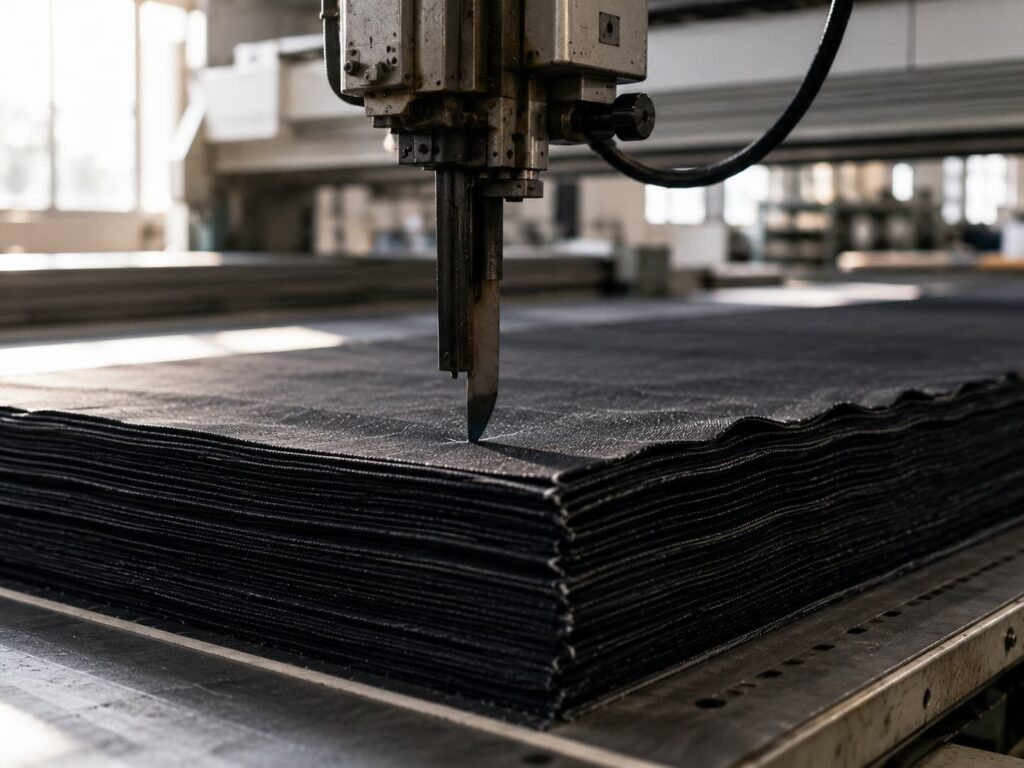
The scenario: the sample looked perfect, so you said go
Your PP sample arrives. The fit is right, the wash looks like your reference, the hardware feels solid. You sign off and tell production to proceed. Three weeks later the bulk lands and the inseam is sitting half an inch short, the back panels are a shade cooler than the front, and a run of units has buttons that already look tarnished. Nothing on your approval form was technically wrong — you approved what you were shown. The problem is what you were shown was not yet committed to bulk reality, and the gap between “looked right on the sample” and “holds on 8,000 washed units” is exactly the gap bulk cutting makes permanent.
How the decision is actually made: freeze by reversibility, not by checklist order
Most pre-production checklists list items in workflow order — tech pack, fit, color, trims, packaging. That order tells you when things happen, not which ones you can never take back. The decision logic that actually protects a denim order is to sort every approval item by one question: can this be changed after cutting, or not?
The defining rule: bulk cutting is the point at which fabric stops being adjustable and the pattern stops being editable; every variable that feeds the pattern or the cut fabric must be frozen before that moment, because after it, the only remedy is rework on finished units.
| Approval item | Reversible after cutting? | What freezing it before cutting prevents |
|---|---|---|
| Wash shrinkage measured and locked | No — pattern is graded around it | Fit failure on washed bulk despite signed-off fit |
| Pattern / grading finalized | No — cut fabric is committed to it | Size run that drifts across the curve |
| Shade band checked vs. actual bulk rolls | No — wrong-shade fabric is already cut | Whole-batch color offset after wash |
| PP sample on real bulk line, wash-tested | No — line capability is what executes bulk | Color bleed, twisting, or construction the bulk line can’t hold |
| Hardware / trims finalized | Partially — replaceable but costly post-cut | Oxidizing rivets and buttons that drive returns |
| Labels, packaging, commercial terms | Yes — can be resolved in parallel | Shipment delays, not garment defects |
Read the table top to bottom: the first four rows are the true gate. The last two matter, but they do not have to hold up cutting. A brand that freezes the bottom of the list while leaving shrinkage unmeasured has approved the reversible items and skipped the irreversible ones — exactly backwards.
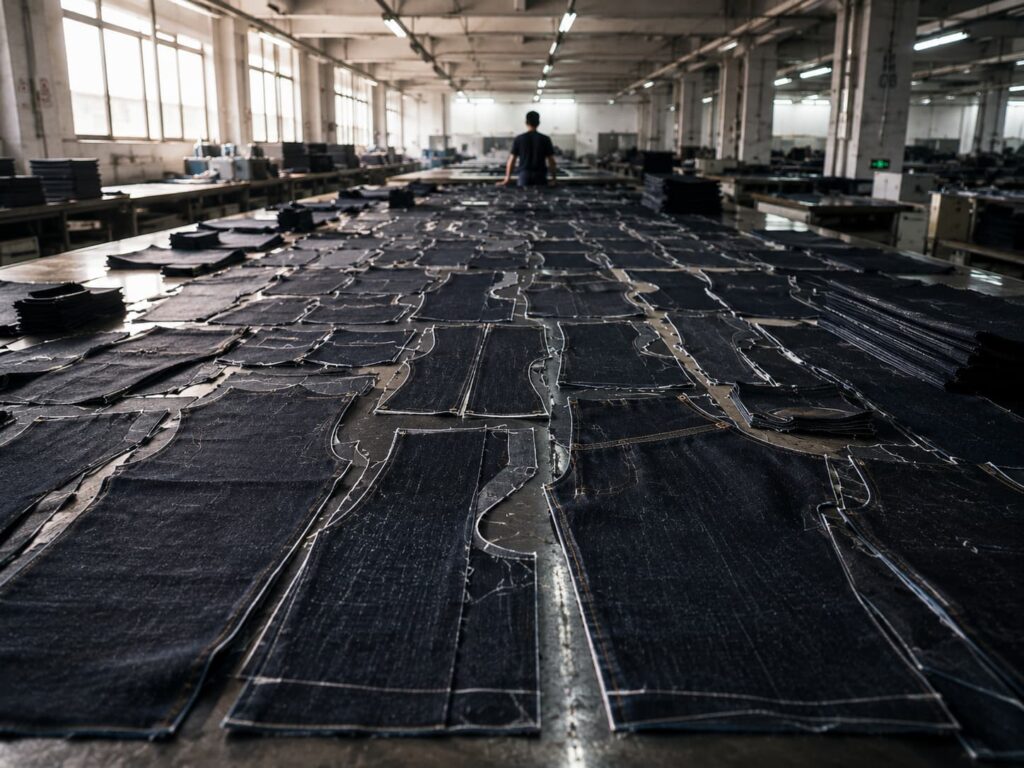
 Once the marker is laid and the fabric is cut, the pattern and shrinkage assumptions behind it are locked in.
How this changes by brand stage
The same pre-cut gate is run differently depending on stage. A creator-led brand on a 500–2,000 unit first run needs the most hands-on approvals — it has no internal product team to catch a shrinkage gap, so the PP sample and a physical wash test do the most work here, and the brand founder is often approving directly. A DTC startup at 5,000–20,000 units is at the stage where ambiguities get expensive fast: enough volume that a single missed shade approval becomes thousands of units of rework, but not yet a documented system that catches it automatically. This is where a written pre-cut freeze list — sorted by reversibility, not workflow — pays for itself. A scaling brand at 20,000+ units per season is no longer approving each run from scratch; it is maintaining consistency against a previously approved standard, and the risk shifts to a new fabric lot or a second source quietly shrinking or shading differently from the locked reference.
The three traps we most often see
Trap 1 — Treating fit sign-off as the freeze point while shrinkage stays unlocked. A brand signs off the fit on a sample-room garment and considers the pattern settled. But wash shrinkage was never measured on the bulk fabric, and the pattern was graded on an assumption. The washed bulk comes back short or twisted, and the fit everyone approved is gone — the pattern is already cut into the order. Shrinkage is freely adjustable before cutting and completely irreversible after; it has to be locked before the pattern is finalized, not after fit looks right.
Trap 2 — Approving the PP sample “with comments.” The sample has a couple of issues, so the brand approves it conditionally with notes to fix them in bulk. Once the line is running, those comments get misread or lost, and the change you assumed would happen was cut into the order unchanged. If a PP sample has issues worth commenting on, the right move is to request a second PP sample and approve it clean — conditional approval pushes an unresolved decision into an irreversible stage.
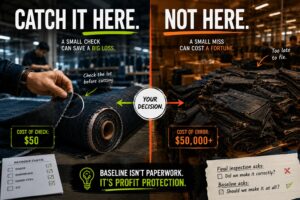
Trap 3 — Skipping the shade-band check against the actual bulk rolls. The fabric was approved as a hanger or a swatch, but the bulk rolls were never checked against the approved shade band before cutting. Cutting proceeds on rolls that are slightly off, and the entire batch washes out at the wrong color. A single missed shade approval can trigger thousands of units of rework — a check that costs minutes before cutting becomes a re-cut after it.
A reference example
On a first bulk run of roughly 1,500 units for a creator-led brand we supported, fit had been signed off cleanly on the PP sample and everyone considered the pattern locked. What had not been done was a wash-shrinkage test on the actual bulk fabric lot — the grading had been built on the sample fabric’s behavior. The bulk fabric, from a slightly different lot, shrank more on the length after the enzyme wash. The signed-off fit was correct on paper and wrong on the finished garment. The fix was not a new fit approval; it was establishing that shrinkage on the bulk lot is measured and the pattern re-graded around it before the cutting marker is laid. Once that freeze step existed, the same fit that had failed held consistently, because the pattern now matched how the bulk fabric actually moved after washing. The approval form had not been the problem; the missing freeze step was.
Frequently asked questions
What is the single most important thing to approve before denim bulk cutting?
Wash shrinkage. Cutting commits the pattern, and the pattern is graded around how much the fabric moves after washing. If wash shrinkage is not measured and locked before cutting, a fit you signed off on an unwashed or sample-room garment can fail on the finished, washed bulk — and by then the pattern is already cut into thousands of units. Shrinkage is the one variable that is freely adjustable before cutting and completely irreversible after.
Isn’t fit sign-off the real gate before bulk production?
Fit sign-off is necessary but it is not the final gate, because fit is usually approved on a sample-room garment or before final wash. The real gate is whether every irreversible-after-cutting variable is frozen: wash shrinkage, the pattern graded around it, the approved shade band against the actual bulk fabric, and final hardware. A signed-off fit means nothing if the washed bulk shrinks differently from the sample.
Why should I never approve a PP sample “with comments”?
Approving “with comments” pushes unresolved decisions into an irreversible stage. Once the line is busy, written comments get misread or forgotten, and the comment you assumed would be actioned was cut into bulk unchanged. If a PP sample has issues serious enough to comment on, the correct move is to request a second PP sample and approve cleanly, not to approve conditionally.
What does checking against a shade band actually prevent?
Bulk denim fabric rolls should be checked against the approved shade band before cutting begins. Cutting on rolls that are off-shade means the entire batch washes out at the wrong color, and a single missed shade approval can trigger thousands of units of rework. The shade check is cheap before cutting and impossible to undo after.
Should the PP sample be made in the sample room or on the bulk line?
On the actual bulk production line, not the sample room. A sample-room garment is made by specialist sample machinists and does not prove that the bulk line’s machinery and operators can execute the style consistently. A PP sample made on the real line is the only one that validates bulk feasibility — and it should always be wash-tested before approval.
Sources
- Joysportwear, “What is a pre-production sample” — PP sample on the actual production line; wash-test before approval; request a second PP sample rather than approving with comments: https://joysportwear.com/pre-production-sample/
- New Asia Garment, “Denim Garment Quality Control Checklist” — bulk rolls checked against approved shade band before cutting; shrinkage testing for washed denim: https://www.newasiagarment.com/denim-garment-quality-control-checklist-for-global-brands-from-pre-production-to-final-qc/
- Fabrikn, “Garment Production Timeline From Sample to Bulk” — a missed shade approval can trigger thousands of units of rework; pre-production sign-off protects margin: https://www.fabrikn.com/blog/garment-production-timeline-from-sample-to-bulk-guide/
- Ninghow Apparel, “Bulk Clothing Manufacturing Checklist” — PP sample confirms style, measurements, fabric, and construction before bulk cutting; matching checklist depth to production scale: https://www.ninghowapparel.com/blog/bulk-clothing-checklist/
Building a pre-cut freeze list sorted by what cannot be reversed after cutting — and making wash shrinkage a locked step before the pattern is finalized — is the kind of work SkyKingdom does as a verified denim supply chain partner for DTC brands setting up their first production framework. See how production supervision works for growth-stage brands.