
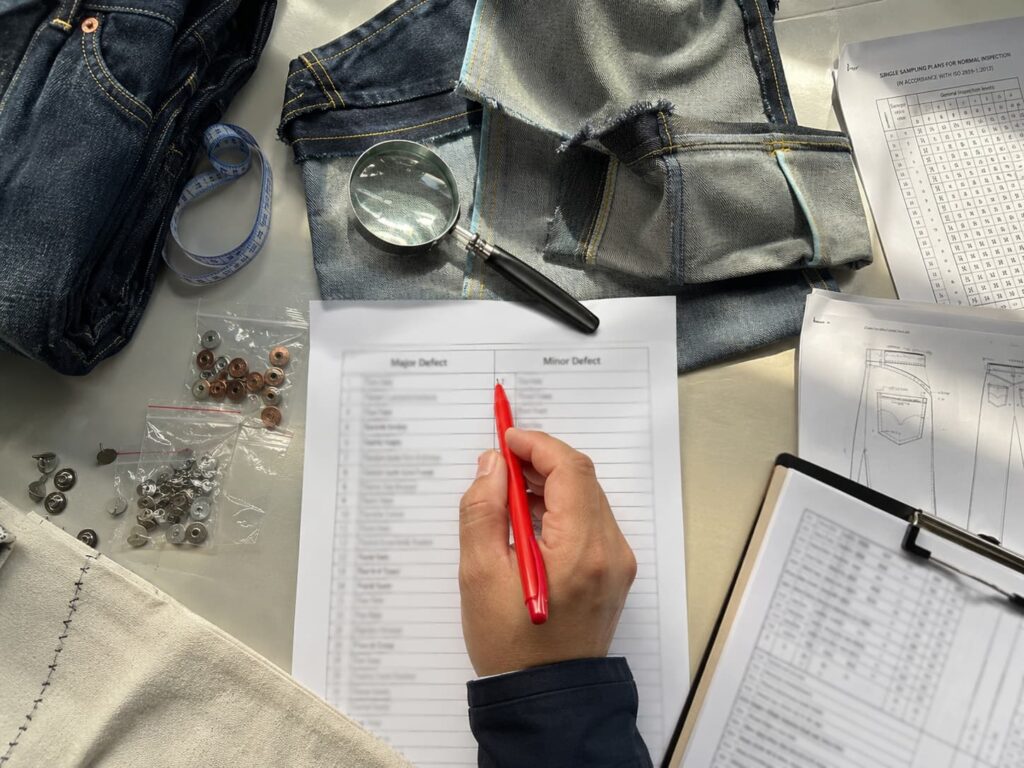
The scenario: your first PO, and production asks “what AQL?”
You have placed your first real production order — say 8,000 units across three washes. Sampling is approved, bulk fabric is in, and the production contact sends a short message: “Please confirm AQL for final inspection.” You have read that 2.5 is standard, so you reply “AQL 2.5” and move on.
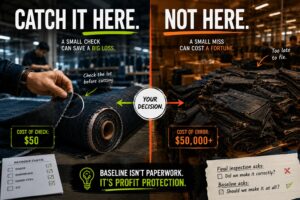
That single reply feels like the quality decision. It is not. You have told the inspector how many defective units to tolerate, but you have said nothing about what makes a unit defective, or how serious each defect is. A faded back pocket, a rivet that has already started to oxidize, a seam that slips under light tension, and a 2cm shade difference between front and back panels are now all in the hands of whoever interprets your one line. The number is set; the standard behind it is empty.
How the decision is actually made
AQL stands for Acceptance Quality Limit: the maximum defect rate a sampling plan is built to accept on average. It does not promise zero defects. It sets a statistical threshold, drawn from the ISO 2859-1 tables (equivalent to ANSI/ASQ Z1.4), that decides whether a batch passes based on a sample rather than a 100% check.
A lower AQL number is stricter — it allows fewer defects. The convention across apparel is to apply different AQL numbers to different defect classes: a tight level for the defects that hurt most, a looser one for cosmetic issues, and zero for anything unsafe. For a first denim order, the working decision is two-layered:
Layer 1 — the numbers. Here is what AQL 1.5, 2.5, and 4.0 mean at General Inspection Level II, Normal Inspection, for the two batch sizes a DTC startup is most likely to ship:
| Order quantity | Code letter | Sample size | AQL 1.5 (Accept / Reject) | AQL 2.5 (Accept / Reject) | AQL 4.0 (Accept / Reject) |
|---|---|---|---|---|---|
| 3,201 – 10,000 | L | 200 | 5 / 6 | 10 / 11 | 14 / 15 |
| 10,001 – 35,000 | M | 315 | 10 / 11 | 14 / 15 | 21 / 22 |
Read a row like this: at AQL 2.5 on an 8,000-unit order, the inspector checks 200 units; 10 or fewer defectives passes the batch, 11 or more fails it. Source: ISO 2859-1:1999, Table 1 (sample-size code letters) and Table 2-A (single sampling plans for normal inspection).
Layer 2 — the classification. This is the layer most first-time brands skip, and it is the one that decides what the numbers above are counting. The industry uses three defect classes, and they do not come from ISO 2859-1 — that standard only defines the sampling math. The three-way split is an industry convention finalized in the inspection criteria sheet (ICS) agreed between you and the inspection party:
| Defect class | Definition | Typical AQL | What it means for denim |
|---|---|---|---|
| Critical | Unsafe, non-compliant, or makes the garment unusable | 0 (zero tolerance) | Broken needle fragment, banned chemical residue |
| Major | Significantly affects function or appearance; the end user would likely return it | 2.5 | Seam slippage, color crocking failure, visible panel-to-panel shade mismatch |
| Minor | Off-spec but does not affect use; most buyers accept it | 4.0 | Slight, even shade variation; a single loose thread |
The defining rule to take away: an AQL level is a counting rule applied to a defect classification you define in advance; without the classification, the number accepts or rejects nothing predictable. Specify your ICS first, then the AQL numbers have meaning.
How this changes by brand stage
The same AQL question has a different correct answer depending on where a brand sits.
A creator-led brand on a 500–2,000 unit first run rarely has the volume to justify a formal sampling plan at all; for them the practical move is a near-100% visual check on a small lot and a short, plain-language defect list rather than a formal AQL table. A DTC startup shipping 5,000–20,000 units per season is exactly where AQL becomes the right tool — enough volume that 100% inspection is uneconomical, and enough repeat risk that a written ICS pays for itself. This is the stage where the two-layer decision above applies directly. A scaling brand at 20,000+ units per season is no longer choosing an AQL once; it is governing AQL consistency across production runs and second sources, where the real risk is the same ICS being interpreted differently by a new inspection team or a new facility.
The three traps we most often see
Trap 1 — Specifying a single AQL number with no defect classification. A brand writes “AQL 2.5” and considers quality handled. But with no ICS defining major versus minor for denim, the inspector applies their own house defaults. Your 2.5 and their 2.5 can pass and fail entirely different batches. The number is precise; the standard behind it is undefined.
Trap 2 — Letting hardware oxidation sit in “minor.” Rivets and shank buttons that have started to oxidize or that detach under light force are routinely defaulted to minor, because at the inspection table they read as cosmetic. But this is one of the denim defects most likely to generate a return — the customer sees it on first wear, not the inspector. A first-time brand should explicitly pull hardware integrity up into major in its ICS rather than accept the default.
Trap 3 — Treating “uneven wash” as one category. There is no universal rule for whether wash unevenness is major or minor; it depends on severity and on your own standard. A faint, even shade shift across a panel is usually minor. A sharp, patchy mismatch between front and back panels is major because it is visible on the rack and drives the customer to swap units. Collapsing both into one line in your ICS means the inspector decides for you, batch by batch.
A reference example
On a first bulk run of roughly 1,200 units for a creator-led brand we supported, the brief specified “AQL 2.5” and nothing else. The first inspection passed on the count — defectives were within the acceptance number for that sample size. But a cluster of units had shank buttons the inspector had logged as minor cosmetic marks, when in fact the plating had begun to lift. Because the ICS had not elevated hardware to major, those units counted lightly against the 2.5 threshold and the batch passed. The fix was not a stricter AQL number; it was rewriting the ICS so hardware integrity was a major defect, after which the same 2.5 level rejected exactly the units that would otherwise have come back as returns. The number never changed. The classification did.
Frequently asked questions
What does AQL 2.5 actually mean for my first denim order?
AQL 2.5 means an inspector checks a sample drawn from your batch and applies an acceptance number from the ISO 2859-1 table. For a 3,201–10,000 unit order at General Inspection Level II, the sample size is 200 units and the batch passes at 10 defects or fewer and fails at 11. The 2.5 is not a promise that only 2.5% of your garments are defective; it is the maximum defect rate the sampling plan is built to accept on average.
Is AQL 2.5 the right default for a denim brand?
AQL 2.5 for major defects and 4.0 for minor defects is the most common default across general apparel, and it is a reasonable starting point for a first denim order. But it is an industry convention, not a standard anyone is required to follow. The level you specify should match your return tolerance and price point, and it only works once you have defined which denim defects count as major versus minor.
Why does choosing an AQL number not protect my order on its own?
An AQL number is only a counting rule. It tells the inspector how many defects to allow, but not what counts as a defect or how severe each one is. If you specify AQL 2.5 without defining which denim defects are major and which are minor, the classification decision passes to whoever runs the inspection. Two parties can apply the same 2.5 and reject or accept completely different batches.
How should denim-specific defects like hardware oxidation be classified?
There is no international standard that classifies denim defects. Hardware oxidation or detachment — rivets, shank buttons — is often defaulted to minor because it is cosmetic at the point of inspection, but it is a frequent driver of consumer returns because the customer sees it on first wear. A first-time brand should explicitly elevate hardware integrity in its inspection criteria rather than accept the default classification.
Where do major, minor, and critical defect categories come from?
The three categories are not defined by ISO 2859-1, which only sets the statistical sampling method. The major / minor / critical split is an industry convention layered on top of that framework and finalized in the inspection criteria sheet agreed between the brand and the inspection party. The same defect can be classified differently across brands and price tiers.
Sources
- ISO 2859-1:1999 — Sampling procedures for inspection by attributes (Table 1 sample-size code letters; Table 2-A single sampling plans, normal inspection).
- ANSI/ASQ Z1.4 — US-equivalent sampling standard.
- QIMA, “Acceptable Quality Limit (AQL)” — defect-class definitions and common-default guidance: https://www.qima.com/aql-acceptable-quality-limit
- Tetra Inspection, AQL calculator and textile inspection checklist — major/minor/critical thresholds: https://tetrainspection.com/aql-calculator-acceptable-quality-limit/
- Iris Publishers, “Comparative Study of the Inspection Parameters for AQL 2.5% and 1.5% in Garments Manufacturing Process” — buyer-declared AQL practice.
Setting an inspection criteria sheet before locking an AQL level — and pulling denim-specific defects like hardware integrity into the right class — is the kind of work SkyKingdom does as a verified denim supply chain partner for DTC brands building their first quality framework. See how production supervision works for growth-stage brands.