

Author: Sky Lung and the production review team
Reviewed: June 13, 2026
Evidence basis: Reviewed against denim material and production checkpoints: fiber content, weave, weight, stretch recovery, wash impact, shrinkage risk, and inspection language. This page is an educational guide, not a supplier ranking.
Why Does My Stretch Denim Lose Its Shape or Sag After Washing, and How Do I Prevent It?
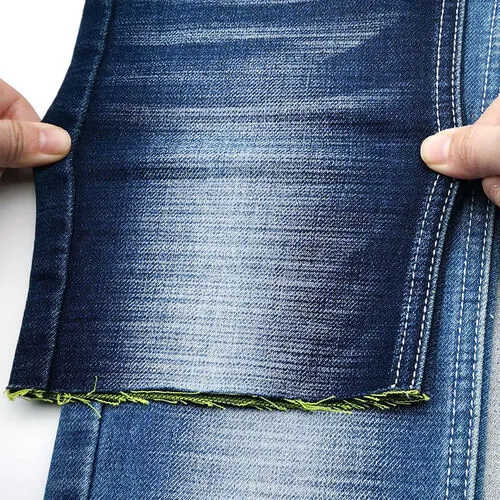
If you are producing larger denim volumes each season and stretch denim sags after washing, the failure is almost never the one you can see at fabric inspection. The defect that produces baggy knees and a loose seat is growth — the length the fabric fails to recover after being stretched — and it is usually latent, appearing only after wet processing or laundering. Three things drive it: the fibre and yarn construction (single-core spandex loses its “memory” faster than a dual-core stretch-plus-recovery system), heat and chemistry in finishing and the wash (which degrade elastane), and the sewing room (needle heat and seams that cannot stretch with the fabric). You prevent it by specifying recovery, not just stretch, on the fabric standard; by testing growth and recovery on the washed garment using a recognised method such as ASTM D3107; and by re-verifying on every reorder and second source. This guide explains each cause and exactly what to check.
The Scenario You Will Recognise
You are a scaling brand. A core stretch jean has reordered cleanly for several seasons. Then one reorder comes back from the wash house looking identical on the inspection table — same shade, same hand — and three weeks after it hits stores the returns start: knees bagging out, seat going slack, customers saying it “stopped fitting” after one wash. Nothing on your spec changed. The elastane percentage is the same. So what moved?
This is the signature problem of stretch denim at volume: recovery is the property most likely to drift between batches, and it is the one a greige-fabric inspection cannot see. At 20,000+ units, a recovery failure does not stay contained — it multiplies across a whole production run and several reorders before the return data catches up. Managing it is not about buying the most expensive fibre. It is about specifying the right property, testing it at the right point, and re-checking it every time the source or the lot changes.
The Core Issue: The Defect You Cannot See Is Called Growth
Here is the part that catches teams off guard: the most dangerous elasticity defect is not a visible break in the spandex that a fabric inspector can catch on the roll. It is latent — it only surfaces after the garment has been through wet processing or laundering. A roll can pass inspection and still produce jeans that sag after one home wash.
The technical name for what the customer experiences as “sagging” is growth. In textile testing, stretch and growth are two different measurements. Stretch is how far the fabric extends under a defined load. Growth is the length the fabric fails to recover after being stretched and released — the permanent, unrecovered elongation. A fabric with no growth returns exactly to its original length; a real stretch fabric never fully does, and the size of that shortfall is the number that decides whether knees bag and seats go slack. As industry test descriptions put it, growth is measured by holding a specimen at a high proportion of its available stretch for a set time, then letting it relax and measuring how much length it failed to recover.
So the working definition for a brand is this: elasticity management is the practice of controlling growth and recovery — not stretch — on the finished, washed garment, so that the jean returns to its original shape wear after wear and wash after wash. The moment a spec talks only about stretch percentage and elastane content, it has left the actual failure mode unmeasured.

Where Stretch Loss Actually Comes From: Four Stages
Recovery can be lost at four points between fibre and finished garment. Most brand specs only control the first one, which is why the failure keeps reappearing downstream.
| Stage | What goes wrong | Why it shows up only after wash | What a brand can control |
|---|---|---|---|
| Fibre & yarn construction | Single-core spandex loses its “memory”; stretch is high but recovery is weak | The weakness is built in; wash and wear simply reveal it over time | Specify the yarn construction (single vs dual-core), not just elastane % |
| Weaving & fabric setting | As stretch rises, the tendency for growth and shrinkage rises with it if construction is not engineered for recovery | Dimensional instability surfaces once the fabric is wet-relaxed | Require a maximum allowable growth on the fabric standard |
| Cutting & sewing | Needle heat damages elastane locally; seams built without give cannot stretch with the fabric; unrelaxed fabric distorts | Restricted or heat-damaged zones fail under the stress of wear and wash | Specify needle type, seam construction, and a fabric relaxation step |
| Wash & finishing | Harsh chemistry and excess heat degrade the elastane polymer | Degradation is chemical; it is invisible until recovery is tested post-wash | Lock pH, temperature, and heat-set conditions; approve on a sealed sample |
Stage 1 — Fibre and Yarn: Single-Core vs Dual-Core
The single biggest lever on recovery is decided before a yard is woven: how the elastane is built into the yarn. In a core-spun yarn, the elastane filament is wrapped in a cotton sheath. That sheath protects the “engine” of the jean from mechanical and chemical stress — but a single elastic core has a structural limit.
The LYCRA Company describes the mechanism plainly: most stretch denim is core-spun with one elastic yarn, which means it stretches but can lose its “memory” over time and start sagging and bagging. The company also notes the general rule that as fabric stretch increases, the tendency for growth or shrinkage increases with it. In other words, pushing for more stretch without engineering for recovery makes the sagging problem worse, not better.
The engineered answer is a dual-core construction. LYCRA dualFX technology combines two stretch fibres — one spandex for stretch, one bi-component polyester (LYCRA T400) for bounce-back recovery — intermingled and covered with cotton, so one fibre delivers stretch and the second ensures the garment snaps back to its original shape. LYCRA frames the benefit in exactly the terms a brand QC standard should use: it makes it easier to meet quality requirements for stretch, shrinkage, and growth. The takeaway for a scaling brand is that the fabric standard should name the construction, because “2% elastane” describes how much stretch fibre is present, not how well the fabric recovers.
Stage 2 — The Sewing Room: Where Quality Is Lost at the Needle
Recovery can be undone in cutting and sewing even when the fabric is sound. Three mechanisms matter.
Thermal damage at the needle. High-speed sewing generates heat at the needle tip, and elastane is heat-sensitive. Friction and thermal energy can damage spandex locally along a seam, creating weak zones that fail under the stress of wear and washing. The industry response is friction-reducing needle choice — smooth-finish ball-point needles sized to the fabric weight — to keep needle heat down. The specific size and finish should be agreed against the actual fabric rather than assumed.
Seams that cannot stretch with the fabric. If a seam is constructed without enough give, it will not extend with the stretch fabric around it. The result is a seam that restricts the garment, distorts the silhouette, or pops under load. Stretch denim needs seam types and stitch settings that allow the seam to stretch and recover with the body of the fabric — which is a construction specification, not a detail to leave to the line.
Unrelaxed fabric distorts. Stretch fabric that is cut while still under tension from the roll will relax unevenly afterwards, producing distorted silhouettes and inconsistent measurements. Allowing rolls of stretch fabric to relax before cutting stabilises the fabric and prevents this distortion. The relaxation step belongs in the production standard, because skipping it to save time is a common and invisible source of fit drift.
Stage 3 — The Wash House and Heat: The Chemistry of Recovery
The wash house is where many stretch garments quietly fail, because elastane degradation is chemical and thermal — invisible until recovery is tested after wash. Two parameters do most of the damage.
Chemistry and pH. Desizing, enzyme washes, and bleaching put the fabric through aggressive chemical environments. Elastane polymers degrade when pH and chemistry are not controlled, and the damage is cumulative and permanent — the recovery does not come back. Controlled pH through the wet processing steps, and thorough neutralisation after bleaching, protect the fibre from long-term degradation. These are recipe parameters that should be written down and approved, not left to the wash line’s judgment.
Heat. Curing and heat-setting apply high temperatures to fix the denim’s appearance. Too much heat “cooks” the stretch out of the fibre — permanently reducing recovery. Notably, LYCRA presents reduced heat-setting as a feature of its dualFX construction, stating it requires no heat-setting or only mild heat-setting, which reduces processing steps. That framing is useful for a brand: it confirms that heat exposure during finishing is a recognised risk to recovery, and that the fabric construction and the finishing window have to be matched. The practical control is to fix curing temperatures in the wash recipe and approve the result on a sealed reference sample.
How to Specify and Test Recovery So It Holds Across Reorders
For a scaling brand, the durable fix is not a one-off inspection — it is putting the right property and the right test method on the standard, so every batch is measured the same way. A supplier’s in-house “recovery is good” number is not comparable across lots; a named standard is.
The recognised methods for woven stretch fabrics such as denim include ASTM D3107 for stretch and growth, with specimens conditioned per ASTM D1776 before testing. Related methods exist for elastic fabrics generally — ASTM D4964 for tension and elongation, used for acceptance testing of commercial shipments, and ASTM D2594 for knitted fabrics — but D3107 is the one that maps to woven denim. The decisive detail is when the test is run: growth and recovery should be measured after a defined wash-and-dry cycle, such as the laundering procedures in ISO 6330, not on greige fabric. Testing only before wash measures the property that does not fail.
| What to put on the standard | Why it matters | Common gap it closes |
|---|---|---|
| Maximum allowable growth (not just target stretch %) | Growth is the property that causes sagging; stretch alone does not bound it | Specs that read “30% stretch” but never cap recovery loss |
| Named yarn construction (single vs dual-core) | Construction governs recovery; elastane % does not | Two fabrics at the same elastane % with very different recovery |
| Named test method (e.g. ASTM D3107) + conditioning | Makes one batch’s result comparable to the next | Non-comparable in-house supplier numbers |
| After-wash testing (e.g. ISO 6330 cycle) | Latent loss only appears after laundering | Pass-before-wash, fail-after-wash batches |
| Re-verification on every reorder & second source | Lot, mill, and wash line all shift recovery | Identical spec, drifted recovery on reorder |
How Variation by Brand Stage Changes the Answer
How much of this machinery a brand needs depends on stage.
A creator-led brand on a 500–2,000-unit first run is mostly choosing a fabric someone else has already engineered. The realistic move is to pick a fabric with a stated recovery specification and a recognised stretch construction, and to wash-test the finished sample before committing — rather than building a full test protocol. The failure to avoid is approving stretch on a greige sample that was never washed.
A DTC startup at 5,000–20,000 units, often with high online return rates, feels recovery failures directly in the return line. At this stage the priority is to start writing the property into the standard — a maximum growth, an after-wash test — even before there is a formal QC system, because a recovery failure at this volume is expensive in returns and reviews.
A scaling brand at 20,000+ units — the reader of this guide — is where recovery becomes a governed, repeatable specification with a named test method, after-wash testing, and re-verification on every reorder and second source. The risk that dominates at this stage is batch-to-batch and source-to-source drift: a second mill or a new fibre lot can shift recovery even when the written spec is identical, so the test, not the spec, is the real control. A sealed reference sample for wash appearance and a maximum growth figure travel with the style and are re-checked whenever the source changes.
| Brand stage | Right level of control | The failure to avoid |
|---|---|---|
| Creator-led (500–2,000) | Choose a fabric with a stated recovery spec; wash-test the sample | Approving stretch on an unwashed greige sample |
| DTC startup (5,000–20,000) | Write max growth + after-wash test into the standard | Recovery failures hitting the return line at volume |
| Scaling (20,000+) | Governed spec + named method + re-verify every reorder/second source | Identical spec, drifted recovery across batches and sources |
The Three Traps We See Most Often
Trap 1: Approving stretch on fabric that was never washed. The sample feels great on the table, stretch is on target, the buyer signs off. But the sample was greige or lightly rinsed, and the latent loss only appears after the production wash. The result is a fully approved fabric that sags in the field. Always require the stretch and growth sign-off to be on a finished, washed specimen run through the recommended care cycle — not the roll.
Trap 2: Specifying elastane percentage and calling it a recovery spec. “2% elastane, 30% stretch” reads like a complete standard but says nothing about growth. Two fabrics at identical elastane content and stretch can have very different recovery depending on yarn construction and finishing. The correct standard names a maximum allowable growth and the yarn construction, with stretch percentage as one figure among several — not the only one.
Trap 3: Treating recovery as a fabric-only problem. A brand chases the fabric mill over a sagging batch when the cause was needle heat at a specific seam, a non-stretch seam construction, an over-hot curing oven, or a skipped relaxation step. Because recovery can be lost at the needle and in the wash as well as in the fibre, a sagging batch needs the whole chain examined — fibre construction, sewing, and wash parameters — not just a fabric re-test.
A Reference Example: Tracing a Sagging Reorder
Consider a scaling brand’s core women’s high-stretch skinny, reordering at 22,000 units, that came back from the field with bagging knees after one season of clean reorders. The cost sheet and fabric spec were unchanged. Walking the chain field by field surfaced where recovery was lost:
The fabric spec named “2% elastane, ~35% stretch” but set no maximum growth, so the property that failed had never been bounded. The approval sample for that reorder had been signed off on a rinsed, not fully washed, specimen — so the latent loss was invisible at sign-off. The reorder had been split to a second mill to meet timing, and that mill’s single-core construction recovered less well than the original dual-core fabric, despite reading identically on the spec sheet. And the second wash line ran a hotter cure, pushing the elastane past the point of full recovery.
None of these was visible on the spec as written, and each was individually defensible. The corrective method is the same one that prevents recurrence: put a maximum allowable growth and a named test construction on the standard; require the stretch-and-growth sign-off on a fully washed specimen via a recognised method (ASTM D3107, conditioned per ASTM D1776, after an ISO 6330 wash cycle); seal a reference sample for wash and cure appearance; and re-run the after-wash test on every reorder and every second source before bulk — not after the returns arrive.
The Stretch-Recovery Risk Assessment
| Question | If yes | Recovery-risk implication |
|---|---|---|
| Does the spec set a maximum allowable growth? | No — only stretch % is specified | The property that causes sagging is unbounded; add a max growth figure |
| Was stretch approved on a fully washed specimen? | No — signed off on greige or rinsed sample | Latent loss is invisible at sign-off; require after-wash sign-off |
| Is the yarn construction named (single vs dual-core)? | No — only elastane % is named | Recovery is governed by construction; name it on the standard |
| Is a recognised test method on the standard? | No — relying on supplier in-house numbers | Results are not comparable across lots; specify ASTM D3107 + conditioning |
| Is the style being reordered or second-sourced? | Yes | Lot, mill, and wash line shift recovery; re-verify after-wash before bulk |
| Is this a high-stretch construction (30%+)? | Yes | Higher stretch raises the tendency for growth; recovery engineering matters more |
| Does the wash involve heavy chemistry or hot curing? | Yes | Elastane degrades under harsh pH and excess heat; lock and seal the parameters |
FAQ
Why do my jeans look fine at inspection but sag after the first wash?
Because the most common form of elasticity loss is latent: it appears only after wet processing or laundering, not in greige fabric inspection. Mechanical and chemical stress during washing and heat during finishing can degrade the elastane, so a garment that passes a visual check before wash can still fail on recovery afterwards. The fix is to test growth and recovery on the washed garment, not only before wash.
What is the difference between stretch and growth, and which one causes sagging?
Stretch is how far the fabric extends under load; growth is the length it fails to recover after being stretched and released. Sagging knees and a baggy seat are growth, not stretch. A fabric can have plenty of stretch and still sag if its growth is high, which is why a fabric standard should set a maximum allowable growth, not just a target stretch percentage.
Does a higher elastane percentage mean better recovery?
Not on its own. Recovery depends on yarn construction and processing as much as on elastane content. As stretch increases, the tendency for growth and shrinkage typically increases too, so high-stretch single-core fabric can lose its memory over time. Dual-core constructions pair a stretch fibre with a recovery fibre specifically to hold shape, which is why naming the construction matters more than the elastane percentage alone.
How should I test stretch denim so the result is comparable across reorders?
Specify a recognised test method on the fabric standard rather than accepting a supplier’s in-house number. ASTM D3107 covers stretch and growth for woven fabrics such as denim, with samples conditioned per ASTM D1776, and the test should be run after a defined wash-and-dry cycle. Naming the method and the wash cycle on the standard is what makes one batch’s result comparable with the next.
Why does stretch recovery change between one reorder and the next when the spec is identical?
Because a written spec does not fully control a different fibre lot, a different mill, or a different wash line. Yarn construction, heat-setting, and wash chemistry all affect recovery, and any of them can shift on a second source even when the fibre content and stretch percentage read the same. Re-running the after-wash growth and recovery test on every reorder and second source is what catches the drift before bulk.
Can the sewing room cause stretch loss, or is it only the fabric and wash?
The sewing room can cause it. High-speed sewing generates heat at the needle that can damage elastane locally, and a seam constructed without enough give will not stretch with the fabric and can restrict or distort it. Needle choice, stitch type, and allowing stretch fabric to relax before cutting all affect whether the finished garment holds its shape, independent of the fabric quality.
The Bottom Line
Stretch denim does not sag because of bad luck or a weak batch of spandex. It sags because growth — the unrecovered elongation that no greige inspection can see — was never specified, never tested after wash, or never re-verified when the lot or source changed. The fix is structural and unglamorous: specify recovery and a maximum allowable growth rather than stretch alone; name the yarn construction, because a dual-core stretch-and-recovery system holds shape where a single core loses its memory; lock the wash chemistry and curing heat that quietly degrade elastane; and test on a fully washed specimen with a recognised method so one batch is comparable with the next. At 20,000+ units, the discipline that matters most is re-running that after-wash test on every reorder and every second source — because the spec stays the same on paper while recovery drifts in the real world. Keeping a jean’s shape wash after wash is not a single decision; it is a property you specify, test at the right point, and re-check every time something upstream moves.
Specifying recovery correctly, sealing the reference sample, and re-verifying stretch across reorders and second sources is the kind of production governance SkyKingdom runs as an external denim product team for scaling brands; if you are tracing a recovery drift across high-volume stretch styles, you can see how that fits your range on the quality and QC page.
Reference Sources
- The LYCRA Company — LYCRA dualFX technology (stretch and recovery in denim)
- ASTM D3107 — Test Methods for Stretch Properties of Fabrics Woven from Stretch Yarns
- ASTM D1776 — Practice for Conditioning and Testing Textiles
- ASTM D4964 — Tension and Elongation of Elastic Fabrics
- ASTM D2594 — Stretch Properties of Knitted Fabrics
- ISO 6330 — Domestic washing and drying procedures for textile testing