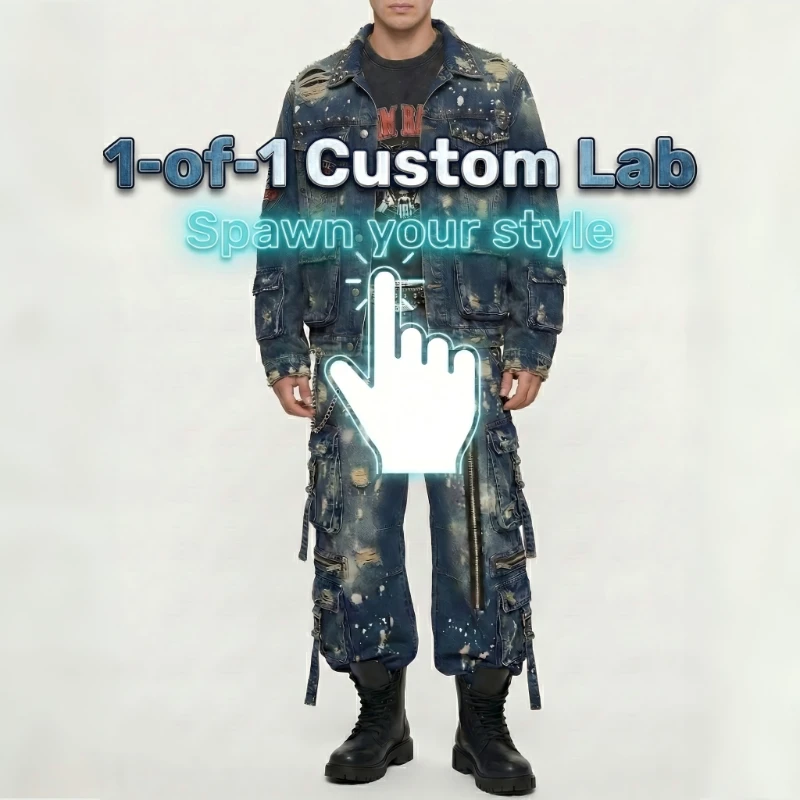

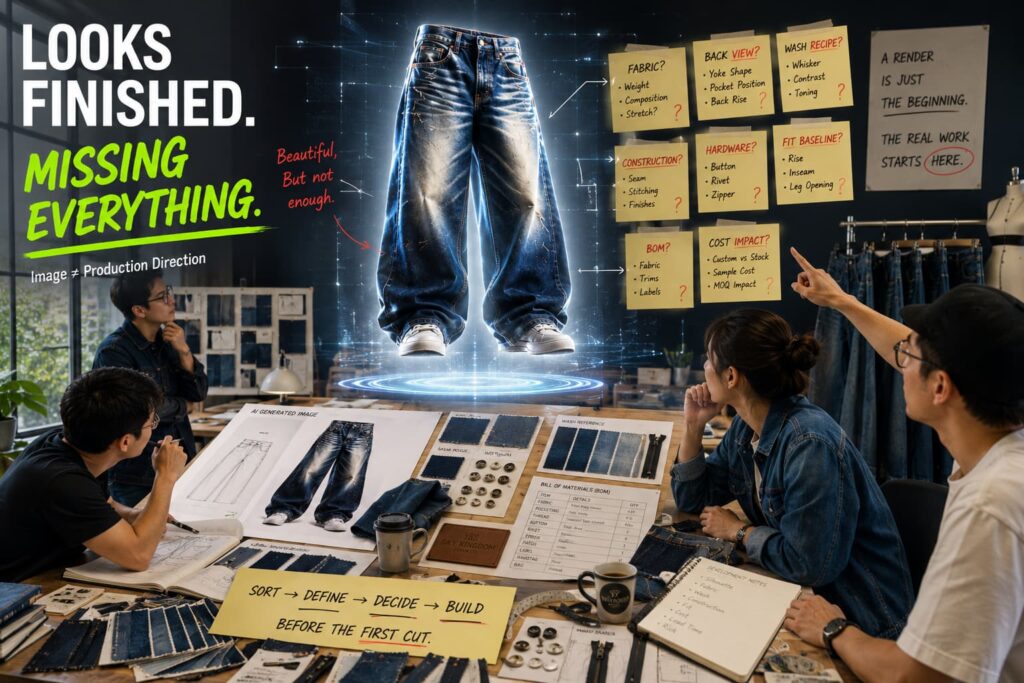

A brand sends an AI-generated denim image to a development team. The image is sharp — sculptural silhouette, heavy indigo wash, custom-looking hardware, a surface texture that reads somewhere between raw and vintage. The brand’s first message is the same one most AI denim conversations open with:
“Can this be sampled?”
The honest answer is almost always yes — given enough time, budget, and development rounds. But that answer hides the real question, and the real question is the one that decides whether the project moves forward or quietly stalls after the first conversation.
The real question is not whether the image can become a garment. It is whether the image — in its current form — contains enough information to define fabric, pattern, wash, construction, fit, and cost. Most AI denim images do not. They contain a visual direction. They do not contain a production direction.
The gap between the two is where most AI denim projects spend their first weeks: not waiting for the factory to start cutting, but waiting for someone to sort what the image actually asks for — which parts land on real materials, which parts need to be redesigned, and which parts were never real to begin with.
This article is the sorting process. Seven feasibility checks, run in sequence, that take an AI denim image from visual concept to a defined sample path — before any quote is built and before the brand discovers that “can this be sampled?” was never the right opening question.
Short answer: An AI-generated denim image can become a real sample, but not directly. Between the image and the first cut of fabric, seven feasibility decisions need to happen: separating garment information from rendering effects, identifying missing views and construction logic, confirming fabric behavior, checking pattern translatability, evaluating wash feasibility, defining construction and BOM, and determining whether the project is ready for sampling or still needs sorting. Skipping these steps does not save time — it moves the discovery process from before sampling to after, where it costs more and takes longer.
The Real Problem Is Not Whether the Image Can Be Made
When a brand holds an AI denim image, the instinct is to treat it like a photograph of a finished garment. The visual quality of current AI generators reinforces this — the lighting is right, the fabric drape looks physical, the wash gradient reads like a real indigo treatment. At a glance, the image looks production-ready.

It is not. And the gap is not aesthetic — it is structural.
A 2024 peer-reviewed study on Midjourney in fashion design found that AI image generators are effective at producing high-quality visual concepts, but their useful role remains concentrated in early-stage design — the output still requires substantial involvement from designers, pattern makers, and technical teams before it can move into downstream development.
A 2025 study on generative AI in the fashion design process went further: Gen AI can support discovery, inspiration, and visualisation, but current tools lack the design language needed to translate visual outputs into garment construction principles and technical features. Technical intervention is still required at the stages of design development, digital pattern making, and virtual prototyping — precisely the stages where an AI denim image needs to become a physical garment.
What this means in denim terms is specific. An AI denim image can carry silhouette direction, wash mood, color attitude, surface decoration, and styling context. What a single AI-generated image normally does not provide is the production-validated information a denim product team needs to cut, sew, wash, and repeat a physical garment:
There is no back view. Most AI denim images are single-angle renders. Back yoke shape, back pocket placement, back rise, label position, inside construction — none of it is shown.
There is no fabric specification. The image cannot tell whether the rendered denim is rigid or stretch, heavyweight or soft drape, raw or pre-washed. In denim, this single variable changes the pattern, the wash recipe, the shrinkage allowance, and the fit behavior — and the fabric must be evaluated after wash, because shrinkage, hand feel, leg twist, recovery, and surface change can all alter the final fit.
There is no wash recipe. The indigo gradient, the fading pattern, the whisker placement, the contrast level — each of these is a separate wash variable that must be defined as a recipe, not admired as a picture.
There is no BOM — and no measurement baseline. A denim sample’s bill of materials includes not just fabric but thread, buttons, rivets, zippers, labels, care labels, pocketing, interlining, patches, and packaging. Two jeans that look similar in an AI image can have very different sampling costs if one needs custom rivets, contrast thread, coated fabric, or multiple wash passes. And alongside the BOM, there is no rise, no inseam, no thigh width, no knee circumference, no leg opening, no seat ease, no tolerance range.
This is the structural gap. The image shows what a garment could look like. It does not show what the garment is made of, how it is constructed, how it behaves after wash, or how it fits a human body in motion. The feasibility check that follows is the process of filling those gaps — systematically, before any fabric is cut.
The 7-Step Feasibility Check: From AI Image to Sample-Ready
These seven steps are not a production process. They are a pre-production sorting process — the work that decides whether an AI denim image is ready for sampling, or whether it still needs development decisions before any quote makes sense.
The order matters. Each step filters what passes to the next.
Step 1 — Image Reality Check
The question: Which parts of this AI image are real garment information, and which parts are only rendering effects?
Not every visual element in an AI denim image carries the same weight. Silhouette direction, proportion, wash mood, overall attitude — these are genuine design signals. The precise glow of the indigo, the surgical perfection of the distressing, the way the fabric holds a shape that real denim cannot support — these are artifacts of the rendering engine.
The practical method is to ask, for each visible element: does this describe something a pattern maker can cut, a wash technician can recipe, or a trim supplier can source? If yes, it is garment information. If not, it is a visual effect that needs to be translated or set aside.
Common failure mode: Treating every pixel as non-negotiable. A more productive starting point is to name which one or two visual elements carry the brand intention — the silhouette attitude, the wash mood, the proportion — and allow the rest to be translated into the closest producible version.
Step 2 — Missing View Check
The question: Does the image contain enough information to define front, back, side, inside, and closure?
Most AI denim images are single front-facing renders. Back yoke shape, pocket placement, back rise, side seam direction, fly construction, pocket bag depth, inside finishing — none of it is shown. Someone has to design these parts. That someone is usually the pattern maker, who either asks the brand to clarify or fills in the missing structure based on what would be reasonable for the category.

Common failure mode: Assuming the factory will “figure it out.” In the AI denim projects we review, one of the most common reasons for a rejected first sample is not a sewing error — it is a back view, pocket construction, or waistband detail that the brand never specified and the pattern maker filled in by default.
What to prepare: If you have a preference for back yoke shape, back pocket placement, or waistband style, communicate it — even as a rough sketch or a reference photo. If you do not, say so explicitly and let the development team propose a construction that fits the front view’s logic.
Step 3 — Fabric Behavior Check
The question: What kind of denim does this silhouette actually need — and does that fabric exist?
This is one of the two steps where AI denim projects most commonly stall. The same silhouette built in two different fabrics produces two different garments. A wide-leg in 14-ounce rigid denim holds structure and volume. The same silhouette in 9-ounce stretch denim collapses into something softer and fundamentally different. The AI image does not tell which one it intended.
In denim, fabric direction must be evaluated together with wash expectation. A fabric that looks right before washing may shrink, soften, twist, or collapse after garment wash — changing both fit and silhouette. Shrinkage behavior is tested under standardized methods like AATCC TM135, which measures dimensional change across multiple washing temperatures, agitation cycles, and drying programs. Sanforized denim typically shrinks 1–3%, while unsanforized raw denim can shrink significantly more — and warp and weft directions often shrink at different rates.
Common failure mode: Letting the image decide the fabric. When no fabric direction is given, the development team either picks a default stock fabric or asks the mill to develop something new — adding lead time and cost the brand did not expect.
Step 4 — Pattern Translation Check
The question: Can the silhouette be translated into measurable pattern dimensions?
An AI image shows a garment on a rendered figure. A pattern maker needs numbers: how high is the rise? How wide is the seat? What is the thigh circumference relative to the knee? How much ease does the garment carry — and is the looseness intentional design ease, wearing ease, or just the visual result of fabric weight in a render?
For denim bottoms, pattern translation is not only about width. The crotch curve, front-to-back rise balance, seat ease, knee position, and stacking allowance decide whether the AI silhouette becomes wearable or only looks good in a render. Our previous article in this series examined in detail the six decisions a pattern maker must make before drawing the first line — body block, ease, grain direction, shrinkage allowance, seam allowance, and tolerance. All six are silent in any AI image.
What helps most: A fit reference garment — a pair of jeans the brand already owns and likes the fit of. This single item gives the pattern maker a measurable starting point instead of a set of assumptions.
Step 5 — Wash Feasibility Check
The question: Can the color, fading, and surface effects be translated into a wash recipe that can be repeated?
This is the other step where AI denim projects most commonly stall. AI-generated indigo tends to be more saturated, more luminous, more uniform than what real denim wash produces. Real denim wash is influenced by fabric base shade, dye penetration, enzyme concentration, water chemistry, machine load, tumble position, and drying conditions.

When traditional wash methods cannot achieve a specific effect, the team evaluates alternatives — laser processing for precision distressing, combined techniques, or adjusted chemistry — before deciding the wash path. But each alternative has its own cost and feasibility profile.
The goal of wash development is not to copy the AI image pixel by pixel. The goal is to create a physical wash standard: trial panels, an approved sample, a shade band, and a recorded recipe that can be repeated within an acceptable variation range.
Decision rule: If a wash effect in the AI image requires more than two trial cycles to approximate, and the brand’s order quantity cannot absorb the development cost, the wash direction should be simplified before sampling — not discovered during it.
What to prepare: Two or three wash reference photos from real garments — not from AI images. A note on which element matters most: depth of indigo, contrast level, fade pattern, or vintage softness.
Step 6 — Construction & BOM Check
The question: Can every visible panel, pocket, hardware piece, trim, and stitch detail be defined — and does the BOM add up to a cost the brand can carry?
AI images can suggest floating pocket layers, sculptural seam lines, oversized custom hardware, and decorative stitching that curves across three-dimensional surfaces. Each of these is a separate construction decision with a separate cost and lead time.
In denim, construction cost is often driven less by the number of materials and more by the number of operations: panel cutting, seam type, bartack placement, rivet setting, pocket reinforcement, fly construction, and any extra surface treatment after sewing. Two jeans that look similar in an AI image can have meaningfully different sample costs depending on whether the hardware is stock or custom, the construction requires four panels or eight, and the finishing involves two operations or twelve.
Common failure mode: Treating BOM as a factory problem. When a brand sends an AI image without specifying hardware preferences, label requirements, or trim direction, the development team either uses defaults (which the brand may reject) or quotes for custom development (which the brand may not have budgeted for).
Step 7 — Sample Readiness Check
The question: Based on the first six checks, is this project ready for sampling — or does it need more sorting?
The output of Step 7 is not “yes” or “no.” It is a sorted list:
Ready for sampling — Silhouette defined, fabric confirmed, wash achievable, construction clear, BOM specified, fit reference exists. A sample quote can be built on real variables.
Ready with noted development items — Most elements defined, but one or two require development (custom hardware tooling, wash recipe trial, fabric substitution needing brand approval). The sample can proceed with flagged items carrying their own lead time and cost.
Not ready — needs more sorting — Three or more checks are unresolved. The brand has no fit reference, no fabric direction, no wash direction, no construction priority. A sample quote at this stage is built on assumptions.
Not ready — needs design revision — The image asks for elements that are physically impossible, mutually contradictory, or only achievable at a cost that does not match the brand’s stage. The productive next step is a revision conversation that preserves the brand intention while adjusting the execution.
In the AI denim projects we review, the most productive outcome of Step 7 is often the third category — not because the project is rejected, but because naming what is missing gives the brand a clear, finite list of decisions to make before sampling begins.
Where Most AI Denim Projects Stall
The seven steps are not equally difficult. Steps 1 and 2 — sorting the image and identifying missing views — are usually resolved in the first conversation. Step 4 — pattern translation — moves quickly once a fit reference garment is provided. Steps 6 and 7 — BOM and sample readiness — are decision gates that depend on the earlier steps being completed.
The two steps that stall projects are Step 3 and Step 5: fabric and wash.
The reason is the same for both. These are the two variables that an AI image is least equipped to communicate — and they are the two variables that most directly determine whether a denim sample can be repeated, reordered, and produced at consistent quality.
Why fabric stalls projects. When no fabric direction is given, the development team cannot start pattern work, because the pattern changes depending on whether the fabric is rigid or stretch, heavy or mid-weight, raw or washed. Every downstream decision — shrinkage allowance, ease, grain direction, seam construction — depends on knowing what the fabric is. An AI image shows a finished surface. It does not show whether that surface sits on top of a 14-ounce rigid twill or a 9-ounce comfort stretch. Until that question is answered, the project is on hold — not because the team is slow, but because the team is waiting for the one decision that unlocks every other decision.
Why wash stalls projects. Wash is the most common source of expectation mismatch between the AI image and the physical sample. The AI image’s indigo is more saturated, more luminous, more uniform than what real denim wash produces. When the first sample arrives and the wash looks quieter, greyer, more organic than the render, the brand’s first reaction is often disappointment — not because the wash is wrong, but because the reference point was a render that no wash plant can match exactly.
The productive way through this is to separate wash mood from wash precision. A brand that says “I want a heavy vintage wash with visible contrast” gives the wash team a direction. A brand that says “I want it to look exactly like this AI image” gives the wash team an impossible target. The first conversation leads to a recipe. The second leads to revision cycles that chase a render instead of building a product.
In practice, most AI denim projects that stall at Step 3 or Step 5 are not stuck because the concept is bad. They are stuck because the brand has not yet made a decision that only the brand can make: what kind of fabric do you want this to feel like, and what wash mood are you actually trying to achieve? The AI image cannot answer these questions. The brand has to.
What a Denim Product Team Actually Does After Receiving an AI Image
When an AI denim image arrives at a working denim product team, it does not go straight to the cutting room. It does not go straight to the pattern desk either. The first move is sorting — and that sorting involves several roles working in parallel before any response goes back to the brand.

In the AI denim projects we review, the internal process typically follows a sequence that most brands never see.
The first pass is a reality check across the team. The front-end product team — the people who handle client briefs — opens the image and flags the obvious questions: is there a back view? Is there a fit reference? Has the brand specified fabric, wash, or hardware direction? If the answer to most of these is no, the image moves into a feasibility sort rather than a sampling queue.
The second pass is a parallel review by specialists. The image fans out to three roles at the same time: the pattern team evaluates whether the silhouette can be translated into measurable dimensions with available fabric. The wash team evaluates whether the color, fading, and surface effects can be achieved with known recipes — or whether alternative methods like laser processing or combined techniques need to be considered. The construction team evaluates hardware, trim, panel count, and BOM feasibility — specifically, which components exist as stock items and which would require custom development.
The third pass is an internal alignment. The findings from all three reviews come back together into a single feasibility response. This is where the team sorts the image into the categories that matter: which parts can be translated directly onto existing materials, which parts need development investment, which parts should be substituted with achievable alternatives, and which parts should be set aside.
The fourth step is the conversation with the brand. This is the step most brands expect to be the first step — but it is actually the fourth. By the time the team responds to the brand, the internal sorting is already done. The conversation is not “can this be made?” It is “here is what we found, here is what works, here is what needs your decision, and here is what we recommend changing.”
In most cases, that conversation leads to a modification of the original AI concept. The brand adjusts the design based on the team’s feasibility findings — and in the projects we review, the modification often earns more recognition from the brand than the original AI image did. Not because the team watered down the design, but because the revised version reflects what the brand actually wanted, translated into what denim can actually do.
This is the part of AI denim development that disappears when a brand sends an image directly to a factory and asks for a quote. Without the sorting process, the factory either guesses (and quotes based on assumptions) or asks the brand to provide information the brand does not yet have (and the project stalls). The feasibility check is not overhead — it is the work that makes the first sample meaningful.
How the Feasibility Path Changes Based on What the Brand Already Has
Not every AI denim project starts from the same place. Some brands arrive with only an AI image and a mood description. Others bring reference garments, partial specs, or wash photos from real products. The feasibility path — and the amount of sorting required — depends on what the brand already has in hand.
| Brand Starting Point | What Is Already Defined | Where the Feasibility Check Focuses | Typical First Step |
|---|---|---|---|
| AI image only, no other materials | Visual direction only — no fabric, no fit, no wash, no construction, no BOM | Full 7-step check required; most decisions are open | Image reality check + missing view identification |
| AI image + reference garment for fit | Silhouette direction + measurable fit baseline | Steps 1–2 move quickly; focus shifts to fabric, wash, and BOM (Steps 3, 5, 6) | Fabric behavior check + wash direction conversation |
| AI image + wash reference photos from real garments | Visual direction + wash mood defined by physical examples | Wash feasibility (Step 5) is faster; focus shifts to fabric, pattern, and construction | Fabric selection + pattern translation |
| AI image + partial tech pack (measurements, some construction notes) | Some garment dimensions and construction preferences exist | Steps 2 and 4 are partially resolved; focus on fabric, wash, and BOM gaps | Gap analysis — what is defined vs. what is still missing |
| Reference photo of an existing garment (not AI) + modification notes | A real garment exists as baseline; brand wants specific changes | Not a full feasibility check — closer to a development brief with defined variables | Direct pattern and wash adjustment |
| Complete tech pack + fabric direction + wash recipe | Production-level specification exists | Feasibility check can be simplified to a technical review and cost confirmation | Sample order with defined variables |
The pattern to notice: the more real-world information a brand brings alongside the AI image, the fewer feasibility steps require deep sorting. An AI image plus a fit reference garment and two wash reference photos can move through the seven steps significantly faster than an AI image alone — not because the steps are skipped, but because the decisions within each step are already partially answered.
The practical takeaway: if a brand’s starting point is the first row of this table — AI image only, no other materials — the single most productive preparation before contacting any development team is to add one fit reference garment and two or three wash reference photos from real products. Those three additions do not require technical knowledge. They require editorial judgment: which existing jeans fit the way you want yours to fit, and which existing wash effects are closest to the mood you are trying to achieve?
What to Prepare Before Sending an AI Denim Image to Any Development Team
A vague AI image and a vague request produce a vague response. The following checklist does not require technical knowledge — it requires editorial decisions that only the brand can make. Each item directly shortens one or more of the seven feasibility steps.
Before sending your AI denim image, prepare:
The AI image itself, in highest available resolution. Front view at minimum. If multiple views exist — back, side, detail — include them. If the image was generated through prompt iteration, a short note on the prompt direction helps the team understand which visual elements the brand was actually trying to achieve versus which elements the AI added on its own.
A short note on which 1–3 visual elements are non-negotiable. Silhouette? Wash mood? Hardware character? Color depth? Proportion? The brand does not need to define every production decision — but naming what carries the brand intention lets the development team protect those elements while suggesting substitutions for the rest.
A fit reference garment. A pair of jeans the brand already owns and likes the fit of — in any brand, any wash, any age. This single item resolves more feasibility questions faster than any other piece of preparation. It gives the pattern maker a measurable starting point for rise, seat, thigh, knee, inseam, and leg opening.
A target sample size. The size the brand wants to develop the first sample in. Without this, the pattern maker has to assume — and assumptions at the fit stage cascade into every subsequent sample.
Two or three wash reference photos from real garments. Not from AI images — from physical jeans, product pages, or vintage pieces. A note on which element matters most in each reference: is it the depth of indigo? The contrast between light and dark? The fade pattern? The vintage softness? Wash references from real products give the wash team a physical target instead of a rendered one.
The intended order quantity. A one-off display piece, a 30-unit creator drop, a 200-unit DTC launch, and a 2,000-unit wholesale program are four different projects with four different feasibility maps. Quantity determines which development costs are reasonable investments and which are overreach for the brand’s current stage.
The brand stage and timeline. Is this a launch product or a content piece? Is there a deadline tied to a campaign, a season, or a marketplace drop? Timeline shapes which development items are realistic and which need to be simplified.
The budget context, even if approximate. Not “what is the cheapest sample” — but a realistic sense of how much development the project can support. This is the difference between a productive feasibility conversation and a quote that gets ignored because the number surprised everyone.
A practical test: if a brand can provide the first five items on this list, the feasibility check typically moves through all seven steps in the first round of conversation. If a brand can only provide the image itself, the first round of conversation will be the feasibility check discovering what is missing — which is still productive, but takes longer.
When the Full 7-Step Check Is Necessary — And When It Is Not
The seven-step feasibility check is not always required in full. Some projects need every step. Some can move through them quickly. Some should not enter the process at all — not because the concept is bad, but because the brand’s current situation does not match what the process requires.
The full 7-step check is necessary when:
The AI image is the only starting document and the brand plans to develop a repeatable, sellable product. No fit reference, no fabric direction, no wash recipe, no construction notes — the image is carrying the entire design brief by itself. In this situation, every feasibility step contains open decisions that must be resolved before a sample quote means anything.
The AI image contains complex wash effects — spray, whisker, contrast fading, vintage tinting, localized bleaching — that require recipe development and testing before they can be repeated across a production run.
The silhouette is unusual or sculptural — oversized volume, exaggerated stacking, architectural panel construction — and the team needs to confirm whether the intended fabric can physically support the shape the AI image shows.
The image includes hardware, trim, or construction details that do not clearly match existing stock components — and the brand needs to understand which items require custom development before budgeting for the sample.
The check can be simplified when:
The brand already has a complete tech pack with measurements, construction notes, and fabric direction. The AI image is supplementary mood direction, not the primary design document. In this case, the feasibility check reduces to a visual alignment review — confirming that the tech pack and the AI image are asking for the same garment.
The brand has a physical reference garment plus modification notes. A real garment exists as a baseline; the brand wants specific changes to wash, fit, or details. This is a development brief with defined variables, not an open feasibility conversation.
The project is a simple base style — clean rinse wash, standard five-pocket construction, stock fabric, stock hardware. The wash variables are low, the construction is conventional, and the feasibility path is short.
The brand has an internal product team with pattern making, fabric sourcing, and wash development capacity. The external team only needs to supplement denim-specific expertise, not run the entire feasibility process.
The project should pause before entering the check when:
The AI image shows only an atmosphere or mood — no clear garment shape, no identifiable silhouette, no defined proportions. This is a direction, not a concept. The productive next step is a design conversation that turns the mood into a defined garment before feasibility begins.
The brand requires the sample to match the AI image exactly, including rendering effects that do not exist in physical denim. This expectation needs to be reset before any development work starts — otherwise every sample will be evaluated against a standard no physical garment can meet.
The brand’s budget cannot support any sample revision. AI concept translation typically requires at least one adjustment round after the first sample. If the budget only covers a single attempt with no room for correction, the risk of disappointment is high.
The brand is not ready to make editorial decisions — which elements are non-negotiable, which can be substituted, which wash mood to prioritize. Without these decisions, the development team is sorting alone, and the result is more likely to be technically correct but emotionally wrong.
Decision rule: If three or more of the seven feasibility steps are fully unresolved — meaning the brand has no fit reference, no fabric direction, no wash direction, no construction priority, and no BOM preference — the project is not a sampling conversation yet. It is a feasibility conversation. Starting with a feasibility review instead of a sample order can reduce the chance of spending the first sample round discovering basic missing decisions.
When a Direct Sample Maker Is Enough
Not every AI denim project needs to run the full feasibility process with a development partner. For some brands and some projects, a direct sample maker — a factory, workshop, or sample studio that takes an image and produces a one-off garment — is the right fit.
A direct sample maker may be enough when the project is a one-off content piece — a garment built for a campaign shoot, a brand video, or a single store display, where the goal is the photograph rather than a repeatable product.
It may also fit when the brand is producing a small creator drop with low commercial stakes, where the brand and the buyer both understand each piece may vary, and where the visual statement matters more than production consistency.
A direct sample maker works well when the brand already has an internal product team — a founder with a pattern maker, a technical designer, and a production manager on staff who can handle the feasibility sorting internally before sending the brief to the sample maker.
And it fits when the AI design is intentionally a one-of-one artifact — an auction piece, an art collaboration, a display object — where the development cost is part of the value, not an overhead to be amortized across units.
In these cases, the seven-step feasibility check may be unnecessary overhead. The faster path is a direct sample maker who can interpret the image, build one piece, and deliver it — without the documentation, baseline recording, and repeatability planning that a product development process requires.
The question is not which model is better. It is which model matches what the project actually needs to become.
When an External Denim Product Team Fits Better
A different kind of project needs a different model.
An external denim product team — distinct from a direct sample maker — operates at the level of the product, not the piece. The work is not building one garment from an image. It is moving a brand from an AI concept to a denim product that can be sampled, evaluated, revised, produced, and reordered.
This model may fit better when the brand is trying to launch a sellable product, not a content piece. The garment needs to enter a store, a website, or a wholesale conversation — which means fit consistency, wash repeatability, measurement tolerances, and quality baselines have to be defined from the first sample, not discovered after the first complaint.
It may fit better when the brand expects to reorder. A repeatable production path requires documented fabric sources, sealed sample references, recorded wash recipes, defined BOM, and measurement tolerances — work that happens during the first sample round, not after.
It often fits better when the AI image asks for development decisions the brand does not have an internal answer for. Which fabric supports this silhouette? Which wash method gets closest to this mood? Which hardware is worth custom tooling and which should be substituted? Which construction details carry the brand intention and which are rendering artifacts that can be released?
And it fits better when the brand is at the AI concept stage and plans to grow. The first AI denim project is rarely the last. A development partner whose work generates documented baselines — approved fabric, sealed wash recipe, recorded measurements, confirmed BOM — makes the second, third, and fourth project significantly faster and cheaper to start, because the decisions do not have to be re-made from zero each time.
In the projects we review, the role the team plays is closer to co-design than order execution. The brand brings the intention — the silhouette direction, the wash mood, the attitude, the commercial context. The team brings the material reality — which fabrics behave the way the image suggests, which wash recipes achieve the mood without chasing the render, which construction choices support the design at the brand’s actual volume and budget. The product that emerges is not a compromise between the two. It is the version that neither the brand nor the AI image could have defined alone.
For brands that need this type of sorting before sampling, SkyKingdom works in this external denim product team role — helping brands move from AI image, reference photo, or early concept into a controlled denim production path. The work is not only sewing garments. It is sorting feasibility, sourcing fabric, directing wash development, running sampling, coordinating construction, and building the documented baseline that makes the product repeatable.
For a brand at the AI concept stage, the practical difference is this: a direct sample maker builds one garment from the image. A denim product team builds a path the brand can keep walking after the first sample is approved.

What to Prepare Next
Whether the project ends up with a direct sample maker or with a denim product team, the same preparation makes the first conversation significantly more productive.
If your brand is holding an AI denim image and considering the next step, start here:
Open the AI image and run a quick version of Step 1 yourself. Ask: which visual elements in this image carry my brand intention — the elements I would not want to lose? And which elements am I flexible on? Write down the answer. Even a one-sentence note — “the silhouette attitude and the vintage wash mood are non-negotiable; the hardware and pocket details are flexible” — changes the quality of every conversation that follows.
Find a fit reference garment. One pair of jeans you already own and like the fit of. Any brand, any wash, any age. This single item answers more feasibility questions than any other piece of preparation.
Collect two or three wash reference photos from real garments — not from AI images. Product pages, vintage pieces, or photos of jeans you have seen and liked in physical form. Note which element matters most in each: depth, contrast, fade pattern, or softness.
Know your quantity. A clear answer to “how many units is this project for?” shapes every feasibility decision — from whether custom hardware tooling makes sense to whether a new wash recipe trial is worth the investment.
Then send these items — the image, the intention note, the fit reference, the wash references, and the quantity — to a denim product team or development partner before requesting production pricing. The first conversation should be about feasibility, not about quotes.
A feasibility review is not a commitment to produce. It is the work that tells the brand whether the project has a defined path — and what that path looks like in fabric, pattern, wash, construction, and cost. The brands that run this check before sampling spend less, revise less, and arrive at a product that matches their intention more precisely than the AI image could express on its own.
The image asks the question. The feasibility check is how the question gets answered.
FAQ
What is the difference between a feasibility review and a sample order?
A feasibility review is the sorting work that happens before sampling. It maps each visual element in an AI denim image against seven checks — image reality, missing views, fabric behavior, pattern translation, wash feasibility, construction and BOM, and sample readiness — to determine which parts of the image can move forward, which need development, and which should be revised. A sample order assumes those decisions are already made. When a brand skips the feasibility review and goes directly to a sample order, the sorting still happens — it just happens during sampling, where it costs more and takes longer.
How long does a feasibility review typically take?
For an AI image with no accompanying materials — no fit reference, no fabric direction, no wash references — the full seven-step feasibility check usually takes one to two rounds of conversation between the brand and the development team before a sample path is defined. The elapsed time depends on how quickly the brand can make the editorial decisions the process surfaces: which elements are non-negotiable, which fabric direction to pursue, which wash mood to prioritize. In the projects we review, the brands that arrive with a fit reference garment and wash reference photos move through the process significantly faster than those who arrive with only an image.
Can I run the feasibility check myself before contacting a development team?
Partially. Steps 1 and 2 — identifying which parts of the image are real garment information versus rendering effects, and noting which views are missing — can be done by the brand without technical expertise. Step 3 (fabric behavior) and Step 5 (wash feasibility) require production knowledge that most brands at the AI concept stage do not have. The practical approach is to run Steps 1 and 2 yourself, prepare the checklist items from this article, and bring the remaining questions to a development team that can answer Steps 3 through 7 with material and production context.
Why is my AI denim image not ready for a quote even though it looks complete?
Because visual completeness and production completeness are two different things. An AI image can look like a finished photograph of a real garment while containing zero production information — no fabric spec, no measurement baseline, no wash recipe, no BOM, no construction logic, no back view. A quote built without these inputs is a guess. It will be either too high (the development team assumes worst-case complexity) or too low (the development team assumes stock components that the brand will later reject). A feasibility review replaces guessing with defined variables, which makes the quote meaningful.
What if my AI image fails multiple feasibility steps — does that mean the concept is not viable?
Not necessarily. Most AI denim images have unresolved elements across several of the seven steps — that is normal for the AI concept stage. The feasibility check does not determine whether the concept is good or bad. It determines which version of the concept the brand’s current stage can carry. An image that fails Step 3 (no fabric direction), Step 5 (wash effects that contradict each other), and Step 6 (custom hardware with no stock equivalent) is not a failed concept — it is a concept that needs sorting before it becomes a sample brief. The output of the feasibility check is not “yes or no” but a sorted list: translate directly, develop selectively, substitute, or defer. That sorted list is the starting point for a sample that can actually be built, repeated, and built upon.
Author: Sky Lung and the production review team
Reviewed: June 13, 2026
Evidence basis: Reviewed against denim development checkpoints: reference-image completeness, fabric and wash feasibility, measurement control, sample approval, QC handoff, and reorder documentation. This page is an educational guide, not a supplier ranking.