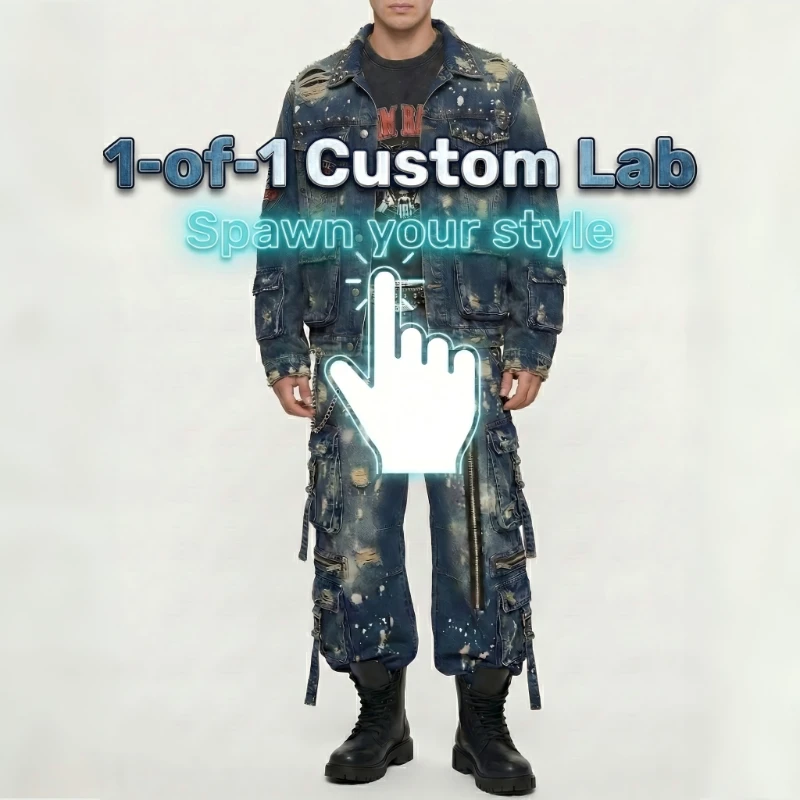


The image looks specific. The wash tone suggests a deliberate vintage fade. The fabric surface implies weight and texture. The silhouette feels resolved. Everything about the image says the design is ready.
But for a denim development team, the first question is not whether the garment can be sewn. It is whether the material in the image can actually exist in real denim — the fabric weight, the indigo depth, the wash effect, the surface texture. The indigo shown may not match any standard dye path. The fade pattern may require a wash process that changes depending on fabric composition and chemical sequence. The texture may suggest a fabric that does not exist at the weight or stretch level the image implies.
This is the gap that most brands do not see when they start with an AI denim concept. The image feels finished. The product brief is not.
In denim development teams that regularly receive AI-generated concepts, a pattern has become clear: the first problem is almost never the sewing or the silhouette. It is the distance between what the AI image shows as material reality and what real denim fabrics, washes, and finishes can actually deliver. This material translation gap is where most preparation failures begin — and where most avoidable sample rework starts.
This guide does not ask brands to stop using AI images. AI-generated concepts are a useful visual starting point. But a visual starting point is not a sample brief. Before a denim sample can begin, the brand needs to close the gap between the image and the production information that the image does not contain.
A better question than “can this be made?” is: what information does this image still need before sampling can start — and which details should the brand prepare, which can a development team help define, and which should no one guess?
Short answer: You do not need a complete tech pack to start denim development from an AI image. But you do need enough confirmed information to stop the development team from guessing on your behalf. At minimum, prepare your AI image or reference visual, a target sample size, a fabric direction (rigid or stretch, approximate weight), and a wash reference (not a color name, but a visual or verbal description of the wash effect you want). These four inputs let a development team begin evaluating feasibility. Beyond these, some details — like final trim specs, graded size charts, or packaging — can be developed later during the sampling process. But fabric behavior, wash direction, and fit intention should never be assumed by the factory or development team without input from the brand, because guessing on these three areas is where most denim sample rework begins.
Decision rule: If your AI image is supported by a confirmed fabric direction, a wash reference, a base size measurement, and a clear fit intention, a first development conversation can begin. If your image is the only input and you are unsure about fabric, wash, and fit, the project needs a preparation step before sampling — not a production quote.
A useful test: if your AI image disappeared tomorrow, would your development team still know what fabric, wash, fit, and sample size to start with? If the answer is no, the image is still a concept — not a sample brief.
The Real Problem Is Not Having a Design
Most brands that start with AI-generated denim concepts do not lack creativity. The images they produce are often visually strong — clear silhouettes, intentional wash effects, specific color tones. The problem is that visual strength creates a feeling of product completeness that does not match the actual state of the production brief.
An AI image is a rendering engine output. It generates pixels based on pattern recognition across training data. It does not select a real fabric. It does not calculate shrinkage. It does not define a wash recipe. It does not set seam allowances or choose thread weight. Every one of these decisions still has to be made by a human — either the brand or the development team — before a sample can be cut.
In denim development teams that receive AI concepts regularly, the same pattern repeats each month, and the frequency is increasing. The issue that comes up first is not construction or stitching. It is material reality. The fabric shown in the AI image often does not correspond to any single real denim fabric available in production. Its surface texture, apparent weight, color depth, and light behavior may each point to a different real fabric. The color may sit between two achievable indigo depths. The surface texture may suggest a weight that does not exist in stretch denim. The wash fade may imply a chemical process that would behave differently on the actual fabric.
This is not a failure of AI. It is simply what happens when a visual model generates an image without referencing real material libraries, real dye paths, or real wash chemistry. The image is useful as a direction. But treating it as a confirmed material specification is where preparation starts to break down.
The real problem is not that the brand has no design. The real problem is that the design exists only as a visual, and the production decisions behind the visual — fabric, fit, wash, measurements, trims, construction — have not been made yet.

What an AI Denim Image Actually Contains — and What It Does Not
To understand the preparation gap, it helps to see exactly what information an AI-generated denim image provides and what it leaves out.
| What the AI image shows | What denim production requires |
|---|---|
| Silhouette and proportions | Pattern block, ease values, seam placement |
| Apparent fabric texture | Confirmed fabric — weight (oz), composition, stretch %, mill source |
| Color tone | Dye method, indigo depth, wash recipe, shade band tolerance |
| Wash fade pattern | Wash process path — enzyme, stone, bleach, tint, softener, sequence and timing |
| Pocket shape and placement | Pocket pattern, bar-tack positions, facing specs |
| Hardware appearance | Confirmed button, rivet, zipper — size, material, finish, supplier |
| Overall fit impression | Base size measurements, points of measure, fit intent, tolerance range |
| Stitching visibility | Thread type, stitch type, SPI, seam allowance, topstitch spacing |
| Trim and label appearance | Label content, placement, material, care instruction compliance |
| Finished look | Construction sequence, pressing, finishing, packaging |
The left column is what the brand sees when reviewing the AI image. The right column is what a development team or factory needs before cutting the first sample.
Every row in the right column represents a production decision. When any of these decisions is missing, the development team has two options: ask the brand and wait, or assume and risk rework. Neither option is efficient. The better path is for the brand to prepare as many of these inputs as possible before the first development conversation.
One distinction matters more in denim than in most other garments: the gap between apparent color and actual wash process. In a t-shirt or a hoodie, color is largely a dye-matching exercise. In denim, the final color is the result of a multi-step wash sequence — and two visually similar AI images may require completely different wash paths depending on the base fabric, the indigo concentration, and the target fade pattern. A color name like “vintage mid-blue” is not a wash direction. A wash direction includes the base fabric shade, the wash method, the target fade level, and an acceptable shade range.
This is why denim preparation requires more specificity than most other garment categories, and why an AI image alone — no matter how realistic — cannot replace the production decisions listed in the right column.
Where Preparation Breaks Down — Visual Completion Feels Like Product Completion
The most common preparation failures do not come from carelessness. They come from a specific illusion that AI image tools create: when a visual looks finished, the product feels finished too.
This is not a criticism of the brands using AI tools. It is a pattern that appears because AI generators are designed to produce polished, final-looking outputs. There are no rough edges, no placeholders, no “TBD” labels. The image looks like a product photograph, not a concept sketch. And that visual completeness makes it easy to skip the production decisions that have not actually been made.
Five misjudgments appear most often in AI-to-denim projects:
AI render treated as sample brief. The brand sends the AI image and asks for a sample quote. But a sample quote requires fabric cost, wash cost, trim cost, and construction time — none of which can be estimated from a rendered image alone. The development team cannot price what has not been specified.
Color name used as wash direction. The brand describes the target wash as “vintage blue” or “light stone.” But in denim production, these are not actionable instructions. A wash direction needs to specify the base fabric shade, the wash method (enzyme, stone, bleach, or combination), the target fade intensity, and an acceptable shade tolerance. Two factories interpreting “vintage blue” independently may produce visibly different results.
AI texture mistaken for real fabric. The surface shown in the AI image suggests a specific hand feel, weight, and weave structure. But the AI model does not reference real fabric mills or real stock. The texture it generates may combine visual properties from multiple fabric types that do not coexist in a single real denim. A development team receiving this image must still identify or source a real fabric that approximates the visual direction — and that fabric may behave differently after washing.
Silhouette assumed to equal pattern logic. The AI image shows a shape — wide leg, tapered, relaxed fit. But a silhouette is not a pattern. Converting a silhouette into a cuttable pattern requires decisions about ease, rise, inseam proportion, leg opening, and seam placement. Two pattern makers interpreting the same AI silhouette may produce different fits if the brand does not provide a base size measurement and a fit reference.
Image approval confused with production readiness. The brand approves the AI image internally and assumes the concept is ready to develop. But internal design approval and production readiness are two different checkpoints. Production readiness means the brief contains enough confirmed information — fabric, wash, fit, measurements, trims — for a development team to begin work without major assumptions.
None of these misjudgments mean the AI image is useless. The image is a valid starting point. But it becomes a problem when visual approval replaces production preparation — because every unconfirmed detail will surface later as a question, a delay, or a sample revision.

A Better Way to Prepare: Must Confirm, Can Develop Later, Should Not Guess
Most preparation guides give brands a single checklist and treat every item equally. But in real denim development — especially when starting from an AI image — not every detail carries the same weight at the same time.
Some information must be confirmed before any development work can begin. Some can be tested, refined, and finalized during the sampling process. And some should never be assumed or guessed by anyone — brand or development team — because getting them wrong creates rework that is expensive and slow to correct.
This three-layer framework helps brands sort their preparation by priority instead of treating every line item as equally urgent.
Layer 1: Must Confirm Before Development Starts
Without these inputs, a development team cannot begin meaningful work. They are the foundation that every other decision builds on.
AI image or reference visual. This is the starting point for the entire project. The image does not need to be a perfect representation of the final product, but it must communicate the style direction clearly enough for a development team to begin interpreting silhouette, wash tone, and construction intent.
Target sample size. A pattern cannot be drafted without a base size. If the brand does not specify which size to develop first, the team must guess — and a guess on base size affects every measurement in the garment. Most denim development starts with a single base size (typically M for menswear or size 28–30 for denim) before grading to a full size range later.
Fabric direction. Not a final fabric specification, but enough to narrow the search: rigid or stretch? Approximate weight range? Cotton or blend? These choices directly affect how the garment drapes, how it responds to washing, how much it shrinks, and what construction methods are appropriate. An AI image cannot answer these questions because it does not reference real fabric behavior. Sanforized denim typically shrinks around 2–3% after washing, while unsanforized denim can shrink up to 10% or more (Denimhunters). If the team does not know whether the brand wants rigid or stretch denim, they cannot predict how the sample will behave after washing.
Wash direction. This is the single most denim-specific preparation item — and the one most often missing or misunderstood. A wash direction is not a color name. It includes the base fabric shade, the wash method (enzyme, stone, bleach, tint, or combination), the target fade or distressing level, and the acceptable shade variation. According to Coats’ denim wash technical guidance, a standard denim wash involves multiple sequential stages, and variables such as stone-to-fabric weight ratio (ranging from 0.5:1 to 3:1), chemical concentration, temperature, and processing time all affect the final result. An AI image shows the end point. A wash direction describes the process path to reach it.
Layer 2: Can Be Developed During Sampling
These details matter for final production, but they do not need to be locked before the first sample conversation. They can be tested, adjusted, and confirmed as part of the development process.
Graded size specifications. Full size grading (XS through XXL or size 26 through 36) is needed before bulk production, but sampling typically starts with one base size. Grading rules can be developed after the base size fit is approved.
Final Bill of Materials (BOM). The complete list of trims — buttons, rivets, zipper, labels, hang tags, thread color — does not need to be finalized on day one. During sampling, many brands refine trim choices based on what is available, what fits the price point, and what matches the approved wash result. Initial development can proceed with placeholder trims.
Construction details. Stitch type, stitches per inch, topstitch spacing, bar-tack placement, and seam finishing can be refined during the sampling process. A development team will typically propose construction methods based on the garment type and the brand’s quality expectations, then adjust based on sample feedback.
Packaging and labeling. Care labels, brand labels, hang tags, poly bag specs, and folding instructions are production-stage requirements. They do not affect the first sample and can be finalized later.
Layer 3: Should Not Be Guessed
These are the high-risk items. When they are unknown, the correct response is to say “I don’t know yet” — not to fill in a placeholder and hope it works. Guessing on these details leads to sample rework that often requires starting over, not just adjusting.
Fit intention without measurement reference. If the brand says “relaxed fit” but provides no measurement baseline, two pattern makers may produce two different interpretations. Fit is subjective. Measurements are not. If the brand does not yet have measurements, the better path is to provide a physical reference garment that represents the target fit, rather than describing fit in words alone.
Wash effect without process discussion. If the brand approves the AI image wash tone but no one discusses the actual wash process, the first sample may look different from expectations — not because of poor execution, but because the wash path was assumed rather than agreed. Wash effects in denim are process-dependent: the same visual target can be reached through different chemical paths, each producing slightly different hand feel, color stability, and aging behavior.
Fabric weight or composition based on image appearance. An AI image may suggest a heavy rigid denim, but the brand may actually want a lighter comfort stretch. If this mismatch is not caught before fabric sourcing, the sample will be made in the wrong material — and a wrong-material sample usually cannot be corrected by adjustments. It requires a new fabric, a new pattern review, and a new sample.
The purpose of this framework is not to overwhelm brands with requirements. It is to help brands focus their preparation on the items that matter most — and to know which gaps are safe to leave open for now and which gaps will cost time and money if left unresolved.
Why Denim Preparation Is Different From Other Garments
Brands that have experience sampling t-shirts, hoodies, or woven basics sometimes assume the same preparation approach works for denim. It does not. Denim has specific material and process variables that make incomplete preparation more costly and harder to correct after the fact.
Four factors make denim different:
Fabric shrinkage is larger and less predictable. Most knit and woven basics shrink within a narrow, well-documented range. Denim shrinkage varies significantly depending on whether the fabric is sanforized, the yarn type, the weave density, and whether the fabric includes stretch fiber. Sanforized denim typically shrinks around 2–3% after washing, while unsanforized denim can shrink up to 10% or more (Denimhunters). Stretch denim with spandex or Lycra core-spun yarns adds another variable: width shrinkage and recovery behavior differ from rigid denim. If the brand does not specify fabric type and the development team makes an assumption, the sample measurements after washing may fall outside acceptable tolerance — not because of a sewing error, but because of a fabric assumption.
Wash is a multi-step production process, not a color selection. In most garment categories, the final color is determined by dyeing or printing, and the result is relatively predictable once the color standard is matched. In denim, the final appearance is created through a sequential wash process that may include desizing, enzyme treatment, stone washing, bleaching, tinting, softening, and tumble drying. Each step has its own variables: time, temperature, chemical concentration, mechanical action, and stone-to-fabric ratio. Coats’ denim wash technical guidance documents stone-to-fabric weight ratios ranging from 0.5:1 to 3:1 depending on the target effect. Changing any single variable in the sequence changes the final result. This means two AI images that look similar may require completely different wash paths — and a wash path cannot be determined from a visual alone.
Shade variation is inherent to the process. Even with a documented wash recipe, denim shade can vary between production batches due to differences in raw fabric lots, dye penetration, enzyme activity, water quality, and machine load. Commercial denim production typically defines an acceptable shade band — a range of acceptable color variation around the target shade. If the brand has no shade expectation or tolerance defined, the development team has no standard to evaluate whether the sample wash result is acceptable. This is a preparation gap that AI images cannot address because AI renders produce a single, exact color — real denim production produces a range.
Hardware and construction affect denim differently. Rivets, buttons, zipper weight, bar-tack placement, and pocket construction are not just aesthetic choices in denim — they affect garment durability, wash behavior, and production cost. A heavy metal button on lightweight denim can distort the waistband during washing. A rivet placed without reinforcement can tear through after repeated wear. These interactions between hardware and fabric do not exist in most other garment categories, and they are invisible in an AI image. If the brand does not indicate hardware expectations, the development team must choose defaults that may not match the brand’s quality positioning.
None of these factors make denim impossible to develop from an AI image. But they do mean that the preparation step matters more in denim than in simpler garment categories. The cost of an incorrect assumption is not a small adjustment — it is often a new sample round with different fabric, different wash, or different construction.
What Happens When Key Information Is Missing
The consequences of incomplete preparation are not abstract. Each missing input creates a specific, predictable problem in the development process. Understanding these consequences helps brands decide which details to prioritize before starting.
Missing fabric direction → wrong material, wrong sample. If the development team does not know whether the brand wants rigid or stretch, lightweight or heavyweight, the first fabric sourced may be fundamentally wrong. A sample made in 8 oz comfort stretch will look, drape, fit, and wash differently from the same pattern cut in 14 oz rigid selvedge. When the fabric is wrong, the entire sample is wrong — fit feedback, wash results, and construction evaluation all become meaningless. This is not a revision. It is a restart. In practice, unclear specifications often turn a first sample into a discovery round rather than an approval round — and fabric mismatch is among the most costly causes because it invalidates the entire sample, not just one detail.
Missing wash direction → unpredictable first sample. If the brand provides only a color name (“medium vintage”) without discussing the wash method, the wash house will interpret the target based on their own defaults. Two wash houses interpreting “medium vintage” independently may produce visibly different results — different fade intensity, different hand feel, different shade depth. The brand then rejects the sample not because of poor execution, but because the wash path was never agreed. Each wash trial cycle adds time and cost. A clear wash reference — even an imperfect one — is better than no reference at all.
Missing base size → pattern built on assumptions. Without a confirmed sample size and target measurements, the pattern maker must choose a body block and ease values based on general industry standards. But fit intention varies widely between brands. A “regular fit” from one brand may correspond to a “relaxed fit” from another. If measurements are not specified, the first sample fit may feel wrong even though it was technically well-made — because the pattern was built on a different fit assumption than the brand intended. Correcting fit after the first sample is normal; building the first sample on a completely wrong size assumption can add one to two extra revision rounds.
Missing fit reference → subjective feedback loops. When the brand has no physical reference garment or measurement spec, fit feedback after the first sample becomes subjective: “it feels too wide,” “the rise seems off,” “the leg is not right.” Without a numerical baseline, the development team cannot measure the gap between what was made and what was expected. Each adjustment becomes a guess-and-check cycle. Providing even one reference garment that represents the target fit — a competitor product, an existing owned garment, anything physical — gives the team a measurable starting point.
Missing hardware expectations → defaults that may not match. When the brand does not specify button type, rivet style, zipper weight, or label material, the development team uses standard defaults. These defaults are functional but generic. If the brand later decides they want antique brass buttons instead of standard nickel, or heavy-gauge zip instead of standard, the change may require a new sample — especially if the hardware change affects waistband construction, fly assembly, or pocket reinforcement. Specifying hardware preferences early is not urgent for the first sample, but flagging general expectations (e.g., “premium metal hardware” vs. “standard”) prevents a late-stage restart.
Missing quantity range → wrong development approach. The expected order quantity affects how the project is developed. A 100-piece first order and a 2,000-piece first order may use different fabrics (stock vs. custom-woven), different wash approaches (small-batch vs. production-scale), and different costing structures. If the development team does not know the target quantity range, they may develop a sample using methods or materials that are not viable at the brand’s actual production scale. Providing even a rough quantity range — “200–500 pieces” or “1,000+” — helps the team make realistic sourcing and process decisions from the start.
The common thread across all six scenarios: guessing is not free. Every assumption the development team makes on behalf of the brand carries a risk of rework. And in denim, where fabric, wash, and fit interact with each other, one wrong assumption can cascade into multiple corrections. The most efficient preparation is not the most detailed — it is the most honest about what is confirmed, what is approximate, and what is still unknown.
Practical Readiness Checklist: The Minimum Viable Sample Brief
This is not a full tech pack checklist. A complete tech pack may contain dozens of pages covering grading, construction specs, labeling, and packaging. That level of detail matters before bulk production — but it is not what you need before the first development conversation.
This checklist covers the minimum information needed to make that first conversation productive. If you can provide these inputs, a development team can begin evaluating feasibility, identifying gaps, and proposing a development path. If most of these are missing, the project likely needs a preparation step before sampling can start.
1. AI image or reference visual. Your AI-generated concept, mood board images, or reference photos that communicate the style direction. More than one reference is better — a single AI image may be ambiguous, but two or three images showing the same direction help the team understand your intent more accurately.
2. Closest real garment reference. If you own or have access to a physical garment that represents the fit, weight, or wash tone you are targeting, include it. A real garment gives the development team something they can measure, touch, and compare against — which an AI image cannot provide. This does not need to be a perfect match. Even an approximate reference is more useful than no reference at all.
3. Target sample size. Specify which size to develop first. Most denim projects start with a single base size — typically M or L for menswear, or size 28–30 for women’s denim. Do not ask for a full size range in the first sample. Start with one size, approve the fit, then grade.
4. Fit intention. Describe the target fit in specific terms: slim, regular, relaxed, wide, oversized. If possible, reference a known product or brand whose fit you are targeting. Better still, provide key measurements for the base size — at minimum: waist, hip, front rise, inseam, leg opening, and thigh. If you do not have measurements, the real garment reference in item 2 becomes more important.
5. Fabric direction. You do not need a confirmed fabric supplier or exact mill reference. But you do need to answer these questions: rigid or stretch? Approximate weight range (lightweight under 10 oz, mid-weight 10–14 oz, heavyweight over 14 oz)? Cotton or cotton-blend? Any specific hand feel expectation (soft, crisp, raw)? These choices narrow the fabric search from hundreds of options to a manageable shortlist.
6. Wash direction. Not a color name — a wash reference. Provide any of the following: a photo of a real garment whose wash tone you want to approximate, a description of the wash method you prefer (raw, rinse, enzyme, stone, bleach, vintage), the target shade depth (dark, medium, light), and whether you expect distressing, whiskering, or other localized effects. If you are unsure about wash details, say so — a development team can propose wash options for you to evaluate, but they need to know whether you have a direction or need guidance.
7. Construction and hardware expectations. You do not need to specify stitch types or SPI at this stage. But flag your general expectations: do you want premium metal hardware or standard? Branded buttons or generic? Leather patch or paper patch? Selvedge details or standard? These signals help the development team position the sample at the right quality level from the start.
8. Quantity range. Provide your best estimate of the first order quantity, even if it is rough. “200–500 pieces,” “around 1,000,” or “testing with 100 first” are all useful inputs. This affects fabric sourcing options, wash process feasibility, and cost structure.
9. What you are unsure about. This is the most important item on the list — and the one most brands leave out. If you do not know your fabric weight preference, say so. If you have no wash reference, say so. If you are unsure whether your design is feasible, say so. A development team that knows where the gaps are can help fill them. A development team that assumes everything is confirmed — because the brand did not flag uncertainties — will build on assumptions that may need to be undone later.
Completing every item on this list is not required before the first conversation. But completing items 1 through 6 and item 9 gives a development team enough to begin — and honest enough to avoid building on wrong assumptions.
Which Development Path Fits Your Current Stage?
Not every brand starting with an AI denim image needs the same type of support. The right development path depends on how much production information the brand has already confirmed — not on how good the AI image looks.
| Starting point | Main risk | Recommended next step |
|---|---|---|
| AI image only, no other inputs | Too many unknowns for any team to begin | Build a minimum viable sample brief first |
| AI image + real garment reference | Direction is clearer, but specs are still missing | Add fabric direction, wash reference, and base size |
| AI image + partial tech pack | Some specs confirmed, but gaps remain | Identify and close the remaining gaps before sampling |
| Complete tech pack + confirmed fabric + wash reference | Ready for sampling | Verify feasibility and request sample quote |
The table above is a starting point for self-assessment. The next two sections explain the two main development paths in more detail: when a direct factory relationship may be enough, and when working with an external development team may fit better.
When a Direct Factory May Be Enough
A direct factory relationship can work well when the brand’s production brief is already close to complete. This means the factory’s role is primarily execution — cutting, sewing, washing, and finishing — rather than helping the brand figure out what the product should be.
A direct factory may be a good fit when the brand has: a complete or near-complete tech pack with flat sketches, measurements, and construction notes; a confirmed fabric — either sourced independently or selected from the factory’s available stock; an approved wash reference with enough detail for the wash house to reproduce the target effect; a base size spec with defined tolerances; a trim list covering buttons, rivets, zipper, labels, and thread; a clear order quantity that meets the factory’s minimum; and an internal team member — product manager, designer, or technical designer — who can review samples, provide structured feedback, and manage the revision process.
When these conditions are met, the brand does not need an intermediary to translate the concept. The factory can quote, sample, and produce based on the documentation provided. Communication is straightforward because the production decisions have already been made by the brand.
This is the most efficient path when it fits. It reduces cost layers, shortens communication chains, and gives the brand direct control over the production relationship. For brands that have experience developing denim products and have built internal product development capabilities, this path often makes the most sense.
The key question is honest self-assessment: does the brand’s current brief contain enough confirmed information for a factory to begin work without making significant assumptions? If the answer is yes, a direct factory relationship may be enough. If the answer involves “the factory can probably figure it out,” the brief may not be as complete as it feels.
When an External Denim Product Team May Help
Some brands start with a strong visual concept but do not yet have the production information, internal expertise, or supplier relationships needed to turn that concept into a confirmed sample brief. This is common for creator-led brands, early-stage founders, and teams that are new to denim development — especially when the starting point is an AI-generated image rather than a traditional design process.
In these situations, the gap is not execution. It is translation. The concept needs to be converted from visual direction into production decisions: what fabric to source, how to interpret the silhouette into a pattern, what wash process could achieve the target look, what measurements to use for the base size, and what construction approach fits the brand’s quality level.
An external denim product team can help when: the brand has a visual concept but no confirmed fabric, wash, fit, or measurement specs; the brand does not have an internal product manager or technical designer who can manage the development process; the brand needs help identifying which details to confirm and which to leave for later development; the brand wants to evaluate feasibility before committing to a factory relationship; or the brand is working on its first denim product and needs guidance on preparation, not just production.
The role of an external product team in this context is closer to translation and coordination than to simple manufacturing. This may include organizing the brand’s brief, sourcing fabric, proposing wash trials, drafting measurements from reference garments, and coordinating sample production through to reorder documentation.
For brands that already have complete specs and internal product development capacity, this layer is not necessary. For brands where the AI image is the starting point and most production decisions are still open, this type of support can reduce the number of sample rounds by closing information gaps before the first sample is cut — rather than discovering them after.
For a brand in this situation, the useful support is not simply sewing capacity. It is product translation: turning the AI image into fabric direction, wash trials, base measurements, sample records, and a development path that can be reviewed before production.
This is the type of work SkyKingdom handles as an external denim product team for brands that do not yet have this function in-house. The role is not to replace the brand’s creative decisions, but to help convert visual concepts — including AI-generated images — into organized, production-ready briefs and manage the development path from first sample through reorder documentation.
What to Prepare Next
If you have an AI-generated denim concept and want to move toward sampling, the most useful next step is not to send the image to a factory and ask for a quote. It is to build a minimum viable sample brief that gives any development partner — factory or product team — enough confirmed information to begin.
Start by organizing these seven inputs: your AI image or reference visuals — the clearest representation of what you are targeting; the closest real garment you can find that represents your target fit, weight, or wash tone; your target sample size and key measurements, or a note that you need help defining them; your fabric direction — rigid or stretch, approximate weight, any hand feel preference; your wash reference — a photo, a description, or an honest statement that you need wash guidance; your general hardware and quality expectations; and a list of what you are unsure about — the gaps you want the development team to help you close.
This brief does not need to be formatted as a tech pack. It can be a shared document, a structured email, or a preparation form. What matters is that the information is organized, honest about what is confirmed and what is not, and available before the first development conversation — not discovered during it.
Preparing this brief before reaching out makes the first conversation more efficient for both sides. It allows the development team to evaluate feasibility quickly, identify the real gaps, and propose a realistic development path — instead of spending the first round asking basic questions that could have been answered in advance.
The gap between an AI image and a producible denim sample is not creativity — it is information. Closing that gap before the first sample starts is the most efficient investment a brand can make.
Frequently Asked Questions
Can I start denim sampling with only an AI image?
You can start a development conversation with an AI image, but you cannot start sampling with an AI image alone. Sampling requires confirmed production inputs — at minimum a fabric direction, a wash reference, and a base size measurement. An AI image provides visual direction but none of these production details. If the AI image is your only input, the first step is building a sample brief, not requesting a sample.
What is the minimum information needed before the first denim sample?
At minimum: your AI image or reference visual, a target sample size, a fabric direction (rigid or stretch, approximate weight), and a wash reference (a photo or description of the wash effect, not just a color name). These four inputs let a development team begin evaluating feasibility. Other details — graded specs, final trims, packaging — can be developed later during the sampling process.
Do I need a full tech pack before contacting a denim development team?
No. A full tech pack is needed before bulk production, but not before the first development conversation. If you are working with a development team rather than a direct factory, the team can help you build toward a complete tech pack during the sampling process. What you do need is enough confirmed information to prevent the team from guessing on critical items — especially fabric, wash, and fit.
Why is material translation harder in denim than in other garments?
Three reasons. First, denim fabric varies widely in weight, stretch, shrinkage behavior, and surface character — and an AI image does not specify any of these properties. Second, denim color is the result of a multi-step wash process, not a simple dye match, so two similar-looking AI images may require very different wash paths. Third, denim shrinkage ranges are significant — sanforized denim typically shrinks 2–3%, while unsanforized denim can shrink up to 10% or more — which means fabric choice directly affects whether the finished garment measurements will be within tolerance after washing.
What should I not guess when preparing an AI denim sample brief?
Three things should never be guessed. Fabric weight and composition — because an AI image may suggest a fabric that does not exist or behaves differently than expected. Wash effect — because a color name is not a wash direction, and different wash paths produce different results even when targeting the same visual. And fit measurements — because “relaxed fit” means different things to different brands, and a pattern built on wrong size assumptions often requires a full restart rather than a simple adjustment.
Author: Sky Lung and the production review team
Reviewed: June 13, 2026
Evidence basis: Reviewed against denim development checkpoints: reference-image completeness, fabric and wash feasibility, measurement control, sample approval, QC handoff, and reorder documentation. This page is an educational guide, not a supplier ranking.